
The single biggest drain on your specialized fleet’s budget isn't fuel or maintenance; it's the initial procurement decision. You already know the challenges of operating in the UAE's demanding environment. Every vehicle must be rugged, reliable, and perfectly suited for its mission, whether it’s a high-spec ambulance built to EN 1789 standards or a tactical patrol unit engineered for extreme heat and terrain.
This guide is built to help you sidestep the seven most costly and common mistakes in vehicle procurement that lead to spiraling repair bills, regulatory non-compliance with GSO standards, and critical operational downtime. We'll break down the technical, financial, and regulatory pitfalls that derail even the most carefully planned projects, ensuring your 2026 fleet investment delivers mission-critical performance and a minimized Total Cost of Ownership.
Key Takeaways
- Understand how to calculate post-conversion Gross Vehicle Weight Rating (GVWR) and specify systems that can withstand Oman's demanding thermal loads.
- Navigate Oman's regulatory landscape by verifying critical GSO and EN 1789 compliance early, preventing costly rejections and project delays.
- Discover why the 'cheap chassis' trap is one of the most common mistakes in vehicle procurement and learn to calculate the true Total Cost of Ownership (TCO).
- Implement an engineering-first procurement strategy to ensure your vehicle is designed for its mission from the start, dramatically improving operational reliability.
What Is Specialized Vehicle Procurement and Why Does It Fail?
Specialized vehicle procurement isn't about buying a car; it's the acquisition of mission-specific assets engineered for a purpose. We're talking about rugged ambulances for the Ministry of Health, tactical units for the Royal Oman Police, or heavy-duty off-road vehicles for the energy sector. Standard consumer buying logic, focused on sticker price and features, completely breaks down here. In the governmental and B2B sectors, the stakes are measured in operational readiness, regulatory compliance, and human safety. A failure isn't an inconvenience; it's a compromised mission.
To better understand the pitfalls, this video outlines some frequent errors made during the purchasing process:
This is why the most effective organizations have shifted their mindset from simple 'purchasing' to 'strategic asset acquisition.' It's a holistic approach that considers the entire operational lifecycle, a core principle of effective Fleet management. The goal isn't just to buy a vehicle. It's to deploy a reliable, durable, and effective tool that performs flawlessly for years. Ignoring this principle is the foundation for some of the most common mistakes in vehicle procurement, leading to budget overruns and operational failures.
The Difference Between Price and Value
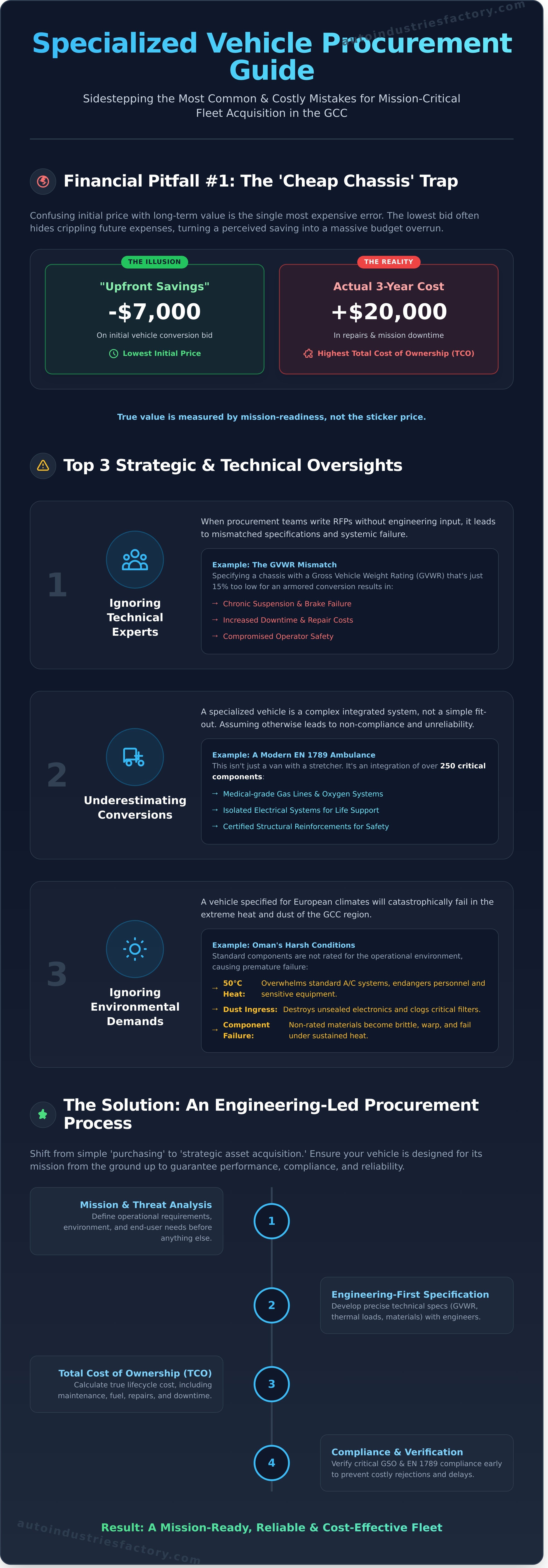
One of the costliest errors is confusing price with value. The lowest bid often results in the highest long-term cost. An ambulance conversion that's $7,000 cheaper upfront can easily cost an additional $20,000 in repairs and downtime over three years due to substandard electrical systems or poor-quality fabrication. True value is measured by 'mission-readiness'-the asset's ability to perform its core function without failure when called upon. Procurement value is the intersection of engineering quality and lifetime reliability.
Common Strategic Missteps
Strategic errors made before a single dollar is spent can doom a project. Three missteps are particularly prevalent in Oman and the wider GCC region:
- Failing to involve technical experts at the RFP stage. When procurement teams write technical specifications without input from engineers or end-users, disaster follows. They might specify a chassis with a Gross Vehicle Weight Rating (GVWR) that's 15% too low for the intended armored conversion, leading to chronic suspension and brake failure.
- Underestimating the complexity of the conversion process. A modern ambulance isn't just a van with a stretcher. It's a complex integration of over 250 components, including advanced medical gas lines, isolated electrical systems, and structural reinforcements that must meet specific safety standards. Assuming it's a simple fit-out is a recipe for non-compliance and unreliability.
- Ignoring the specific environmental demands of Oman. A vehicle built for European climates will fail in the Omani interior. Standard air conditioning systems can't cope with the 50°C summer heat of the Rub' al Khali. Dust ingress will destroy sensitive electronics unless properly sealed, and components must be rated for extreme, sustained temperatures. This is a critical factor in making smart procurement decisions.
Technical Oversights: The Most Common Mistakes in Vehicle Procurement
The most damaging procurement errors aren't found on the initial invoice. They are buried in technical specifications that, when overlooked, lead to catastrophic failures, mission compromise, and spiraling operational costs. A vehicle that looks perfect on paper can become a liability in the field if its engineering isn't meticulously matched to its intended use and environment. Ignoring these details is one of the most frequent and costly common mistakes in vehicle procurement.
From structural integrity to climate resilience, getting the technical details right from the start is non-negotiable for a reliable and cost-effective fleet. These oversights directly impact a vehicle's total cost of ownership, a metric central to sound financial planning. Failing to account for these technical factors undermines the life-cycle cost analysis recommended by experts, like the principles found in the GAO best practices for fleet management, resulting in budget overruns and excessive downtime.
Payload and Structural Integrity
A vehicle's Gross Vehicle Weight Rating (GVWR) is its absolute maximum operating weight, as specified by the manufacturer. Exceeding it, even by 15%, can reduce the chassis and suspension service life by over 30%. For converted vehicles, adding heavy medical equipment, tactical gear, or custom bodywork without recalculating the final payload capacity is a critical error. This leads to premature brake failure, suspension collapse, and dangerous handling characteristics. For vehicles operating in rugged Omani terrain like the Wahiba Sands, consistent overloading causes 'chassis fatigue', where microscopic stress fractures develop and lead to sudden structural failure. For high-roof ambulances, which are common in Oman, structural reinforcement isn't an option; it's a safety mandate to counteract the higher center of gravity and ensure stability during emergency maneuvers.
Climate-Specific Engineering
Operating a vehicle in the GCC presents unique engineering challenges that standard models are not equipped to handle. The extreme thermal loads are a primary concern. In Muscat, where ambient temperatures regularly exceed 48°C, a standard air conditioning system will fail. Specialized fleets require:
- Heavy-Duty Cooling: Upgraded AC compressors, larger condensers, and auxiliary cooling fans for both the cabin and mission-critical electronics are essential to prevent system failure and overheating.
- UV-Resistant Materials: Intense solar radiation will degrade, warp, and cause off-gassing from low-quality interior plastics and upholstery. Specifying UV-stabilized polymers and premium materials prevents premature interior decay and protects personnel from harmful fumes.
- Advanced Filtration: The fine dust and sand prevalent across Oman can bypass standard engine air filters, causing accelerated wear on internal components. A multi-stage or cyclonic pre-filtration system is vital for engine longevity and reliability.
Beyond the hardware, the interior workflow is a crucial technical consideration often missed. For a paramedic team, the layout of equipment inside an ambulance can directly impact patient outcomes. An ergonomic design that minimizes movement and places critical supplies within immediate reach is a technical specification as important as the engine. Getting these complex, region-specific requirements right demands deep engineering expertise. A consultation with a specialized vehicle converter can identify and prevent these costly technical oversights before a single dollar is spent.
The Compliance Gap: Navigating Regulations and Standards
Procuring a specialized vehicle is not like buying a standard car. One of the most financially damaging and common mistakes in vehicle procurement is assuming a vehicle that looks correct is also legally compliant. In Oman, a fleet asset is useless until it passes rigorous inspections. An ambulance that fails its Royal Oman Police (ROP) inspection is nothing more than a very expensive van, creating operational delays that can last for months and cost thousands in rectification work.
The compliance landscape is complex, governed by a mix of regional and international standards. A critical error is misunderstanding the scope of these regulations. For emergency medical vehicles, compliance isn't just a suggestion; it is a mandate for safety and operational readiness.
Key compliance failures we see include:
- Misinterpreting GSO Requirements: The Gulf Standardization Organization (GSO) sets the benchmark for vehicles in the region. For ambulances, these standards dictate everything from patient compartment dimensions to the performance of onboard medical systems. A superficial check is not enough; your converter must prove adherence to the specific, current GSO standard.
- Ignoring EN 1789 Certification: This European standard is the global gold standard for ambulance safety. It involves dynamic crash-testing of the entire converted vehicle, not just the base chassis. Failing to verify a converter's EN 1789 certification means you have no proof the patient compartment will remain intact or that heavy equipment will stay secured during a collision.
- The Uncertified Chassis Assumption: A brand new vehicle chassis from a major manufacturer is certified for its original design. The moment a converter adds a patient cabin, cabinetry, and heavy medical equipment, that original certification becomes void. The vehicle must be recertified as a completed ambulance. Assuming the base vehicle's legality covers the conversion is a frequent and costly oversight.
International vs. Local Standards
Successfully navigating compliance means balancing global best practices with local realities. A fully EN 1789-compliant ambulance built for a European climate may require modifications to its HVAC and electrical systems to handle Oman's extreme heat. Your vehicle converter must be an expert in this synthesis, not just an assembler. Before signing any contract, demand proof that the converter is officially registered and authorized by Omani authorities to perform such critical modifications.
Documentation and Traceability
Your vehicle's compliance journey doesn't end after it passes inspection. A frequent procurement mistake is failing to demand a complete documentation package. This file should include full technical drawings, material certificates for all structural components, and a detailed record of every modification. This traceability is essential for securing proper insurance, handling future maintenance, and maximizing the vehicle's resale value. Without it, you own a black box. You can learn more about our commitment to detailed documentation as part of our mission-critical engineering at AIF.
Financial Pitfalls: Calculating Total Cost of Ownership (TCO)
The sticker price is a siren's call, luring fleet managers toward seemingly good deals. One of the most common mistakes in vehicle procurement is fixating on the initial purchase price while ignoring the lifetime operational costs. A truly smart investment isn't measured by its day-one price tag but by its Total Cost of Ownership (TCO), a comprehensive calculation that reveals the real financial impact of a vehicle over its entire service life.
This is the 'cheap chassis' trap. A base vehicle that's $5,000 cheaper upfront can easily demand an extra $15,000 in powertrain and suspension repairs over a five-year period if it isn't engineered for Oman's demanding terrain. Beyond the direct repair bills lies the crippling cost of operational downtime. For an oil and gas contractor, a single specialized vehicle out of service near Fahud can halt operations, costing the company upwards of $1,200 per day in lost productivity and logistical chaos.
Heavy-duty modifications also have a direct impact on your operational budget. Adding 800kg of custom equipment, armor, or cabinetry can reduce fuel efficiency by as much as 18%. For a vehicle traveling 50,000 km annually, that's thousands of dollars in extra fuel costs each year. Conversely, a well-planned vehicle holds its value. A custom-engineered unit with integrated, certified modifications is a valuable asset. It will command a much higher resale price than a standard vehicle with mismatched, 'bolt-on' accessories that often need to be removed by the next buyer.
A 4-Step Framework for TCO Analysis
A disciplined TCO analysis cuts through assumptions and provides a clear financial picture. It's a simple but powerful process:
- Acquisition Cost: Calculate the full, landed price. This includes the base chassis, all custom fabrications and conversions, shipping, and any required certifications for use in Oman.
- 5-Year Maintenance: Project all repair and maintenance costs. Be realistic; specialized hydraulic or electronic components may have a 25% higher maintenance cost than standard OEM parts.
- Operational Expenses: Estimate five years of fuel, insurance, and other running costs based on the vehicle's final, modified weight and its intended mission profile.
- Residual Value: Subtract the projected resale value. A professionally converted vehicle can retain up to 60% of its initial value, versus just 45% for a standard model with poorly integrated aftermarket additions.
Maintenance and Spare Parts Availability
Another of the common mistakes in vehicle procurement for the region is overlooking the supply chain for spare parts. Sourcing proprietary components from an overseas manufacturer can mean a mission-critical vehicle is sidelined for 3-4 weeks waiting for a single part to clear customs in Sohar. This is an unacceptable operational risk.
Smart fleet managers mitigate this by standardizing their chassis. By building fleets on proven platforms like the Toyota Land Cruiser or GMC Sierra, you ensure that essential mechanical parts are readily available from suppliers across Oman. This strategy dramatically reduces downtime and simplifies maintenance logistics.
The final piece of the puzzle is expert regional support. Partnering with a reputable and experienced UAE-based auto factory gives your organization a decisive advantage. We understand the harsh operating conditions of the GCC and engineer our conversions using durable, readily available components, ensuring your fleet stays on the road, not in the workshop.
Don't let a low initial price dictate a high lifetime cost. Consult with our engineering team to build a detailed TCO analysis for your next fleet vehicle and ensure maximum return on your investment.
The Solution: An Engineering-Led Procurement Process
Most fleet acquisition failures trace back to a single root cause: treating vehicle conversion as a simple purchase. The most effective way to avoid the common mistakes in vehicle procurement is to shift from a transactional mindset to a collaborative, engineering-first approach. This process doesn't start with a tender document; it starts with a technical deep-dive into your operational reality.
Consultation must precede fabrication. Designing for the mission means analyzing every operational variable before a single piece of metal is cut. For fleets in Oman, this involves engineering for sustained performance in 50°C ambient temperatures, accounting for the corrosive effects of coastal humidity in Muscat, and ensuring structural integrity for rough tracks in the Al Hajar Mountains. A standard, off-the-shelf conversion will fail under these specific pressures. An engineering-led partner identifies these failure points during the design phase, not after a costly in-field breakdown.
This level of precision is only possible with complete manufacturing control. By keeping advanced fabrication in-house, we eliminate the quality drift and communication gaps common with outsourced production. Our process includes:
- CNC Laser Cutting: Guarantees component accuracy to within 0.1mm, ensuring flawless fitment and eliminating stress points that lead to premature cracks.
- Robotic and Certified Welding: Delivers consistent, high-integrity welds that exceed minimum safety standards, crucial for armored or emergency response vehicles.
- In-House Powder Coating: Provides a durable finish chemically bonded to the metal, offering up to three times the corrosion resistance of conventional paint in saline environments.
Consider the procurement of armored patrol vehicles. A frequent error is specifying an armor level without re-engineering the vehicle's dynamics. The added weight, often over 1,200 kg, overwhelms the OEM suspension and braking systems. This leads to a 30% reduction in the vehicle's operational lifespan and a dangerously high center of gravity. Our engineering-led process models the new gross vehicle mass, specifies heavy-duty suspension, and calculates the required braking force, creating a balanced and safe platform. This is the difference between simply supplying a product and delivering a true operational solution. It's how you transition from a vendor relationship to a technical partnership.
Why Auto Industries Factory (AIF) Wins
Our Ajman-based facility gives us end-to-end control over the entire fabrication lifecycle, from initial CAD models to final inspection. We specialize in mission-critical units where failure is not an option, including advanced life support ambulances and tactical police vehicles. Every component is engineered for ruggedness, safety, and proven performance in the demanding GCC climate, making our solutions perfectly adapted for Omani operational requirements.
Your Next Steps in Fleet Procurement
To prevent the most expensive and common mistakes in vehicle procurement, your process must evolve. Before issuing your next tender, conduct a comprehensive technical needs assessment with an engineering team. Don’t just rely on paper specifications; insist on a factory visit to audit fabrication standards, material certifications, and quality control protocols in person. Your fleet is a long-term asset, and its foundation should be built on verifiable engineering excellence. Contact Auto Industries Factory for a technical consultation to build your next fleet vehicle the right way.
Secure Your Fleet's Future with Engineering-Led Procurement
As we look toward 2026, the success of your specialized fleet in Oman hinges on avoiding critical errors. Overlooking detailed technical specifications and miscalculating the Total Cost of Ownership, which can account for over 60% of a vehicle's lifetime expense according to a 2024 Fleet Management Weekly report, are two of the most damaging yet preventable issues. These are the common mistakes in vehicle procurement that derail fleet performance and inflate budgets. The antidote is a robust, engineering-led process that prioritizes precision from the start. As the UAE's leading specialist in ambulance and military conversions, Auto Industries Factory LLC leverages in-house CNC laser cutting and precision fabrication to eliminate guesswork. Our facility in Jurf Industrial Area 1, Ajman, is equipped to build vehicles that meet exact operational demands. Take the first step towards a flawless acquisition. Request a Free Technical Estimate for Your Fleet and build a fleet that's not just acquired, but engineered for peak performance.
Frequently Asked Questions
What is the single biggest mistake in vehicle procurement?
The single biggest mistake is focusing only on the initial purchase price instead of the Total Cost of Ownership (TCO). TCO includes maintenance, fuel, insurance, and potential resale value over the vehicle's entire service life. Ignoring TCO is one of the most common mistakes in vehicle procurement; a vehicle that costs 15% less upfront can easily cost 30% more to operate over five years due to poor fuel efficiency or frequent repairs.
How do I ensure my converted ambulance is GSO compliant?
You must partner with a specialized vehicle converter who has proven experience with GCC Standardization Organization (GSO) standards, specifically those applicable to ambulances in Oman. They will ensure every component, from the patient cabin construction to the medical equipment installation and electrical systems, is documented and certified to meet or exceed GSO requirements. This is non-negotiable for passing Royal Oman Police (ROP) inspections and getting the vehicle into service.
Why is payload capacity so important for specialized vehicles?
Payload capacity is critical because it dictates the legal and safe weight limit of all equipment, personnel, and modifications a vehicle can carry. Exceeding this limit by even 10% drastically compromises braking performance, suspension durability, and overall stability. For a tactical unit, an overloaded chassis can lead to catastrophic suspension failure during a mission, rendering a high-value asset useless and endangering personnel.
Can I convert any standard vehicle into an ambulance or tactical unit?
No, you cannot. A successful conversion depends entirely on the base vehicle's capabilities. A suitable vehicle must have a robust ladder-frame chassis, a heavy-duty suspension, and a powertrain and electrical system capable of handling significant added weight and power demands. Attempting to convert a standard passenger SUV without these features results in an unreliable and unsafe vehicle that will not be certified for operational use in Oman.
How does the Oman climate affect specialized vehicle procurement?
Oman's extreme climate, with ambient temperatures regularly exceeding 45°C, demands specific vehicle enhancements. Standard cooling systems are often inadequate. Procured vehicles must have upgraded radiators, heavy-duty air conditioning systems, and heat-resistant interior materials. Electronics and sensitive equipment also require specialized ventilation to prevent failure, a factor that adds an estimated 5-10% to the initial conversion cost but prevents far costlier field failures.
What is the difference between a 'bolt-on' accessory and a 'fabricated' solution?
A 'bolt-on' accessory is a mass-produced part designed for general fitment, like a universal roof rack. A 'fabricated' solution is custom-engineered and built by our team for a specific vehicle and purpose. For example, we don't use a bolt-on mount for a communications antenna; we fabricate a heavy-duty mount that is welded directly to the vehicle's structural frame, ensuring it withstands extreme vibration and operational stress without fail.
How long does the specialized procurement and conversion process typically take?
The timeline varies based on complexity. A straightforward conversion of an in-stock vehicle, such as adding basic police equipment, can take 4 to 6 weeks. However, a custom-built Type B ambulance or a fully-equipped tactical response vehicle requires a more intensive process involving detailed fabrication and systems integration. These complex projects typically have a timeline of 12 to 20 weeks from final design approval to delivery.
Is it better to buy a pre-converted vehicle or commission a custom build?
Commissioning a custom build is almost always the better long-term investment for specialized applications. While pre-converted vehicles offer faster deployment, they often require compromises that don't perfectly match your operational needs. A custom build ensures every detail is mission-specific, improving efficiency and safety. Avoiding the need for post-purchase modifications is key to sidestepping one of the most common mistakes in vehicle procurement and achieving a lower total cost of ownership.


