A single failed inspection in 50°C heat can ground your entire fleet, but the real challenge arrives on January 1, 2026, when the new Federal Authority for Ambulance and Civil Defense officially takes control. You’re likely already struggling to reconcile the Abu Dhabi DOH June 2025 standards with the long-standing DCAS Resolution No. 30 in Dubai. Auto Industries Factory (AIF) specializes in engineering mission-critical vehicles that don't just meet these codes but exceed them.
This professional guide helps you master the ambulance conversion compliance standards UAE, providing a clear path to a 100% audit pass rate while protecting your equipment from the brutal Gulf climate. We’ll examine the mandatory 2026 inspection points, the updated 10-year retirement rules for van conversions, and the international EN 1789:2020+A1:2023 benchmarks required for modern mission success. From box-type builds to GMC extended roofs, you'll learn exactly how to secure your fleet's future in an evolving regulatory landscape.
Key Takeaways
- Understand the distinct regulatory roles of DCAS in Dubai and DOH in Abu Dhabi to ensure your fleet meets specific regional licensing requirements for 2026.
- Learn how to perform critical mechanical checks on sirens, LED perimeter lighting, and tire integrity calibrated for the UAE’s extreme 50°C+ summer temperatures.
- Master the ambulance conversion compliance standards UAE for medical interiors, focusing on ALS vs. BLS equipment readiness and precision oxygen system leak tests.
- Verify operational documentation, including specialized medical insurance and narcotics logs, to guarantee a 100% audit pass rate during official inspections.
- Discover how precision-engineered, CNC-cut components and custom fabrication from Auto Industries Factory simplify complex audits and extend vehicle lifespan.
Navigating UAE Ambulance Standards: DCAS, DOH, and MOHAP
In the UAE, ambulance compliance isn't a single-step process. It's a multi-layered regulatory framework. The Dubai Corporation for Ambulance Services (DCAS) dictates local inspections for all vehicles operating in Dubai, focusing on technical specifications under Resolution No. 30 of 2011. Meanwhile, the Department of Health (DOH) Abu Dhabi enforces strict requirements for private medical fleets, specifically referencing the 2023 and upcoming 2025 standards. Mastering the ambulance conversion compliance standards UAE requires understanding these local nuances before a vehicle ever hits the road. Failure to align with these emirate-specific rules can result in immediate fleet grounding during annual audits.
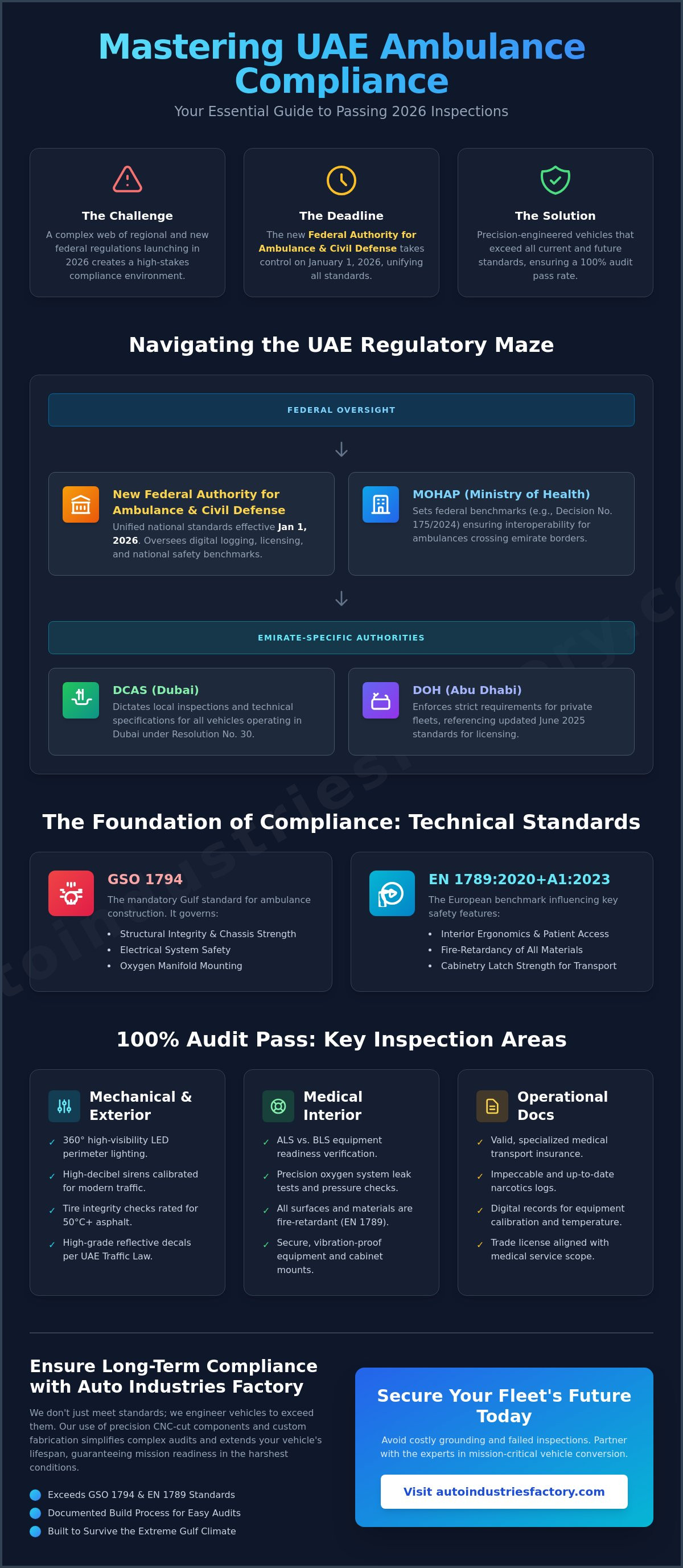
Starting in Q2 2026, the UAE will transition to a unified national digital platform for health professional licensing. This shift includes new digital logging requirements for real-time compliance tracking. Every ambulance must maintain electronic records of equipment calibration, narcotics logs, and temperature monitoring that sync directly with federal databases. The newly established Federal Authority for Ambulance and Civil Defense will oversee these standards starting January 1, 2026, ensuring that every vehicle on the road meets a unified safety benchmark.
To better understand this concept, watch this helpful video:
Regional vs. Federal Regulatory Hierarchy
While DCAS and DOH manage emirate-level operations, the Ministry of Health and Prevention (MOHAP) sets the federal benchmark for Emergency Services in the UAE. This is critical for units operating across borders, such as those traveling between Ajman and Dubai. Your trade license activity must perfectly align with your medical service scope; a mismatch here results in immediate fleet grounding. MOHAP’s Ministerial Decision No. 175/2024 serves as the guiding federal regulation for medical transport centers nationwide. It ensures that an ambulance licensed in Sharjah can legally and safely transport patients to a facility in Abu Dhabi without violating local health codes.
The Role of GSO 1794 and EN 1789 Standards
Technical excellence begins with GSO 1794. This is the mandatory Gulf standard for ambulance construction, covering everything from structural integrity to electrical safety. It's often paired with EN 1789:2020+A1:2023, which heavily influences interior ergonomics and fire-retardancy of materials. Auto Industries Factory (AIF) integrates these benchmarks during the initial fabrication phase of our specialized vehicle conversions. We focus on high-stress points like oxygen manifold mounting and cabinetry latch strength to ensure they survive the vibration of long-distance transport.
Professional ambulance conversion specialists use CNC-cut components to ensure every interior panel meets these fire-safety and durability codes. By aligning with GSO 1794 from the start, we ensure your vehicle passes the rigorous 2026 inspections without costly retrofits. Our engineering team prioritizes a safety-first mission readiness, meaning every bolt and weld is documented for your compliance file.
Exterior and Mechanical Compliance Checklist
Exterior readiness is the first barrier to passing a rigorous 2026 inspection. Beyond simple aesthetics, the ambulance conversion compliance standards UAE mandate that emergency lighting be visible from a 360-degree radius. Sirens must reach specific decibel levels to penetrate modern soundproofed cabins, and perimeter LED integrity is non-negotiable for night operations. Exterior branding must strictly follow UAE Traffic Law, utilizing high-grade reflective decals that don't peel or fade under the intense Gulf sun. These markings ensure the vehicle is immediately identifiable as an emergency unit, even in low-visibility conditions.
Mechanical reliability is scrutinized with the same intensity as medical equipment. During an audit, inspectors verify several critical mechanical points:
- Tire Integrity: Pressure and tread depth must be calibrated for road temperatures that often exceed 60°C in Ajman and Sharjah.
- Fluid Verification: Engine oil, brake fluid, and hydraulic lift systems must show no signs of leaks or degradation.
- Electrical Capacity: A health check for the heavy-duty alternator and dual-battery management system is mandatory to support life-saving devices.
- Branding Compliance: Verification that all reflective patterns meet the latest 2026 visibility requirements.
If you're managing a growing medical fleet, you can explore our heavy-duty conversion solutions to see how we reinforce these mechanical foundations for long-term service.
UAE Climate-Specific Mechanical Checks
Extreme heat is the primary cause of vehicle failure in the region. High-performance AC units require frequent inspection for dust accumulation and refrigerant pressure to maintain a life-saving interior environment of 20-22°C. Engine air filtration systems must be checked for sand ingress, which is a constant risk for units operating near desert borders. We also test battery heat shields and cooling efficiency to prevent mid-mission electrical failures that could ground a vehicle during a critical transport.
Structural Integrity and Fabrication Quality
The weight of Advanced Life Support (ALS) equipment puts immense strain on a vehicle's chassis. Inspectors look for rear suspension sagging, which can compromise handling and safety. The DoH Standard for EMS and Ambulance Services requires that all modifications, including custom-fabricated side steps and patient loading ramps, maintain structural integrity under load. At Auto Industries Factory, we use precision welding and CNC-cut reinforcements to prevent fatigue or corrosion in conversion boxes and extended roof sections, ensuring every build meets the rugged demands of the UAE terrain.
Medical Interior and Equipment Readiness Standards
The patient compartment is a precision-engineered environment where medical readiness meets structural safety. Adhering to the ambulance conversion compliance standards UAE requires more than just carrying the right tools; it demands that every device is mounted, calibrated, and documented for immediate use. Auditors in 2026 prioritize the distinction between Advanced Life Support (ALS) and Basic Life Support (BLS) configurations. An ALS unit must carry ventilators, cardiac monitors, and advanced airway management kits, while BLS units focus on trauma dressings and basic oxygen therapy. A single missing item from the mandatory inventory list results in an immediate inspection failure.
Oxygen systems are a primary focal point during DOH and DCAS audits. You must perform pressure leak tests on all manifold systems and verify flowmeter precision to ensure delivery accuracy. Defibrillators and patient monitors require up-to-date calibration stickers and comprehensive battery cycle logs to prove they won't fail during a long-distance transfer. Additionally, the performance of the suction unit is verified by measuring vacuum pressure against standard benchmarks, alongside a check of disposable canister stock levels. These technical details ensure the vehicle functions as a mobile intensive care unit rather than just a transport van.
For fleet managers looking to upgrade their interior configurations, you can view our specialized medical fabrication solutions to see how we integrate these systems into our builds.
Patient Compartment Safety and Ergonomics
Safety during transit depends on the structural integrity of the conversion's interior. We test the main stretcher locking mechanism to ensure it withstands sudden maneuvers or emergency braking without shifting. Medical cabinet latches must be heavy-duty and precision-aligned; they don't just hold supplies, they prevent projectiles during high-speed transit. Furthermore, 2026 compliance mandates fully functional intercom systems and CCTV links between the driver’s cabin and the paramedic station. This ensures constant communication and patient monitoring without the driver needing to leave their seat.
Infection Control and Sanitation Compliance
Maintaining a sterile environment is a core requirement of the ambulance conversion compliance standards UAE. Inspectors examine the patient compartment for seamless interior flooring. Any cracks, peeling, or exposed wood can harbor pathogens, making the vehicle non-compliant. We use medical-grade, non-porous materials that withstand aggressive chemical sanitization. Beyond the surfaces, auditors check PPE supply levels—specifically masks, gloves, and high-visibility vests—and verify the expiration dates of all sterile medical supplies and emergency medications. If a single bandage is past its date, the vehicle's readiness status is revoked.
Operational Documentation and Communication Systems
Operational readiness depends on more than just high-performance fabrication. It requires a flawless trail of documentation. The ambulance conversion compliance standards UAE mandate that every vehicle carries a valid Mulkiya (registration) and specialized medical insurance. This insurance must explicitly cover the crew, patients, and high-value life-support equipment. These aren't standard automotive policies; they're specialized legal protections required for official licensing. Inspectors will verify these documents first during any roadside or facility audit.
While older protocols relied on manual logbooks, the 2026 digital-first initiative requires automated records. You must maintain electronic narcotics logs and medication fridge temperature records. If a medication fridge fluctuates outside the mandatory 2-8°C range, the integrity of the drugs is compromised, leading to an immediate audit failure. Your GPS and fleet management systems must also maintain 100% connectivity to local dispatch centers. This ensures that every unit is visible to DCAS or DOH coordinators for optimized response times across the emirates.
Safety benchmarks include certified fire suppression. Every ambulance must carry fire extinguishers with a visible pressure gauge and current UAE Civil Defense certification. These units must be mounted in vibration-resistant brackets that prevent them from becoming projectiles during high-speed maneuvers. We ensure these brackets are precision-engineered to withstand the rugged terrain of the Northern Emirates.
If you're looking to upgrade your fleet with these digital capabilities, consult with our engineering team for a full compliance audit.
Advanced Communication Systems
Mission success relies on clear, uninterrupted communication with UAE emergency networks. We test TETRA and VHF radio systems to ensure they penetrate the dense urban environments of Dubai and Abu Dhabi. 2026 compliance also requires on-board Wi-Fi for real-time patient data transmission. This allows paramedics to send vitals directly to the receiving hospital's ER before the vehicle even arrives. All communication hardware must be supported by dedicated backup power supplies, ensuring the unit remains online even if the primary vehicle battery fails.
Personnel and Licensing Verification
The most advanced conversion is useless without a qualified crew. Inspectors verify that the driver holds a valid UAE ambulance license, whether Heavy or Light, depending on the vehicle's Gross Vehicle Weight (GVW). Paramedic licenses must show as active in the DCAS or DOH professional portals, which will be unified under the National Unified Digital Platform in Q2 2026. Finally, every cabin must contain the 'Vehicle Daily Inspection Report' (VDIR), proving the unit was mechanically and medically vetted before starting its shift.
Ensuring Long-Term Compliance with Auto Industries Factory
Long-term compliance isn't a one-time event; it's a byproduct of superior engineering. AIF's in-house specialized vehicle conversions simplify official audits by providing a transparent documentation trail for every weld, wire, and bolt. When a DCAS or DOH inspector reviews your fleet, they look for structural modifications that don't compromise the vehicle's original safety ratings. Because we handle everything from metal cutting to final painting in our Ajman and Dubai facilities, we provide the precision-engineered proof required for a 100% audit pass rate.
Precision matters when your fleet operates in 50°C heat. We use CNC-cut components to ensure a flawless fit for all interior cabinetry and medical equipment mounts. This precision prevents the rattling and vibration that lead to structural fatigue over time. Our welding and fabrication standards don't just meet the GSO 963:1997 requirements; they exceed them. By reinforcing high-stress points in the conversion box or extended roof sections, we help your vehicles survive the full 10-year service life permitted under the new 2025 standards. A professional appearance is also a regulatory necessity for private medical fleets, so we provide heavy-duty painting and decal services that resist the abrasive effects of sand and UV exposure.
The AIF Engineering Advantage
Auto Industries Factory (AIF) specializes in creating robust solutions for the UAE's most demanding missions. We utilize lightweight, high-strength materials to reduce the overall strain on the chassis and braking systems. This is critical for vehicles carrying heavy Advanced Life Support (ALS) kits. Our custom-designed electrical looms are a core feature of our about us track record. These looms are specifically engineered with heat-resistant insulation to prevent the circuit failures common in the Gulf summer. We don't just build to pass an inspection; we build to protect the paramedics and patients inside.
Next Steps for UAE Fleet Compliance
The regulatory landscape is shifting quickly with the establishment of the Federal Authority for Ambulance and Civil Defense on January 1, 2026. You can't afford to wait for a failed audit to address compliance gaps. We recommend scheduling a professional AIF audit of your existing fleet to identify potential failures before they result in heavy fines. Our team is ready to consult on new vehicle conversions that meet the upcoming June 2026 DOH and DCAS revisions. Contact Auto Industries Factory today in Ajman or Dubai for a specialized consultation and ensure your fleet remains mission-ready and fully compliant.
Secure Your Fleet’s Future for 2026
The January 1, 2026, launch of the Federal Authority for Ambulance and Civil Defense marks a new era of standardized safety across all emirates. You’ve seen how critical it is to align your fleet with the latest GSO 963:1997 and EN 1789:2020+A1:2023 benchmarks to avoid costly grounding during audits. Success in the UAE depends on more than just carrying medical kits; it requires climate-hardened engineering that withstands 50°C summer peaks while maintaining 100% digital connectivity to dispatch centers. Mastering the ambulance conversion compliance standards UAE ensures your mission stays active and your patients stay safe.
As a leading UAE ambulance manufacturer, Auto Industries Factory (AIF) provides the expert in-house fabrication and design needed to navigate these complex regulatory shifts. We don't just build vehicles; we engineer solutions that pass the most rigorous DCAS and DOH inspections. It's time to transform your fleet into a model of reliability and technical excellence. Contact Auto Industries Factory for Certified Ambulance Conversions today. Let’s build a fleet that’s ready for the road ahead.
Frequently Asked Questions
What is the difference between DCAS and DOH ambulance inspections?
DCAS inspections are governed by Dubai Executive Council Resolution No. 30 of 2011, focusing primarily on technical NOCs for Dubai-based licensing. In contrast, DOH Abu Dhabi inspections follow the 2023 Ambulance and EMS Standards, with updated revisions effective June 2025. While both reference international codes, the DOH enforces specific vehicle retirement ages, such as 5 years for van conversions, which DCAS manages through separate local protocols.
How often must a UAE ambulance undergo a full technical inspection?
Every ambulance in the UAE must undergo a full technical inspection every 12 months to renew its specialized registration. This annual audit verifies that the ambulance conversion compliance standards UAE are maintained across both mechanical and medical systems. Vehicles failing this check are grounded until all non-conformities, such as expired fire extinguishers or faulty sirens, are corrected and successfully re-inspected by the relevant authority.
Is GSO 1794 certification mandatory for all ambulances in the UAE?
GSO 1794 is the mandatory technical foundation for all ambulance conversions across the GCC, including every emirate in the UAE. It sets the baseline for structural safety, weight distribution, and electrical systems. While authorities like DOH Abu Dhabi also mandate EN 1789 or KKK-A-1822 compliance, GSO 1794 remains the primary Gulf-wide standard that every builder must meet before a vehicle is legally registered for medical use.
What are the common reasons for failing a DCAS ambulance audit?
Failure often stems from non-functional communication systems or expired medical supplies found during the inventory check. Inspectors frequently flag units for siren decibel levels falling below the required threshold or 360-degree LED lighting failures. Additionally, if the vehicle's reflective decals don't meet the high-visibility patterns specified in UAE Traffic Law, the unit will fail the audit immediately and requires a complete re-inspection.
Can I convert a standard van into an ambulance in my own workshop in the UAE?
You cannot legally convert a standard van into an ambulance in a private workshop unless you hold a specialized manufacturing license from the Ministry of Industry and Advanced Technology. Compliance requires precision engineering and certified fabrication that only licensed factories can provide. Unauthorized conversions will fail the mandatory DCAS or DOH inspections and cannot be insured for medical transport operations across the emirates.
What medical equipment is mandatory for a BLS ambulance in Abu Dhabi?
Basic Life Support (BLS) ambulances in Abu Dhabi must carry an Automated External Defibrillator (AED), portable oxygen cylinders, and comprehensive trauma dressing kits as per DOH 2023 standards. Other mandatory items include a portable suction unit and specialized patient immobilization gear like spine boards. Every piece of equipment must be secured in vibration-resistant mounts to prevent injury or equipment damage during emergency transit.
How does the UAE summer heat affect medical equipment calibration?
Extreme UAE summer temperatures, which often exceed 50°C, cause significant calibration drift in sensitive medical monitors and defibrillators. Heat accelerates battery degradation and can lead to oxygen flowmeter inaccuracies. To remain compliant, fleets must perform monthly calibration checks during the summer peak and ensure AC units maintain a constant internal temperature of 22°C to protect delicate sensors and ensure life-saving accuracy.
Do I need a separate license for a mobile clinic vs. an emergency ambulance?
Yes, a mobile clinic requires a different licensing activity than an emergency ambulance under MOHAP and local health authority rules. Mobile clinics focus on outpatient consultation and lack the high-decibel sirens and ALS equipment required for emergency response. Each vehicle's trade license must exactly match its medical mission to pass the ambulance conversion compliance standards UAE during the annual registration and inspection process.


