
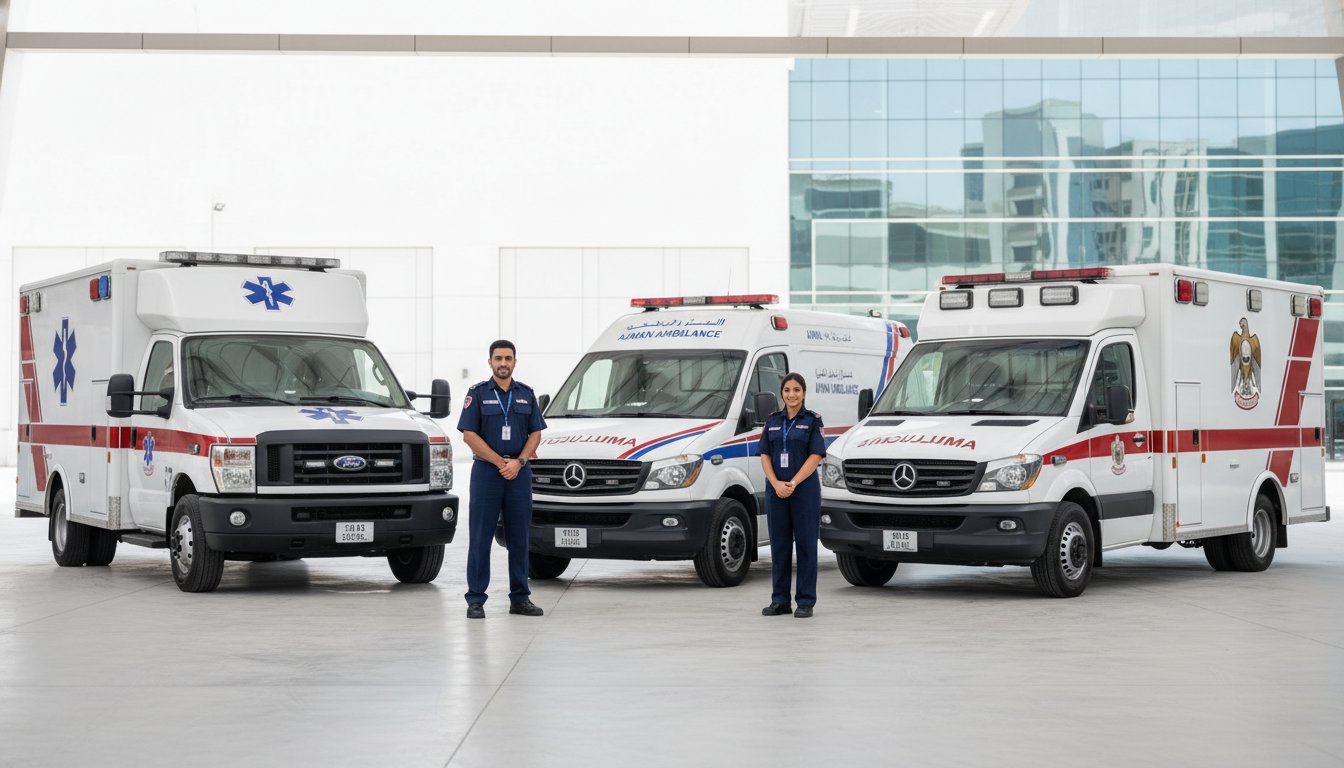
Understanding the critical distinctions between Type 1, Type 2, and Type 3 ambulances is essential for any fleet manager, procurement officer, or emergency services leader. Choosing the correct vehicle directly impacts operational efficiency, patient care, and crew safety. This guide provides a clear, authoritative explanation of each ambulance classification to help you make an informed decision for your fleet.
Understanding the Core Ambulance Classifications
The ambulance classification system, widely recognized in North America and influential globally, standardizes vehicle design for safety and function. The primary difference between each type lies in the chassis-the base frame of the vehicle-and the construction of the patient compartment. Each type is engineered to excel in different operational environments, from dense urban centers to rugged rural landscapes.
Type 1 Ambulance: The Heavy-Duty Workhorse
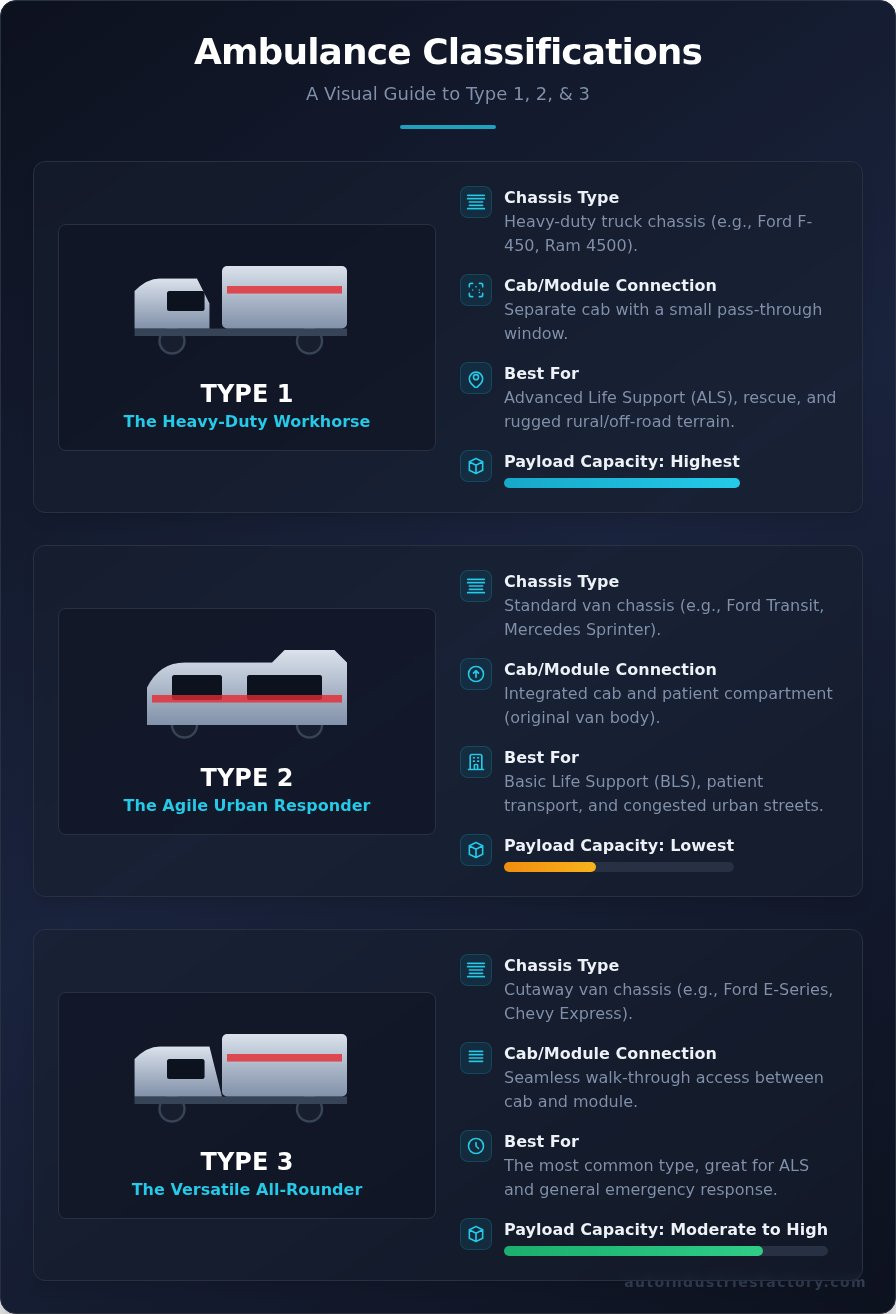
A Type 1 ambulance is built on a heavy-duty truck chassis, similar to those used for commercial pickup trucks like the Ford F-450 or Ram 4500. This design features a separate, square patient compartment, often called a module, which is mounted directly onto the chassis frame. The driver's cab is distinct from the patient area, with only a small pass-through window connecting the two. Thanks to its robust construction and powerful engine, the Type 1 ambulance is ideal for rescue operations, advanced life support (ALS) configurations with heavy equipment, and navigating challenging rural terrains.
Type 2 Ambulance: The Agile Urban Responder
The Type 2 ambulance is constructed using a standard van chassis, such as a Ford Transit or Mercedes-Benz Sprinter. In this configuration, the original van body serves as both the driver and patient compartment. The key modification is a raised roof, which provides the necessary interior headroom for medical personnel to work effectively. Type 2 ambulances are known for their maneuverability and better fuel economy, making them the perfect choice for basic life support (BLS), inter-facility patient transport, and navigating congested urban streets.
Type 3 Ambulance: The Versatile All-Rounder
A Type 3 ambulance is built on a cutaway van chassis, like a Ford E-Series or Chevrolet G-Series. This design is a hybrid of the other two types, combining a van-style cab with a separate, square patient module. A significant advantage of the Type 3 is the seamless, walk-through access between the driver's cab and the patient compartment. This versatility makes the Type 3 the most common ambulance type in many fleets, suitable for a wide range of applications, including advanced life support (ALS) and general emergency response.
At a Glance: Comparing Ambulance Types 1 vs. 2 vs. 3
Choosing the right ambulance requires a careful assessment of your organization's specific mission profile, common response terrain, and equipment needs. Consider factors like patient accessibility, required medical payload, and crew workflow when evaluating which type best fits your operational requirements.
Key Differentiators: A Comparison Table
| Feature | Type 1 Ambulance | Type 2 Ambulance | Type 3 Ambulance |
|---|---|---|---|
| Chassis Type | Heavy-duty truck chassis | Van chassis | Cutaway van chassis |
| Cab/Module Connection | Separate cab with pass-through | Integrated cab and body | Van cab with walk-through |
| Typical Use Case | ALS, rescue, rural/off-road | BLS, patient transport, urban | ALS, general emergency response |
| Payload Capacity | Highest | Lowest | Moderate to High |
| Common Vehicle Models | Ford F-Series, Ram HD | Ford Transit, Mercedes Sprinter | Ford E-Series, Chevy Express |
How to Choose the Right Type for Your Fleet
To select the optimal vehicle, start by analyzing your core needs. Assess your primary operational environment-are you navigating dense city traffic, suburban roads, or unpredictable rural terrain? Next, determine the required level of care, as an advanced life support (ALS) unit has far greater equipment and space requirements than a basic life support (BLS) vehicle. Finally, factor in the total weight of your crew and all necessary medical gear to ensure you select a chassis with adequate payload capacity. If you need assistance, consult our experts for a fleet assessment.
Beyond the Standards: Custom Ambulance Conversions
While the standard Type 1, 2, and 3 classifications provide an excellent baseline, they are often just the starting point for creating a truly mission-ready vehicle. Expert vehicle fabrication can adapt any standard type to meet unique operational requirements, from reinforcing structures for harsh environments to integrating specialized medical and communications technology.
Adapting Standard Types for Specialized Missions
Customization allows for the transformation of a standard ambulance into a specialized asset. This can include reinforcing the chassis and suspension for extreme durability and off-road capability, integrating advanced communication suites for command and control, and designing custom interior layouts that optimize workflow for specific medical procedures. Every element can be tailored to enhance performance and reliability in the field.
Auto Industries Factory: Engineered for Reliability
At Auto Industries Factory, we specialize in converting base vehicles into mission-ready ambulances engineered for performance and durability. Our complete in-house fabrication capabilities-from design and engineering to welding and systems integration-ensure the highest levels of quality and strict adherence to international standards. Our vehicles are built to perform in the demanding conditions of the UAE and the wider GCC region, providing reliable service when it matters most.
Frequently Asked Questions (FAQs)
What is the most common type of ambulance?
The Type 3 ambulance is often the most common type found in emergency fleets due to its versatility. It offers a good balance of interior space, payload capacity, and accessibility with its walk-through design, making it suitable for a wide range of emergency medical services.
What is the main difference between a Type 1 and Type 3 ambulance?
The primary difference is the chassis and cab design. A Type 1 is built on a truck chassis with a separate cab, while a Type 3 is built on a cutaway van chassis where the cab is seamlessly integrated with the patient module via a walk-through opening.
Can any van be converted into a Type 2 ambulance?
While many commercial vans can be converted, only those with sufficient gross vehicle weight rating (GVWR) and interior space are suitable. The conversion process is complex, requiring structural modifications like a raised roof, reinforced flooring, and installation of certified medical, electrical, and oxygen systems.
Are there other ambulance classifications besides Types 1, 2, and 3?
Yes, while these are the most common, other classifications exist. For example, Medium-Duty ambulances are built on larger truck chassis (like a Freightliner or International) for higher payload and specialty uses like critical care transport or bariatric services.
Which ambulance type has the highest payload capacity?
The Type 1 ambulance typically offers the highest payload capacity due to its heavy-duty truck chassis. This makes it the preferred choice for carrying extensive medical equipment, rescue gear, and larger crews.
Does Auto Industries Factory build all three types of ambulances?
Yes, at Auto Industries Factory, we have the expertise and in-house capabilities to design and manufacture custom Type 1, Type 2, and Type 3 ambulances, as well as specialized medium-duty units, tailored to the precise specifications of our clients.
Choosing the right ambulance is a critical decision that ensures your team is equipped for success. With a clear understanding of the differences between Type 1, 2, and 3 ambulances, you can build a fleet that is safe, efficient, and perfectly matched to your mission. Backed by our in-house design, fabrication, and engineering, Auto Industries Factory has a proven track record of serving government and private clients across the UAE. Request a Consultation for Your Specialized Vehicle Fleet today to discuss how we can build a solution engineered for your needs.


