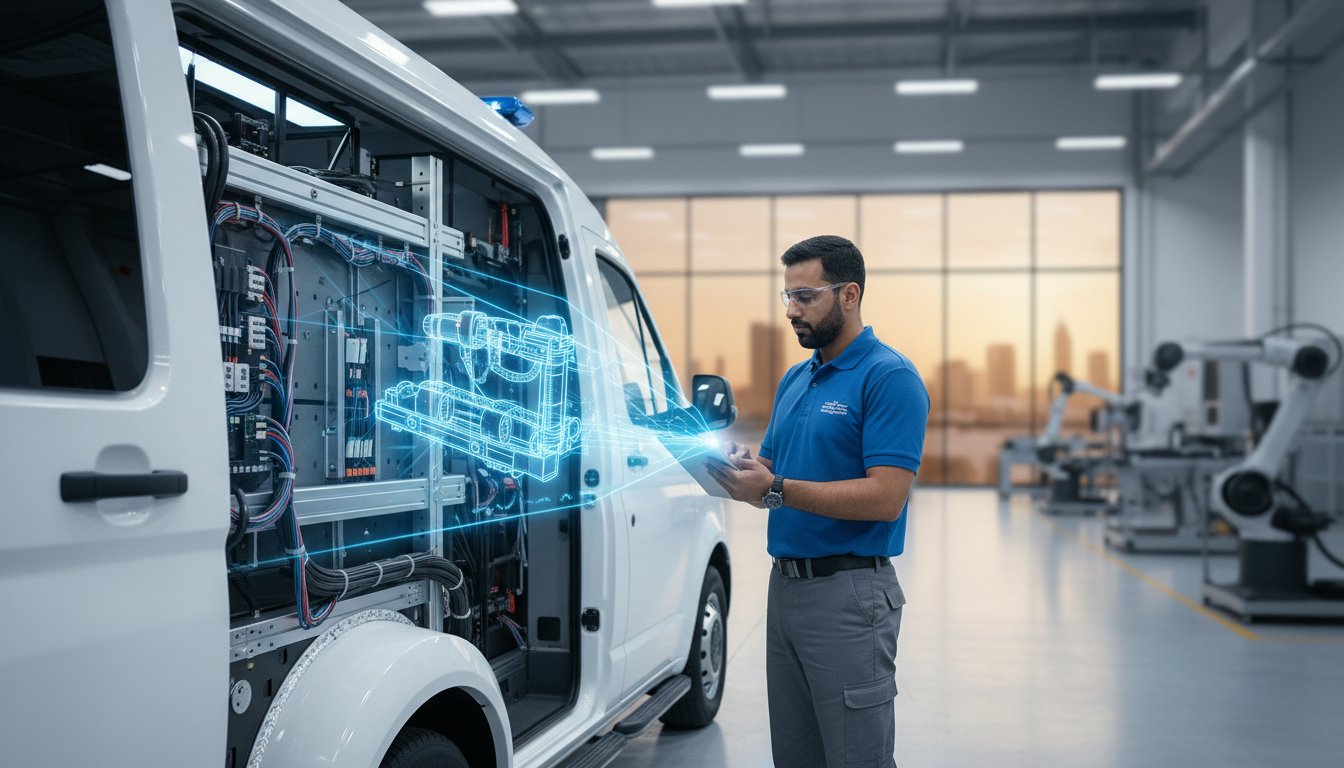
What if the life-saving equipment in your new ambulance was secured with bolts that can't handle a rough road, or the armor on a security vehicle was welded with substandard techniques invisible to the naked eye? In mission-critical operations across the UAE and the wider GCC, you know that vehicle failure isn't just an inconvenience; it's a catastrophic risk. The pressure to procure a reliable fleet is immense, yet the market contains fabricators whose work looks good on the surface but hides critical engineering flaws beneath the paint.
This guide, brought to you by Auto Industries Factory LLC, cuts through the sales pitches and provides the essential engineering checklist for avoiding low quality vehicle conversions. We promise to equip you with the technical knowledge to distinguish premium, durable fabrication from dangerous shortcuts. You'll learn exactly how to inspect welds, verify material certifications, and confirm full compliance with GSO/GCC standards, ensuring your fleet is built for absolute reliability and reduced long-term costs.
Key Takeaways
- Learn to identify critical technical red flags, from poor welding to disorganized wiring, that immediately signal an unreliable build.
- Understand the crucial difference between a simple kit 'assembler' and a true engineering partner with in-house fabrication capabilities.
- Ensure your fleet meets mandatory GSO and EN 1789 ambulance standards to guarantee compliance and operational safety within Oman.
- Discover a proven framework for avoiding low quality vehicle conversions, ensuring your mission-critical assets deliver maximum reliability when it matters most.
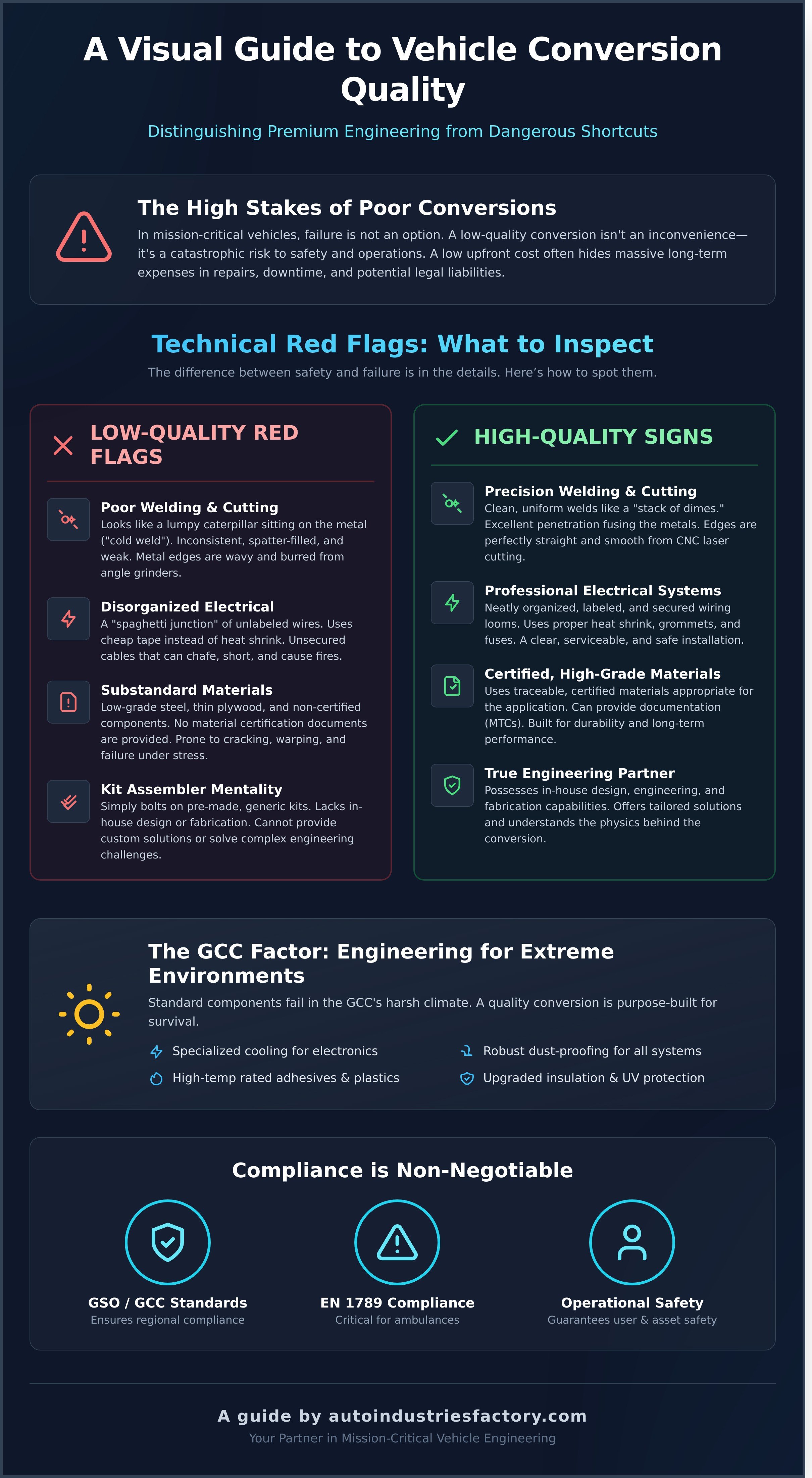
The High Stakes of Vehicle Conversions: Why Quality Matters
A vehicle conversion is a mission-critical engineering process, not a simple aesthetic upgrade. It's a discipline that goes far beyond the cosmetic vehicle modifications seen on city streets. For an ambulance operating in Muscat or a tactical unit deployed in a remote region, the conversion's integrity is a matter of life and death. A structural failure, an electrical short, or a cooling system breakdown isn't an inconvenience; it's a catastrophic mission failure. This is why the conversation must shift from initial price to long-term reliability, especially in demanding environments.
To see the real-world consequences of poor craftsmanship, the following video highlights dangerous flaws found in subpar conversions.
The core principle for any fleet manager or private buyer in Oman should be Total Cost of Ownership (TCO). A conversion that costs $5,000 less upfront can easily lead to over $15,000 in repairs, operational downtime, and replacement costs within 24 months. Choosing a reputable converter isn't an expense; it's an investment in safety, durability, and operational readiness. The goal of avoiding low quality vehicle conversions is to secure an asset that performs flawlessly for its entire service life, not just for the first few months.
The Hidden Risks of Substandard Fabrication
Cutting corners on fabrication leads to severe, predictable failures. In off-road environments like the wadis of the Al Hajar Mountains, inferior welds and low-grade steel can lead to rapid structural fatigue and frame cracks. We've seen improperly balanced electrical systems, rushed to meet a deadline, result in shorts and fires. This is especially dangerous when auxiliary batteries and high-draw equipment are installed. Furthermore, operating a non-compliant specialized vehicle in Oman can lead to significant legal penalties and insurance claim denials in the event of an accident.
The GCC Factor: Engineering for Extreme Environments
Oman's climate is an unforgiving proving ground. Standard automotive components, designed for temperate European or North American climates, simply fail when subjected to summer temperatures that can exceed 50°C. Adhesives lose their bond, plastic dashboards become brittle, and wiring insulation degrades. For any specialized vehicle, particularly those carrying sensitive electronics, effective engineering is critical. This means implementing robust dust-proofing to protect systems from fine desert sand and installing specialized cooling and ventilation for equipment racks. Success in this region requires deep, localized knowledge. It’s where our expertise in regional modifications becomes a non-negotiable advantage for our clients, ensuring that every component is specified for survival and peak performance in the harshest conditions imaginable.
Technical Red Flags: How to Spot a Low-Quality Conversion
A fresh coat of paint can hide a multitude of sins. The true measure of a vehicle conversion isn't its showroom shine; it's the engineering integrity hidden beneath the surface. A hands-on inspection is your primary defence against a poor investment. Understanding what to look for is the most critical step in avoiding low quality vehicle conversions that compromise safety and operational readiness.
Structural Integrity and Welding Quality
The foundation of any durable conversion is its structure. Start by examining panel fitment. A professionally installed interior wall, roof rack, or external compartment will have consistent, tight gaps, typically with no more than a 4mm variance. Anything wider or visibly uneven suggests a lack of precision. Look at the edges of any custom-cut metal. Components cut with a CNC laser have a clean, smooth, and perfectly straight edge. In contrast, manual cuts made with an angle grinder often leave a wavy, burred finish with visible scoring-a clear indicator of rushed, low-cost fabrication.
Welds are the stitches that hold the vehicle's new structure together. Look for:
- Uniformity: A quality weld looks like a neat stack of dimes. It should be consistent in width and height.
- Penetration: The weld should fuse seamlessly into the parent metals. Avoid "cold welds," which look like lumpy caterpillars sitting on top of the metal. These have poor penetration and can snap under stress.
- Cleanliness: The area around the weld should be clean, with minimal spatter (small balls of metal).
For a troop carrier or armored vehicle, a single cold weld on a blast plate or roll cage is a catastrophic failure point. Finally, consider weight distribution. A poorly engineered conversion that places a 200kg equipment rack entirely behind the rear axle will cause premature suspension failure, often within 20,000 kilometers on demanding terrain. This oversight demonstrates a fundamental lack of engineering foresight.
Electrical Systems and Component Integration
A vehicle's electrical system is its nervous system. Amateur work here isn't just unreliable; it's a fire hazard. Pull back an access panel and look for the "wiring nest"-a tangled mess of unlabeled, different-colored wires secured with electrical tape. This is the biggest red flag. A professional installation features neatly loomed, color-coded, and labeled wires running to a dedicated, auxiliary fuse box.
Ask how new equipment is powered. If the answer is by "tapping" into existing factory wiring, this is a dangerous shortcut. A factory circuit for a dome light might only be rated for 5 amps, while a new set of emergency lights could draw 20 amps, overloading the circuit and creating a fire risk. While local Omani regulations provide a baseline, premier converters often engineer to even higher standards, mirroring the principles found in strict frameworks like the federal vehicle conversion regulations in the U.S. This ensures every new circuit is protected by its own properly rated fuse and relay.
In the engine bay, all added wiring must be rated to at least 125°C and be housed in heat-resistant, protective conduit. For an ambulance, test the power system. A life-saving defibrillator can spike to a 1,500-watt draw. Ensure the vehicle has a pure sine wave inverter with a continuous output of at least 2,000 watts to handle sensitive medical equipment without causing damage. If the converter can't prove these specifications, you are looking at a system built to fail. For mission-critical vehicles where failure is not an option, a professional engineering review of your conversion plan is your best assurance of quality and long-term reliability.
The Engineering Gap: In-House Manufacturing vs. Kit Assembly
In the world of vehicle modification, not all providers are created equal. A critical distinction exists between a true vehicle converter and a simple assembler, and understanding this difference is the first step in avoiding low quality vehicle conversions. An assembler buys pre-fabricated, mass-produced kits and bolts them onto your vehicle. A converter, in contrast, is an engineering partner who designs, fabricates, and integrates custom solutions from raw materials. This engineering gap is where quality, durability, and safety are either won or lost.
A true engineering-led converter understands the full scope of modification, from material science to regulatory frameworks. For complex projects, this involves a deep knowledge of vehicle dynamics and compliance, a stark contrast to a parts-assembler. This commitment to standards, similar to the detailed requirements for EPA compliance for conversions in other specialized fields, shows a dedication to precision that an assembler simply cannot provide.
The advantage of in-house manufacturing is absolute control. Using advanced 3D design software, we model every component to ensure it integrates flawlessly with the vehicle's specific chassis points. This digital prototyping allows us to run stress analysis and optimize for weight distribution before a single piece of steel is cut. When we fabricate a heavy-duty bumper for a Toyota Land Cruiser, it's not a generic accessory. It's an engineered safety component, custom-formed from 4mm reinforced steel using CNC press brakes to match the vehicle's lines and integrate with its airbag sensor system. A generic bolt-on kit rarely offers this level of integration, often compromising safety systems and creating weak points on the frame.
Precision Fabrication: The AIF Standard
Our commitment to in-house fabrication delivers tangible results. CNC laser cutting guarantees that every component, from a mounting bracket to a side panel, is cut with a precision of +/- 0.1mm. For fleet orders, this ensures 100% consistency across dozens of vehicles. After fabrication, each part undergoes a multi-stage preparation before receiving a heavy-duty powder coat, which is certified to withstand over 1,000 hours of salt spray testing. This is essential for long-term durability in Oman’s demanding coastal and desert climates. Custom-designed canopies for safari and logistics vehicles are a perfect example; they are engineered to handle extreme loads and vibrations unique to off-road use, a standard that generic kits cannot meet.
Why Outsourced "Kits" Often Fail
Relying on imported, mass-produced kits is a recipe for long-term failure and one of the clearest signs of a low-quality conversion. These products present several fundamental problems for vehicle owners in Oman:
- The "One-Size-Fits-All" Problem: Kits designed for a global market don't account for regional vehicle specifications. This mismatch often leads to improper fitment, requiring installers to drill new holes or force parts into place, which compromises the vehicle's structural integrity and finish.
- No Localized Support: When an imported component breaks, the vehicle can be out of commission for weeks awaiting a replacement part from an overseas supplier. A local fabricator can produce a replacement or repair the component within days, minimizing operational downtime.
- Inflexible and Obsolete: Generic systems are rigid. They cannot be easily modified or upgraded to meet changing operational needs. A custom-fabricated solution is modular by design, allowing for future enhancements and adaptations without requiring a complete system overhaul.
Compliance and Certification: Navigating GCC Regulations
A vehicle's performance is meaningless if it isn't legally allowed on the road. In the GCC, and specifically in Oman, regulatory compliance isn't a suggestion; it's a hard-line requirement enforced by bodies like the Royal Oman Police (ROP). A key step in avoiding low quality vehicle conversions is demanding proof of adherence to established standards. A conversion without the right paperwork is not an asset; it's a liability waiting to be discovered at the first inspection point.
For ambulance manufacturing, the Gulf Standard Organization's GSO 1794 is the foundational benchmark. It dictates everything from patient compartment dimensions to electrical system safety. While the European EN 1789 standard isn't a direct GCC law, elite fabricators adopt its classifications (Type A, B, C) as a best-practice model. A manufacturer who can build to EN 1789 standards demonstrates a level of engineering discipline that far exceeds minimum requirements. Furthermore, a converter's recognition by reputable industry bodies provides an initial layer of trust, indicating they are vetted and adhere to established industry practices. Ultimately, the final test is practical: can your converted vehicle pass a stringent ROP inspection without issue? If a converter can't guarantee this, you are buying a significant operational risk.
Safety Standards for Emergency and Tactical Vehicles
Beyond basic roadworthiness, specialized vehicles carry a much higher burden of proof for safety. For safari trucks operating in Oman's challenging terrains, a Roll-Over Protection Structure (ROPS) isn't just a feature, it's a life-saving necessity certified to standards like ECE R66. For ambulances, medical gas systems must be certified to ISO 7396-1, ensuring zero cross-contamination and precise flow rates. When it comes to armored vehicles, a simple claim of "BR6" is insufficient. Demand independent ballistic and blast certification from a globally recognized institute like Germany's Beschussamt Ulm, which provides verifiable proof of protection levels.
Documentation and Warranty Support
A quality conversion is always accompanied by professional documentation. Insist on a comprehensive "As-Built" manual that includes more than just an owner's guide. A proper manual contains:
- Complete electrical and plumbing schematics.
- A detailed parts list with manufacturer and model numbers.
- A prescribed maintenance schedule for all added components.
- Certification copies for all major systems (armoring, medical, etc.).
This documentation is critical for long-term maintenance and proves the fabricator stands behind their work. A warranty is only valuable if you can actually use it. A converter's physical presence in the GCC, such as our facilities in Ajman and Dubai, is critical for Omani clients. This proximity, just a few hours from Muscat, ensures that warranty claims and after-sales support are handled in days, not weeks, minimizing operational downtime. This local support network is a non-negotiable part of a high-value conversion package.
Don't leave compliance to chance. A certified, road-legal vehicle is the only acceptable outcome. Contact our engineering team to discuss our fully certified conversion solutions for Oman.
Partnering with a Master Craftsman: The AIF Solution
Your search for a dependable vehicle conversion partner in Oman ends here. After exploring the risks of substandard work, the final and most critical step is choosing an expert fabricator. A partner whose engineering prowess and manufacturing integrity turn your specifications into a durable, mission-ready asset. Auto Industries Factory LLC (AIF) is the region's leading specialist in precision vehicle fabrication, delivering solutions where failure is not an option.
We operate on a simple principle: total quality control. Unlike assemblers who outsource critical stages, AIF manages the entire process in-house. From initial CAD design and engineering to CNC laser cutting, metal fabrication, and final protective coating, every step happens under our direct supervision. This integrated approach is the foundation for avoiding low quality vehicle conversions. It guarantees that every weld, component, and system meets our exacting standards, ensuring flawless performance and maximum operational uptime for your fleet.
Our expertise is proven in the most demanding sectors. We have delivered hundreds of specialized vehicles for:
- Ambulance & Emergency Services: We build life-saving vehicles compliant with rigorous international standards, including EN 1789, ensuring they are equipped for critical medical response.
- Military & Defense Solutions: Our tactical conversions provide rugged, reliable platforms for security and defense operations, built to withstand the harshest environments.
- Safari & Tourism Vehicles: We engineer safari cruisers and tour buses that offer superior durability and passenger comfort for Oman's unique and challenging off-road terrains.
Custom Fabrication for Mission-Critical Reliability
Our philosophy, "Built to Protect What Matters," is welded into every project. Inside our 150,000-square-foot facility in Ajman, UAE, advanced machinery, including CNC lasers with 0.1mm precision, executes complex designs flawlessly. This capacity allows us to manage large-scale government and B2B fleet orders, processing over 50 vehicles simultaneously without compromising our commitment to quality for clients across the GCC, including Oman.
Get a Free Technical Estimate Today
Don't just take our word for it. We invite you to view our portfolio of completed projects on the Auto Industries Factory LLC website to see the quality of our craftsmanship firsthand. Taking this step is crucial for avoiding low quality vehicle conversions from the outset. When you are ready to discuss your requirements, our team is prepared to provide expert guidance.
Consult with our engineering team for your next vehicle conversion project. For a detailed technical consultation or a comprehensive fleet estimate, contact our specialists directly via WhatsApp or phone for immediate assistance. Let's build a solution engineered for performance and built to last.
Secure Your Fleet's Future with Engineering Excellence
Your vehicle is a critical asset, and its performance depends entirely on the quality of its conversion. Recognizing technical red flags and understanding the engineering gap between kit assembly and true in-house manufacturing are the most powerful strategies for avoiding low quality vehicle conversions. It’s the difference between a reliable tool and a recurring liability.
At Auto Industries Factory (AIF), we champion this engineering-first approach. As the leading ambulance manufacturer in the UAE, with a proven track record in mission-critical military and medical conversions, our standards are uncompromising. We don't just assemble parts; our in-house CNC and laser cutting capabilities deliver a fabrication precision of up to 0.1mm, ensuring every component meets rigorous GCC specifications and operational demands.
Don’t settle for uncertainty. Contact Auto Industries Factory for a Professional Conversion Estimate and partner with a team that builds for life-saving reliability.
Frequently Asked Questions About Vehicle Conversions
What are the most common signs of a low-quality ambulance conversion?
The most obvious signs are poor craftsmanship and substandard materials. Look for exposed, untidy wiring secured with zip ties instead of being loomed and fused. Check for rough welds on equipment mounts and cabinetry made from standard MDF instead of durable, non-porous PVC. A professional conversion uses seamless, medical-grade vinyl flooring, not simple rubber matting. Any rattling or vibrating from internal components while driving is a major red flag indicating poor fitment and a lack of engineering precision.
Is it cheaper to buy a conversion kit or hire a custom fabricator?
Buying a kit is initially cheaper, but custom fabrication provides superior long-term value and safety. A basic off-the-shelf roof rack kit might cost $700, while a custom-fabricated, load-tested aluminum rack starts around $2,000. The extra cost for custom work covers precision engineering, superior materials designed for Oman's climate, and professional installation that won't compromise your vehicle's structural integrity. It's a premium investment in durability and performance.
Do vehicle conversions in Oman require specific approvals?
Yes, all significant vehicle modifications in Oman require inspection and approval from the Royal Oman Police (ROP). For specialized vehicles like ambulances, conversions must meet or exceed standards set by the Gulf Standardization Organization (GSO). Reputable converters will manage the entire ROP approval process, providing all necessary engineering documentation to ensure your vehicle is 100% road-legal. Don't work with any fabricator who skips this critical step.
Why do electrical systems often fail in converted safari vehicles?
Over 80% of electrical failures stem from improper installation and components unsuited for Oman's environment. Installers often use undersized wiring for high-draw accessories like winches or lights, leading to overheating. They also fail to use sealed, marine-grade connectors, which allows dust and humidity, especially in coastal areas, to cause corrosion and short circuits. A professional setup uses a dedicated fuse box, correctly gauged wiring, and weatherproof connections for rugged reliability.
What materials are best for heavy-duty vehicle canopies in the desert?
For Oman's extreme heat and humidity, 3mm marine-grade 5052 aluminum is the superior choice. It offers a far better strength-to-weight ratio than steel and won't become brittle like fiberglass after years of UV exposure. Aluminum also dissipates heat more effectively and offers exceptional corrosion resistance, which is essential for vehicles used near the coast in Muscat or Sohar. A powder-coated finish provides a final layer of durable, rugged protection against scratches and fading.
How long does a professional high-quality vehicle conversion typically take?
The timeline depends entirely on the project's complexity. A comprehensive, GSO-compliant ambulance conversion built on a Toyota Land Cruiser chassis typically requires 6 to 8 weeks, representing 450-600 man-hours of precision work. A less complex safari vehicle fit-out, including a custom canopy, drawers, and an auxiliary electrical system, can usually be completed in 2 to 3 weeks (approximately 80-120 man-hours). These timelines ensure no steps are rushed and quality is maintained.
What is the difference between EN 1789 and GSO 1794 standards?
Both are ambulance standards, but they have different scopes. EN 1789 is the rigorous European standard that includes specific requirements for vehicle dynamics, crash testing (a 10G deceleration test), and medical device integration. GSO 1794 is the accepted standard across the GCC, including Oman. It focuses primarily on the essential requirements for vehicle type, dimensions, and the list of medical equipment required, making it the key benchmark for local compliance.
Can a low-quality conversion void the original vehicle manufacturer warranty?
Yes, a low-quality conversion can absolutely void your manufacturer's warranty. If an aftermarket electrical system overloads and damages the vehicle's ECU, or if a poorly installed suspension component causes a drivetrain failure, the manufacturer can deny the warranty claim. A key part of avoiding low quality vehicle conversions is choosing a certified fabricator who understands how to integrate systems properly without compromising the vehicle's original engineering, thereby protecting your valuable investment.


