
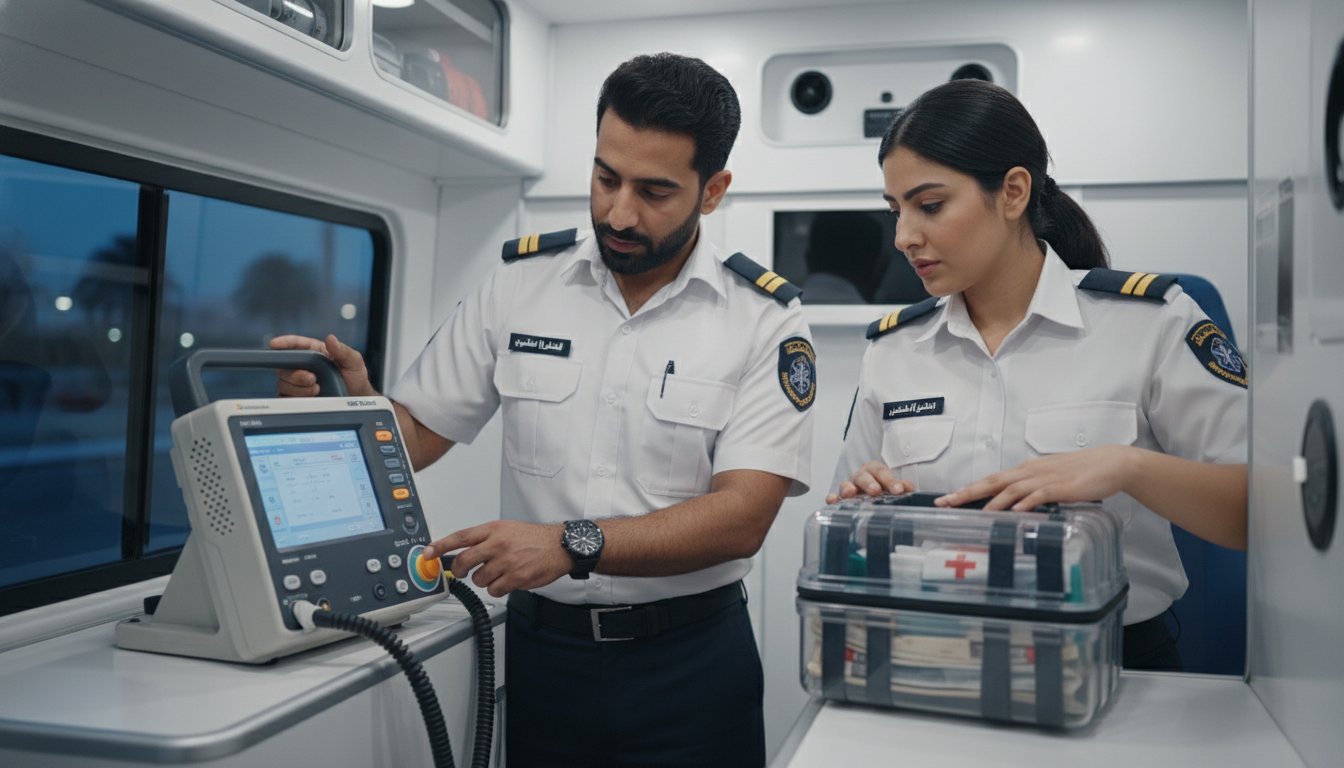
Specifying an ambulance is more than choosing a vehicle; it is a critical decision that directly impacts patient outcomes. The world of emergency medical services can be a complex landscape of acronyms and standards, making it difficult to define the exact requirements for your fleet. Understanding the core principles of basic life support (BLS) is the essential first step. This foundational level of care provides immediate, non-invasive intervention for life-threatening emergencies, forming the backbone of any effective emergency response system operating in Oman.
This guide is engineered to provide clarity. We will move beyond the jargon to define what BLS entails and outline the mission-critical equipment and advanced design features every BLS ambulance needs to comply with international standards. Our goal is to equip you with the knowledge to confidently specify and procure vehicles that are not just compliant, but built for uncompromising, life-saving performance. Consider this your definitive resource for building a capable and reliable emergency fleet.
What is Basic Life Support (BLS)? The Foundation of Emergency Care
In any medical emergency, the actions taken within the first few minutes are critical to the outcome. This immediate intervention is known as basic life support, the essential first level of medical care administered to a patient facing a life-threatening illness or injury. Fundamentally, Basic Life Support (BLS) comprises a set of crucial interventions designed to maintain vital functions, primarily circulation and breathing, until advanced medical assistance can take over. The core objective is not to diagnose or cure, but to preserve life.
This foundational care can be performed by a wide range of individuals, from trained bystanders and first aiders to professional emergency responders, including the highly skilled crews of the Royal Oman Police Ambulance service. The principles of BLS form the bedrock of all pre-hospital emergency care, providing a systematic response to catastrophic events like cardiac arrest or choking.
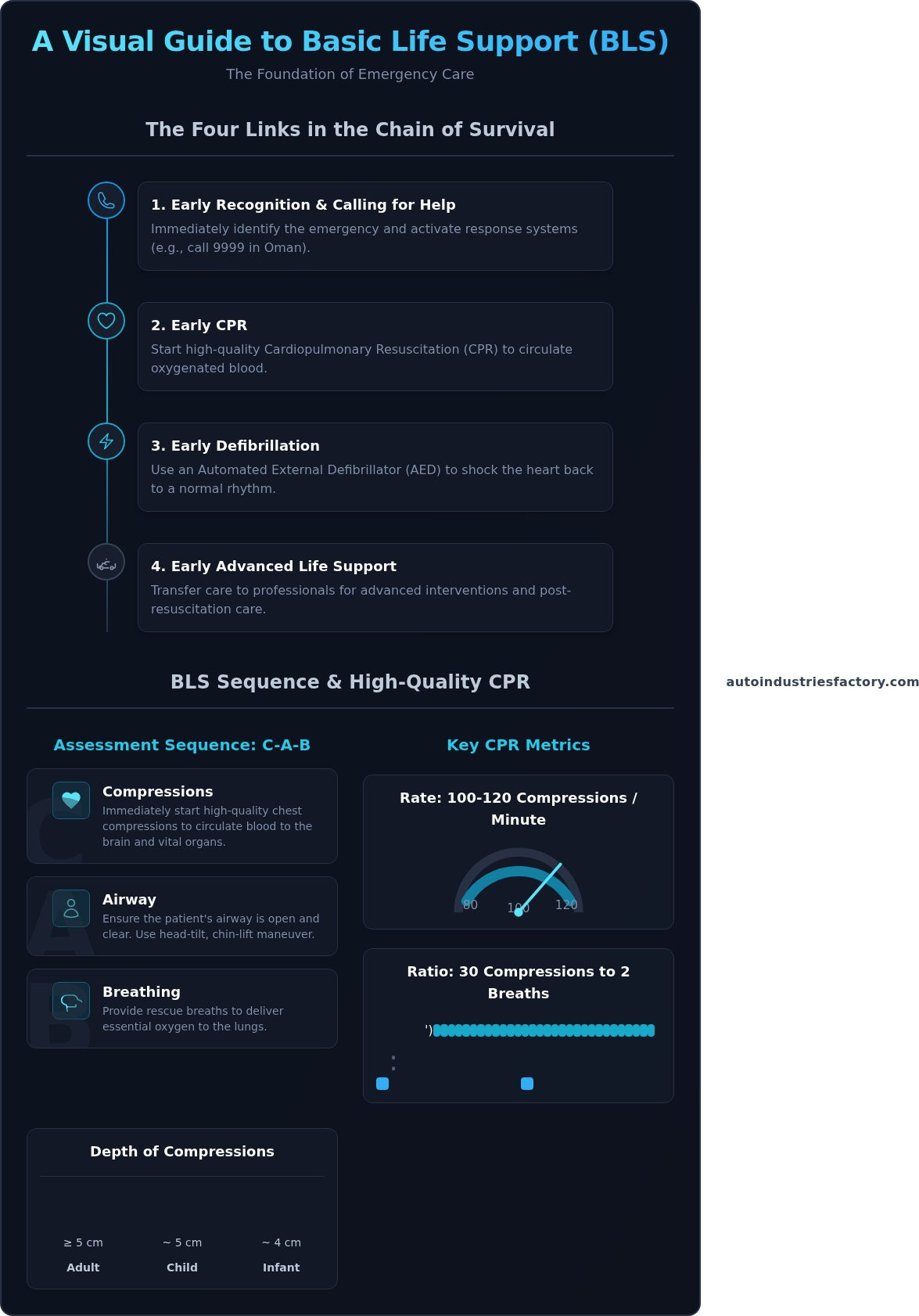
The Four Links in the Chain of Survival
The effectiveness of BLS is best understood through the "Chain of Survival," a concept that outlines the sequence of actions necessary to maximize the chances of survival from sudden cardiac arrest. Each link is as critical as the next; a weakness in any one can break the chain.
- Early Recognition & Calling for Help: Immediately identifying a medical emergency and activating the emergency response system (e.g., calling 9999 in Oman) to dispatch professional help.
- Early CPR: Starting high-quality cardiopulmonary resuscitation (CPR) without delay to keep oxygenated blood flowing to the brain and other vital organs.
- Early Defibrillation: Using an Automated External Defibrillator (AED) as soon as possible to shock the heart back into a normal rhythm.
- Early Advanced Life Support: The transfer of care to paramedics and other healthcare professionals who can provide advanced interventions and post-resuscitation care.
Understanding the BLS Assessment Sequence (C-A-B)
To ensure a consistent and effective response, modern BLS protocols follow the C-A-B sequence. This approach prioritizes the most critical action-restoring blood flow-to give the patient the best possible chance of survival.
- C for Compressions: The immediate start of high-quality chest compressions is paramount. Pushing hard and fast in the center of the chest manually pumps the heart, circulating blood to the brain.
- A for Airway: Once compressions are underway, the rescuer must ensure the patient's airway is open and clear of obstructions. This is typically done using a head-tilt, chin-lift maneuver.
- B for Breathing: After clearing the airway, the rescuer provides rescue breaths to deliver essential oxygen into the patient's lungs, which is then circulated by the chest compressions.
The Core Components of BLS: A Step-by-Step Breakdown
Effective basic life support is a systematic, high-stakes process where precision and speed are paramount. Before any patient contact, the absolute first priority is ensuring scene safety. Responders must rapidly assess for hazards-such as traffic, unstable structures, or electrical dangers-to protect themselves, bystanders, and the patient. Once the scene is secure, the next critical step is patient assessment. Check for responsiveness by tapping the shoulder and shouting. Simultaneously, scan the chest for normal breathing for no more than 10 seconds. If a person is unresponsive and not breathing or only gasping, you must take immediate action.
If your assessment reveals a conscious patient with a severe airway obstruction (choking), the priority shifts to clearing the airway. For adults and children, this involves performing abdominal thrusts (the Heimlich maneuver). For infants, the correct technique is a cycle of 5 back blows and 5 chest thrusts.
High-Quality Cardiopulmonary Resuscitation (CPR)
For an unresponsive patient without normal breathing, high-quality CPR is the cornerstone of survival, designed to manually circulate oxygenated blood to the brain and vital organs. Mastering these precise techniques is a core focus of any accredited BLS course, as improper execution can be ineffective. Key performance metrics include:
- Hand Placement & Rate: Place the heel of one hand on the center of the chest on the lower half of the sternum, with the other hand on top. Push hard and fast at a rate of 100-120 compressions per minute.
- Compression-to-Ventilation Ratio: For a single rescuer, the universal ratio for all age groups is 30 powerful compressions followed by 2 rescue breaths.
- Depth and Technique: For adults, compress at least 5 cm. For children, use one or two hands to compress approximately 5 cm (about one-third the chest depth). For infants, use two fingers to compress approximately 4 cm.
Using an Automated External Defibrillator (AED)
An AED is an advanced, portable device essential for treating sudden cardiac arrest caused by lethal heart rhythms. Its function is to deliver a controlled electrical shock (defibrillation) to reset the heart's chaotic electrical activity and allow a normal rhythm to resume. Operation is direct and guided by clear instructions:
First, turn on the device and follow the voice prompts. Apply the adhesive pads to the patient's bare, dry chest as shown in the diagrams on the pads. Plug the pad connector into the AED. It will then analyze the heart rhythm. It is critical that no one touches the patient during analysis or when the device instructs you to deliver a shock. Always be mindful of the environment; avoid using an AED in standing water and move the patient to a drier surface if necessary.
Key Distinction: Basic Life Support (BLS) vs. Advanced Life Support (ALS)
In emergency medical services, care is delivered in tiers. The two most fundamental levels are Basic Life Support (BLS) and Advanced Life Support (ALS). While both are critical for patient outcomes, they represent vastly different scopes of medical intervention. Understanding this distinction is not just academic; it is a mission-critical factor for healthcare providers in Oman when determining the necessary ambulance fleet capabilities. The choice between a BLS or ALS vehicle directly impacts the level of care that can be provided en route to a hospital.
Scope of Practice and Interventions
The primary difference lies in the complexity and invasiveness of the procedures performed. Basic life support (BLS) forms the foundation of pre-hospital emergency care and focuses on non-invasive, life-sustaining interventions that can be performed with minimal equipment. ALS, in contrast, involves invasive procedures that build upon BLS principles to manage more complex medical emergencies.
- BLS Interventions: Primarily focus on circulation, airway, and breathing. This includes high-quality cardiopulmonary resuscitation (CPR), automated external defibrillator (AED) use, basic airway management like oropharyngeal (OPA) and nasopharyngeal (NPA) airways, and controlling severe bleeding.
- ALS Interventions: Include all BLS skills plus advanced techniques. This tier involves establishing intravenous (IV) or intraosseous (IO) access, administering a wide range of emergency medications, performing advanced cardiac monitoring and 12-lead ECG interpretation, and complex airway management such as endotracheal intubation.
Personnel and Equipment Comparison
The required level of care dictates the training of the crew and the equipment they carry. This is the core difference between a BLS and an ALS ambulance configuration. A BLS unit is staffed by Emergency Medical Technicians (EMTs) who are expertly trained in foundational emergency procedures. In contrast, an ALS unit requires Paramedics, who undergo extensive, advanced training in pharmacology, cardiology, and invasive skills.
Consequently, the vehicle outfitting reflects these roles. A BLS ambulance is equipped with essential diagnostic tools, oxygen delivery systems, AEDs, and trauma supplies. An ALS ambulance carries all this and more, effectively functioning as a mobile emergency room. It contains advanced cardiac monitors/defibrillators, ventilators, and a comprehensive pharmacy of life-saving drugs, making it an indispensable asset for critical care transport.
Equipping a Vehicle for Basic Life Support: The Ambulance Essentials
The theoretical principles of basic life support are only effective when backed by mission-critical equipment. An ambulance is far more than a transport vehicle; it is an advanced mobile environment engineered for delivering immediate care. The layout and outfitting must be flawless, ensuring every piece of equipment is not only reliable and durable but also securely mounted to withstand demanding conditions. A precision-engineered interior allows responders 360-degree access to the patient, transforming a critical space into an efficient, life-saving platform.
Essential Airway and Breathing Equipment
Maintaining a patent airway is the first priority in emergency care. Our conversions ensure that premium, heavy-duty equipment is always within reach for managing respiratory emergencies.
- Suction Units: Both portable and onboard suction units are vital for clearing the airway of fluids, ensuring the patient can breathe.
- Bag-Valve-Masks (BVMs): A full range of BVMs for adult, child, and infant patients is essential for providing ventilatory support.
- Oxygen Delivery Systems: Securely mounted portable oxygen cylinders with precision regulators and a variety of delivery masks are fundamental for managing hypoxia.
Circulation and Patient Assessment Tools
Effective interventions for cardiac events and trauma depend on rapid assessment and the right tools. Equipment must be robust and ready for immediate deployment.
- Automated External Defibrillator (AED): A modern, reliable AED is a non-negotiable component for responding to sudden cardiac arrest.
- Diagnostic Tools: A high-quality sphygmomanometer (blood pressure cuff) and stethoscope are foundational for monitoring a patient's vital signs.
- Hemorrhage Control Supplies: A comprehensive trauma kit with bandaging, tourniquets, and splinting materials is critical for managing bleeding and stabilizing injuries.
Patient Handling and Safety
Safely securing and transporting the patient is paramount. Every component, from the stretcher to immobilization devices, must meet stringent safety standards to protect both patient and crew.
- Primary Stretcher: The main stretcher must feature a durable frame and a secure locking mechanism to anchor it firmly to the vehicle floor during transit.
- Spinal Immobilization: Equipment such as rigid backboards and cervical collars are critical for preventing further injury in cases of suspected spinal trauma.
The strategic placement and integration of these tools are what define a superior emergency vehicle. The expert fabrication at Auto Industries Factory ensures every component is optimized for performance and reliability. See how we integrate BLS equipment into our ambulance conversions.
How Ambulance Design Standards Support Effective BLS
An ambulance is far more than a transport vehicle; it is a precisely engineered mobile medical environment where every second counts. To ensure patient and crew safety, manufacturers adhere to stringent international standards like EN 1789. This European standard, widely recognized as a benchmark for excellence in Oman and across the globe, provides a comprehensive framework for ambulance construction, design, and equipment.
These standards dictate everything from the vehicle's structural integrity in a crash to the ergonomic layout of the patient cabin. Adherence ensures that the ambulance is not just a vehicle, but a robust, reliable platform where responders can perform effective basic life support without compromise. A well-designed ambulance directly translates to a higher standard of care on the road.
Patient Compartment Requirements
A compliant ambulance interior is designed for clinical efficiency. Standards mandate minimum space around the stretcher, allowing responders 360-degree access for critical interventions like CPR. Advanced, non-glare LED lighting is essential for accurate patient assessment, day or night. Furthermore, all surfaces-from the flooring to the cabinetry-must be non-porous, slip-resistant, and easy to disinfect, a critical factor for robust infection control.
Equipment Mounting and Accessibility
In transit, unsecured equipment can become a lethal projectile. Design standards demand that all medical devices are secured with heavy-duty, crash-tested brackets and mounts. The placement of this equipment is equally critical. Essential tools for basic life support, such as the AED, suction unit, and oxygen outlets, are strategically positioned within arm's reach of the attendant's seat, minimizing movement and maximizing response speed. Every cabinet and drawer is engineered for secure latching and easy, one-handed operation.
Why Compliance Matters for Your Fleet
Investing in standards-compliant ambulances is a direct investment in safety and operational excellence. It guarantees a proven level of protection for patients and medical crews during transport, even in challenging conditions. Compliance also ensures interoperability, allowing seamless integration of equipment with other agencies and hospitals. Ultimately, operating a fleet built to these rigorous specifications demonstrates an unwavering commitment to providing the highest standard of emergency care. To learn more about custom-built, compliant vehicles, explore the advanced solutions at autoindustriesfactory.com.
Empowering Responders: Where BLS Principles Meet Engineering Excellence
From the foundational C-A-B sequence to the layout of a modern emergency vehicle, it is clear that effective emergency response is a complete system. The successful delivery of basic life support hinges not just on the training of personnel, but on the reliability and functionality of their mobile environment. An ambulance is more than transportation; it is a meticulously engineered workspace where every piece of equipment and design choice supports life-saving action when seconds count.
At Auto Industries Factory, we translate these critical needs into mission-ready solutions. Trusted by government and private emergency services across the UAE and ready to serve the Oman market, our expertise in EN 1789 compliant vehicle conversions and in-house fabrication ensures every vehicle is built for peak performance. We deliver the durable, intelligently designed ambulances that empower first responders to act with confidence and precision.
Design an ambulance built for life-saving reliability. Get your free estimate.
Equip your heroes with the tools they need to protect what matters most.
Frequently Asked Questions About Basic Life Support
What is the main goal of Basic Life Support?
The primary goal of Basic Life Support (BLS) is to maintain vital organ function, particularly for the brain and heart, in a person experiencing cardiac or respiratory arrest. By performing immediate interventions like chest compressions and rescue breaths, responders provide critical circulation and oxygenation. This action serves as a crucial bridge, preserving life and preventing irreversible damage until advanced medical teams can arrive and take over patient care.
Can anyone with proper training perform BLS?
Yes, absolutely. BLS is specifically designed to be performed by anyone who has completed an accredited certification course. This includes not only healthcare professionals but also first responders, law enforcement, and members of the public. The standardized, proven techniques ensure that any trained individual can confidently step in and provide effective, life-saving care during a critical emergency, forming a vital first link in the chain of survival.
What is the single most important piece of equipment for cardiac arrest in a BLS ambulance?
The Automated External Defibrillator (AED) is the most critical piece of equipment for cardiac arrest. While chest compressions are vital for circulation, an AED is the only device in a BLS setting that can analyze the heart's rhythm and deliver a controlled electrical shock to correct a fatal arrhythmia. Early and rapid defibrillation is a non-negotiable factor in survival rates, making a reliable AED an essential component of any mission-ready BLS ambulance in Oman.
How does BLS for a child differ from BLS for an adult?
While the core principles are the same, BLS techniques are precisely adapted for the smaller anatomy of children and infants. Key differences include the depth of chest compressions (approximately 5 cm for a child vs. 5-6 cm for an adult) and the compression-to-ventilation ratio for two-rescuer CPR (15:2 for children versus 30:2 for adults). For infants, compressions are performed using two fingers. These modifications ensure the intervention is both safe and effective for pediatric patients.
Is an advanced cardiac monitor required in a BLS ambulance?
No, an advanced cardiac monitor with 12-lead diagnostic capability is a requirement for Advanced Life Support (ALS) units, not BLS. A BLS ambulance in Oman is equipped with an AED, which effectively assesses for shockable heart rhythms. The scope of BLS is focused on essential, non-invasive interventions and stabilization. The primary function is to provide immediate life support and transport the patient to definitive care or an awaiting ALS team.
Why is the 'Chain of Survival' so important in pre-hospital care?
The Chain of Survival is a critical framework outlining the interdependent steps needed to maximize survival from cardiac arrest. It consists of early recognition and call for help, early CPR, rapid defibrillation, and effective advanced care. A failure in any one of these links significantly decreases the chance of a positive outcome. It highlights that success depends not on a single action but on a coordinated and rapid system response, from the public to the hospital.
How often should BLS equipment in an ambulance be checked?
To ensure mission readiness and operational reliability, all basic life support equipment must be checked at the start of every single shift. This comprehensive daily inspection confirms that all essential items-from the AED and oxygen cylinders to suction units and medical supplies-are present, fully functional, and within their expiration dates. This rigorous protocol is fundamental to patient safety and guarantees that the crew has dependable tools ready for any emergency.


