What if the most significant cost of your new ambulance isn't its initial price, but the operational downtime caused by premature rust and fabrication failures? It’s a high-stakes challenge for fleet managers across the UAE. You're tasked with procuring mission-critical vehicles that meet stringent UAE Civil Defence, DCAS, and MOHAP standards, all while navigating tight budgets and demanding timelines. The fear of a vehicle failing during an emergency is immense, and the cost of poor craftsmanship goes far beyond the initial invoice; it impacts lives and drains maintenance funds.
This guide, brought to you by Auto Industries Factory LLC, is engineered to eliminate that risk. We're cutting through the sales pitches to focus on what truly matters when selecting reliable emergency vehicle builders for your 2026 fleet. You will discover the non-negotiable engineering standards, critical certification requirements, and advanced fabrication techniques that define a truly durable and compliant emergency vehicle. Get ready to learn how to identify superior build quality that guarantees reduced maintenance costs and ensures your vehicles are always mission-ready, without ever sacrificing safety for speed.
Key Takeaways
- Understand why true vehicle reliability goes beyond the base chassis to include engineering integrity and ergonomic design that maximizes equipment uptime.
- Learn to navigate critical international and regional compliance standards, including GSO 1794 for the GCC, to ensure your fleet is legally compliant and safe.
- Discover why the most reliable emergency vehicle builders utilize in-house fabrication and precision metalwork for superior quality and mission-specific customization.
- Get a practical checklist for auditing a potential builder's facility and portfolio, helping you distinguish between proven fleet suppliers and less experienced workshops.
What Defines Reliable Emergency Vehicle Builders in 2026?
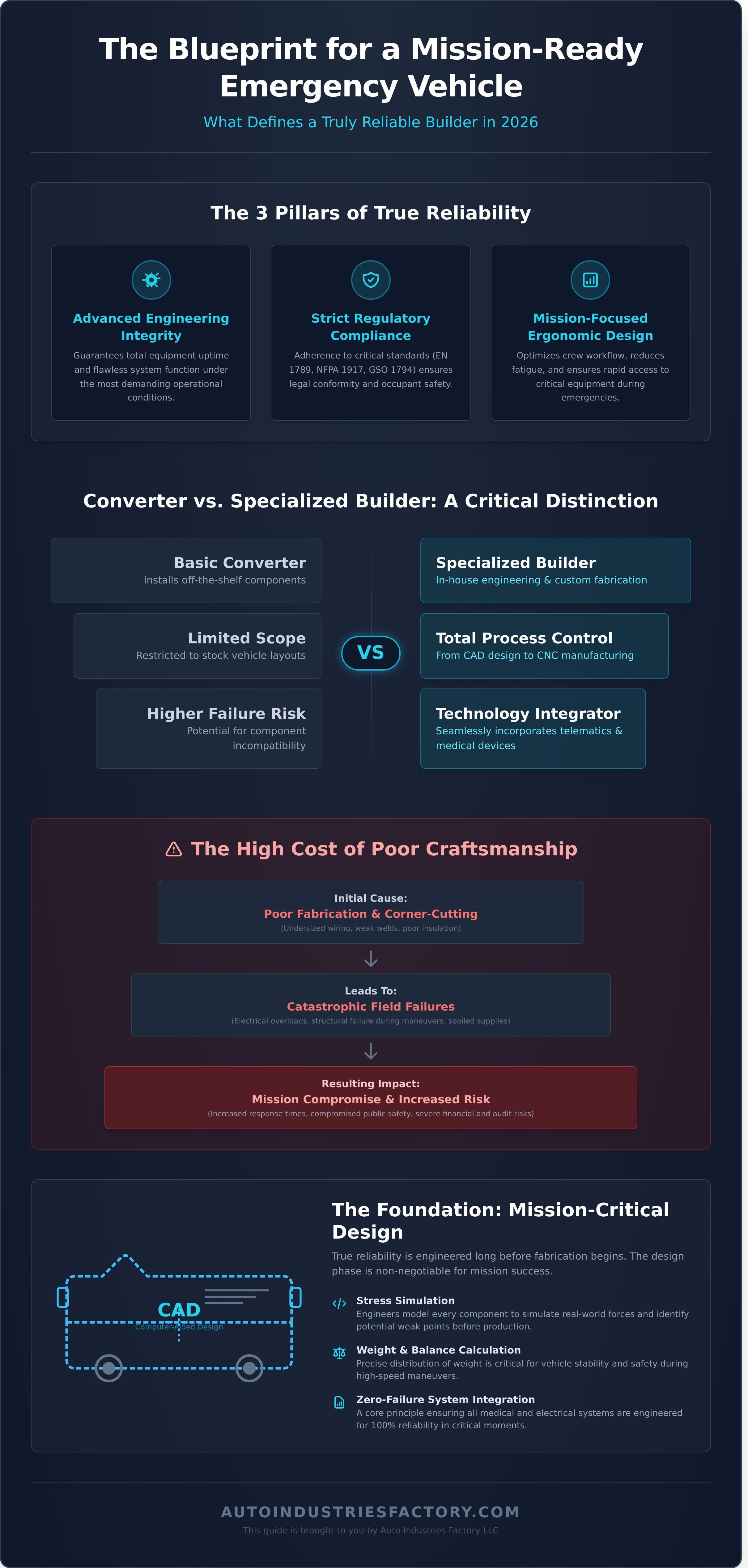
In the high-stakes world of emergency response, "reliability" is a term that carries immense weight. It's not just about a chassis that starts every time. True reliability in 2026 is a complex synergy of three core pillars: advanced engineering integrity, strict regulatory compliance, and mission-focused ergonomic design. A dependable emergency vehicle is defined by its total equipment uptime, ensuring every system, from the onboard defibrillator to the communications array, functions flawlessly when lives are on the line. This is the standard that separates basic outfitters from genuine life-saving partners.
To see how precision engineering translates into a finished product, this video details the custom fabrication process:
A critical distinction exists between a simple "converter" and a specialized vehicle builder. A converter typically installs off-the-shelf components onto a stock vehicle. In contrast, reliable emergency vehicle builders with in-house fabrication capabilities design, engineer, and manufacture custom solutions. They control the entire process, from CNC-cutting reinforced aluminum for interior modules to fabricating heavy-duty mounting points for critical equipment. This integrated approach is essential as the role of builders evolves. By 2026, they aren't just fabricators; they are technology integrators, responsible for seamlessly incorporating smart-fleet telematics, predictive maintenance sensors, and networked medical devices that define modern emergency response.
The Consequences of Unreliable Vehicle Fabrication
Cutting corners during the build process leads to catastrophic failures in the field. Common failure points often stem from poor craftsmanship and directly impact mission success. These include electrical overloads from undersized wiring, structural weld failures on equipment mounts during high-speed maneuvers, and poor insulation that allows critical medical supplies to spoil in Oman's extreme heat. Each minute of vehicle downtime caused by these preventable issues directly increases emergency response times, compromising public safety and creating severe financial risks during audits by bodies like the Civil Defence and Ambulance Authority (CDAA).
Mission-Critical Thinking in Design
The foundation of a dependable vehicle is laid long before the first piece of metal is cut. True reliability starts at the Computer-Aided Design (CAD) phase, where engineers use software to model every component and simulate real-world stresses. For high-speed vehicles like ambulances, precise calculations of weight distribution and center of gravity are non-negotiable; an imbalanced vehicle is dangerously unstable during emergency driving. This meticulous planning defines the entire build. Mission-critical reliability is the zero-failure expectation of medical and electrical systems under the most demanding operational conditions.
Technical Standards and Regulatory Compliance for Fleet Reliability
A vehicle’s long-term performance isn't just about the base chassis; it’s engineered during the conversion process. The difference between a dependable asset and a constant liability often comes down to one thing: adherence to technical standards. For fleet managers in Oman, understanding these regulations is the first step in vetting potential partners. Globally, two benchmarks dominate the conversation: the European EN 1789 and the US KKK-A-1822. While the KKK-A-1822 has been a longtime US benchmark, many modern builders also adhere to the comprehensive NFPA 1917 ambulance standards for an even higher level of design and performance validation. However, for our region, these serve as a foundation for our own stringent local requirements.
EN 1789: The Gold Standard for Ambulances
The European Committee for Standardization's EN 1789 is a non-negotiable benchmark for quality and safety in ambulance manufacturing. It provides a clear framework that categorizes vehicles by their intended medical mission, ensuring the final product is fit for purpose. This standard removes guesswork and enforces mission-critical safety features.
- Classification by Mission: EN 1789 defines three core types. Type A is for non-emergency patient transport, Type B is the standard emergency ambulance, and Type C is a mobile intensive care unit equipped for advanced life support.
- Dynamic Safety Testing: A key mandate is the 10g crash test for all interior cabinetry, seating, and equipment mounts. This ensures that in the event of a collision, medical equipment and storage units do not become deadly projectiles, protecting both patient and crew.
- Infection Control: The standard requires all interior patient compartment surfaces to be non-porous, seamless, and resistant to disinfectants. This design is crucial for preventing cross-contamination and maintaining a sterile environment, a vital factor for patient outcomes.
GCC-Specific Regulations and GSO Standards
Operating in Oman and the wider GCC presents unique environmental and regulatory challenges that international standards alone don't address. This is where local expertise becomes essential. Reliable emergency vehicle builders must demonstrate mastery of these regional requirements, which are often enforced by authorities like the Royal Oman Police (ROP) and the Public Authority for Civil Defence and Ambulance (PACDA).
- GSO 1794 Compliance: This Gulf Standard governs ambulance design and equipment specifically for our region. It adapts EN 1789 principles and adds requirements crucial for local operations, from specific medical load-outs to communication system integration.
- Extreme Climate Engineering: A standard ambulance air conditioning system will fail in a 50°C summer. GSO standards mandate heavy-duty HVAC systems and rigorous heat-load testing to ensure the patient cabin remains at a stable, medically safe temperature even when the vehicle is idling in direct sun. Insulation and component selection are critical.
- Manufacturer Authorizations: Beyond regulations, top-tier converters secure approvals from base vehicle manufacturers like Toyota or Nissan. This Registered Manufacturer Authorization (RMA) or equivalent certification confirms that the conversion process does not compromise the vehicle's structural integrity, safety systems, or warranty. It’s the ultimate proof that a builder’s engineering is sound. Ensuring your fleet meets these demanding local requirements is a core part of our expert vehicle conversion process.
In-House Fabrication: The Key to Mission-Specific Customization
An emergency vehicle is more than just a chassis with lights and a siren; it's a precisely engineered tool where every component must function flawlessly under extreme pressure. The most dependable conversions aren't assembled from a catalogue of third-party parts. Instead, reliable emergency vehicle builders command the entire manufacturing process, from raw metal to the final systems check. This end-to-end control is the only way to guarantee that every bracket, cabinet, and wire harness is built for a specific mission, not as a generic add-on.
Controlling the fabrication process allows for a level of customization that is impossible when outsourcing. A builder working on a Toyota Land Cruiser 70 Series for Oman's Royal Hospital ambulance fleet understands its unique frame dynamics and payload limits. They can design and build internal structures that maximize patient space without compromising the vehicle's legendary off-road stability. The same principle applies to converting a Nissan Patrol for the Royal Oman Police or a GMC Savana for tactical response, where every modification is engineered to complement the base vehicle's strengths.
The core challenge is always balancing payload capacity with the sophisticated equipment required for modern emergency services. Adding advanced life support systems, communication arrays, or tactical gear increases the vehicle's weight. A builder with in-house fabrication capabilities can engineer solutions using lightweight, high-strength aluminum alloys and composites, ensuring the vehicle remains well within its Gross Vehicle Weight Rating (GVWR) for safe handling and long-term durability.
Precision Engineering and Metal Fabrication
The difference between a vehicle that lasts 3 years and one that serves for over a decade often comes down to the precision of its metalwork. Computer Numerical Control (CNC) machining and laser cutting create components with tolerances as tight as 0.1mm. This precision ensures internal cabinetry, equipment mounts, and structural reinforcements fit perfectly, eliminating the rattles and stress fractures common in manually modified vehicles. Furthermore, a powder-coated finish, which is up to 10 times more durable than standard liquid paint, is essential for protecting metal components from the harsh sun and abrasive sand common in Oman. Leading specialists like Auto Industries Factory (AIF) utilize their expertise in laser-cut structural components to create conversions that are both rugged and flawlessly integrated.
Advanced Systems Integration
A modern emergency vehicle is a complex network of integrated systems. Proper integration requires a deep understanding of electrical engineering, communications technology, and medical standards.
- Electrical Systems: Onboard equipment like defibrillators, ventilators, and tactical computers draw significant power. A professional build includes a dual-battery setup with a smart isolator and a dedicated power management system to prevent mission-critical failures and protect the primary vehicle battery.
- Communication Integration: For police and military units, secure communication is paramount. Builders fabricate custom consoles and secure enclosures to house multiple tactical radios, satellite links, and computer terminals, ensuring they are protected from vibration and easily accessible to the crew.
- Oxygen and Medical Gas Systems: In an ambulance, there is zero room for error. Medical gas systems must be installed by certified technicians using medical-grade, leak-proof components that meet stringent international standards like NFPA 99. This guarantees the safety of both patient and crew.
How to Audit and Evaluate an Emergency Vehicle Builder
Once you've shortlisted potential partners, the real due diligence begins. A glossy brochure and a competitive price are just the starting point. To identify truly reliable emergency vehicle builders, you must go beyond the sales pitch and critically assess their operational capabilities. This hands-on evaluation is what separates a world-class engineering partner from a simple assembler, ensuring your fleet is built for mission-critical durability, not just for a low initial bid.
Your first step should be a physical facility tour. A professional fabrication workshop is defined by organization and specialized zones. Look for dedicated, clean bays for electrical work, fabrication, and final assembly. The presence of advanced equipment like CNC laser cutters, press brakes, and a self-contained, dust-free paint booth signals a serious investment in quality control. A disorganized shop with overlapping work areas is a clear indicator of inefficient processes that often lead to compromised build quality.
Next, scrutinize their portfolio with a critical eye. Distinguish between a one-off prototype built for a trade show and a proven, large-scale fleet delivery. Ask for case studies and contact information for clients who have deployed 10 or more of their vehicles. This is where you verify claims of durability. A builder with a track record of successful fleet deliveries understands the importance of material consistency, from using non-porous, medical-grade ABS plastics for interior surfaces to integrating heavy-duty, 3mm-thick steel reinforcements into the vehicle’s core structure.
Finally, assess their industry relationships and long-term support. Does the builder have an official upfitter or converter relationship with major OEMs like Toyota, Ford, or Nissan? This can be crucial for maintaining the base vehicle’s warranty. Their own warranty and after-sales support are just as vital. A comprehensive warranty should cover the conversion for a minimum of 3 years and clearly define coverage for high-failure-rate items like custom wiring harnesses, control panels, and auxiliary power systems. This is the foundation of a low total cost of ownership.
The 5-Step Procurement Checklist
A systematic check ensures no detail is missed. Before signing any contract, your procurement team should verify these critical points:
- Step 1: Certifications. Confirm the facility holds current ISO 9001:2015 for quality management. For specialized vehicles in Oman, verify their capability to build to specific standards like the GCC's GSO 1822/2007 for ambulances.
- Step 2: Raw Materials. Don't accept vague terms like "premium." Demand material specification sheets for all key components, from the grade of aluminum used in cabinets to the fire-retardant rating of upholstery.
- Step 3: Electrical Schematics. Review their wiring standards. Professional builders provide detailed schematics, use protective braided loom sleeving on all wiring, and ensure every circuit is clearly labeled and independently fused.
Red Flags to Avoid in Vehicle Conversions
Some warning signs immediately disqualify a builder. Exposed wiring, generic interior modules that aren't tailored to the specific vehicle chassis, and a complete lack of testing or validation documentation are unacceptable risks. A builder who cannot provide dynamic crash test data or payload certification is not operating at a professional level. Remember that the lowest price often leads to the highest total cost of ownership. A bid that is 25% lower may result in 40% higher lifetime maintenance and downtime costs. The most dangerous red flag is a builder who outsources core fabrication to unvetted third parties, creating a complete breakdown in quality control. True reliable emergency vehicle builders control every stage of the process in-house. To see how a fully-integrated fabrication and conversion process guarantees superior quality, we invite you to audit our advanced production facility.
Auto Industries Factory (AIF): Leading the Way in Specialized Conversions
When your mission demands absolute dependability, your choice of vehicle builder is critical. Auto Industries Factory LLC stands as a premier engineering partner, transforming standard vehicles into mission-ready, specialized units for organizations across the UAE, Oman, and the wider region. We don't just modify vehicles; we re-engineer them from the ground up to meet the extreme demands of emergency services, defense operations, and commercial applications. Our Ajman-based facility is the trusted hub for regional government and B2B clients seeking uncompromising quality and performance.
Our entire conversion process is controlled in-house, giving us complete oversight of quality at every stage. This vertical integration is what separates us from assemblers who rely on third-party components. It's how we guarantee rugged durability and a flawless finish on every project. Our capabilities include:
- Precision Metal Fabrication: Utilizing advanced CNC laser cutting and press brake machinery for components with micron-level accuracy.
- Advanced Welding and Assembly: Certified technicians ensure structural integrity for roll cages, armor plating, and custom chassis modifications.
- Professional Automotive Painting: Our dedicated paint booths deliver durable, OEM-quality finishes, from tactical matte coatings to high-visibility ambulance liveries.
- Complete Systems Integration: We expertly install and test complex electrical systems, including communications equipment, emergency lighting, sirens, and medical devices.
Auto Industries Factory LLC’s expertise spans the most demanding sectors. We are one of the region's most reliable emergency vehicle builders, engineering ambulances that meet rigorous GCC standards for patient care and first responder safety. Our tactical conversions for police and military clients provide enhanced protection and operational advantage. Beyond emergency services, we apply the same engineering discipline to create highly capable safari and expedition vehicles, designed to conquer the harshest terrains. This diverse experience proves our ability to deliver purpose-built solutions for any operational challenge, making us a strategic partner for fleet managers in Oman looking for proven results.
The Auto Industries Factory LLC Difference: Precision Fabrication
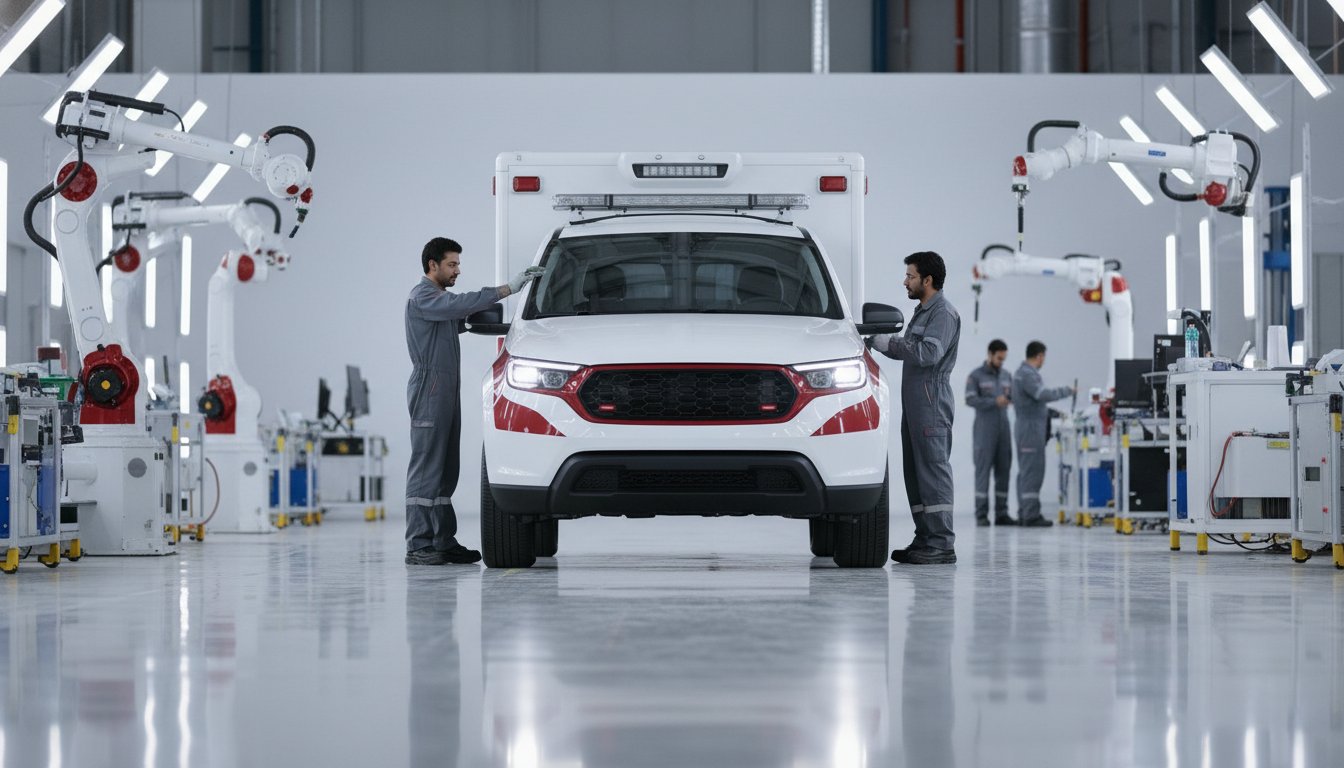
Our commitment to "Ambulances Built for Life-Saving Reliability" is rooted in our fabrication process. We leverage advanced technology not just for speed, but for unparalleled precision. This ensures every bracket, panel, and reinforcement is perfectly engineered for a flawless fit and rugged durability. Our work on platforms like the Toyota Land Cruiser 70-series and GMC Sierra demonstrates this mastery, converting these robust chassis into highly capable units for diverse missions, from remote medical response to tactical patrol.
Partnering for Your Next Fleet Project
We believe a successful project starts with a consultative partnership. Our process moves from initial design and engineering to final delivery with complete transparency, ensuring your specifications are met without compromise. We listen to your operational needs to deliver a fleet that is "Built to Protect What Matters." If you're looking for a builder that combines technical expertise with a commitment to your mission, our team is ready to assist. Get a free estimate for your specialized vehicle project today.
Partnering for Mission-Critical Reliability in 2026 and Beyond
Selecting the right partner for your emergency fleet in Oman goes far beyond a simple purchase. It's an investment in operational readiness and public safety. The most critical factors for 2026 are a builder's strict adherence to technical standards and their capacity for in-house, mission-specific fabrication. These elements separate adequate suppliers from truly reliable emergency vehicle builders.
Auto Industries Factory (AIF) exemplifies these principles. As a leading UAE ambulance manufacturer, their commitment to quality is demonstrated through their advanced in-house CNC laser and fabrication facility. This control over the entire production process ensures every vehicle, from ambulances to specialized military and police tactical solutions, is built for rugged durability and flawless field performance.
Don't leave your fleet's capability to chance. Ready to work with a partner dedicated to precision and strength? Upgrade Your Fleet with Auto Industries Factory and secure the heavy-duty solutions your team deserves.
Frequently Asked Questions
What is the most important certification for an ambulance builder in Oman?
The most critical requirement for an ambulance builder in Oman is full compliance with the standards set by the Omani Ministry of Health (MOH). These regulations dictate everything from vehicle dimensions and patient compartment layout to the specific medical equipment that must be installed. Builders must provide documentation proving every component, from the electrical system to the stretcher mounts, meets or exceeds these life-saving MOH mandates. This ensures the vehicle is legally operable and medically effective.
How long does a typical emergency vehicle conversion take from design to delivery?
A typical emergency vehicle conversion takes between 8 to 12 weeks from final design approval to delivery. This timeline can vary based on chassis availability and the complexity of the build. For instance, a standard patient transport unit might be completed closer to the 8-week mark, while a specialized Advanced Life Support (ALS) ambulance with custom cabinetry and advanced electrical systems could extend to 12 weeks or more. Clear communication with the builder is key to managing this schedule.
Can any vehicle chassis be converted into a reliable ambulance?
No, not every vehicle chassis is suitable for a reliable ambulance conversion. The base vehicle must have a high Gross Vehicle Weight Rating (GVWR) to safely handle the added weight of medical equipment, cabinetry, and personnel. Heavy-duty chassis like the Toyota Land Cruiser, Nissan Patrol, or Ford Transit are preferred for their robust frames and durable suspension. Using an inadequate chassis compromises safety, performance, and the vehicle's operational lifespan, leading to premature failure.
What are the main differences between Type I, Type II, and Type III ambulances?
The main differences lie in the chassis and cabin construction. A Type I ambulance uses a heavy-duty truck chassis with a separate, custom-fabricated patient module. Type II ambulances are built on a van chassis, like a Mercedes Sprinter, with the original van body serving as the patient compartment. A Type III ambulance also uses a van chassis, but it features a custom-fabricated patient module that is connected to the cab via a pass-through, offering more space than a Type II.
Why is in-house CNC fabrication important for vehicle reliability?
In-house CNC fabrication is vital because it guarantees precision-engineered components with tolerances as fine as 0.1mm. This level of accuracy in cutting and shaping metal for cabinetry, equipment mounts, and structural reinforcements eliminates weak points and ensures a perfect fit. Reliable emergency vehicle builders who control their own CNC fabrication can maintain stringent quality control over every part, resulting in a more durable, safer, and longer-lasting vehicle without depending on third-party suppliers.
How do builders ensure electrical systems don’t fail under heavy medical equipment loads?
Builders prevent electrical failure by designing a completely independent and robust secondary electrical system. This includes installing high-output alternators, at least one auxiliary deep-cycle battery, and a power management system with circuit breakers. All wiring for medical equipment, lighting, and communication systems is isolated from the chassis's original wiring. This dedicated system ensures that heavy power draws from defibrillators or ventilators don't compromise the vehicle’s essential functions.
What maintenance is required for specialized emergency vehicle conversions?
Maintenance for converted vehicles focuses on the specialized additions. Beyond standard chassis service, technicians must perform monthly checks on the secondary electrical system, including battery health and inverter function. It’s also crucial to inspect all equipment mounts, latches, and cabinetry for security. The patient compartment's HVAC system, oxygen lines and regulators, and suction units require regular inspection and servicing according to a documented schedule to ensure they are always mission-ready.
Do reliable builders provide international shipping for converted fleets?
Yes, established and reliable emergency vehicle builders offer comprehensive international shipping and logistics solutions. They manage the entire process, from secure loading at their facility to customs clearance and final delivery in the destination country. This includes handling all necessary export documentation and ensuring the vehicles are properly protected for sea or air freight. This turnkey service is essential for government agencies or private organizations procuring fleets from a specialized builder abroad.


