
What if the structural integrity of your emergency response vehicle was compromised before it ever saw its first mission? In a life-saving situation, the difference between a successful outcome and catastrophic failure often comes down to engineering details decided months earlier in a fabrication facility.
You already know that for mission-critical fleets operating in the demanding operational conditions prevalent across the UAE and the wider GCC, cutting corners isn't an option. The risks of mechanical failure, regulatory penalties for non-compliance with GSO standards, and the hidden costs of rework are simply too high. That's why ensuring vehicle conversion quality control is a non-negotiable requirement for operational readiness and safety. We're pulling back the curtain on the advanced engineering standards of 2026 to give you a clear, actionable checklist for evaluating fabrication quality.
In this guide, you'll discover the rigorous multi-stage inspection protocols, material stress tests, and documentation required to transform a standard chassis into a specialized vehicle you can trust when it matters most.
Key Takeaways
- Pinpoint the specific fabrication technologies, like CNC laser cutting, that guarantee precision and structural integrity in every component of your converted vehicle.
- Discover the multi-stage electrical audit process for systems integration that is essential for preventing on-duty equipment and power failures.
- A key step in ensuring vehicle conversion quality control is verifying compliance with mandatory GCC standards, such as GSO 1794 for ambulances.
- Learn how to evaluate a conversion partner based on their quality framework, not just the final price, to secure a reliable and mission-ready asset.
What is Vehicle Conversion Quality Control?
Vehicle conversion quality control is a systematic, engineering-led process designed to guarantee the structural, electrical, and functional integrity of a modified vehicle. It's not a simple final inspection. It's a comprehensive methodology that scrutinizes every modification, from the first weld bead to the final wiring harness. Unlike standard factory QC, which verifies that a vehicle meets its original design specifications, conversion QC validates that the new, mission-specific design is safe, reliable, and fit for purpose. This process operates within the specialized automotive aftermarket, where the responsibility for safety shifts from the original equipment manufacturer (OEM) to the conversion specialist.
Standard automotive QC is fundamentally insufficient for units like ambulances, armored personnel carriers, or ruggedized mobile command centers. An OEM's checklist doesn't account for the immense stress a 500-kilogram medical cabinet places on a chassis during an emergency maneuver, nor does it validate the power draw of tactical communication arrays. This is why leading fabricators in Oman adopt a 'Life-Cycle Quality' philosophy. This approach begins with material certification, verifying the grade of raw steel and aluminum, and extends through every stage of fabrication to final field deployment trials that simulate years of harsh operational use. The core objective is ensuring vehicle conversion quality control is an active, ongoing process, not a passive, end-of-line check.
The Stakes of Quality in Mission-Critical Vehicles
In emergency medical services and defense applications, the consequences of a quality failure are measured in lives, not dollars. A faulty weld on an ambulance's subframe could lead to catastrophic structural failure during patient transport. In Oman's rugged desert environments, constant chassis flex over uneven wadis and dunes can cause metal fatigue in poorly reinforced vehicles in as little as 18 months. Proper structural QC, involving gusseting and reinforcing key stress points, prevents this fatigue and can extend a vehicle's operational lifespan by over 50%. Precision engineering isn't a luxury; it's a direct contributor to vehicle longevity and mission success.
Engineering vs. Aesthetics in Conversion
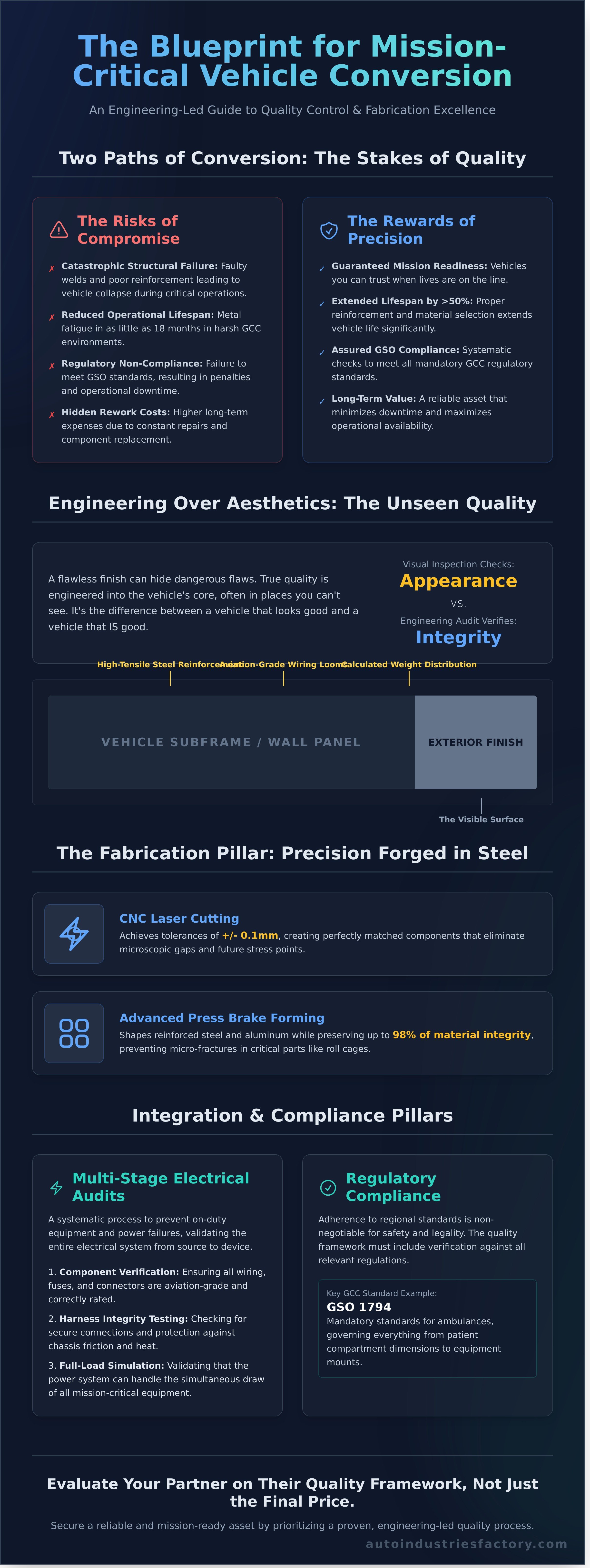
A clean, seamless interior finish doesn't guarantee a safe build. The most critical safety components in a converted vehicle are often hidden from view. A visually flawless wall panel might conceal inadequate insulation or, more dangerously, a lack of structural reinforcement at critical load-bearing points. True quality lies in the unseen details: the certified high-tensile steel plates welded to the vehicle's pillars to support heavy equipment, the use of aviation-grade wiring looms to prevent electrical fires, and the precise calculation of weight distribution to maintain vehicle stability. The industry is moving away from simple visual inspections and toward data-driven engineering audits. This involves using tools like ultrasonic weld testers and finite element analysis (FEA) software to digitally stress-test designs, ensuring vehicle conversion quality control is based on verifiable data, not just appearance.
The Fabrication Phase: Precision as a Quality Pillar
The transition from digital blueprint to physical reality is where a vehicle conversion's integrity is truly forged. This fabrication stage is not merely about assembly; it's a discipline of precision engineering where every cut, bend, and weld directly impacts the vehicle's final performance, safety, and lifespan. A commitment to advanced technology and certified expertise is the only way to guarantee that custom components meet or exceed original manufacturer standards.
At the core of this process is the use of computer-controlled machinery. In-house CNC laser cutting achieves tolerances as fine as +/- 0.1mm, creating components that fit together with seamless accuracy. This eliminates the microscopic gaps and misalignments common with manual cutting, which can lead to stress points and premature failure. Following the cut, advanced press brake technology shapes metals like reinforced steel without creating the micro-fractures that compromise tensile strength. This process preserves up to 98% of the material’s structural integrity, a critical factor for components like roll cages and heavy-duty bumpers.
In-House Manufacturing: The AIF Advantage
Controlling the entire fabrication process under one roof is fundamental to ensuring vehicle conversion quality control. Relying on third-party suppliers introduces variables in material quality and production standards, creating 'quality leakage' that can compromise the final build. The Auto Industries Factory home page showcases a vertically integrated model where every stage, from raw material selection to final finish, is meticulously managed. Here, the 'Master Craftsman' oversees automated systems, ensuring technology serves as a tool for perfection, not a replacement for expertise.
Welding is arguably the most critical skill in fabrication, especially for armored or emergency vehicles. Our welders are certified to AWS D1.1 standards for structural steel, employing both MIG welding for robust framework and TIG welding for the high-precision joins required on ballistic steel plates. Every welding procedure must align with globally recognized benchmarks, such as the SAE International engineering standards, to guarantee joint integrity under extreme stress. This is complemented by a strict material selection policy, from AR500 ballistic steel for armored units to lightweight, non-porous medical-grade composites for ambulance interiors that meet Omani Ministry of Health regulations.
Structural Integrity and Load Testing
Any significant modification, like a high-roof conversion, fundamentally alters a vehicle's dynamics. A critical quality check involves calculating the new Center of Gravity (CoG) and verifying it with a physical tilt-table test, where the vehicle must remain stable up to a 28-degree incline to pass safety protocols common in Oman and the wider GCC region. This rigorous testing protocol for ensuring vehicle conversion quality control extends to all custom-fabricated additions.
- Custom Roof Racks: Undergo static load testing at 2.5 times their rated carrying capacity. A rack rated for 150kg is tested to 375kg to verify the integrity of its mounting points and structure.
- Internal Cabinetry: Mounts for medical cabinets and equipment storage are stress-tested to withstand forces of at least 10G, preventing them from becoming dangerous projectiles in a sudden stop or collision.
- Bull Bars & Bumpers: Custom bull bars are subjected to simulated impact tests to ensure they provide protection without interfering with the vehicle’s airbag deployment sensors, a critical safety and regulatory requirement.
This exhaustive approach to fabrication and testing forms the structural backbone of a reliable and safe vehicle conversion. See how our integrated fabrication services deliver these mission-ready results.
Electrical and Systems Integration Audits
The electrical system is the central nervous system of any specialized vehicle. In mission-critical conversions for police, ambulance, or defense, it's not just about adding lights and sirens; it's about engineering a completely new, robust ecosystem. A single faulty connection or an overloaded circuit can compromise an entire operation. A meticulous, multi-stage audit of all electrical and digital systems is therefore a non-negotiable pillar of ensuring vehicle conversion quality control.
Our process moves from the foundational to the systemic, verifying integrity at every level:
- Step 1: Wire Harness Loom Design: We don't just run wires; we engineer custom looms. Every wire is sheathed in braided sleeving and sealed with adhesive-lined heat-shrink, achieving an IP67 rating against dust and water ingress-a critical standard for Oman's demanding environment. This prevents chafing, short circuits, and corrosion over the vehicle's service life.
- Step 2: Load Balancing: We calculate the total electrical load of all added equipment. For an Advanced Life Support (ALS) ambulance, this means accounting for a ventilator (6 amps), a full LED lighting package (15 amps), communications gear (4 amps), and the peak draw of a defibrillator. We ensure the alternator, often upgraded to a 250A unit, can handle the maximum load without draining the primary battery.
- Step 3: Electromagnetic Interference (EMI) Testing: Sensitive medical equipment, like an EKG monitor, can be disrupted by electrical "noise" from sirens or radios. We conduct EMI testing, modeled on MIL-STD-461G protocols, to shield sensitive components and ensure a police radio transmission doesn't interfere with a patient's diagnostic readings.
- Step 4: Redundancy Testing: Critical systems cannot fail. We test secondary battery systems, managed by smart isolators like a Redarc BCDC1240D, to confirm they can power essential equipment for over 8 hours with the engine off. Power inverters are tested for a failover switching time of less than 20 milliseconds, guaranteeing uninterrupted power to life-support devices.
- Step 5: Full System Thermal Imaging: Under a full, sustained load, our technicians use a FLIR thermal camera to scan every connection, fuse block, and high-draw component. Any connection point reading above 65°C is flagged, disassembled, and re-secured, eliminating potential hotspots that could lead to catastrophic failure or fire.
Managing Complex Power Requirements
Powering advanced equipment in Oman's high-ambient temperatures, which can exceed 50°C, presents a unique engineering challenge. Standard automotive wiring can degrade quickly. That's why we mandate marine-grade, tinned copper wiring compliant with ABYC standards for its superior resistance to heat and corrosion. For critical systems like medical oxygen and suction, we implement multiple fail-safes, including pressure-sensitive shut-off solenoids and independent power circuits that are isolated from non-essential equipment.
Software and Communication Calibration
A modern converted vehicle is a network of interconnected computers. Our technicians focus on ensuring the seamless integration of systems like the Royal Oman Police (ROP) radio network, GPS tracking, and fleet management telematics without software conflicts. This process involves deep calibration and validation, adhering to principles outlined in global standards for Regulatory Compliance and Performance Testing to guarantee all systems function as a cohesive unit. We also conduct rigorous user interface testing on digital control panels to ensure driver ergonomics are optimized for high-stress situations, and we harden the vehicle's CAN bus to protect its core operational systems from external digital interference.
Regulatory Compliance and Performance Testing in the GCC
A converted vehicle’s operational success in Oman isn’t just defined by its components; it’s proven through meticulous validation against regional and global standards. At Auto Industries Factory LLC, our approach to ensuring vehicle conversion quality control is built on a foundation of certified compliance and aggressive, real-world performance testing. We engineer vehicles not just to pass inspections, but to perform flawlessly under the immense pressure of their mission.
For every medical vehicle, we build to the stringent Gulf Standard GSO 1794, which governs everything from patient compartment dimensions to the layout of critical medical equipment. We then elevate this regional benchmark by integrating key principles from the European EN 1789 standard, particularly concerning equipment anchorage and structural integrity. This dual-standard approach guarantees a level of safety and ergonomic efficiency that far exceeds basic requirements, a critical factor for emergency responders.
Our extensive experience navigating the rigorous demands of the UAE’s Ministry of Health (MOH) and Roads and Transport Authority (RTA) has created a battle-hardened quality management system. We apply this exact framework to meet and exceed the specific certification requirements of Oman’s Ministry of Health and the Royal Oman Police (ROP), ensuring a seamless and swift vehicle registration process for our clients.
Beyond static checks, every Auto Industries Factory LLC conversion undergoes a punishing road-test protocol designed to simulate years of hard use. Key dynamic tests include:
- Powertrain Stress Test: Verifying 0-100 km/h acceleration times with a full 500kg payload to ensure no performance loss from the added weight of the conversion.
- Braking Endurance: Conducting ten consecutive 100-0 km/h emergency braking maneuvers to measure brake fade and confirm stopping distances remain within 5% of the base vehicle’s OEM performance.
- High-Speed Stability: Executing evasive lane-change maneuvers at 120 km/h to validate the modified suspension and center of gravity, guaranteeing predictable handling when it matters most.
Environmental Testing for Desert Conditions
Vehicles in Oman face some of the world's most hostile conditions. Our environmental chamber tests components to their breaking point. We conduct sand and dust ingress tests on HVAC systems and sensitive electronics, ensuring seals and filters prevent failures. Paint and coatings undergo 2,000 hours of accelerated Xenon Arc testing, simulating over 5 years of intense UV exposure. Critically, we verify cooling system efficiency by forcing vehicles to idle for 60 minutes with the AC at full load in ambient temperatures exceeding 50°C.
Certification and Documentation
With every completed vehicle, Auto Industries Factory LLC provides a comprehensive 'Quality Passport'. This is not a simple checklist; it’s a detailed dossier containing material traceability certificates, full electrical wiring schematics, GSO/ROP compliance paperwork, and the signed results from every performance test. This documentation is invaluable, simplifying future maintenance for fleet managers and providing undeniable proof of build quality for insurance claims. To further validate our process, we voluntarily participate in third-party audits with agencies like TÜV Nord, reinforcing the integrity of our internal QC metrics.
This rigorous, multi-layered validation process is fundamental to ensuring vehicle conversion quality control and delivering a final product that is safe, reliable, and built to endure. Ensure your fleet is compliant and mission-ready from day one. Contact an Auto Industries Factory LLC conversion specialist to discuss our GSO-compliant certification process.
Choosing a Conversion Partner with a Proven Quality Framework
Your vehicle conversion is a critical investment. The final decision shouldn't rest on price alone, but on a partner's documented commitment to engineering excellence. A high-quality facility provides more than just a service; it delivers a certified, reliable, and safe asset. Key indicators of a superior partner include ISO 9001:2015 certification, a comprehensive portfolio of mission-critical vehicles, and complete in-house fabrication capabilities, from CNC cutting to final assembly. These aren't just features; they are foundational pillars for ensuring vehicle conversion quality control from start to finish.
When you request a 'Free Estimate,' treat it as a quality audit. A low price often hides compromises. A professional consultation should focus heavily on the quality control protocols that justify the cost. Ask direct questions: What are your material traceability standards? What specific electrical load calculations are performed for auxiliary systems? Can you walk me through your multi-point inspection process? A partner confident in their work will welcome this scrutiny. A partner who deflects is a liability.
Red Flags in Vehicle Conversion
In Oman's demanding operational environment, shortcuts lead to catastrophic failures. Be vigilant for warning signs like 'cut-and-shut' fabrication, where sections of different vehicles are welded together, compromising structural integrity by over 50%. Substandard wiring, often using incorrect gauges or failing to insulate against heat and vibration, is a primary cause of electrical fires. A provider without in-house CNC and laser cutting outsources precision, risking component mismatches and project delays. Remember, a conversion that costs 25% less upfront can easily result in a 50% higher Total Cost of Ownership (TCO) within 24 months due to downtime and repairs.
The Future of Quality: AI and Predictive Maintenance
Auto Industries Factory (AIF) is already engineering for the next decade. The future of quality isn't just about inspection; it's about prediction. We are actively developing conversions with integrated IoT sensors that provide real-time monitoring of conversion-specific components. Imagine an ambulance that alerts fleet managers to a potential refrigeration failure before medicine is compromised, or a utility vehicle that signals hydraulic pressure anomalies. This proactive approach is the next evolution in fleet management and safety.
Ultimately, the process of ensuring vehicle conversion quality control comes down to your choice of partner. As the leading vehicle conversion specialist serving clients in Ajman, Dubai, and across Oman, AIF builds vehicles to a standard, not a price. Our framework is built on precision engineering, certified processes, and an unwavering commitment to operational reliability.
Don't compromise the safety of your personnel or the integrity of your mission. For a conversion defined by safety, reliability, and precision, Partner with Auto Industries Factory for your next fleet project.
Secure Your Fleet's Future with Certified Quality Control
As engineering standards for 2026 approach, the operational integrity of your specialized vehicles hinges on a robust, multi-layered quality framework. Success now demands documented precision in the fabrication phase, meticulous electrical and systems integration audits, and proven adherence to critical regional regulations. This comprehensive approach is the only method for ensuring vehicle conversion quality control that meets the demands of mission-critical work in Oman and the wider GCC.
Auto Industries Factory delivers this certainty. Our advanced, in-house CNC Laser and Press Brake facilities guarantee fabrication accuracy, while our expertise is certified against both GSO 1794 and EN 1789 standards. It's this uncompromising process that has earned us the trust of government and defense sectors across the UAE. Your fleet deserves the same level of dependability. Don't leave its performance and safety to chance.
Secure your fleet's reliability. Contact Auto Industries Factory for a technical consultation today.
Frequently Asked Questions
What are the most important quality standards for ambulance conversions in Oman?
The most critical standards are those set by Oman's Royal Oman Police (ROP) and the Civil Defence and Ambulance Authority (CDAA). These regulations govern everything from the internal layout and medical equipment mounts to the electrical systems and patient compartment safety. Additionally, conversions must often comply with GCC-wide GSO standards, ensuring a baseline of quality and interoperability. Adherence to these specific codes is non-negotiable for a vehicle to be legally registered and operated as an ambulance in Oman.
How do you test the structural integrity of a high-roof vehicle conversion?
We test structural integrity through a combination of digital and physical assessments. Initially, a Finite Element Analysis (FEA) computer simulation models stress points under various load conditions. Following fabrication, we perform a physical roof load test, applying a minimum of 150 kg per square meter to verify the structure's strength and rigidity. All welding points undergo non-destructive testing (NDT) to ensure they meet or exceed the base vehicle's original structural specifications for maximum safety.
Why is in-house laser cutting superior to manual fabrication for vehicle parts?
In-house CNC laser cutting offers unmatched precision and consistency, which is impossible to achieve manually. Our laser systems operate with a tolerance of just +/- 0.1mm, ensuring every component fits perfectly. This precision eliminates gaps, reduces material stress, and results in a stronger, more durable final product. Manual fabrication introduces a higher margin of error, potentially compromising the fit, finish, and long-term reliability of critical conversion components like brackets and interior panels.
Can a converted vehicle maintain its original manufacturer warranty?
It depends entirely on the modification's scope and the manufacturer's policy in Oman. Modifications to the vehicle's chassis, frame, or suspension will almost certainly void the warranty on those specific parts. However, the original warranty for the unmodified powertrain, like the engine and transmission, often remains valid. We always recommend consulting with the official vehicle dealer, such as Toyota or Nissan in Oman, before beginning a conversion to understand the exact warranty implications for your specific vehicle.
What electrical tests are performed on specialized medical vehicles?
Specialized medical vehicles undergo rigorous electrical testing to guarantee reliability and safety. Key tests include a full load bank test on the auxiliary power system to ensure it can handle all medical equipment simultaneously. We also perform insulation resistance testing to prevent electrical shorts and conduct electromagnetic compatibility (EMC) checks. This last test is vital; it confirms that the vehicle’s systems don't interfere with sensitive life-support and diagnostic equipment onboard.
How does the Oman climate affect the quality requirements for vehicle conversions?
Oman's extreme climate of high heat and humidity dictates stringent material and system requirements. All conversions must feature heavy-duty HVAC systems, specifically rated to perform efficiently in ambient temperatures exceeding 50°C. We use UV-stabilized polymers and high-temperature-rated wiring to prevent degradation and failure. Properly sealing the cabin against fine dust and sand is also a critical step, making robust weather stripping and filtration systems essential for ensuring vehicle conversion quality control and long-term durability.
What is the difference between a standard conversion and a GSO-certified conversion?
A GSO-certified conversion has been independently verified to meet the unified safety and quality standards set by the GCC Standardization Organization, which are legally recognized in Oman. This includes over 100 specific checks on materials, construction methods, and safety features. A standard conversion may be built to a high quality but is only certified against the manufacturer's internal checklist or the client's specifications, which may not be as comprehensive or officially recognized by regional authorities.
How long does a comprehensive quality control audit take for a single vehicle?
A comprehensive quality control audit for a single specialized vehicle, like an ambulance or tactical unit, typically takes between 8 and 12 hours. This process involves a meticulous 200-point inspection covering all mechanical, electrical, and structural modifications. The audit includes full systems functionality tests, water leak testing, and a final 50-kilometer road test to assess performance and identify any potential issues before final delivery to the client. This detailed process is fundamental to our quality assurance.


