What if the biggest threat to your mission-critical fleet isn't a mechanical breakdown, but a single grain of sand or a missed regulatory deadline? You know that in the UAE, the 50°C heat and fine desert dust don't just test your engine; they relentlessly attack custom electrical systems and specialized fabrication. Whether you manage a fleet of box type ambulances or heavy-duty tactical units, you understand that downtime isn't just an inconvenience; it's a risk to lives and operations. Finding reliable maintenance tips for converted vehicles that actually account for these extreme conditions is the difference between a high-performing asset and a costly liability.
This guide will help you master the essential maintenance protocols required to keep your specialized fleet operational and fully compliant with the latest RTA and MoIAT standards. We'll walk you through a 2026 reliability checklist that covers everything from Euro 6b emission compliance to protecting custom bull bars and medical oxygen systems. You'll learn how to meet the new Federal Decree-Law No. (11) of 2024 reporting requirements by the May 30, 2026, deadline while avoiding fines that can reach up to AED 50,000. By the end, you'll have a clear roadmap to extend vehicle lifespan and ensure 100% mission readiness in the harshest environments on earth.
Key Takeaways
- Master essential maintenance tips for converted vehicles to ensure 100% mission readiness and prevent costly downtime for specialized fleets.
- Learn to identify structural stress points on custom bull bars, metal canopies, and heavy-duty roof racks caused by rugged off-road operations.
- Understand the critical calibration protocols for medical oxygen systems and high-output electrical setups in specialized ambulances.
- Discover proven methods to protect sensitive electrical connectors and rubber seals from 50°C+ heat and fine silica dust ingress.
- Stay compliant with 2026 RTA and MoIAT standards while leveraging precision engineering for rapid part replacement and fleet reliability.
Why Specialized Maintenance is Essential for Converted Fleets in the UAE
Converted vehicle maintenance isn't just an extension of standard car care; it's a specialized discipline focused on aftermarket structural, electrical, and medical systems. While a standard garage handles engine oil and brake pads, they rarely possess the technical blueprints for a box type ambulance's secondary power grid or a tactical unit's reinforced chassis. Gaining a deep understanding converted vehicles means recognizing that the base chassis now supports a complex ecosystem of mission-critical hardware. In the UAE, where sand and heat are constant, these secondary systems require specific oversight to remain operational.
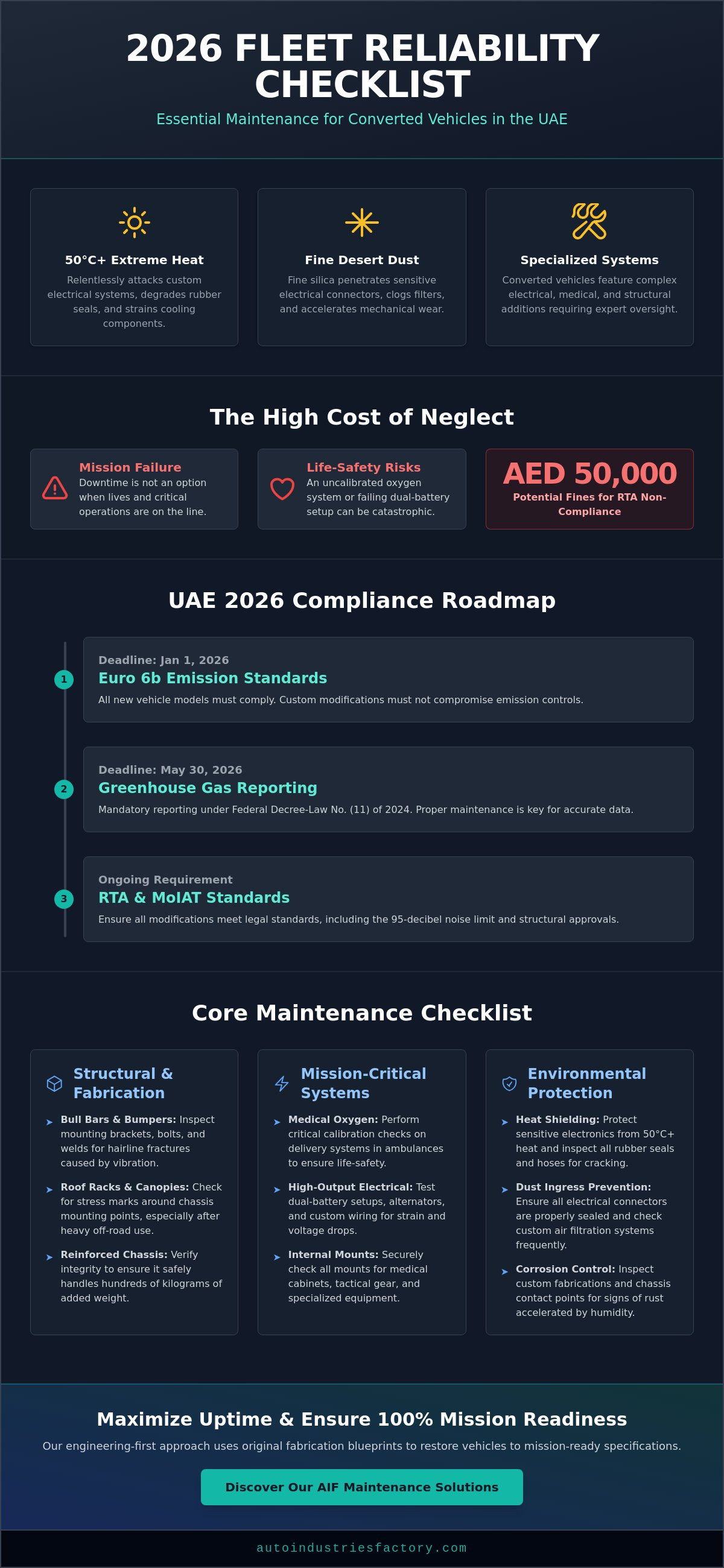
Effective maintenance tips for converted vehicles must account for the rigorous 2026 GCC safety standards. As of January 1, 2026, all new vehicle models must comply with Euro 6b emission standards, and fleet operators face a May 30, 2026, deadline to report greenhouse gas emissions under Federal Decree-Law No. (11) of 2024. A standard oil change won't help a heavy-duty ambulance stay compliant if its high-output alternator is straining the engine or if custom exhaust modifications exceed the 95-decibel noise limit. Specialized servicing ensures that every modification remains within legal and mechanical tolerances.
To better understand the balance between professional and DIY care, watch this helpful video:
The Cost of Neglect: Safety and Uptime
Neglect leads to catastrophic failure. In emergency medical transport, an uncalibrated oxygen system or a failing dual-battery setup is a life-safety risk, not just a mechanical annoyance. For Dubai-based safari operators, a hairline fracture in a custom roof rack can ground a vehicle during peak season, leading to immediate revenue loss. Beyond the physical risks, the legal liabilities are immense. Operating a modified vehicle that doesn't meet RTA approval can result in fines ranging from AED 1,000 to AED 50,000, making specialized maintenance a financial safeguard.
AIF's Approach: Engineering-First Maintenance
Auto Industries Factory (AIF) specializes in building for durability, but even the most rugged fabrication requires expert monitoring. We use original fabrication blueprints and CNC-precision data to verify the integrity of every bull bar, canopy, and internal mount we manufacture. This engineering-first approach ensures that any repair work restores the vehicle to its original mission-ready specifications. You can learn more about our conversion services to see how our manufacturing expertise translates into long-term fleet reliability and 100% uptime.
Structural and Mechanical Integrity: The Core Fabrication Checklist
Converted vehicles often carry hundreds of kilograms of additional weight in the form of steel plating, medical cabinets, or tactical equipment. This added mass shifts the vehicle's center of gravity and places extreme stress on the original chassis and aftermarket mounting points. While standard service centers focus on the engine, effective maintenance tips for converted vehicles prioritize the structural integrity of these modifications. Adhering to rigorous standards, such as the FMCSA Inspection, Repair, and Maintenance Regulations, ensures that your fleet remains safe and operational under the heavy-duty demands of Dubai's landscape.
Inspecting custom bull bars and rear bumpers requires a detailed look at the mounting brackets and bolts. High-speed desert driving creates persistent vibrations that can loosen even the most rugged hardware. You should check for hairline fractures in welds and stress marks around the chassis mounting holes. These components protect mission-critical cooling systems and lighting; if the mounts fail, the resulting damage can ground an ambulance or security unit for weeks. Verifying the integrity of laser-cut and CNC-machined components is equally vital, as these precision parts must maintain their exact tolerances to prevent rattling or structural fatigue over time.
Suspension recalibration is non-negotiable for armored or weighted vehicles. When a vehicle is converted into a box type ambulance or a tactical unit, the factory suspension is often pushed to its absolute limit. You must monitor leaf springs and shock absorbers for signs of sagging or fluid leaks. Heavy-duty bushings play a critical role in maintaining stability under load, and they should be replaced at the first sign of cracking. It's a professional necessity to consult specialists in high-quality fabrication to ensure your suspension setup matches your specific mission requirements.
Fabricated Accessory Care: Bull Bars and Canopies
Maintaining the powder-coated finish on your metal canopies and bull bars is your first line of defense against the desert. Sandblasting during high-wind days can chip this coating, exposing raw steel to humidity and rapid corrosion. You must tighten all vibration-prone mounts after every off-road safari mission to prevent hardware loss. For a deeper look at these components, see our guide to custom bull bars and bumpers.
Chassis and Suspension Reinforcement
On converted Toyota Land Cruisers, the rear leaf springs often bear the brunt of heavy medical or tactical gear. You should inspect these weekly for any loss of arch or uneven ride height. Heavy-duty bushings must be lubricated regularly to prevent the squeaking and stiffness that leads to premature component failure. Suspension load ratings must be checked annually to ensure the vehicle's gross weight hasn't exceeded the safety limits of its structural reinforcements.
Maintaining Mission-Critical Systems: Electrical and Specialized Equipment
While structural checks ensure the vehicle's shell remains intact, the electrical and life-support systems represent the true mission capability of a specialized fleet. For emergency and security operators, maintenance tips for converted vehicles must prioritize the "nervous system" of the conversion. This includes high-output power grids, specialized medical hardware, and integrated communication arrays that must function flawlessly in Dubai's extreme climate. When the ambient temperature hits 50°C, the demand on your vehicle's electrical system peaks, making proactive testing essential for 100% uptime.
High-output alternators and dual-battery systems are the heart of any box type ambulance or tactical unit. These vehicles often run 180-amp to 250-amp alternators to power sirens, climate control, and life-support equipment simultaneously. You should perform a load test on the auxiliary batteries every 30 days to ensure they hold a charge under maximum stress. Check the battery isolators and split-charge relays to confirm that the starter battery isn't being drained by the medical or tactical equipment. A failure here doesn't just mean a dead engine; it means a total loss of mission-critical systems during an emergency.
Specialized equipment like medical oxygen systems and suction units requires precise calibration. You must conduct high-pressure leak tests on oxygen lines every month to prevent hazardous gas buildup and ensure delivery accuracy. Integrated control panels, which manage everything from scene lighting to power distribution, require regular software updates to maintain compatibility with new hardware. In tactical units, you should inspect wiring harnesses for signs of heat-induced brittleness. Sand and heat can degrade wire insulation, leading to short circuits that are difficult to diagnose once the vehicle is in the field.
Ambulance-Specific Equipment Maintenance
In a medical environment, maintenance extends to sanitization. You must follow strict protocols for cleaning medical-grade interior surfaces and flooring to prevent cross-contamination. Testing the reliability of inverter systems is equally vital; these units convert DC power to AC for sensitive life-support equipment. You can find more detail on these systems in our Complete Guide to Ambulance Conversion, which outlines the engineering required for professional medical vehicles.
Tactical and Security Upfitting Care
Police and military units face unique wear patterns on their emergency light bars and sirens. Check all external wiring for signs of UV damage or sand abrasion that could lead to signal failure. If your vehicle features ballistic glass or armored panels, inspect the seals for gaps that could allow moisture or dust ingress. For a deeper look at these specialized modifications, refer to our Police Vehicle Modifications Guide to ensure your law enforcement fleet remains rugged and reliable.
UAE Environmental Maintenance: Combatting Heat, Sand, and Humidity
Dubai's climate doesn't just test a vehicle; it actively tries to dismantle it. For fleet managers, the 50°C summer peak and fine silica dust represent a constant battle against mechanical and electrical degradation. Effective maintenance tips for converted vehicles in the UAE must address the invisible threats of silica ingress and humidity-induced oxidation. In coastal hubs like Ajman and Fujairah, where humidity levels often exceed 90% during the summer months, metal components that aren't properly treated will oxidize at double the standard rate. If your fleet is already showing signs of such wear, The Solution offers specialized restoration and damage repair services to bring your equipment back to mission-ready standards. Proactive environmental care is the only way to prevent these elements from compromising mission-critical assets.
Fine desert dust is particularly destructive to aftermarket electrical systems. Silica particles are small enough to bypass standard gaskets, building up inside electrical connectors and causing intermittent signal failures or short circuits. You should apply dielectric grease to all specialized wiring harnesses and use sealed, dust-proof caps for any external ports. Similarly, rubber seals on custom canopies and ambulance doors are prone to dry-rot when exposed to intense UV radiation and extreme heat. Inspecting these seals every six months and applying silicone-based conditioners can prevent the leaks that lead to interior damage or expensive equipment failure.
Air filtration is another area where converted vehicles diverge from standard maintenance schedules. Because safari vehicles and tactical units operate in high-dust environments, their air filtration systems require 50% more frequent replacement cycles compared to city-driven cars. A clogged filter doesn't just reduce performance; it forces the engine to run hotter, which is a recipe for disaster in the UAE heat. Keeping the engine's "lungs" clean is vital for maintaining the power needed to navigate dunes or respond to emergencies.
Heat Management for Specialized Fleets
High-performance cooling systems are the lifeblood of any heavy-duty conversion. You must flush these systems before the June-August peak to ensure maximum heat dissipation. This is especially critical for ambulances, where the auxiliary AC units in the patient compartment must maintain a stable temperature regardless of the external environment. Additionally, ensuring your custom fabrication has premium UV-protective powder coatings will prevent the paint from chalking and the underlying metal from weakening under the relentless sun.
Sand and Dust Mitigation
Sand is an abrasive that acts like sandpaper on moving parts. Custom roof racks and safari tops on Toyota Land Cruisers or Nissan Patrols should be cleaned weekly to prevent sand from grinding into the joints. You must follow strict lubrication protocols, using dry-film lubricants that don't attract dust, for all hinges, latches, and sliding components. For those managing desert-bound fleets, our Ultimate Guide to Safari Vehicle Conversions provides deeper insights into building and maintaining vehicles for the dunes.
Contact our experts today to optimize your fleet's environmental resilience and ensure mission readiness year-round.
Professional Support: How Auto Industries Factory (AIF) Maximizes Uptime
Auto Industries Factory (AIF) specializes in providing comprehensive, engineering-led support for specialized fleets across the UAE. While general automotive shops focus on standard passenger cars, our facility in Ajman is equipped to handle the complex structural and electrical needs of mission-critical vehicles. We understand that for an ambulance or a tactical unit, downtime isn't just a loss of revenue; it's a gap in essential services. By offering specialized maintenance tips for converted vehicles, we help fleet managers transition from reactive repairs to proactive uptime management that accounts for the unique stresses of heavy-duty modifications.
Our in-house manufacturing capabilities are a cornerstone of our support model. We utilize CNC laser cutting and precision press brake technology to fabricate replacement parts on-demand. If a custom bull bar or a metal canopy is damaged during a mission, we don't wait for international shipping. We use our original blueprints to cut and bend a flawless replacement in-house, significantly reducing the weeks of downtime typically associated with specialized vehicle repairs. This rapid-response fabrication ensures your fleet stays on the road instead of waiting in a garage.
For government and commercial operators, AIF provides scheduled maintenance programs designed for heavy-duty cycles. These programs are essential as we approach the May 30, 2026, deadline for Federal Decree-Law No. (11) of 2024, which requires businesses to report greenhouse gas emissions from their fleets. Our team conducts full fleet audits to ensure every conversion remains compliant with RTA standards and the new Euro 6b emission regulations. We also offer full vehicle painting and color transformations to keep your fleet's branding as rugged and professional as the engineering beneath the surface.
Why Choose an OEM-Style Conversion Factory?
The primary advantage of working with AIF is that the original designers and engineers are the ones servicing your fleet. We have a deep understanding of the load ratings, electrical schematics, and structural reinforcements we built into your vehicles. This level of precision ensures that maintenance tips for converted vehicles are applied with an "engineering-first" mindset, preserving the mission reliability that AIF is known for. You can learn more about Auto Industries Factory LLC and our commitment to durability and safety.
Get a Fleet Maintenance Estimate
Securing the longevity of your specialized fleet starts with a professional audit. Whether your vehicles are stationed in Dubai, Ajman, or across the Northern Emirates, our team is ready to provide a comprehensive reliability check. We'll assess your structural integrity, electrical systems, and environmental resilience to ensure 100% mission readiness. Contact us today to get a free estimate for your fleet's custom maintenance program.
Auto Industries Factory (AIF) is the trusted UAE partner for specialized vehicles because we combine master-craftsman precision with the industrial scale required to keep mission-critical fleets operational in the world's most demanding environments.
Future-Proofing Your Specialized Fleet Operations
Maintaining a high-performing specialized fleet in the UAE is a commitment to engineering precision and regulatory excellence. By integrating these maintenance tips for converted vehicles, you ensure your assets meet the Euro 6b emission standards mandatory for all new models since January 1, 2026. You also protect your organization from the steep AED 50,000 fines associated with unapproved modifications or missed greenhouse gas reporting deadlines. True reliability in the desert isn't accidental; it's the result of rigorous structural oversight and proactive environmental mitigation.
Auto Industries Factory (AIF) stands ready as your dedicated technical partner. Based in Ajman and Dubai, we are specialists in ambulance and tactical conversions with comprehensive in-house CNC and laser fabrication capabilities. We don't just build for the mission; we engineer for long-term durability and 100% uptime. Secure your fleet’s reliability with AIF’s expert maintenance services today. Your mission readiness depends on the quality of your care, and with the right protocols in place, your specialized vehicles will continue to perform flawlessly in the world's most demanding environments.
Frequently Asked Questions
How often should converted ambulances be serviced in the UAE?
Converted ambulances require a full technical inspection every 5,000 to 7,500 kilometers. This frequency is necessary because high-output alternators and life-support systems operate under constant stress in 50°C temperatures. Regular servicing prevents secondary battery failure and ensures oxygen delivery systems remain calibrated. Following these maintenance tips for converted vehicles helps fleet managers avoid the 50% increase in repair costs typically seen with neglected emergency units.
What are the most common maintenance issues for safari vehicles in Dubai?
Suspension fatigue and sand abrasion are the primary issues for safari vehicles operating in the Dubai dunes. The constant oscillating loads on Toyota Land Cruiser leaf springs can lead to sagging within 12 months if not monitored. Sand acts as an abrasive on custom roof racks and bull bar joints; it grinds down protective coatings and leads to rapid oxidation. Weekly cleaning of all moving joints is essential to maintain structural integrity.
Can standard automotive workshops maintain specialized conversion electronics?
Standard automotive workshops generally cannot maintain specialized conversion electronics because they lack the specific wiring schematics and diagnostic tools for aftermarket power grids. Specialized vehicles use complex dual-battery isolators and high-capacity inverters that require expert knowledge of the original conversion blueprints. Attempting repairs at a general garage often leads to electrical shorts or the accidental draining of the primary starter battery; this risks total mission failure.
How does the UAE heat affect custom bull bars and metal fabrication?
Intense UAE heat causes thermal expansion and UV degradation that can compromise the structural mounts of custom bull bars. When temperatures fluctuate between day and night, the metal expands and contracts; this puts immense pressure on the chassis mounting bolts. High UV levels also cause standard paints to chalk and peel within 24 months. AIF uses premium powder coatings that are specifically engineered to withstand these environmental extremes without losing their protective properties.
What is the maintenance protocol for armored vehicle glass?
Armored vehicle glass maintenance focuses on inspecting for delamination and ensuring the ballistic seals remain airtight. You must check the edges of the glass for milky spots; these indicate that the polycarbonate layers are separating, which reduces protection levels. Only use non-ammonia based cleaners and soft microfiber cloths. Harsh chemicals can cause the inner layers to cloud, making it difficult for tactical teams to maintain clear visibility during critical operations.
Are there specific GCC regulations for converted vehicle maintenance?
Converted vehicles must adhere to the latest MoIAT technical standards and the 2026 Euro 6b emission regulations. As of January 1, 2026, all new models must meet these environmental benchmarks to pass RTA inspections. Fleet operators are also legally required to report greenhouse gas emissions by May 30, 2026. Non-compliance with these GCC-wide safety and environmental protocols can result in vehicle impoundment and fines ranging from AED 1,000 to AED 50,000.
How do I prevent sand ingress in my tactical vehicle's communication systems?
Preventing sand ingress requires the use of IP67-rated sealed enclosures and the application of dielectric grease to all electrical pins. Fine silica dust is small enough to penetrate standard gaskets; it creates a layer of insulation that causes signal drops in communication arrays. You should also install dust-proof caps on all external ports. These proactive maintenance tips for converted vehicles ensure that tactical teams don't lose contact during high-stakes desert missions.
Does AIF provide on-site maintenance for large commercial fleets?
AIF provides comprehensive on-site maintenance audits and scheduled service programs for large government and commercial fleets across the UAE. We understand that moving 20 or 30 specialized units to a central facility is logistically difficult. Our mobile technical teams can perform structural inspections and electrical testing at your location. This service maximizes your fleet's uptime and ensures every vehicle remains mission-ready without the need for complex transport logistics.


