In the unforgiving terrain of the UAE, a standard factory SUV isn't a security asset; it's a liability waiting to fail once the mercury hits 50°C. You already know that off-the-shelf vehicles lack the heavy-duty cooling and tactical reinforcement required for high-stakes missions. Investing in professional border patrol vehicle modifications is the only way to ensure your fleet doesn't just survive the desert but dominates it.
We agree that balancing mission readiness with strict ESMA regulations and potential fines of up to AED 50,000 for unauthorized changes is a massive challenge for fleet managers. This guide shows you how to transform standard platforms into high-performance units that survive the heat and neutralize modern threats. You'll discover the essential engineering upgrades for ballistic protection, AI-driven surveillance integration, and how to secure local support from expert fabricators in Dubai and Ajman. We will also preview the latest 2026 safety standards to ensure your specialized fleet remains fully compliant and mission-ready.
Key Takeaways
- Learn how specialized filtration and heavy-duty cooling systems protect your fleet against fine silica sand and extreme desert temperatures.
- Understand the critical structural reinforcements required to support ballistic protection while maintaining mission-critical mobility and agility.
- Identify the specific suspension and tire configurations necessary for high-speed stability and maximum traction in soft dune environments.
- Discover the benefits of custom-fabricated bull bars and canopies for animal strike protection and secure tactical equipment storage.
- Explore how local precision engineering ensures your border patrol vehicle modifications comply with the latest UAE safety standards and mission requirements.
The Unique Challenges of Border Security in the UAE Terrain
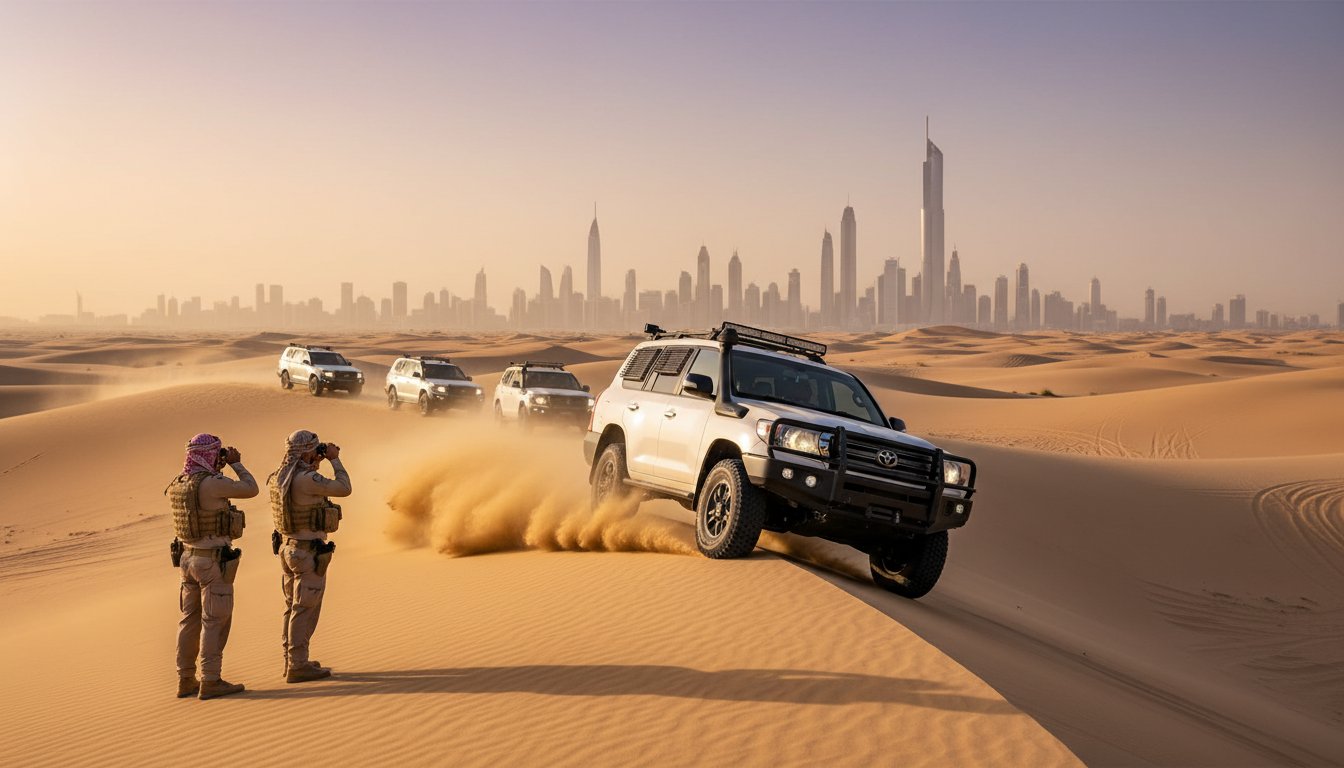
Border security in the Arabian Peninsula is a relentless engineering challenge. While agencies like the U.S. Border Patrol operate across various international climates, UAE fleets face a singular, hostile environment where temperatures regularly exceed 50°C. Standard SUVs are not built for this level of thermal stress or the abrasive nature of the Rub' al Khali. Successful border patrol vehicle modifications must solve these environmental problems first to ensure the vehicle actually reaches its destination in the field.
Patrol routes in the Emirates are notoriously diverse. A single mission might involve navigating the soft, shifting dunes of the Liwa Oasis before transitioning to the sharp volcanic rock found in the wadis of Fujairah. This topographic variety demands a suspension that provides both sand floatation and high impact durability. Without specific underbody armor and optimized approach angles, a vehicle can be immobilized by a single rock strike in a remote border zone. Since the 2017 cabinet decision regarding vehicle standards, all high-spec builds must be performed at authorized workshops to remain compliant and mission ready.
To see how tactical vehicles are inspected and utilized in active duty, watch this helpful video:
Thermal Management for the Empty Quarter
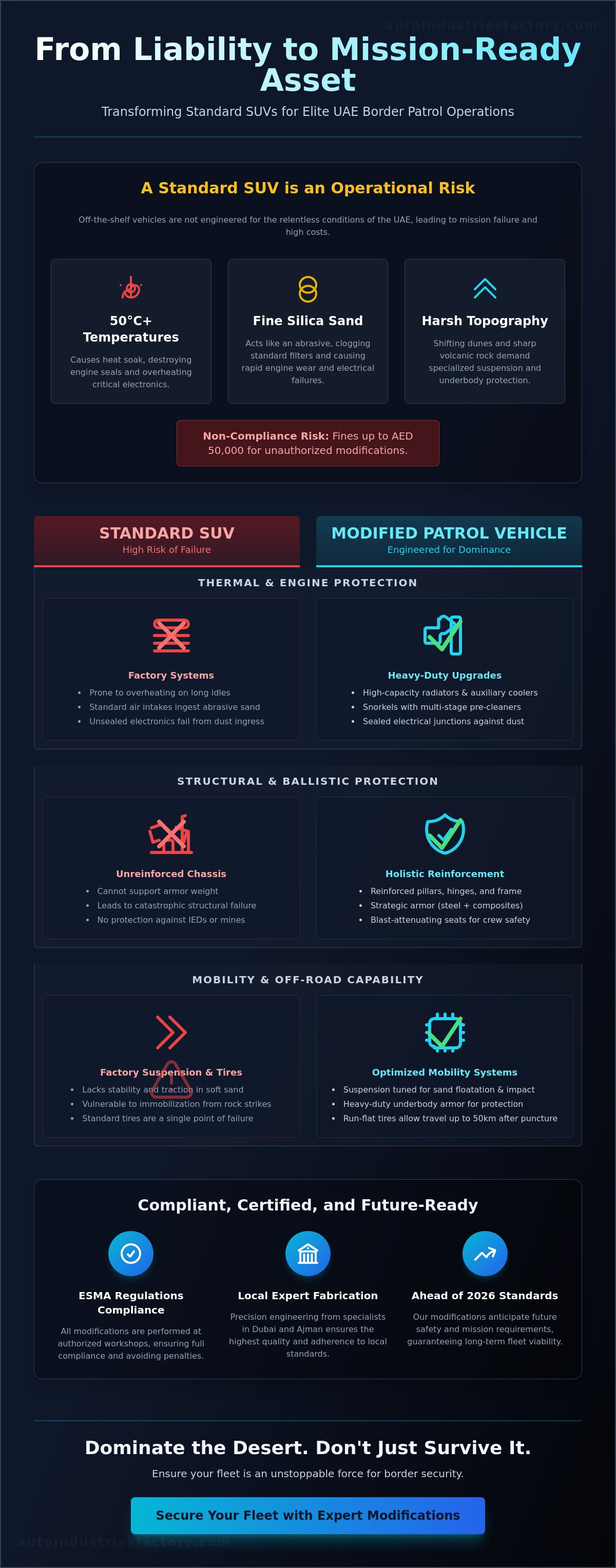
Standard cooling systems usually fail during stationary surveillance missions. When a patrol unit sits idling for hours in direct sunlight, heat soak destroys transmission seals and degrades sensitive surveillance electronics. We replace factory radiators with high capacity aluminum units and integrate auxiliary oil coolers to maintain stable operating temperatures. Specialized HVAC modifications are also implemented to keep the crew alert. Maintaining a focused cabin temperature is a mission requirement for effectiveness during long endurance shifts in the desert heat.
Sand Mitigation and Engine Protection
Fine silica sand acts as an abrasive that can ruin an engine in a single shift. Standard air intakes are insufficient for the UAE's dust density, especially during seasonal storms. We install heavy duty snorkels paired with multi stage centrifugal pre cleaners that remove the majority of particulates before they reach the air box. Beyond the engine, we seal all critical electrical junctions against dust ingress. This prevents the micro abrasions that lead to electrical failure in remote sectors. Each step in the process of border patrol vehicle modifications ensures that a fleet remains a functional asset rather than a recovery project.
Essential Structural and Ballistic Modifications
Standard production vehicles like the Toyota Land Cruiser 300 or Nissan Patrol Y62 are engineering marvels, but they weren't designed to carry two tons of ballistic steel. Effective border patrol vehicle modifications begin with the skeleton of the vehicle. Adding armor without reinforcing the pillars and hinges leads to catastrophic structural failure within months of field use. High intensity operations require a holistic approach where every weld and bolt is accounted for. This level of technical precision supports the broader goals of UAE border security collaboration, ensuring that local fleets can operate alongside international defense standards.
We focus on maintaining the vehicle's center of gravity to prevent rollovers during high speed maneuvers on uneven terrain. Strategic armor placement involves using lighter composite materials in non critical areas while reserving hardened ballistic steel for the passenger cell and engine bay. To protect personnel from underbody threats such as landmines or IEDs, we integrate blast attenuating seating. These seats use specialized energy absorbing mechanisms to decouple the occupant from the vehicle floor, significantly reducing spinal injuries during a blast event. For mission continuity, run flat tire systems are mandatory, allowing the vehicle to travel up to 50 kilometers at 80 km/h even after total pressure loss.
Ballistic Protection Levels (BR6 vs. BR7)
Understanding the threat profile is vital for fleet efficiency. BR6 protection stops 7.62mm assault rifle rounds, which is the standard for most border security applications in the region. However, certain high risk zones may require BR7, which protects against armor piercing rounds. This upgrade comes with a significant weight penalty, often adding 15 percent more mass than a BR6 build. This extra weight directly impacts fuel range and top speed. You can find a deep dive into these technical standards in our car armouring guide.
Chassis and Frame Reinforcement
The original chassis must be strengthened to handle the increased Gross Vehicle Weight (GVW). We use precision welding techniques at high stress points, such as the shock towers and engine mounts, to prevent frame cracking. Axle ratings are often upgraded to heavy duty specifications to ensure the drivetrain doesn't snap under the load of armor and roof mounted tactical gear. If your mission requires 360 degree surveillance turrets or weapon mounts, the roof structure must be entirely rebuilt with reinforced steel tubing to distribute the weight through the pillars to the frame. For organizations planning a fleet upgrade, reviewing our specialized conversion services provides a clear roadmap for these complex engineering requirements.
Optimizing Mobility for Desert and Off-Road Environments
Desert mobility for a tactical fleet is about more than just four-wheel drive. When you add 1,500kg of armor, the original vehicle's center of gravity shifts and its factory suspension bottoms out. Effective border patrol vehicle modifications must recalibrate the entire drivetrain to handle this permanent payload. In the soft dunes of the Empty Quarter, a heavy vehicle that can't stay on top of the sand becomes an easy target. We focus on flotation and heat dissipation to keep units moving when standard vehicles fail.
Tire choice is a critical engineering decision for UAE operations. We move away from standard road-biased rubber toward specialized off-road tires with reinforced sidewalls. These allow operators to drop tire pressures significantly to increase the footprint on soft sand without risking a bead failure. Coupled with heavy-duty winches rated for at least 12,000 lbs and reinforced recovery points welded directly to the chassis, these units are equipped for self-rescue in the most remote border sectors. These mechanical upgrades ensure that the vehicle remains an asset rather than a liability during pursuit or extraction.
Suspension Tuning for Heavy-Duty Use
Standard SUV suspension systems are designed for passenger comfort, not mission-critical tactical payloads. We replace factory components with nitrogen-charged shock absorbers. Nitrogen shocks are superior in the UAE because they resist "shock fade" during high-speed desert crossings where internal oil temperatures can skyrocket. We also install heavy-duty leaf springs and coil upgrades to maintain a specific ride height. This ensures the vehicle has enough clearance to avoid high-centering on dunes while keeping the center of gravity low enough for high-speed stability on paved roads.
Auxiliary Power and Electrical Systems
Modern border security relies on power-hungry technology. High-output alternators, often rated at 250 amps or more, are essential to support the increased electrical load from radios, night vision systems, and signal jammers. We integrate dual-battery setups with smart isolators. This allows the crew to run surveillance gear with the engine off without draining the primary starter battery. For long-term remote monitoring, we often mount low-profile solar panels on custom rear canopies. This provides a sustainable trickle charge, ensuring that these specialized border patrol vehicle modifications deliver maximum uptime in the field. If you need a fleet that remains operational in the most demanding conditions, explore our comprehensive conversion solutions.
Specialized Fabrication: Bull Bars, Canopies, and Accessories
Once the chassis is reinforced and the suspension is tuned, the focus of border patrol vehicle modifications shifts to mission-specific hardware. Standard plastic bumpers and open cargo beds are useless in active security sectors. We replace these with custom-fabricated steel and aluminum components designed to withstand high-impact animal strikes and provide secure housing for sensitive tactical gear. Every piece of hardware we produce in our Ajman and Dubai facilities is engineered to serve a dual purpose: protecting the vehicle and increasing its operational utility.
Durability in the desert depends on the quality of the finish. Fine sand and occasional coastal humidity in the UAE can lead to rapid oxidation on raw metal. Auto Industries Factory (AIF) specializes in applying heavy-duty powder-coated finishes to all fabricated parts. This isn't just for aesthetics; a premium powder-coat provides a rugged, corrosion-resistant barrier that survives years of abrasive sandblast-like conditions during patrol. We use precision manufacturing techniques, including CNC laser cutting and press brake forming, to ensure every accessory fits the vehicle's geometry without compromising factory sensor arrays or cooling airflow.
Tactical Bull Bars and Bumpers
Auto Industries Factory (AIF) specializes in designing and fabricating high-quality bull bars for the Toyota Land Cruiser 300 and 70-series. We use CNC laser cutting to achieve a precision fit that matches the vehicle's lines perfectly. These aren't just decorative; they feature integrated winch mounts and reinforced recovery points capable of handling the vehicle's full Gross Vehicle Weight (GVW). If you want to understand the technical details of our welding and material selection, check out our guide on custom bull bars and bumpers. These bumpers also serve as stable mounting platforms for high-intensity LED light bars and infrared illuminators required for night-time border surveillance.
Secure Storage and Canopies
For vehicles like the Nissan Hilux or the Land Cruiser 79-series pickup, an open bed is a security risk. We fabricate custom aluminum canopies that transform these trucks into secure troop transports or mobile command centers. Inside, we build modular racking systems for weapons, medical kits, and communication arrays. To address the sand infiltration issues mentioned in previous sections, every compartment features automotive-grade weather sealing. This keeps fine silica dust away from expensive night vision and radio equipment. If your fleet needs specialized storage solutions, you can request a custom fabrication quote for your specific vehicle models. Our roof rack systems are similarly over-engineered, featuring reinforced mounting points to support heavy communication satellite dishes and multiple spare tires for long-range endurance missions.
Custom Conversion Solutions at Auto Industries Factory LLC
Auto Industries Factory (AIF) specializes in providing end-to-end engineering for mission-critical fleets across the Middle East. While some international firms only offer pre-built proprietary vehicles, we focus on the complex task of executing border patrol vehicle modifications on your existing fleet of Toyota, Nissan, or Ford platforms. This approach allows security agencies to maintain their established maintenance cycles while benefiting from world-class tactical upgrades. Our facility in Ajman, UAE, utilizes advanced CNC laser cutting and press brake technology to ensure every structural reinforcement and accessory meets a flawless standard of precision.
We understand that a uniform appearance is as vital as mechanical reliability for national security units. Our comprehensive painting and finishing department provides fleet-wide consistency using premium, heat-reflective coatings. These specialized finishes don't just look professional; they help manage the thermal load on the vehicle's bodywork during long hours of desert exposure. Every build we undertake adheres to both regional ESMA regulations and international ballistic standards, ensuring your fleet is legally compliant and operationally superior.
The AIF Modification Process
Our engineering journey begins with an intensive consultation to define the specific threat profile and operational environment of your mission. We then move to 3D CAD modeling and prototyping, where our engineers visualize every aspect of the border patrol vehicle modifications before a single piece of steel is cut. This stage allows us to optimize weight distribution and component placement for maximum efficiency. Before any unit is deployed, we conduct rigorous testing on all electrical and mechanical systems to ensure they survive the vibration and heat stress of the UAE desert. You can learn more about our services and how we handle specialized tactical conversions for diverse vehicle types.
Serving the UAE and GCC Region
Proximity is a major advantage for our clients. Being based in Ajman, UAE, allows us to provide immediate local support and maintenance for agencies operating in Sharjah, Abu Dhabi, and Ras Al Khaimah. We don't just deliver a vehicle and disappear; we act as a long-term technical partner for your fleet. Beyond our local borders, we maintain robust export capabilities, delivering converted tactical units to security forces across the entire GCC region. Our team manages the logistics and compliance requirements for international transit, ensuring your upgraded fleet arrives ready for immediate duty. To begin your fleet transformation, contact Auto Industries Factory for a custom assessment and technical consultation. Our engineers are ready to solve your most complex vehicle modification challenges.
Future-Proof Your Tactical Fleet Today
Securing the UAE's diverse borders requires more than just standard equipment. It demands a fleet engineered to survive the 50°C heat of the Empty Quarter while providing flawless protection. From nitrogen-charged suspension systems that conquer soft dunes to BR7 ballistic steel integration, every technical decision impacts mission success. You've seen how specialized border patrol vehicle modifications transform standard Toyota and Nissan platforms into rugged, mission-ready assets. By prioritizing local fabrication and precision engineering, you ensure your units remain operational when standard vehicles fail.
Auto Industries Factory (AIF) remains the trusted partner for regional law enforcement and military units. Our expert fabrication team in Ajman, UAE, specializes in tactical conversions that meet both ESMA regulations and international ballistic standards. We don't just build vehicles; we provide durable, heavy-duty solutions tailored to the specific topography of the GCC. Don't leave your crew's safety to chance in the desert. Request a Custom Quote for Your Border Patrol Fleet and partner with the region's leading automotive engineers. Your mission deserves the highest level of protection and reliability.
Frequently Asked Questions
What are the most common vehicles used for border patrol in the UAE?
The Toyota Land Cruiser 300 series, Nissan Patrol Y62, and Toyota Hilux are the primary choices for regional fleets. These models represent over 75 percent of tactical vehicles in the GCC because their parts are widely available. Their factory chassis designs also provide the necessary structural integrity to support heavy armor and desert-specific cooling upgrades required for long endurance missions.
Can standard 4x4 vehicles like the Nissan Patrol be armored for border duty?
Yes, the Nissan Patrol Y62 is one of the most frequently armored platforms for high-stakes border security. Its powerful V8 engine and robust frame allow it to carry the 1,500kg to 2,000kg weight of ballistic steel and glass. When we perform these border patrol vehicle modifications, we focus on maintaining the vehicle's agility while ensuring the passenger cell remains a hardened environment.
How do modifications affect the vehicle's warranty and maintenance?
Extensive tactical modifications typically void the original manufacturer's warranty, which is why we provide a specialized maintenance roadmap. Heavily armored units require 50 percent more frequent inspections of the braking and suspension systems compared to standard vehicles. This ensures the permanent ballistic payload doesn't lead to premature component failure during critical field operations in remote border sectors.
What is the difference between a police car conversion and a border patrol modification?
Police conversions focus on urban lighting, sirens, and prisoner transport, while border patrol vehicle modifications prioritize environmental survival and ballistic protection. Border units require advanced thermal management for 50°C heat and multi stage air filtration for fine silica sand. These environmental reinforcements are rarely necessary for city police cruisers that operate primarily on paved roads within urban cooling zones.
How much weight does ballistic armoring add to a border patrol vehicle?
Ballistic armoring adds between 1,200kg and 2,500kg to the vehicle's total mass depending on the protection level. A standard BR6 build for an SUV typically adds 1,500kg of weight. This significant increase in mass is why we always upgrade the axle ratings and install nitrogen charged shock absorbers to prevent the vehicle from bottoming out on uneven desert terrain.
Are there specific UAE regulations for modified security vehicles?
All modified security vehicles must comply with the 2017 cabinet decision and receive approval from the Emirates Authority for Standardisation & Metrology (ESMA). Unauthorized modifications can result in fines ranging from AED 1,000 to AED 50,000. Working with an authorized workshop like AIF ensures your fleet meets these national safety standards while remaining fully compliant with UAE road laws.
How does extreme heat affect the electronics in a converted patrol vehicle?
Extreme heat exceeding 50°C causes standard electronics to suffer from thermal throttling or permanent hardware failure. We use military grade components and auxiliary cooling loops to protect sensitive surveillance and communication gear. This specialized engineering prevents system crashes during stationary surveillance missions where heat soak is most aggressive, ensuring your crew never loses their tactical advantage in the field.
What kind of surveillance technology can be integrated into the vehicle during conversion?
We integrate long range thermal imaging, 360 degree PTZ cameras, and signal jammers directly into the vehicle's tactical architecture. These systems are supported by the high output alternators and dual battery setups mentioned in our mobility guide. This integration allows for continuous remote monitoring and communication even when the engine is off, providing a sustainable surveillance solution for remote border outposts.


