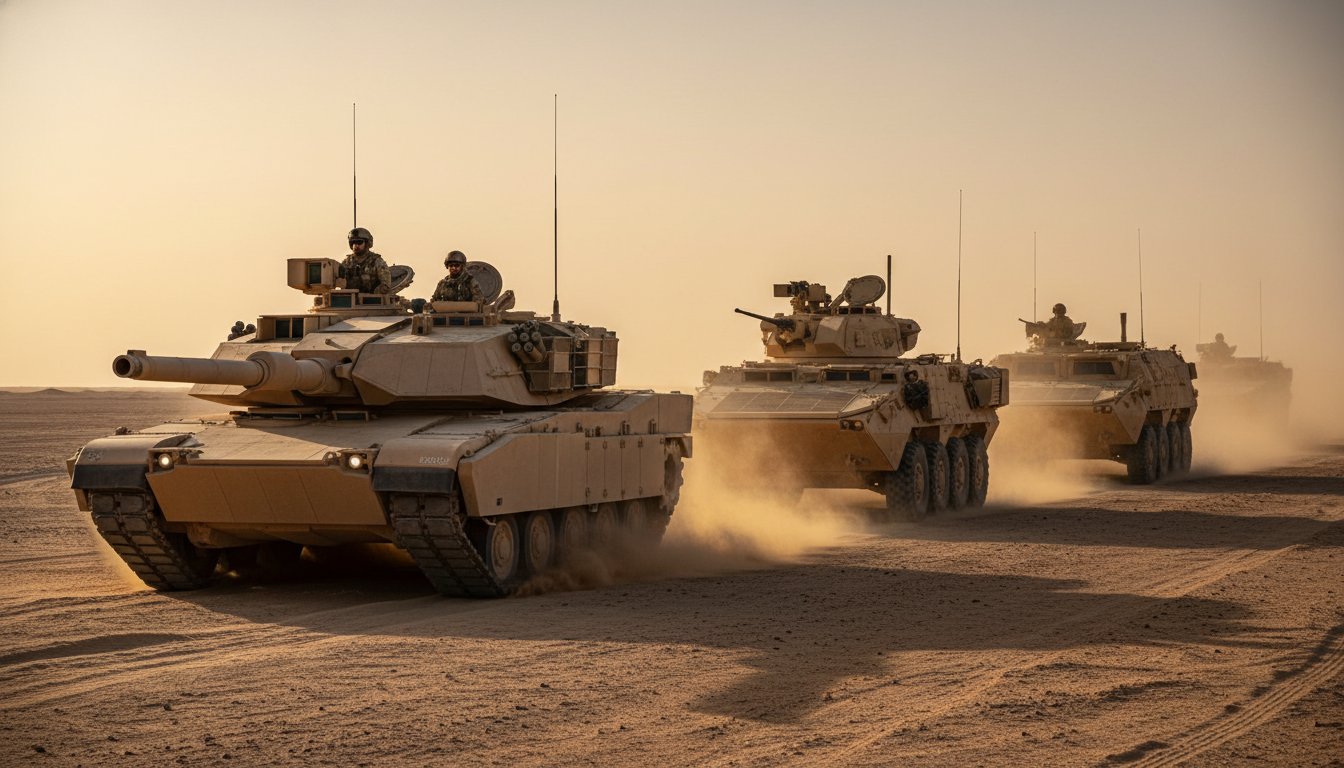
On the modern battlefield, distinguishing between an Infantry Fighting Vehicle (IFV) and an Armored Personnel Carrier (APC) can mean the difference between mission success and failure. The sheer variety of armored platforms, from rugged personnel carriers to formidable military armored tanks, presents a complex landscape of technical specifications, capabilities, and tactical roles. For procurement officers and operational commanders in Oman and across the region, cutting through the jargon of armoring standards and mobility metrics is a critical, high-stakes challenge.
This definitive guide is engineered to provide that clarity. We go beyond surface-level descriptions to deliver a comprehensive understanding of the entire spectrum of armored fighting vehicles. You will learn to identify different vehicle classes, evaluate the core components of firepower, protection, and mobility, and determine the precise asset required for a specific mission profile. We will also demystify the essential process of vehicle modification and upfitting, empowering you to specify and source tactical solutions built for mission reliability and peak performance.
Beyond the Main Battle Tank: A Guide to Modern Armored Fighting Vehicles (AFVs)
When people think of military armored tanks, the iconic Main Battle Tank (MBT) usually comes to mind-a heavily armed and armored titan designed to dominate the battlefield. However, the world of armored warfare is far more diverse. Modern military doctrine demands a range of specialized vehicles, each engineered for a specific mission profile. The general term Armoured fighting vehicle (AFV) encompasses a wide array of platforms, from troop transports to reconnaissance units, all built to balance firepower, mobility, and protection.
Understanding these differences is key to appreciating the complex, combined-arms approach of today's armed forces. Each vehicle type represents a purpose-built solution designed for mission success and crew survivability.
Main Battle Tanks (MBTs): The Spearhead of an Assault
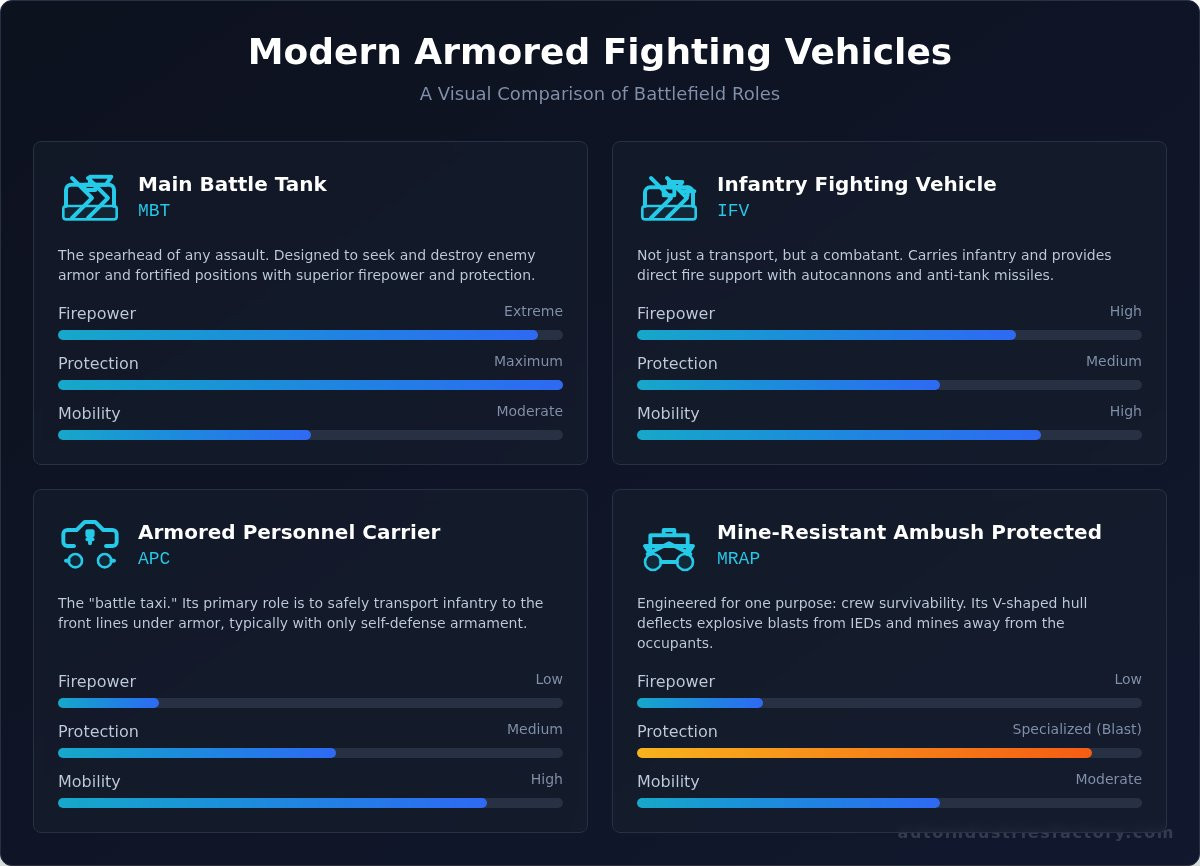
The MBT is the undisputed king of direct-fire ground combat. Engineered with advanced composite armor, a powerful main cannon (typically 105mm to 125mm), and a rugged tracked chassis, its primary role is to seek out and destroy enemy armor and fortified positions. Iconic examples like the American M1 Abrams and the German Leopard 2 define this class, combining lethal firepower with surprising agility to lead offensive operations.
Armored Personnel Carriers (APCs) & Infantry Fighting Vehicles (IFVs)
While often grouped, these two vehicles serve distinct roles. The APC is essentially a "battle taxi," designed to transport infantry squads to the front lines under armor protection, typically armed with only a heavy machine gun for self-defense. In contrast, the IFV is engineered not only to carry troops but to fight alongside them, boasting heavier armament like an autocannon and anti-tank missiles to provide direct fire support.
Mine-Resistant Ambush Protected (MRAP) Vehicles
Developed in response to the threats of asymmetric warfare, the MRAP's design is focused entirely on crew survivability against improvised explosive devices (IEDs) and ambushes. Its most recognizable feature is a V-shaped hull, which deflects the blast from an explosion away from the crew compartment. These rugged vehicles are essential for convoy protection, route clearance, and patrols in high-threat environments.
Light Armored Vehicles (LAVs) and Reconnaissance
In reconnaissance and rapid-response roles, speed and stealth are more critical than heavy armor. LAVs prioritize mobility, often using a wheeled design for superior on-road speed and lower maintenance requirements. Their mission is to scout enemy positions, screen the main force's flanks, and act as a fast-moving strike force, equipped with weapons sufficient to engage light targets.
| Vehicle Type | Primary Role | Typical Armament | Key Feature |
|---|---|---|---|
| MBT | Anti-Tank / Direct Assault | Large Caliber Main Cannon | Heavy Armor |
| IFV | Transport & Fight with Infantry | Autocannon, Missiles | Fire Support Capability |
| APC | Transport Infantry | Heavy Machine Gun | High Troop Capacity |
| MRAP | Survive IEDs & Ambushes | Machine Gun / Grenade Launcher | V-Shaped Hull |
The Anatomy of a Fighting Vehicle: Protection, Mobility, and Firepower
Every armored fighting vehicle (AFV) is engineered around a critical balance of three core principles known as the 'Iron Triangle': Protection, Mobility, and Firepower. Mastering the fabrication of military armored tanks and support vehicles requires a deep understanding of the constant trade-offs between these elements. It is impossible to maximize all three simultaneously; a heavily armored tank sacrifices speed, while a fast reconnaissance vehicle compromises on protection. The vehicle's intended mission, whether it's a Main Battle Tank like the Challenger 2 used by the Royal Army of Oman or a nimble patrol vehicle, dictates this crucial balance.
Protection: The Science of Vehicle Armor
Vehicle survivability begins with its armor. Modern systems go far beyond simple rolled homogenous steel, incorporating advanced materials and designs. Key types include:
- Composite Armor: Layers of ceramics, plastics, and metal alloys designed to shatter and absorb the energy of incoming projectiles.
- Explosive Reactive Armor (ERA): Blocks of explosives that detonate outward to disrupt and defeat shaped-charge warheads.
- Blast Protection: Specialized V-shaped hulls that deflect the force of mines and IEDs away from the crew compartment, a critical feature for operations in asymmetric environments.
Protection levels are standardized, such as by NATO's STANAG 4569, which defines a vehicle's resistance to specific threats, ensuring it meets mission requirements.
Mobility: Tracks vs. Wheels and Powertrain Engineering
An AFV's ability to move effectively across the battlefield is governed by its mobility systems. The choice between tracks and wheels is fundamental: tracked systems offer superior off-road performance and weight distribution for heavy vehicles, while wheeled platforms provide greater speed on roads and a reduced logistical footprint. At the heart of mobility is the powertrain-the engine and transmission. Its output dictates the vehicle's power-to-weight ratio, directly impacting acceleration, speed, and tactical agility. Every kilogram of armor or armament adds weight, creating a direct trade-off with operational range and strategic deployability.
Firepower: From Cannons to Advanced Weapon Stations
Firepower is the vehicle's ability to engage and defeat the enemy. This ranges from the heavy 120mm smoothbore cannons on main battle tanks to the rapid-fire autocannons on infantry fighting vehicles and machine guns for close-in defense. Modernization is constant, with nations continually re-evaluating threats and capabilities, as seen in the latest Abrams tank modernization plans. A key innovation is the Remote Weapon Station (RWS), which allows the crew to operate weapons from the safety of the hull. For defeating heavily armored threats at a distance, many vehicles integrate advanced Anti-Tank Guided Missiles (ATGMs), providing immense destructive power in a compact package.
The Modern Battlefield: Matching the Vehicle to the Mission
Success in modern military operations depends not on a single, all-powerful vehicle, but on the strategic deployment of the right asset for the right task. A versatile and balanced fleet enables commanders to tailor their force precisely to the mission at hand, from high-intensity combat to complex stability operations. Understanding the unique role of each vehicle is critical for achieving tactical and strategic objectives.
High-Intensity Conflict: Combined Arms Operations
In conventional warfare, victory is achieved through the synchronized effort of combined arms. Heavy-duty military armored tanks (MBTs) act as the spearhead, using their immense firepower and robust protection to breach enemy defenses. They are supported by Infantry Fighting Vehicles (IFVs), which protect the tanks' flanks, engage lighter targets, and safely deliver infantry squads to secure ground. This potent combination is shielded by mobile air defense systems and supported by self-propelled artillery that provides devastating long-range fire.
Counter-Insurgency and Peacekeeping: Prioritizing Protection
The operational calculus changes dramatically in asymmetric environments where threats like Improvised Explosive Devices (IEDs) and ambushes are prevalent. Here, the Mine-Resistant Ambush Protected (MRAP) vehicle is essential. Its specialized V-shaped hull is engineered to deflect explosive forces, offering unparalleled protection for its crew. For urban patrols and transport in high-risk zones, heavily armored Armored Personnel Carriers (APCs) provide the necessary security, while some variants can be fitted with non-lethal systems for crowd management in peacekeeping scenarios.
Specialized Roles: MedEvac, EOD, and Command Vehicles
Beyond direct combat, the true versatility of a modern armored fleet is demonstrated by its support vehicles. A single, proven chassis can be expertly converted to perform a range of mission-critical functions, ensuring operational readiness and force preservation. Key examples include:
- Medical Evacuation (MedEvac): Armored ambulances designed to extract and provide immediate care to casualties under fire.
- Explosive Ordnance Disposal (EOD): Rugged platforms equipped with specialized tools and robotic arms to safely neutralize explosive hazards.
- Command & Control: Mobile headquarters with advanced communications and surveillance gear to manage battlefield operations effectively.
This ability to adapt a core platform for diverse roles is a key force multiplier. For nations seeking to enhance their operational capabilities, investing in customized vehicle conversion and fabrication provides a decisive advantage.
Vehicle Conversion & Upfitting: Creating Mission-Ready Solutions
In modern defense, standard-issue vehicles are often the starting block, not the finish line. The gap between a manufacturer's base model and the specific demands of a mission requires specialized engineering and fabrication. Converting and upfitting vehicles is a critical process that transforms capable platforms into precision tools, ensuring operational superiority and personnel safety in demanding environments like those found in Oman.
Why Base Models Are Just the Starting Point
An off-the-shelf armored personnel carrier or utility vehicle is designed for general use. However, true mission readiness demands customization. Operations may require the integration of advanced C4ISR (Command, Control, Communications, Computers, Intelligence, Surveillance, and Reconnaissance) systems, specialized weapons mounts, or electronic warfare suites that are not standard. Furthermore, adapting vehicles for unique environmental challenges-such as installing heavy-duty cooling systems and advanced air filtration for peak performance in extreme desert heat-is non-negotiable for mission success.
The Conversion Process: From Design to Deployment
Transforming a standard chassis into a mission-specific asset is a meticulous, engineering-led process. While the specific modifications vary, the methodology for creating rugged, reliable solutions follows a proven path that ensures durability and performance when it matters most.
- Step 1: Needs Assessment & Engineering Consultation: Every project begins with a deep dive into operational requirements, threat levels, and environmental conditions to create a detailed engineering blueprint.
- Step 2: Chassis Reinforcement & Fabrication: The vehicle's frame and body are modified, reinforced, or rebuilt to handle increased weight from armor, integrated systems, and harsh terrain.
- Step 3: Advanced Systems Integration: This crucial phase involves flawlessly integrating all electrical, communications, life support, and tactical systems into a cohesive, user-friendly platform.
- Step 4: Quality Control & Testing: Rigorous testing and certification validate the vehicle's performance, durability, and adherence to strict military standards before deployment.
Finding the Right Fabrication Partner
Choosing a conversion specialist is as critical as selecting the base vehicle itself. The ideal partner possesses in-house engineering and fabrication capabilities, ensuring total control over quality from initial design to final delivery. Look for a proven track record working with military and security clients in the region, demonstrating an understanding of local operational needs. While new military armored tanks serve a vital purpose, expertly converted vehicles provide the flexible and specialized support that modern forces depend on. A partner with a history of delivering durable, mission-proven solutions is an invaluable asset. See how we engineer and fabricate tactical vehicle solutions.
Your Strategic Partner for Mission-Ready Armored Solutions
As this guide has detailed, the landscape of modern warfare demands highly specialized armored fighting vehicles. True operational dominance is achieved not just by raw power, but by expertly balancing the core tenets of protection, mobility, and firepower for specific mission profiles. Understanding the diverse capabilities beyond traditional military armored tanks is the first step; converting that knowledge into a decisive tactical advantage through custom modification is what truly ensures success on the ground.
This is where precision engineering meets battlefield reality. At Auto Industries Factory, we deliver that advantage. Trusted by government and security clients across the UAE, our comprehensive, in-house capabilities-from initial design and fabrication to complete systems integration-are proven in the world's most demanding conditions. We specialize in converting and upfitting platforms to excel in harsh desert environments, guaranteeing your assets are always mission-ready and built to last.
Don't just acquire vehicles; deploy purpose-built solutions. Discuss Your Military Vehicle Modification Needs with Our Experts and let our team engineer a fleet that provides an undeniable strategic edge.
Frequently Asked Questions
What is the main difference between a tank and an Armored Personnel Carrier (APC)?
The primary difference lies in their designated combat roles. A Main Battle Tank (MBT) is an offensive, direct-fire platform designed to engage and destroy enemy armor with its large-caliber main gun. An Armored Personnel Carrier (APC), conversely, is engineered primarily to transport infantry safely to the front lines. While armed for self-defense, an APC's weaponry is significantly lighter than a tank's, and its armor is designed to protect against small arms and shrapnel, not anti-tank weapons.
Can a standard commercial truck be converted into a military armored vehicle?
Yes, a standard commercial truck can be converted through a process known as "up-armoring." This involves reinforcing the chassis and suspension to handle the immense weight of added ballistic steel and composite armor panels. While this provides crucial protection for personnel transport in lower-threat environments, these conversions do not match the integrated survivability, mobility, and combat effectiveness of a purpose-built military fighting vehicle designed from the ground up for battlefield conditions.
What are the most common materials used for vehicle armor today?
Modern vehicle armor employs a sophisticated, multi-layered approach. The foundation is often high-hardness rolled homogeneous steel armor (RHA). This is layered with advanced materials like ceramic plates (e.g., alumina or silicon carbide) to shatter incoming projectiles, and composite backings made from materials like Kevlar or Dyneema to catch fragments. For high-threat environments, Explosive Reactive Armor (ERA) is added to defeat shaped-charge warheads by detonating outwards upon impact.
How much does a military armored vehicle cost?
The cost varies dramatically based on the vehicle's type, capability, and level of technology. In the international defense market, an up-armored commercial vehicle suitable for security operations in Oman might range from $200,000 to over $500,000. A new, advanced Infantry Fighting Vehicle (IFV) can cost between $3 million and $5 million, while a state-of-the-art Main Battle Tank can easily exceed $10 million per unit, reflecting its complex systems and heavy-duty protection.
What does 'STANAG' mean in relation to vehicle armor?
STANAG is an acronym for Standardization Agreement, established by NATO to ensure interoperability among member forces. In the context of vehicle armor, STANAG 4569 provides a universal classification system for protection levels. It rates a vehicle's ability to withstand specific threats, including ballistic rounds, artillery shell fragments, and mine blasts. This allows procurers, such as those in Oman, to clearly specify and verify the required survivability for their operational needs.
How are modern armored vehicles protected against anti-tank missiles?
Modern military armored tanks and vehicles use a layered defense strategy. Passive defenses include advanced composite armor and Explosive Reactive Armor (ERA) to disrupt incoming warheads. The most advanced solution is an Active Protection System (APS), such as Israel's Trophy system. An APS uses radar to detect an incoming missile or rocket and then launches a countermeasure to intercept and destroy it before it can strike the vehicle, providing a crucial shield against advanced threats.


