In high-threat environments across Oman and the wider region, the risk of IEDs and ambushes is a critical operational reality. The safety of your personnel is paramount, and the vehicle they depend on can be the decisive factor between mission success and catastrophic failure. But what truly separates a standard armored truck from a genuine mine resistant vehicle? The answer lies in advanced engineering, specific design principles, and precision fabrication-details that are often misunderstood yet are absolutely vital for survival.
This comprehensive guide delivers the clarity you need. We break down the core components of blast protection, from V-shaped hull designs to advanced material science. You will gain the expertise to identify the features that save lives, evaluate the critical differences between protection levels, and make confident decisions about procuring new assets versus up-armoring your existing fleet. This is the essential knowledge required to secure your personnel and select a fabrication partner with proven engineering excellence.
What is a Mine Resistant Vehicle? Defining the Modern Battlefield Workhorse
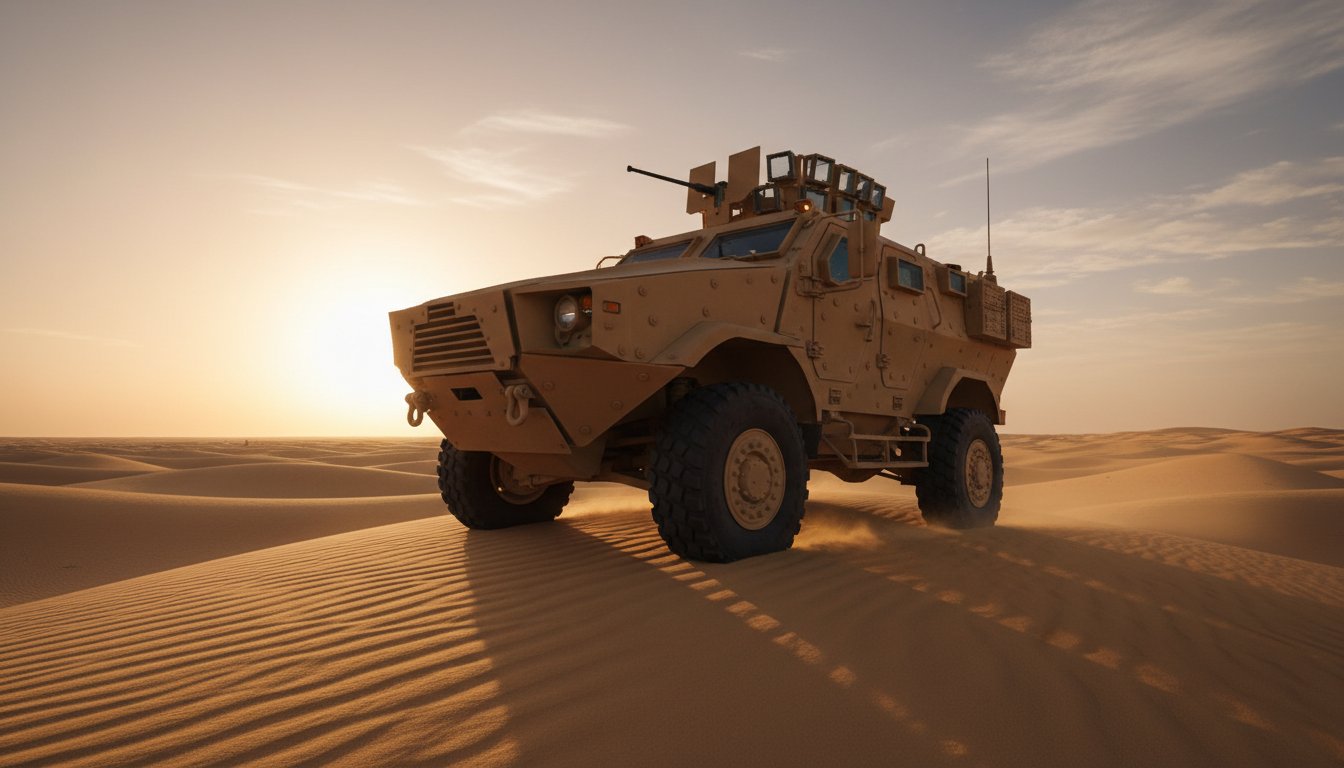
A mine resistant vehicle is not merely an armored truck; it is a purpose-built platform fundamentally engineered for one primary mission: crew survivability. The most common term for these vehicles is MRAP, an acronym for Mine-Resistant Ambush Protected (MRAP) vehicles. Their core design philosophy centers on protecting personnel from the asymmetric threats that define modern conflict, specifically underbelly blasts from landmines and Improvised Explosive Devices (IEDs).
Unlike traditional armored platforms, an MRAP prioritizes protection over offensive firepower or mobility in the same way as a main battle tank. While a tank is designed for direct-fire engagements and an Armored Personnel Carrier (APC) is built to transport troops under conventional fire, the MRAP is a mobile fortress designed to withstand and deflect catastrophic explosive forces from below. This specialized focus results in a unique design, most notably a V-shaped hull, which channels a blast's energy away from the crew compartment.
The Primary Threats: IEDs and Landmines
Improvised Explosive Devices (IEDs) and landmines represent the most significant threats that MRAPs are designed to counter. An IED's destructive power is channeled upward upon detonation, attacking the weakest point of a conventional vehicle-its flat underbelly. This focused blast can tear through standard armor plating, instantly compromising the crew cabin. Conventional armored vehicles, designed to defeat bullets and shrapnel, simply lack the specialized structural integrity to mitigate such a direct and powerful upward force.
Evolution from Armored Car to MRAP
While early concepts of mine-protected vehicles emerged in conflicts like the Rhodesian Bush War, the modern MRAP's development was accelerated by necessity during operations in Iraq and Afghanistan. The widespread and devastating use of IEDs against conventional transport vehicles created an urgent demand for a new class of patrol vehicle. This operational need drove the rapid design, fabrication, and deployment of MRAP fleets, fundamentally shifting military doctrine on troop transport in asymmetric warfare environments.
The Science of Survivability: Core Engineering & Design Principles
The effectiveness of a mine resistant vehicle is not measured in the thickness of its steel alone, but in the intelligence of its design. True survivability is a product of advanced physics and precision engineering, where every component works in concert to achieve three primary goals: deflect the initial blast, absorb the residual energy, and protect the occupants within a hardened crew capsule. It is a holistic system where geometry, materials, and interior ergonomics combine to defeat the threat.
The V-Shaped Hull: Deflecting the Blast
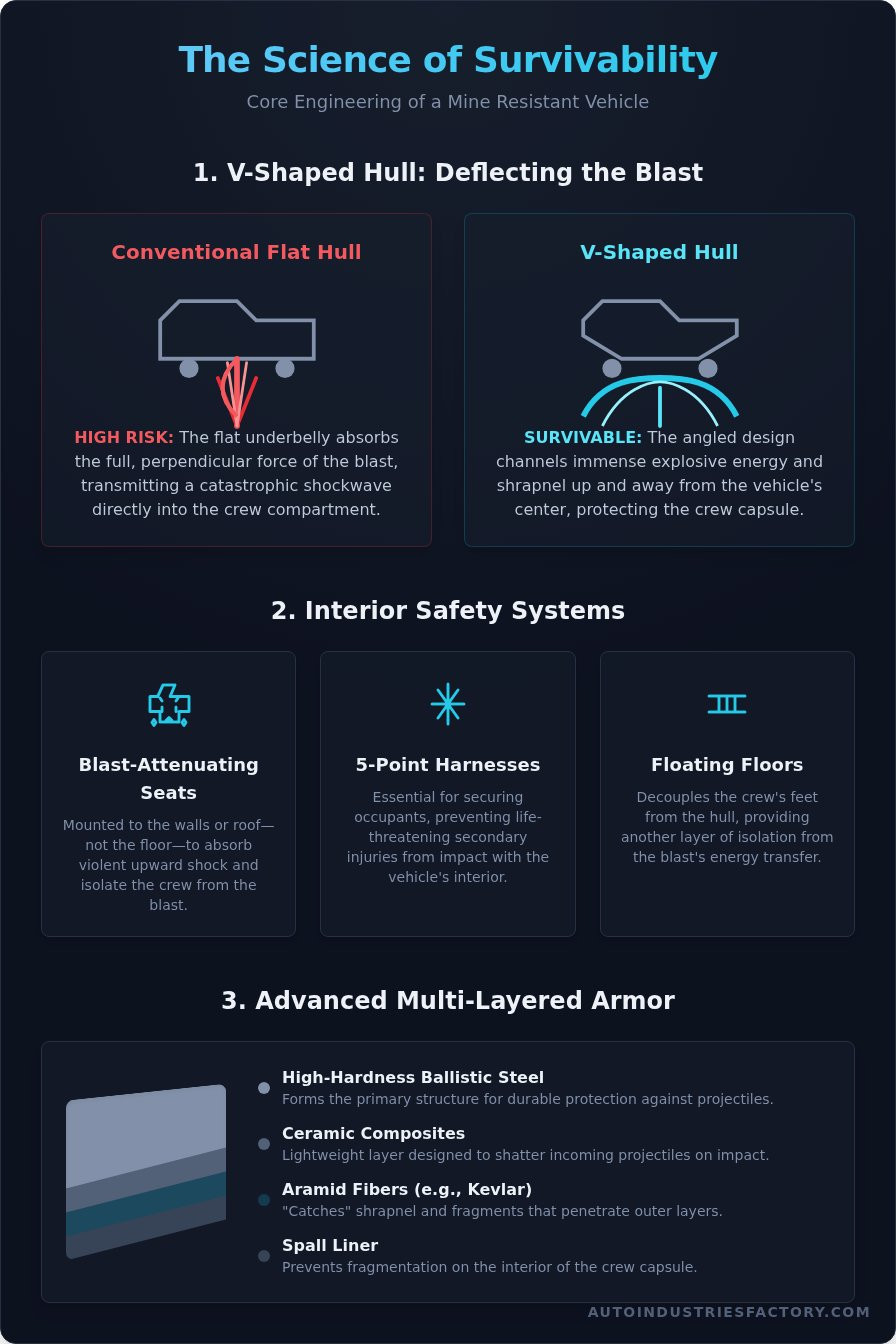
The cornerstone of modern blast protection is the V-shaped hull. This design is a direct application of physics, engineered to redirect the immense energy from an underbelly explosion. When a mine or IED detonates, the V-shape channels the force and shrapnel up and away from the vehicle's center, rather than absorbing it directly. The optimal angle of the "V" is critical; too shallow and it's ineffective, too steep and it compromises vehicle stability. This principle was validated extensively during the development of modern armored fleets, as detailed in this comprehensive MRAP Vehicle Case Study. In stark contrast, a traditional flat-bottom hull receives the full, perpendicular force of the blast, transmitting a catastrophic shockwave directly into the crew compartment.
Blast-Attenuating Seats and Crew Protection
Even with a V-hull deflecting the majority of the blast, the vehicle can be thrown upwards with extreme force. To counter this, a mine resistant vehicle relies on a specialized interior safety system. Key components include:
- Blast-Attenuating Seats: These are not bolted to the floor. Instead, they are typically mounted to the walls or roof, using advanced shock-absorbing mechanisms to cushion the crew from the violent vertical acceleration.
- 5-Point Harnesses: Essential for keeping occupants secured in their seats, preventing life-threatening secondary injuries that occur when bodies are thrown against the vehicle's interior.
- Floating Floors: An additional layer of protection that decouples the crew's feet and legs from the hull floor, further isolating them from the blast's energy transfer.
Advanced Materials: Ballistic Steel and Composites
The final layer of defense is the armor itself. Modern protective capsules utilize a multi-layered approach to defeat both blast and ballistic threats. High-hardness ballistic steel forms the primary structure, providing durable and cost-effective protection against projectiles and fragmentation. To enhance this protection without adding prohibitive weight, advanced composite armors are used. These can include layers of ceramics, which shatter incoming projectiles, and aramid fibers (like Kevlar), which "catch" shrapnel. For windows and viewports, transparent armor-a laminate of ballistic glass and polycarbonate-provides critical situational awareness while maintaining the integrity of the protective cell.
Purpose-Built vs. Up-Armored: Two Paths to Mine Resistance
In the world of protected mobility, not all vehicles are created equal. The fundamental difference lies in their origin: are they designed from a clean sheet of paper with survivability as the core principle, or are they existing platforms modified for a new, hazardous role? Understanding this distinction is critical for any organization, as the choice between a purpose-built and an up-armored mine resistant vehicle directly impacts cost, deployment speed, and mission suitability. The optimal path is always dictated by the operational requirements and logistical realities of the fleet.
Purpose-Built Platforms (e.g., Oshkosh M-ATV)
A purpose-built vehicle is engineered from the ground up for one primary mission: crew survival in hostile environments. Every component, from the V-shaped hull that deflects blast energy to the integrated electronics and fire suppression systems, is part of a holistic design. This approach delivers the highest levels of protection and performance.
- Pros: Optimized blast mitigation, fully integrated combat and communication systems, and superior off-road performance under heavy armor loads.
- Cons: Extremely high acquisition costs often running into millions of USD per unit, long procurement and manufacturing timelines, and a demanding logistical tail requiring specialized parts and technicians.
Up-Armoring Commercial Chassis (The AIF Method)
The alternative strategy involves modifying a proven, commercially available platform-such as the rugged Toyota Land Cruiser or a heavy-duty truck chassis. This method, known as up-armoring, involves reinforcing the frame, adding a custom-fabricated armored capsule for the crew, and upgrading key components like suspension and brakes to handle the additional weight. Auto Industries Factory specializes in this advanced engineering approach. Discover our vehicle conversion and fabrication expertise.
- Pros: A significantly more cost-effective solution, enabling faster fleet deployment. Maintenance is simplified by using Commercial Off-The-Shelf (COTS) parts, which are readily available in markets like Oman.
- Cons: Performance and protection levels are constrained by the original chassis's design limits, particularly regarding payload capacity and overall gross vehicle weight.
When is Up-Armoring the Right Choice?
While purpose-built platforms are essential for front-line combat, up-armoring provides a pragmatic and powerful solution for a wide range of missions. This approach is ideal for police, internal security, and special forces units that require enhanced protection without the profile or expense of a massive military vehicle. When budgets are a primary constraint or when a mission demands a lower-profile presence in urban or sensitive areas, a professionally up-armored commercial platform delivers a capable and efficient solution.
Beyond the Hull: Critical Systems for Mission Success
While a blast-deflecting V-hull and advanced armor are the foundation of crew protection, they are only part of the equation. A truly effective mine resistant vehicle depends on the seamless integration of critical subsystems that enhance survivability, mobility, and overall mission capability. These systems transform a protected steel box into a formidable operational asset, ensuring personnel can not only survive an attack but also maintain control and complete their objective.
Mobility and Drivetrain Enhancements
The immense weight of ballistic steel and composite armor places extreme stress on a vehicle's original chassis. To compensate, heavy-duty upgrades are non-negotiable. This includes reinforced suspension systems to manage the load and maintain performance over rugged terrain, along with high-capacity brake systems for safe deceleration. Crucially, run-flat tire systems allow the vehicle to escape an ambush zone even after suffering multiple tire punctures, providing a critical window for survival.
Fire Suppression and Life Support
Secondary threats following a blast, such as fire or environmental hazards, must be managed instantly. Key life support and safety systems include:
- Automatic Fire Suppression Systems (AFSS): Installed in the engine bay and crew compartment, these systems detect and extinguish fires in seconds, preventing catastrophic damage and protecting occupants.
- CBRN Systems: A Chemical, Biological, Radiological, and Nuclear air filtration system provides a sealed, safe environment for the crew against unconventional threats.
- Emergency Egress Points: Strategically placed and reinforced escape hatches are vital for rapid evacuation if the primary doors are blocked or damaged.
Communications and Situational Awareness
Maintaining command and control is paramount. A modern protected vehicle must be a hub of information and defensive capability. This is achieved by integrating secure communication suites, including encrypted radios and internal intercoms, to ensure constant contact. Furthermore, the vehicle must be equipped with mounting points for advanced sensors, 360-degree camera systems, and thermal imagers. These tools, combined with strategically placed gun ports and weapon stations, allow the crew to assess threats and respond effectively without leaving the vehicle's protective shell.
The expert integration of these advanced systems is what elevates a basic armored truck to a complete, mission-ready mine resistant vehicle. To learn more about custom fabrication and system integration, visit autoindustriesfactory.com.
Choosing a Partner for Mine Resistant Vehicle Fabrication
The successful conversion of a commercial chassis into a life-saving mine resistant vehicle is not a task for a standard workshop. The performance, safety, and operational reliability of the final product depend entirely on the fabricator's engineering depth and manufacturing discipline. Selecting a partner goes far beyond evaluating their welding and cutting capabilities; it requires a thorough assessment of their design prowess, quality control systems, and proven ability to deliver mission-critical assets.
When lives are on the line, there is no room for compromise. Asking the right questions before committing to a project ensures your investment results in a vehicle that performs exactly as designed under the most demanding conditions.
In-House Engineering and Design Capability
A premier fabricator operates as an engineering firm first. They must possess a dedicated team of engineers capable of using advanced software to model blast dynamics and ballistic performance. Look for demonstrated expertise in materials science and structural engineering, ensuring they can select and integrate the correct armour for the specified threat level. Verify their use of modern tools like CAD/CAM systems, CNC laser cutting, and precision press brakes, which are essential for flawless fitment and structural integrity.
Quality Control and Material Traceability
Rigorous quality control is non-negotiable. Your potential partner must provide clear documentation of their QC processes, from raw material inspection to final systems checks. Insist on using certified ballistic steel and composites from reputable, internationally recognized mills, and ask for material traceability reports. Furthermore, their welders must hold certifications to international standards (e.g., AWS), as improper welding techniques can critically compromise the armour's protective capabilities.
Proven Experience and Past Performance
Theoretical knowledge must be backed by real-world results. A credible partner will have a portfolio of successfully completed projects for military, law enforcement, or high-security clients, ideally within Oman or the GCC region. This track record is the ultimate proof of their ability to manage complex projects and deliver a reliable mine resistant vehicle that meets stringent operational requirements. A history of successful deployments demonstrates an understanding of the unique challenges and standards expected in this sector. See why organizations trust Auto Industries Factory for critical missions.
Secure Your Mission: Partner with Fabrication Experts
Understanding the core principles of a mine resistant vehicle, from the science of its V-shaped hull to the critical choice between purpose-built and up-armored designs, is essential for ensuring personnel safety and operational success. The ultimate effectiveness of these platforms, however, hinges not just on design theory but on the quality and precision of their construction. Choosing the right fabrication partner is a mission-critical decision.
At Auto Industries Factory, we transform advanced engineering concepts into tactical reality. Based in the UAE and serving the entire region, including Oman, we leverage proven experience with military and police vehicle conversions. Our state-of-the-art facility, equipped with in-house CNC laser cutting and precision fabrication technology, is ready to meet your most demanding protection requirements. Protect what matters most. Request a consultation for your custom vehicle protection needs. Let us build the durable, reliable solutions your team can depend on.
Frequently Asked Questions About Mine Resistant Vehicles
What does MRAP stand for and what is its primary purpose?
MRAP stands for Mine-Resistant Ambush Protected. Its primary purpose is to provide maximum survivability for personnel during transport through hostile areas. These vehicles are specifically engineered to withstand improvised explosive device (IED) attacks, mine blasts, and small arms fire. Unlike standard armored vehicles, every aspect of an MRAP's design is optimized to protect its occupants from the unique threats of asymmetrical warfare, ensuring troops can be moved safely in high-risk operational environments.
How exactly does a V-shaped hull protect a vehicle's occupants from a mine?
A V-shaped hull is a critical engineering feature that deflects the force of an explosion originating from below the vehicle. When a mine or IED detonates, the angled shape of the hull channels the blast wave and shrapnel up and away from the crew compartment, rather than absorbing the full impact. This advanced design significantly dissipates the explosive energy, drastically reducing the force transferred to the vehicle and its occupants, which is paramount for crew survivability.
What is the main difference between a mine-resistant vehicle and a main battle tank?
The core difference lies in their mission and design philosophy. A main battle tank (MBT) is an offensive platform, built for direct, heavy combat with thick armor and a powerful main cannon. In contrast, a mine resistant vehicle is a defensive transport platform. Its design prioritizes crew survivability against underbelly blasts and ambushes over offensive firepower. It uses specialized features like a V-hull and high ground clearance to protect personnel, not to engage in frontline battle.
Can a standard commercial truck like a Toyota Hilux be converted to be mine-resistant?
While a Toyota Hilux, a highly durable and popular vehicle in Oman, can be armored for ballistic protection against bullets, achieving true mine-resistance is a different challenge. A full conversion requires extensive re-engineering of the chassis to integrate a V-shaped hull, which is often impractical. Standard armoring enhances protection, but it does not replicate the specialized blast-deflecting capabilities inherent in a purpose-built mine-resistant vehicle's design. It's a matter of ballistic versus blast protection.
What are the most important factors to consider when choosing a vehicle armoring company?
When selecting a partner in Oman or the wider region, prioritize companies with proven experience and certifications, such as ISO 9001. Scrutinize their track record, particularly with government or security clients. Verify they use certified, high-grade materials for both ballistic steel and glass. A company with advanced in-house fabrication capabilities, from CNC cutting to precision welding, demonstrates a higher level of quality control and engineering expertise, ensuring a flawless and durable final product.
Are there international standards for testing mine-resistant vehicles?
Yes, the most widely recognized international standard is NATO’s STANAG 4569. This agreement provides a clear framework for the "Protection Levels for Occupants of Logistic and Light Armored Vehicles." It outlines specific testing methodologies and threat levels for kinetic energy (bullets), artillery fragments, and crucially, mine blast threats. Compliance with STANAG 4569 ensures a vehicle has been rigorously tested and provides a verified level of protection against a defined set of dangers.


