
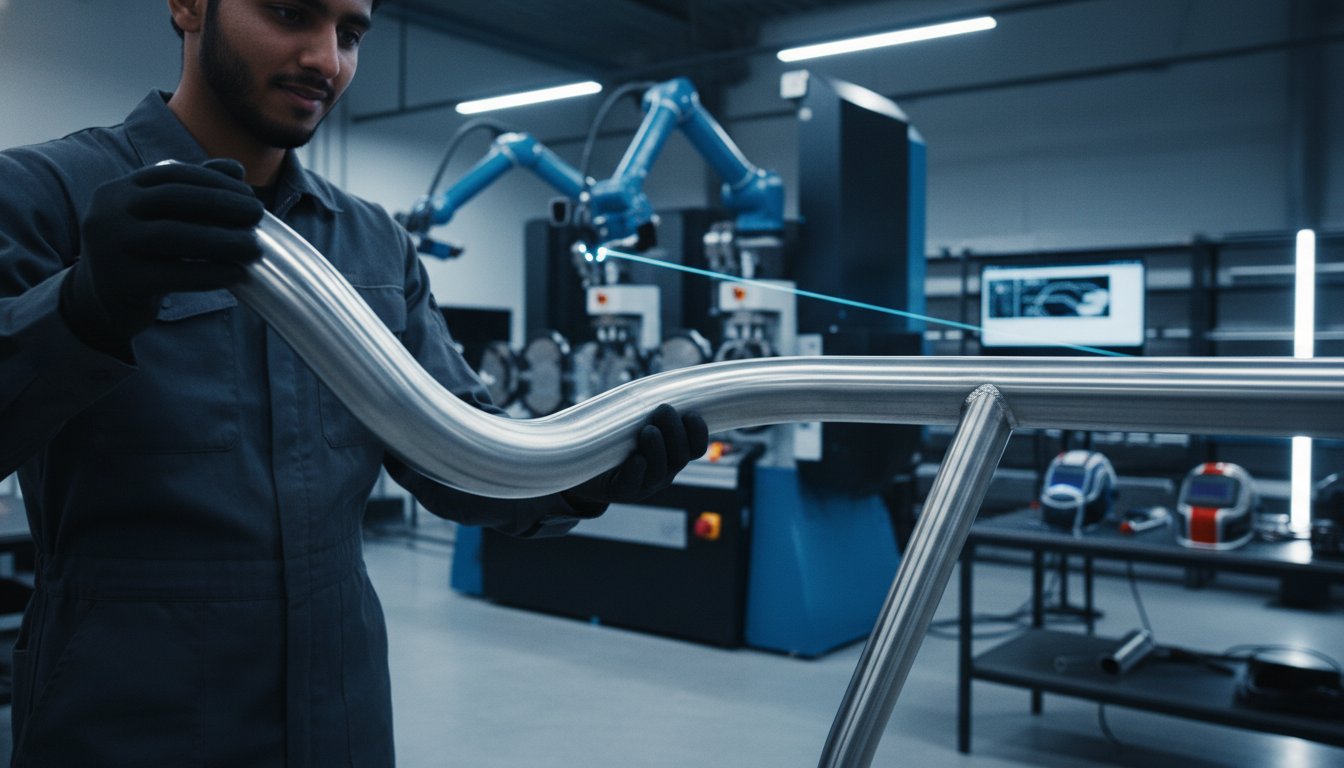
Choosing the wrong fabrication technique can lead to costly defects like wrinkling or flattening, compromising both the strength and appearance of your final component. This uncertainty often makes it difficult to specify project needs or find a reliable partner. From custom bull bars on a 4x4 exploring the Wahiba Sands to complex industrial frameworks, precision pipe bending is the foundational skill that separates amateur work from professional-grade results. It's a process where engineering meets artistry, and getting it right is non-negotiable for safety and performance.
This guide cuts through the complex jargon and provides a direct, no-nonsense look at the core principles of bending. You will learn to distinguish between major methods like mandrel and roll bending, understand the critical factors that ensure a flawless bend, and gain the confidence to define the exact specifications for your automotive or industrial project. Consider this your essential brief for achieving the durable, high-performance components your project demands, right here in Oman.
What is Pipe Bending? The Fundamentals of Precision Metal Forming
Pipe bending is a precision fabrication process that permanently forms a straight piece of pipe into a desired curve or angle. At its core, this metal forming technique utilizes mechanical force to push the material beyond its elastic limit, causing it to deform plastically without compromising its integrity. Unlike cutting and welding sections together, a properly executed bend creates a single, continuous component. This method is superior for applications requiring maximum structural strength and unimpeded flow, as it eliminates the weak points and internal turbulence often introduced by weld seams.
To see this advanced fabrication process in action, the following video provides an excellent demonstration:
The science behind a successful bend involves carefully managing two key principles: plastic deformation and springback. Plastic deformation is the permanent change in the pipe's shape. However, all materials have "memory" and will try to return to their original form-a phenomenon known as springback. Expert technicians must precisely over-bend the pipe to compensate for this effect, ensuring the final angle meets exact specifications.
Key Terminology in Pipe Bending
Understanding the language of PIPE BENDING is critical for achieving flawless results. Here are the core terms you need to know:
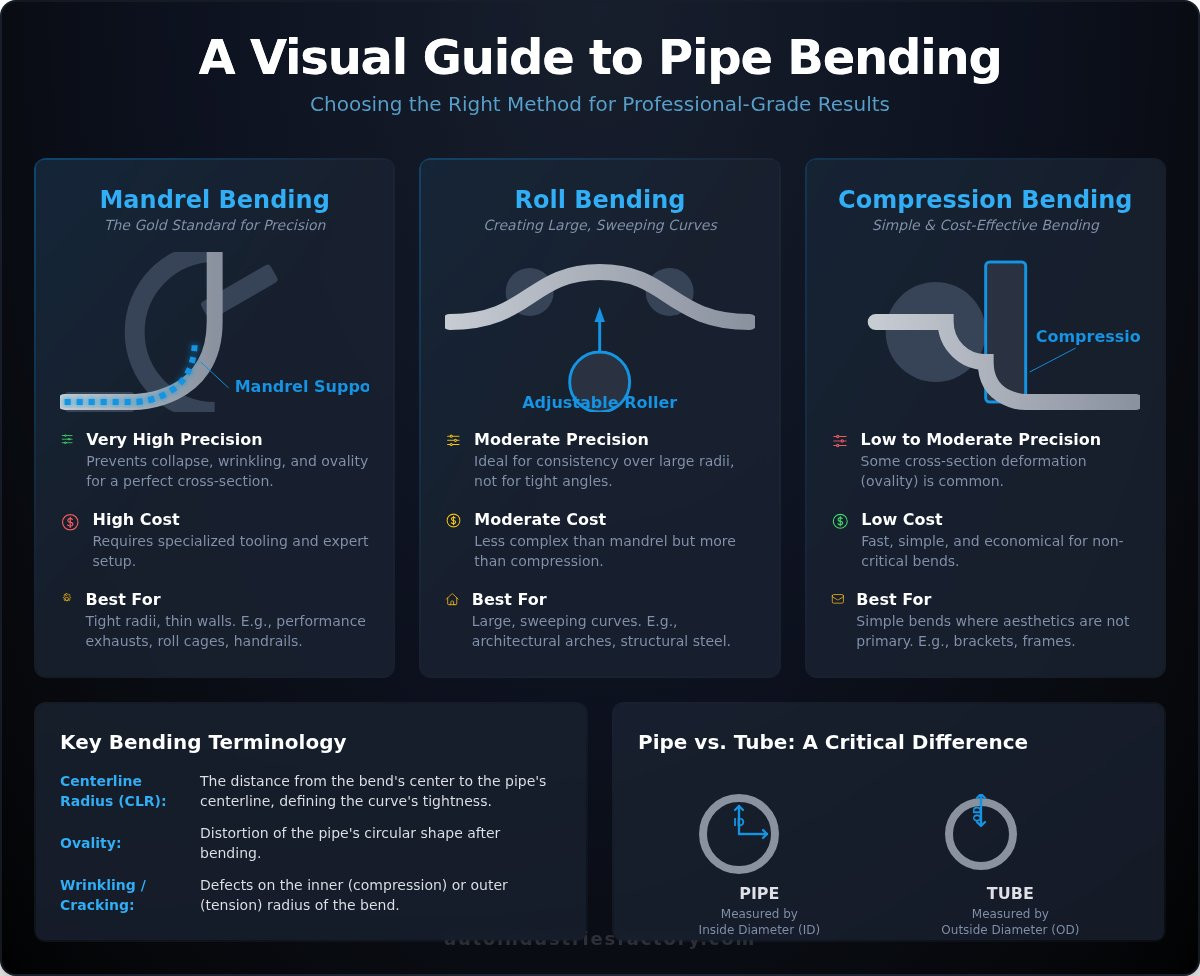
- Centerline Radius (CLR): The distance from the center of the bending die to the centerline of the pipe. This is the most critical dimension, defining how tight or gradual the curve will be.
- Wall Thickness & Ovality: Bending stretches the outer wall (extrados) and compresses the inner wall (intrados). Ovality measures the resulting distortion of the pipe's circular cross-section.
- Wrinkling and Cracking: These are common defects. Wrinkling occurs on the compressed inner radius, while cracking or splitting can happen on the stretched outer radius if the material limits are exceeded.
- Mandrel & Dies: A mandrel is a tool inserted inside the pipe to support its walls and prevent collapse. The clamp die holds the pipe, while the wiper die prevents wrinkling during tight-radius bends.
Pipe vs. Tube Bending: Is There a Difference?
While often used interchangeably, "pipe" and "tube" have a critical distinction in fabrication. Pipe is measured by its nominal inside diameter (ID), whereas tubing is measured by its exact outside diameter (OD). This fundamental difference directly impacts tooling selection. While the fundamental techniques of Tube Bending are similar to those for pipe, the dies and mandrels must be sized precisely to the material's OD to ensure a secure grip and prevent defects. Therefore, a 2-inch pipe and a 2-inch tube require entirely different setups for a successful bend.
Core Pipe Bending Techniques for Industrial Applications
In professional fabrication, the method used for PIPE BENDING is not a one-size-fits-all decision. The choice is a critical engineering calculation based on the material, wall thickness, required bend radius, and the final application's performance demands. Selecting the correct technique ensures structural integrity, optimal flow characteristics, and cost-efficiency. While there are numerous specialized methods, industrial applications primarily rely on a core set of processes. For a deeper dive into the mechanics, industry resources on Tube bending basics offer excellent foundational knowledge.
| Technique | Precision | Relative Cost | Best For |
|---|---|---|---|
| Mandrel Bending | Very High | High | Tight radii, thin walls, flawless finish |
| Roll Bending | Moderate | Moderate | Large, sweeping curves and coils |
| Compression Bending | Low to Moderate | Low | Simple bends where minor deformation is acceptable |
Mandrel Bending: The Gold Standard for Precision
When a bend must be perfect, mandrel bending is the definitive solution. This technique involves inserting a flexible rod (the mandrel) inside the pipe during the bending process. This internal support prevents the pipe from collapsing, wrinkling, or ovalizing, which is critical for thin-wall tubing. It is the only method that guarantees a smooth, uniform cross-section through tight-radius bends, making it essential for high-performance applications like custom vehicle exhaust headers, mission-critical roll cages, and premium architectural handrails. This precision requires specialized, calibrated tooling and significant operator expertise.
Roll Bending: Creating Large, Sweeping Curves
For applications requiring large, gentle arcs rather than tight corners, roll bending is the ideal method. The process uses three rollers, typically in a pyramid formation, to incrementally push the pipe into a gradual curve. By adjusting the distance and pressure of the rollers, fabricators can create consistent, large-radius bends, circles, or even complex coils. This technique is highly scalable and is the go-to for structural steelwork, including architectural arches, bridge components, and large-scale industrial piping. Its strength lies in forming massive shapes, not in creating the tight, complex geometries possible with other methods.
Compression Bending: A Simple and Cost-Effective Method
As one of the simplest and most economical forms of pipe bending, compression bending is used for applications where speed is a priority and minor cross-section deformation is acceptable. In this process, a clamp holds the pipe stationary while a bend die forces the material around it. This can cause a slight flattening or ovality on the bend. While it lacks the precision of mandrel bending, it is a fast and highly effective technique for producing non-critical components, such as furniture frames, simple supports, and general fabrication where perfect aesthetics or fluid dynamics are not the primary concern.
Materials in Focus: Bending Steel, Stainless Steel, and Aluminum
Mastering the art of PIPE BENDING begins with a deep understanding of the material itself. The success of any fabrication project, from a rugged bull bar to a precision-engineered roll cage, is dictated by the metal's inherent properties. Key characteristics like tensile strength, ductility, and work hardening dramatically influence how a tube responds to force. The complex process of Tube bending is therefore not a one-size-fits-all operation; matching advanced techniques and tooling to the specific material is essential for achieving flawless, durable results.
Bending Carbon Steel and Stainless Steel
Carbon steel is the workhorse of heavy-duty vehicle fabrication due to its exceptional strength and predictable performance. Its high ductility allows for clean, consistent bends without fracturing. However, its strength also leads to a phenomenon known as 'springback'-the material's tendency to partially return to its original shape. Our advanced CNC machines precisely calculate and compensate for this by over-bending the tube by a specific amount, guaranteeing perfect angles every time. Stainless steel, while also robust, introduces the challenge of work hardening, particularly in common grades like 304. As it's bent, the material becomes progressively harder, requiring increased force and specialized machine calibration to maintain a smooth, uniform bend radius.
The Challenges of Bending Aluminum Tube
Aluminum offers a lightweight advantage but presents unique challenges in the bending process. With lower ductility compared to steel, it has a higher tendency to crack or collapse, especially when forming tight-radius bends. For high-strength alloys like 6061-T6, pre-treatment is often required. We perform a controlled annealing process to temporarily soften the material, allowing it to be formed without structural damage. Furthermore, aluminum’s soft surface demands immaculate tooling. Any imperfection in the dies or mandrel can mar the finish, so we utilize highly polished, premium tooling to ensure every component leaves our facility with a flawless, professional appearance.
Real-World Applications: Pipe Bending in Custom Vehicle Fabrication
At Auto Industries Factory (AIF), the technical mastery of pipe bending is not an abstract concept-it is the foundation of the rugged, reliable components that define our custom vehicles. This process is where engineering theory becomes tangible strength, transforming raw tubing into mission-critical equipment designed to perform in the demanding conditions of Oman and beyond. Our expertise ensures that every curve serves a purpose, contributing directly to the durability, safety, and flawless performance of the final product.
Crafting Heavy-Duty Bull Bars and Safari Bumpers
Frontal protection demands uncompromising strength. We utilize advanced mandrel bending on heavy-gauge steel tubing to create seamless bull bars and bumpers. This technique is essential as it prevents the tube from collapsing or wrinkling, maintaining its structural integrity at the bend. The result is a premium, single-piece construction that offers maximum resistance to impact and a flawless, rugged aesthetic worthy of a high-performance off-road vehicle.
Building Structural Roll Cages and Safari Vehicle Frames
When it comes to occupant safety, precision is non-negotiable. The structural integrity of a roll cage is entirely dependent on the accuracy of its bends. Our use of CNC pipe bending technology guarantees absolute precision, ensuring perfect symmetry and fitment inside the vehicle's cabin. This digital control is central to our custom vehicle fabrication process, allowing us to build safety structures that meet the most rigorous standards for strength and protection.
Fabricating Custom Roof Racks and Canopies
Functionality must integrate seamlessly with vehicle design. We use a combination of roll and mandrel bending to fabricate custom roof racks and canopies that are both durable and stylish. Precision bending is critical to perfectly match the unique contours and rooflines of each vehicle, from a Toyota Land Cruiser to a Nissan Patrol. This expertise ensures every accessory looks like a factory-fitted component, making it a perfect addition to any special purpose vehicle.
Ultimately, advanced fabrication techniques are at the core of every durable and reliable vehicle modification. To see how our expert capabilities can enhance your fleet, explore the solutions at autoindustriesfactory.com.
Ensuring Quality and Precision in Every Bend
In high-performance fabrication, the margin for error is zero. A poorly executed bend can compromise structural integrity, leading to costly failures and critical safety hazards. The difference between an acceptable result and a truly flawless component lies in an unwavering commitment to precision engineering. This is what separates standard workshops from expert fabricators: a systematic approach to guaranteeing quality, reliability, and repeatability in every single piece.
The Role of CNC Bending Technology
Modern precision is driven by Computer Numerical Control (CNC) technology. CNC benders translate digital designs into physical parts with exceptional accuracy, ensuring every angle and radius is identical to the last. This level of automation is essential for producing complex, multi-bend components for custom roll cages, heavy-duty roof racks, or intricate exhaust systems. By minimizing setup time and reducing material waste, CNC technology delivers unparalleled consistency and efficiency.
Advanced Tooling for Flawless Results
Even the most advanced machine is ineffective without premium tooling. The strategic use of mandrels, wiper dies, and clamp dies is critical to a perfect outcome. This specialized equipment supports the pipe internally and externally throughout the bending process, preventing common defects that compromise both aesthetics and strength, such as:
- Wrinkling: Unsightly and structurally weak ripples on the inside radius of the bend.
- Ovality: The flattening or distortion of the pipe's cross-section.
- Wall Thinning: Excessive stretching of the outer wall, which can create a weak point.
Investing in high-quality, material-specific tooling is a non-negotiable aspect of professional pipe bending.
Quality Control and Operator Expertise
Technology provides the capability, but human expertise delivers the quality. A skilled machine operator is just as crucial as the machine itself. Our process is built on a foundation of rigorous quality control, where experienced technicians inspect every component for dimensional accuracy, surface finish, and structural integrity. This fusion of advanced machinery and seasoned craftsmanship ensures every project we undertake is built for maximum durability and mission-critical performance.
Ultimately, achieving flawless results is a holistic system where technology, superior tooling, and expert oversight converge. For components that demand flawless execution and reliability, trust the experts. Learn more about our advanced fabrication capabilities at autoindustriesfactory.com.
Transforming Metal into Mission-Critical Components
From understanding the core principles to witnessing its real-world application in custom vehicle fabrication, it is clear that precision metal forming is both an art and a science. The key takeaways are simple: the right technique is crucial for structural integrity, and the choice of material dictates performance under pressure. Expert PIPE BENDING is the backbone of any durable, heavy-duty, and reliable custom component, ensuring every curve serves a purpose.
At Auto Industries Factory, this level of precision is not just a goal; it is our standard. As leading specialists in military, police, and ambulance vehicle components, we serve the UAE and GCC with unmatched engineering. Our in-house CNC bending and laser cutting capabilities ensure that every project meets the most demanding specifications for safety and durability.
Ready to translate your vision into a robust reality? Request a Quote for Your Custom Fabrication Project and partner with a team dedicated to flawless execution.
Frequently Asked Questions
What is the difference between pipe bending and tube bending?
The primary distinction lies in how they are measured and their typical application. Pipe is measured by its nominal inside diameter (ID) and is engineered to transport fluids or gases. Tubing is measured by its precise outside diameter (OD) and is typically used for structural purposes, like in roll cages or frames. While the bending mechanics are similar, the tooling-specifically the bend dies-must be precisely matched to either the pipe's nominal size or the tube's exact OD to ensure a flawless result.
What is the minimum bend radius I can achieve for a pipe?
The minimum bend radius is not a fixed value; it depends on the pipe's material, outside diameter (OD), and wall thickness. A common industry guideline for achieving a quality bend without specialized tooling is a centerline radius of 3 to 5 times the pipe's OD. Achieving a tighter radius, such as 1.5D, requires advanced techniques and equipment, like a mandrel bender, to prevent the pipe from collapsing or deforming during the process.
How does the pipe's wall thickness affect the bending process?
Wall thickness is a critical factor in determining bend quality. A thicker wall provides greater structural integrity, making the pipe more resistant to kinking or collapsing on the outer radius. Conversely, thin-walled pipes are highly susceptible to defects like wrinkling on the inner radius and excessive flattening. Bending thin-walled material successfully demands precision tooling, particularly the use of an internal mandrel to support the pipe's profile throughout the bend.
Can you bend square or rectangular tubing?
Yes, square and rectangular tubing can be bent, but the process requires specialized tooling designed to support the material's flat sides and prevent distortion. Bending these profiles is more challenging than bending round pipe, as the inner wall is prone to buckling and the outer wall to collapse. The quality of the bend depends heavily on using the correct die set that fully encapsulates the tubing's profile, ensuring a clean, uniform radius without structural compromise.
What are the most common defects in pipe bending and how are they avoided?
The most common defects in pipe bending are wrinkling on the inside of the bend, excessive flattening (ovality), and kinking or collapsing of the pipe wall. These issues are avoided through meticulous setup and the use of correct equipment. Employing a mandrel prevents collapse, a wiper die smooths the inner radius to stop wrinkling, and ensuring the correct clamp pressure and bend radius for the material's properties are essential for achieving a flawless, defect-free component.
Is a bent pipe weaker than a straight pipe?
A bent pipe experiences changes in its material structure. The outer wall thins slightly and is placed under tension, while the inner wall compresses and thickens. This can make the bend point marginally weaker than a straight section. However, when professional techniques are used with the correct tooling, wall thinning is minimized. The resulting component maintains exceptional structural integrity and is engineered to safely meet the demands of its application, from fluid transfer to structural frames.


