
Justifying the significant upfront investment for a vehicle conversion to your leadership is a major challenge. Add the complexities of navigating diverse regional vehicle standards, the risk of selecting an unreliable fabrication partner, and the critical need to minimize operational downtime, and the pressure mounts. A successful project requires more than just a plan; it demands precision, foresight, and a deep understanding of the regional market. This is your definitive fleet manager guide to vehicle conversion for 2026, engineered to address these exact pressures head-on and transform them into strategic advantages.
This comprehensive guide delivers a robust framework for mastering the entire vehicle conversion lifecycle. Backed by the industry insights of Auto Industries Factory LLC, we provide a practical, heavy-duty checklist for vetting and selecting a premium conversion partner you can trust. You will gain the confidence to accurately calculate the Total Cost of Ownership (TCO) and build an undeniable case for the long-term ROI of your specialized fleet. Prepare to move from uncertainty to complete control over your next conversion project.
Key Takeaways
- Learn how to conduct a comprehensive Total Cost of Ownership (TCO) analysis to determine whether converting or buying new offers the best long-term value for your Omani fleet.
- Master the art of drafting a detailed specification sheet based on your vehicle's core mission-the essential first step to a flawless and efficient conversion project.
- This fleet manager guide to vehicle conversion includes a complete checklist for vetting partners in Oman, ensuring you select a fabricator with proven engineering expertise.
- Understand the key project milestones from kick-off to handover and learn how to integrate new vehicles seamlessly with crucial operator training to maximize uptime.
Step 1: The Strategic Decision - When to Convert vs. Buy New
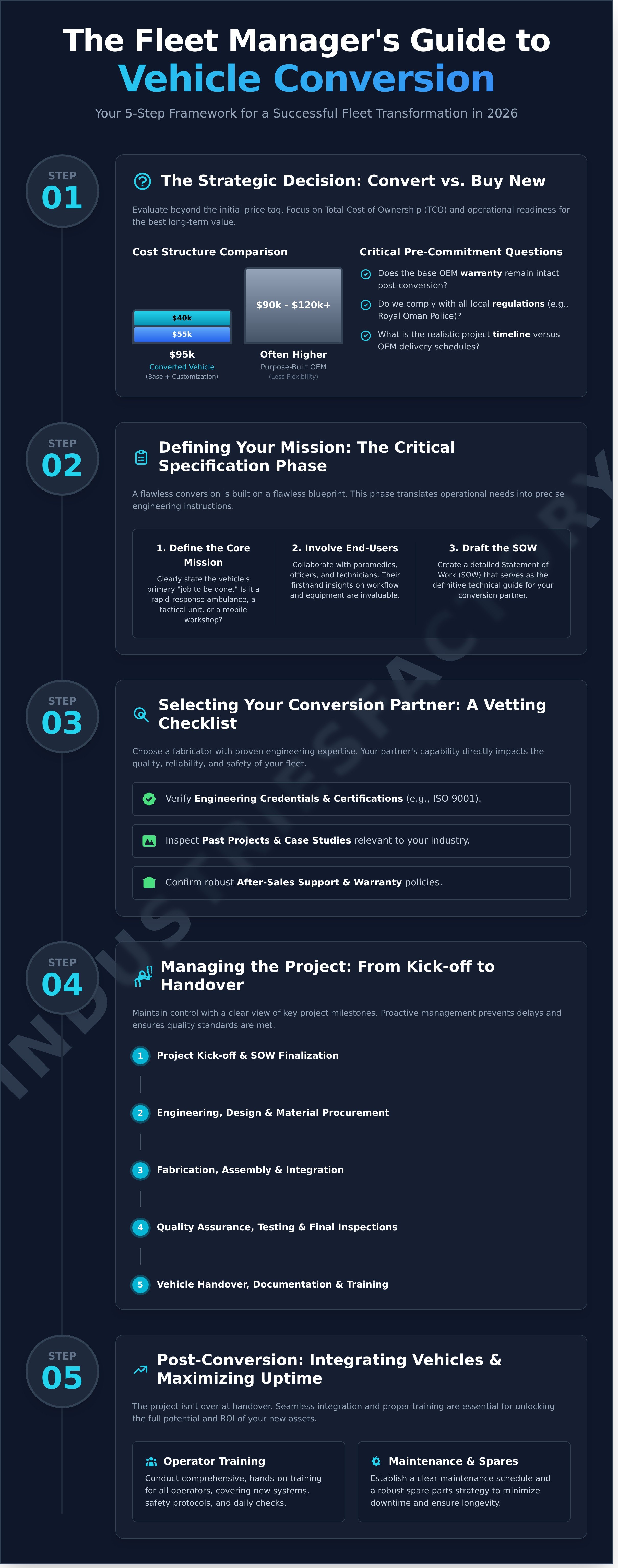
For any fleet manager, the foundational decision in vehicle acquisition is a critical one: should you modify a proven, existing chassis or purchase a purpose-built vehicle directly from an OEM? This choice goes far beyond the initial price tag, directly impacting Total Cost of Ownership (TCO), operational readiness, and long-term reliability. A comprehensive fleet manager guide to vehicle conversion begins by weighing the strategic advantages of transforming a known asset versus integrating an entirely new platform into your operations.
To better understand a key aspect of fleet modernization, watch this helpful video:
Vehicle conversion often emerges as the superior strategy in several key scenarios. When your operational requirements are highly specific-such as needing a desert-capable ambulance or a tactical response unit-a custom conversion ensures every tool and feature is exactly where it needs to be. This is particularly true in Oman, where leveraging a robust and familiar platform like a Toyota Land Cruiser provides a solid foundation, a key concept in understanding vehicle conversions. Converting a vehicle your maintenance teams already know reduces training time, simplifies parts procurement, and leverages a proven track record of durability in demanding local conditions.
Calculating the ROI of Vehicle Conversion
A true cost-benefit analysis looks at the full lifecycle. Consider a base vehicle cost of $55,000 plus a specialized conversion cost of $40,000. While the initial outlay may be similar to a purpose-built option, the TCO is often lower due to more accessible parts and service. Gains in operational efficiency-like an ambulance conversion that allows for faster patient services-provide tangible returns. Furthermore, a professionally converted, high-demand vehicle often commands a strong resale value in niche markets.
Key Questions to Ask Before Committing
Before proceeding, every fleet manager must address these critical points to ensure a successful outcome:
- Warranty and Service Network: Does the base vehicle's OEM warranty remain largely intact after conversion? Is the manufacturer's service network, such as Toyota's in Oman, accessible in our primary areas of operation?
- Local Regulations: Are there specific regulations from the Royal Oman Police (ROP) or other ministries regarding vehicle modifications that might favor one approach over the other?
- Projected Timeline: What is the realistic timeline for a custom conversion project versus the often-extended delivery and importation schedule for a new, factory-built specialized vehicle?
Step 2: Defining Your Mission - The Critical Specification Phase
A successful vehicle conversion is not built in the workshop; it is forged in the specification phase. Before any metal is cut or a single wire is run, a detailed specification sheet must be created. This document is the definitive blueprint for the entire project, translating your operational needs into precise engineering instructions. Getting this stage right is the most critical component of this fleet manager guide to vehicle conversion, ensuring the final product is not just adequate, but perfectly aligned with its mission.
The process begins by defining the vehicle's primary purpose-the "job to be done." Is it a rapid-response ambulance, a tactical patrol unit, or a heavy-duty maintenance vehicle? The answer dictates every subsequent decision. While understanding the basics of vehicle conversion provides a strong foundation, only your team on the ground can translate operational theory into functional reality. Involving end-users-the paramedics, officers, and technicians who will operate the vehicle daily-is non-negotiable. Their firsthand insights into workflow, equipment placement, and operational challenges are invaluable for creating a truly effective and user-centric design.
Drafting the Statement of Work (SOW)
Your SOW is the technical contract that guides our engineers. It must be exhaustive and precise, detailing every modification and required system. Key elements include:
- Structural Modifications: This covers everything from chassis reinforcement and suspension upgrades to custom roof extensions or the integration of ballistic armoring.
- Integrated Systems: Specify all required systems, including heavy-duty electrical grids for auxiliary power, advanced communications arrays, mission-specific HVAC, and specialized lines for medical gas.
- Materials & Performance Standards: Define the required materials (e.g., medical-grade, non-porous surfaces) and mandated performance benchmarks, such as adherence to international standards like EN 1789 for ambulances.
Ensuring Regulatory and Environmental Compliance
Operating in Oman and the wider GCC region demands adherence to strict local and regional standards. Your SOW must account for regulatory compliance to ensure safety and legality. This includes meeting Gulf Standardization Organization (GSO) requirements and, most critically, performing meticulous payload calculations. Overloading a vehicle compromises safety, handling, and durability. Furthermore, the design must be optimized for the Gulf's harsh environment-our engineering process incorporates solutions for extreme heat, sand ingress, and high humidity to guarantee mission reliability.
Step 3: Selecting Your Conversion Partner - A Fleet Manager’s Checklist
In any comprehensive fleet manager guide to vehicle conversion, this step is paramount. The partner you choose to upfit your vehicles is as critical as the base chassis you select. A premium vehicle can be rendered ineffective by a subpar conversion, leading to operational failures, safety hazards, and costly downtime. Your goal is to find a true engineering partner, not just an assembler of parts. This checklist will help you identify a capable and reliable conversion specialist in Oman.
Evaluating Technical Capabilities
A key differentiator is a partner’s ability to control the entire manufacturing process. Assemblers who outsource critical tasks introduce supply chain risks and quality control gaps. Look for a true in-house fabricator with proven, end-to-end capabilities.
- In-House Engineering: Do they have a dedicated team for design and engineering? Ask to see their process for turning a concept into a robust, functional design.
- Advanced Fabrication: Verify they possess in-house CNC machining, heavy-duty welding, and professional painting facilities. A partner with full control over the process, like Auto Industries Factory LLC, significantly reduces supply chain vulnerabilities and ensures consistent quality.
- Proven Track Record: Request case studies or examples of similar projects, whether for police fleets, custom safari trucks, or mission-critical ambulances.
- Quality & Certifications: Inquire about their quality control protocols. Certifications like ISO 9001 demonstrate a commitment to standardized, high-quality output.
Assessing Business Stability and Support
Technical skill must be backed by a stable business structure and a commitment to post-delivery support. A cheap conversion becomes expensive if the provider disappears after delivery.
- Local Presence & Licensing: Verify their trade licenses and confirm they have a physical workshop or factory in Oman. A local partner is invaluable for project inspections, collaboration, and rapid support.
- Client References: Ask for references from other fleet managers or government entities in the region. A reputable company will gladly provide them.
- Warranty and Aftercare: Clarify the terms of their post-delivery warranty. Do they offer operator training and a clear maintenance support plan? Ensure they are compliant with local standards and understand international best practices for vehicle conversion regulations.
Step 4: Managing the Conversion Project - From Kick-off to Handover
Once the design is finalized and a partner is selected, your role shifts to active project management. A successful outcome depends on rigorous oversight and clear communication. This section of our fleet manager guide to vehicle conversion provides a framework for steering the project from the initial kick-off to the final, mission-ready handover, ensuring your specifications are met with precision.
Effective management begins with establishing a single point of contact with your conversion partner. This streamlines communication and ensures accountability. The project should follow clear phases:
- Kick-off & Design Sign-off: Final confirmation of all specifications and drawings.
- Chassis Arrival & Prep: The base vehicle is delivered and prepared for modification.
- Fabrication & Assembly: The core conversion work, from structural changes to equipment installation.
- Finishing: Painting, upholstery, and livery application, ensuring compliance with local Omani regulations.
- Final Inspection & Handover: Comprehensive quality checks before the vehicle is returned to your fleet.
Be prepared to manage change orders formally. Any deviation from the initial scope must be documented, quoted, and approved in writing to prevent scope creep and budget overruns. This disciplined approach is critical for maintaining project control.
The Role of Inspections and Quality Gates
Trust must be verified. Plan for inspections at critical quality gates, such as pre-paint and before final electrical systems are enclosed. For fleet managers in Oman, an in-person visit can be invaluable, but if not feasible, demand detailed progress reports with high-resolution photos. The most crucial step is the Pre-Delivery Inspection (PDI). Use a comprehensive checklist to verify every component and function against the agreed-upon specifications before accepting the vehicle.
Timeline and Downtime Management
Realistic timelines are essential for operational planning. A complex, heavy-duty ambulance conversion can take 8-12 weeks, while simpler modifications may be faster. This downtime must be factored into your fleet availability to avoid service disruption. Coordinate closely with your conversion partner on logistics for vehicle drop-off and collection. Proactive planning ensures a seamless transition and minimises the impact on your demanding operations.
Managing a complex conversion requires an expert partner. For guidance on ensuring your project meets the highest standards of durability and performance, consult with our engineering team.
Step 5: Post-Conversion - Integrating Vehicles & Maximizing Uptime
The successful handover of a newly modified vehicle is a milestone, but it is not the end of the project. For a fleet manager, this is the beginning of the operational phase where the true value of the conversion is realized. A focus on seamless integration, proactive maintenance, and performance measurement is essential to maximize vehicle uptime and validate the investment. This final stage is a critical component of any comprehensive fleet manager guide to vehicle conversion.
Properly managing this phase ensures your upgraded assets deliver the efficiency, safety, and durability promised on paper, directly impacting your bottom line and operational capability.
Training and Vehicle Familiarization
Your operators are on the front line; their proficiency with new equipment is non-negotiable. Ensure your conversion partner provides hands-on training for all drivers and personnel who will interact with the vehicle. This session should cover the safe and efficient use of all new systems, from hydraulic lifts and refrigeration units to specialized communication and lighting arrays. Arm your team with clear documentation, and establish new daily check protocols specific to the converted components to catch potential issues before they lead to downtime.
Specialized Maintenance & Performance Measurement
Converted components require a dedicated maintenance strategy that runs parallel to the OEM's standard service schedule. Work with your conversion partner to develop a clear plan for servicing specialized parts.
- Proactive Servicing: Schedule regular inspections for custom wiring, auxiliary batteries, mounting hardware, and hydraulic systems, especially considering the demanding operating conditions in Oman.
- Parts & Consumables: Identify and stock critical spare parts unique to the conversion to minimize repair delays.
- Measure Success: The project's success must be measured. Track key performance indicators (KPIs) like fuel consumption, task completion times, and maintenance costs. Compare this real-world data against the initial Total Cost of Ownership (TCO) and ROI calculations to quantify the project's value and inform future fleet decisions.
Long-Term Partnership and Support
Your relationship with your upfitter should not end at handover. A premier conversion company operates as a long-term partner, providing ongoing support, technical advice, and a reliable supply of parts. It is also vital to create a feedback loop where operators can report on the vehicle's performance. This field data is invaluable for refining specifications on future projects. Auto Industries Factory (AIF) is a full-service vehicle conversion specialist dedicated to providing this level of robust, long-term fleet support, ensuring your investment continues to perform for years to come.
Your Strategic Partner for Mission-Ready Fleet Conversions
Successfully upgrading your fleet is more than a transaction; it is a strategic process. As this fleet manager guide to vehicle conversion has detailed, every stage-from the initial decision to convert versus buy new, to the critical specification phase and final vehicle integration-demands precision and foresight. Mastering these steps is the key to maximizing your fleet's uptime and operational ROI, a crucial factor for success in Oman's demanding commercial and governmental sectors.
Choosing the right conversion partner is the most critical decision you will make. At Auto Industries Factory, we bring engineering certainty to this process. Trusted by leading government and commercial fleets across the GCC, our in-house design, fabrication, and assembly facility in Ajman, UAE, delivers rugged, mission-ready vehicles. Our proven expertise in complex ambulance, police, military, and safari conversions ensures your project is built to protect what matters.
Your fleet's future performance starts with the right conversation. Discuss your fleet conversion project with our engineering team. Let's build a durable, high-performance fleet tailored to your mission's exact demands.
Frequently Asked Questions About Vehicle Conversion
How does a vehicle conversion affect the original manufacturer's (OEM) warranty?
A vehicle conversion will typically void the OEM warranty on any parts that are modified or directly impacted by the installation. However, the warranty on unmodified components, such as the core engine or transmission, generally remains valid. A professional conversion specialist provides a separate, comprehensive warranty covering all new fabrication, parts, and labour. This ensures your converted assets are protected and your fleet's operational readiness is maintained with confidence and clear accountability.
What is the average lead time for a complex vehicle conversion like an ambulance or police car?
The lead time for a complex, mission-critical conversion like an ambulance or police interceptor typically ranges from 8 to 16 weeks. This timeline is influenced by the base vehicle's availability, the complexity of the onboard systems, and the extent of custom fabrication required. For large fleet orders, we often establish a phased delivery schedule. This approach ensures meticulous quality control for each vehicle and allows you to integrate new assets into service efficiently.
Are there specific regulations for vehicle modifications in Oman I need to know about?
Yes, all vehicle modifications in Oman must adhere to the standards and regulations set by the Royal Oman Police (ROP), especially the Directorate General of Traffic. Emergency and special-purpose vehicles have strict requirements governing sirens, emergency lighting, vehicle markings, and internal equipment layouts. Partnering with a converter experienced in Omani regulations is critical to ensure your vehicles pass inspection, are legally certified for road use, and avoid costly compliance delays.
How do you ensure consistent quality when converting a large fleet of vehicles?
Consistency across a large fleet is achieved through rigorous, standardized processes. We use detailed engineering blueprints, precision CNC fabrication, and templated assembly protocols for every unit. Each vehicle undergoes multiple quality control checks at critical stages, from structural welding to final systems integration. This methodical process, a key part of any effective fleet manager guide to vehicle conversion, guarantees that every vehicle is built to the exact same premium, heavy-duty standard.
What are the most common failure points to watch for in a converted vehicle?
The most common failure points are typically found in the electrical system and high-stress structural areas. Improperly integrated wiring for auxiliary equipment can cause shorts or power failures. Additionally, weak mounting points for heavy gear or subpar welds on custom fabrications can lead to structural fatigue over time. A professional conversion mitigates these risks with robust, independent electrical circuits and engineering-certified, reinforced mounting and structural work.
Can you convert both new and used vehicles for fleet use?
Yes, we are equipped to perform high-quality conversions on both new and pre-owned vehicles. While new vehicles provide a fresh platform, converting a well-maintained used vehicle can be a highly cost-effective solution for your fleet. Before proceeding with a used vehicle, we conduct a thorough structural and mechanical inspection to confirm the chassis and powertrain can reliably support the demands of the new configuration, ensuring a durable and safe final product.


