

For fleet managers and procurement specialists in the emergency services sector, selecting the right ambulance is a critical decision with far-reaching implications for patient care, operational efficiency, and crew safety. The term "ambulance" covers a wide range of vehicles, each designed and fabricated for specific missions and environments. Understanding the key classifications of ambulances-from standard types to highly specialized conversions-is the essential first step in making a confident and informed procurement decision that aligns with your organization's unique requirements.
Understanding the Primary Ambulance Classifications
Ambulance types are primarily defined by their chassis, body style, and the level of medical capability they can support. While regional standards may vary, the most widely recognized classifications in North America provide a clear framework for understanding vehicle construction. Knowing these fundamental types is the first step in a successful fleet procurement strategy. This guide covers these common classifications to provide a solid foundation for your decision-making process.
Type I Ambulances: The Heavy-Duty Standard
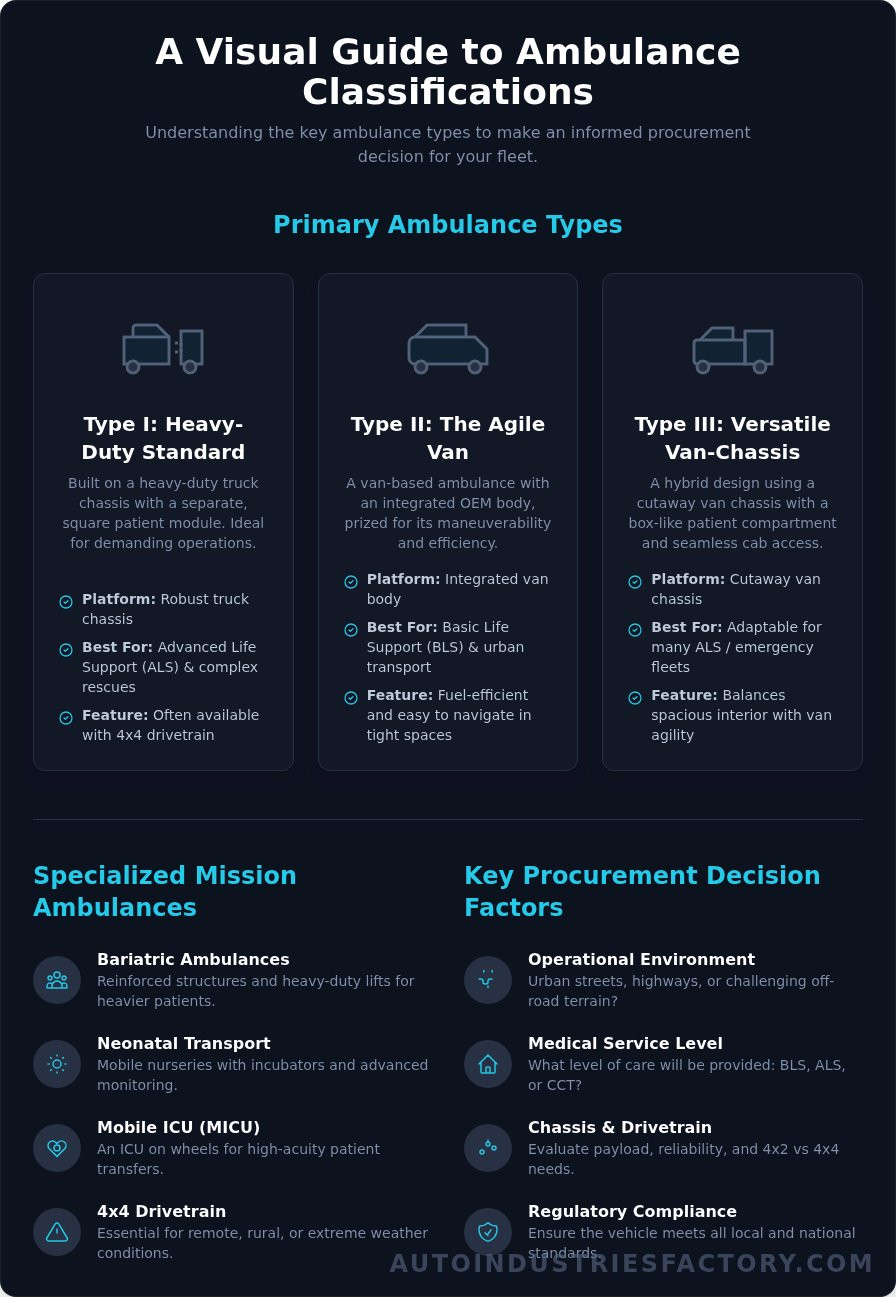
Type I ambulances are built on a heavy-duty truck chassis, which provides a robust and durable platform for demanding operations. A key feature is the square patient compartment, or module, which is mounted onto the chassis separately from the driver's cab. The two sections are connected by a small pass-through, allowing for communication but maintaining structural separation. This rugged construction makes Type I ambulances ideal for Advanced Life Support (ALS) and complex rescue operations that require extensive equipment. Many models are available with a 4x4 drivetrain, offering superior performance in rugged or adverse weather conditions.
Type II Ambulances: The Agile Van
A Type II ambulance is a van-based vehicle, where the cab and patient area are part of an integrated, original-equipment-manufacturer (OEM) body. These vehicles are known for their excellent maneuverability in dense urban environments and their superior fuel efficiency compared to larger truck-based units. Due to their more compact size, Type II ambulances are commonly used for Basic Life Support (BLS) and routine patient transport where the need for extensive equipment and interior space is less critical. Their lower profile also allows for easier access to parking garages and areas with height restrictions.
Type III Ambulances: The Versatile Van-Chassis
The Type III ambulance utilizes a cutaway van chassis, combining features from both Type I and Type II models. It features a square, box-like patient compartment similar to a Type I, but the cab is an integral part of the ambulance unit, allowing for seamless movement between the driver's seat and the patient care area. This configuration offers the spacious interior of a box module while retaining the driving characteristics of a van chassis. This versatility makes the Type III ambulance a popular and adaptable choice for many ALS and emergency response fleets, balancing interior workspace with operational agility.
Beyond Standard Types: Specialized and Custom-Built Ambulances
While the standard classifications provide a useful baseline, they do not cover the full spectrum of operational needs required by modern emergency medical services. Specialized vehicles are engineered and equipped for specific, high-stakes patient-care missions, demanding a level of customization that goes beyond off-the-shelf solutions.
Specialized Mission Ambulances
Certain patient needs require vehicles with unique capabilities. These specialized ambulances are purpose-built to deliver a higher level of care during transport:
- Bariatric Ambulances: These units feature reinforced structures, heavy-duty lifts, and wider stretchers to safely transport heavier patients with dignity and security.
- Neonatal Transport: Equipped with advanced incubators, specialized monitoring systems, and a controlled environment, these ambulances are mobile nurseries for critically ill newborns.
- Mobile Intensive Care Units (MICU): Essentially an ICU on wheels, these vehicles are fitted with advanced critical care equipment, such as ventilators and infusion pumps, for inter-hospital transfers of high-acuity patients.
Body Style and Drivetrain Classifications
Beyond medical loadout, the physical construction and drivetrain are critical for performance and reliability, especially in challenging environments:
- Box-Type Ambulances: This design, common in Type I and Type III models, maximizes interior space, allowing for optimal equipment storage, crew mobility, and patient access. The modular build also allows for remounting onto a new chassis, extending the service life of the patient compartment.
- 4x4 Ambulances: For services operating in remote, rural, or extreme weather regions, a 4x4 drivetrain is non-negotiable. It provides the necessary traction and stability to ensure that emergency care can be delivered regardless of terrain. This design is critical for mission reliability where standard vehicles would fail.
Auto Industries Factory: Your Partner in Custom Conversions
At Auto Industries Factory, we specialize in the fabrication of ambulances designed to meet unique and demanding operational requirements. Our expert team understands that standard models are often just the starting point. We provide complete in-house engineering and manufacturing to deliver mission-specific solutions built for durability and performance. We convert a wide range of reliable chassis from leading brands like Toyota, GMC, and Ford into specialized emergency vehicles. If your mission demands more than a standard solution, Discuss your custom ambulance requirements with our experts.
How to Select the Right Ambulance Type for Your Fleet
Choosing the correct ambulance type is a strategic decision that directly impacts patient outcomes, crew safety, and long-term operational costs. A thorough assessment of your specific needs is essential to ensure your fleet is truly fit for purpose and provides a reliable return on investment.
Key Procurement Decision Factors
Before issuing a tender or request for proposal, consider these critical factors to define your requirements clearly:
- Operational Environment: Will the vehicle primarily navigate dense urban streets, long-distance highways, or challenging rural and off-road terrain?
- Medical Service Level: What level of care will be provided? Basic Life Support (BLS), Advanced Life Support (ALS), or specialized Critical Care Transport (CCT)?
- Chassis & Drivetrain: Evaluate the required payload capacity, engine reliability, maintenance accessibility, and whether a 4x2 or 4x4 drivetrain is necessary.
- Regulatory Compliance: Ensure the vehicle design, equipment, and conversion process meet all local, regional, and national standards for emergency vehicles.
Why a High-Quality Conversion Matters
The base vehicle is only one part of the equation; the quality of the conversion determines the ambulance's long-term durability, safety, and functionality. A superior conversion process focuses on robust fabrication, secure and ergonomic equipment mounting, and a reliable, fault-tolerant electrical system. Investing in a high-quality build from a reputable fabricator minimizes vehicle downtime, reduces maintenance costs, and ultimately protects your most valuable assets: your crew and your patients.
Frequently Asked Questions
- What is the main difference between a Type 1 and Type 3 ambulance?
- The primary difference lies in the chassis. A Type 1 is built on a truck chassis with a separate cab and patient module. A Type 3 is built on a cutaway van chassis where the cab is integrated with the patient module, allowing pass-through access.
- Are there international standards for ambulance types?
- While the Type I, II, and III classifications are common in North America, other regions, like Europe, use different standards (e.g., Type A, B, C) based on patient transport capabilities. It's crucial to adhere to your specific region's regulations.
- Can a standard cargo van be converted into a Type 2 ambulance?
- Yes, a Type 2 ambulance is fundamentally a cargo van that has been professionally converted with the necessary medical equipment, interior fittings, warning systems, and electrical infrastructure to function as an emergency vehicle.
- What are the advantages of a box-type ambulance body?
- A box-type body offers significantly more interior space for patient care and equipment storage. Its modular design also allows for it to be refurbished and remounted on a new chassis, which can be a cost-effective strategy for extending its service life.
- How long does a custom ambulance conversion take?
- The timeline for a custom conversion depends on the complexity of the build, chassis availability, and the specific equipment required. A detailed consultation with the fabricator will establish a precise production schedule.
Choosing the right ambulance requires a clear understanding of your operational needs and the capabilities of different vehicle types. From standard-duty patient transport to custom-built, mission-critical mobile care units, the right vehicle is the one engineered for your specific environment. At Auto Industries Factory, we have the in-house design, fabrication, and engineering expertise to deliver specialized vehicles built for durability, reliability, and mission success. Request a Consultation for Your Specialized Vehicle Needs and let our team build the solution your fleet requires.


