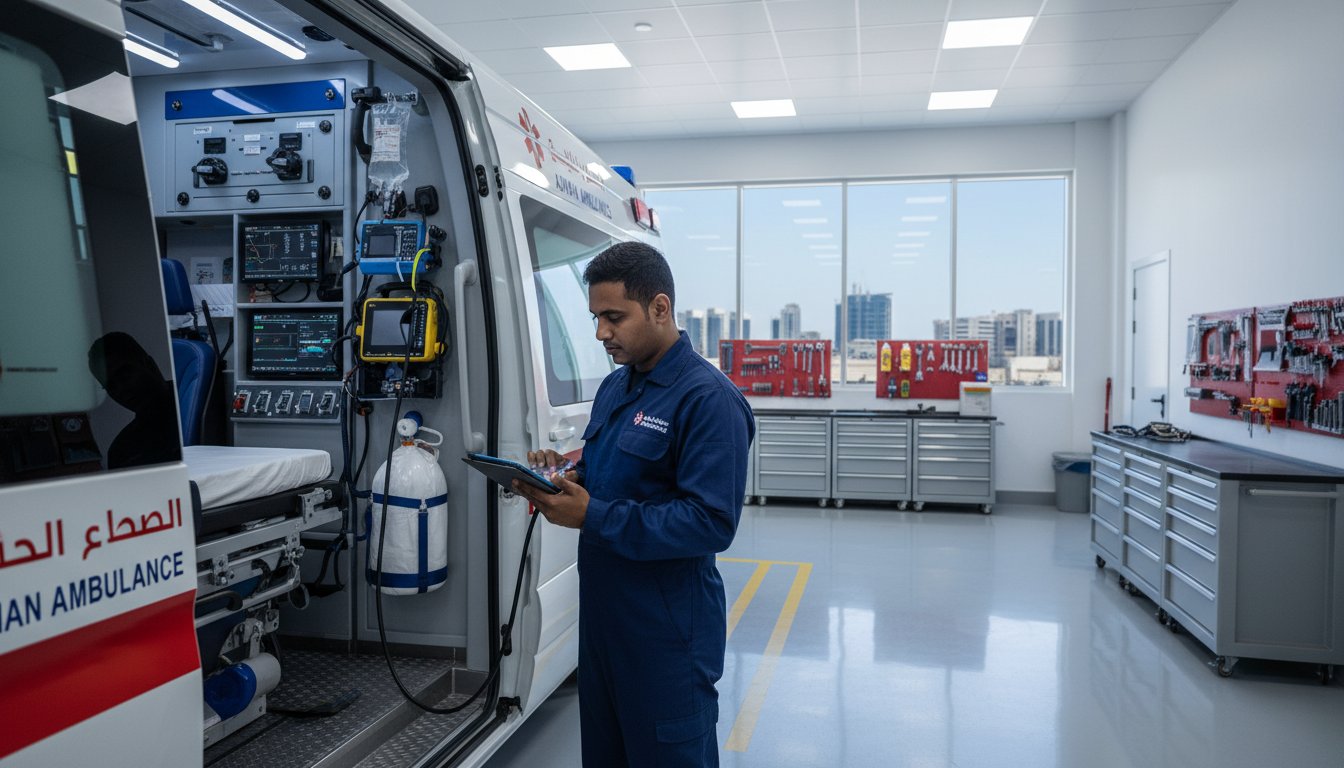
What's the true cost of one hour of downtime for your mission-critical ambulance on a demanding route? You've invested heavily in outfitting your fleet for rigorous operations across the region, but a superior conversion is only half the battle. World-class after-sales support for converted vehicles is what truly guarantees long-term operational readiness and protects that crucial investment.
This isn't just about routine maintenance. It’s about securing a strategic advantage that keeps your specialized ambulances, military transport, and commercial units mission-ready when failure isn't an option. We'll show you exactly what to look for, detailing the non-negotiable elements of support from sourcing custom-fabricated parts without delay to maintaining complex integrated systems, ensuring you build a reliable partnership for the entire lifecycle of your fleet.
Key Takeaways
- Learn why specialized converted vehicles, like ambulances and tactical units, require support that standard automotive service centres cannot provide.
- Discover how proactive maintenance strategies are critical for protecting sensitive integrated systems from Oman's extreme heat and sand conditions.
- Identify the key questions to ask a potential partner to verify their in-house engineering resources and dedicated technical support capabilities.
- Understand how robust after-sales support for converted vehicles directly translates into maximized mission uptime, enhanced safety, and greater operational efficiency.
What is After-Sales Support for Converted Vehicles?
After-sales support for converted vehicles is a comprehensive, long-term partnership that begins the moment a specialized unit is delivered. It goes far beyond standard vehicle maintenance. It’s a dedicated service framework designed to ensure every custom-fabricated component, from advanced medical systems in an ambulance to reinforced armor on a tactical unit, performs flawlessly throughout its operational life. This support ecosystem includes specialized diagnostics, rapid access to custom-built parts, ongoing operator training, and detailed technical documentation. For fleet operators in Oman, robust support isn't a luxury; it's a critical component for guaranteeing mission readiness and maximizing the return on a significant investment.
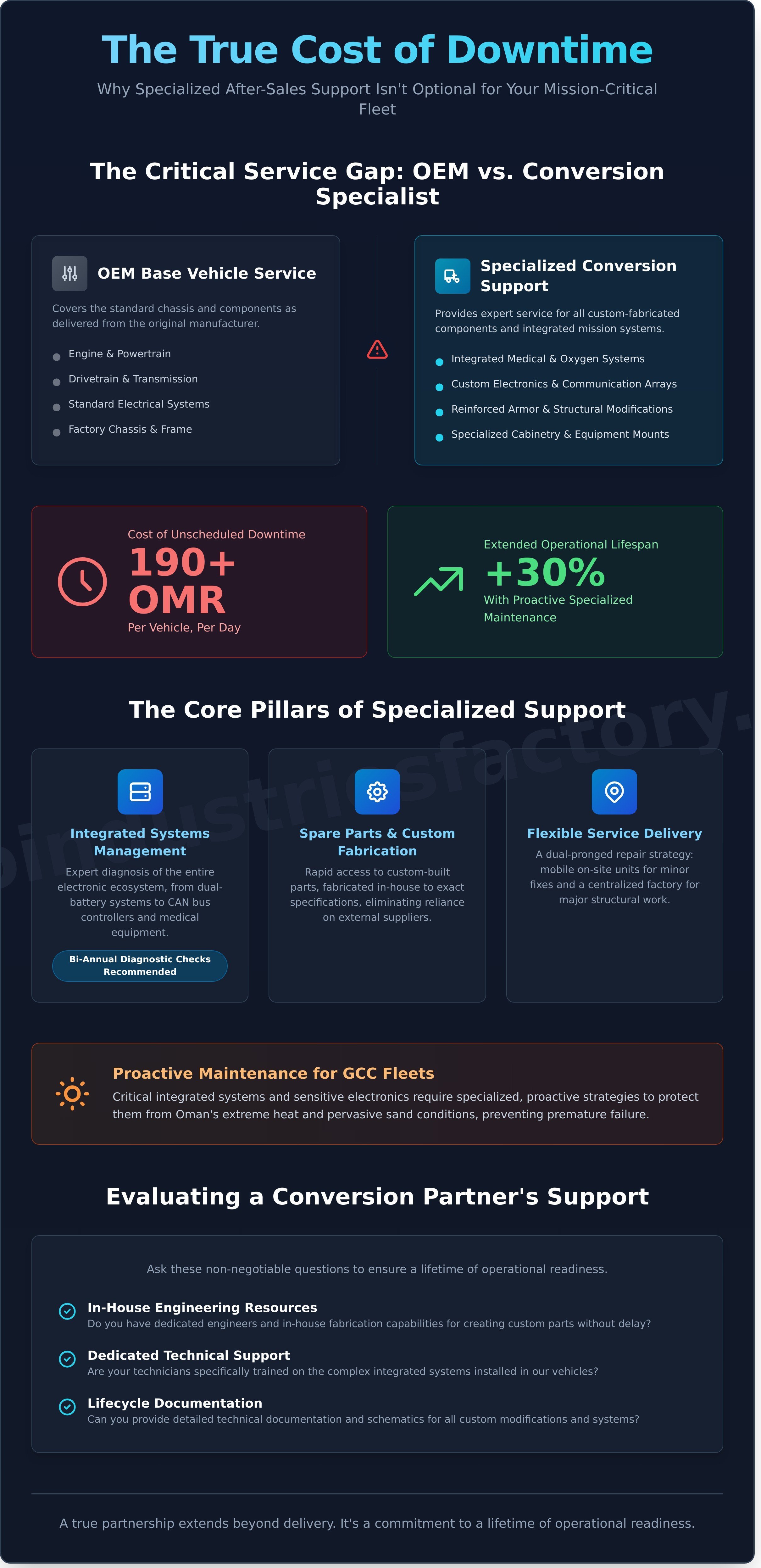
The impact of dedicated support on a vehicle's service life is substantial. Proactive, specialized maintenance can extend the operational lifespan of a converted vehicle by up to 30%, significantly lowering its total cost of ownership. This is a core principle of effective fleet management, where the focus shifts from initial purchase price to long-term value and reliability. Without this specialized care, complex integrated systems can degrade, leading to premature decommissioning and costly replacements. High-quality support ensures every vehicle in your fleet remains a dependable, mission-capable asset for years to come.
The Difference Between OEM Service and Conversion Support
A clear distinction exists between the service provided by the original vehicle manufacturer (OEM) and the support required for its conversion. The OEM, such as Toyota or Nissan, provides a warranty and service for the base chassis: the engine, drivetrain, and standard electrical systems. However, their technicians aren't trained to diagnose or repair the custom-installed patient cabin, sophisticated communication arrays, or specialized equipment. This creates a critical service gap that only a conversion specialist can fill with technicians who possess deep knowledge of the custom fabrication and integrated systems.
Why Mission-Critical Vehicles Demand Superior Support
For mission-critical fleets like the Royal Oman Police or national ambulance services, vehicle downtime is measured in risk, not just inconvenience. An ambulance out of commission directly impacts emergency response times. Unscheduled downtime for a single specialized vehicle can cost an organization over 190 OMR per day in lost operational capacity and logistical challenges. Superior after-sales support for converted vehicles minimizes this risk through preventative maintenance and rapid-response repairs, building trust through a reliable engineering partnership. This ongoing support also ensures the vehicle continues to meet rigorous safety standards, like EN 1789 for medical vehicles, throughout its entire lifecycle.
The Core Pillars of Specialized Technical Support
Once a vehicle is converted, its lifecycle is just beginning. Standard dealership service can't address the complex, integrated systems that define a specialized vehicle. Effective after-sales support for converted vehicles is not an add-on; it's a fundamental component of the conversion itself, ensuring operational readiness and protecting the initial investment. This support rests on a foundation of deep technical expertise, rapid parts availability, and flexible service delivery.
For large organizations, particularly government and security fleets, the logistics of maintenance are a major operational factor. The decision between deploying a mobile on-site repair unit for minor fixes versus returning a vehicle to a centralized factory for major structural work directly impacts fleet availability. The complexities of managing these assets, as detailed in documents like the U.S. Federal Vehicle Fleet Report, highlight why a conversion partner must offer a dual-pronged repair strategy. A factory-based approach is essential for significant repairs or system-wide upgrades on 5 or more vehicles, while on-site support is critical for maximizing uptime by addressing smaller issues directly in the field.
Managing Integrated Systems and Electronics
A converted vehicle's nervous system is its electronics. Our support focuses on the complete integrated ecosystem, not just isolated components. This includes maintaining auxiliary dual-battery systems that power critical equipment, troubleshooting advanced LED emergency lighting linked to CAN bus controllers, and ensuring communication arrays function flawlessly. For medical conversions, this extends to the meticulous inspection and troubleshooting of integrated oxygen and vacuum systems, which must adhere to stringent performance standards. We mandate bi-annual diagnostic checks to preemptively identify and resolve potential electronic failures before they impact a mission.
Spare Parts Availability and Custom Fabrication
You can't find a custom-built roof rack or a specialized internal cabinet on a shelf at a typical parts store. A critical failure of after-sales support for converted vehicles is the inability to quickly replace bespoke components. Our advantage lies in our in-house fabrication capabilities. With advanced CNC and laser cutting machinery, we can replicate any custom-fabricated part, from a heavy-duty steel bumper to a precision-cut aluminum equipment mount, reducing replacement time by up to 75% compared to relying on external suppliers. This in-house control is essential when you evaluate a conversion partner's long-term value. For vehicles operating in Oman's demanding desert environment, we also guarantee the integrity of our powder-coated finishes, applying an 80-120 micron thick layer that resists the intense UV radiation and abrasive sand that cause lesser coatings to fail.
Proactive Maintenance Strategies for GCC Fleets
In the demanding operational landscape of the GCC, a reactive approach to vehicle maintenance is a direct route to mission failure and escalating costs. For specialized conversions, where custom systems are integrated into a standard chassis, waiting for a component to break is not an option. The focus must shift to a structured, proactive maintenance plan. This strategy is the backbone of effective after-sales support for converted vehicles, ensuring maximum uptime, operator safety, and a significantly longer service life for your high-value assets. It's about anticipating challenges before they compromise operational readiness.
Combating the Harsh Middle Eastern Climate
The extreme environment across Oman and the wider GCC region is the primary adversary of any vehicle, especially one with custom modifications. Ambient temperatures regularly exceeding 50°C in interior regions, combined with the abrasive nature of fine desert sand, accelerate wear on components far beyond manufacturer specifications. A robust maintenance plan must directly address these unique threats.
- Wiring and Seals: Standard PVC-coated wiring and rubber seals become brittle and fail rapidly under intense UV exposure and heat. We recommend scheduled inspections every six months, prioritizing high-spec, heat-resistant wiring (rated to at least 125°C) and silicone seals that retain flexibility. A standard rubber seal can degrade by over 50% in just 18 months of Omani sun exposure.
- Mission-Critical AC Systems: In ambulances and mobile clinics, a functioning AC system is a life-support device. A vehicle's AC system can lose 5% of its efficiency annually; in the GCC, this rate can double to 10% due to extreme thermal loads. Monthly checks of refrigerant levels, compressor clutch engagement, and condenser coil cleanliness are non-negotiable to guarantee performance.
- Heavy-Duty Suspension: For off-road conversions like safari or patrol vehicles, sand infiltration is a constant threat. After every major off-road operation, a high-pressure wash of the undercarriage is essential. Key inspection points every 10,000 km include polyurethane bushings and shock absorber seals, as sand accumulation acts as a grinding paste, causing premature failure.
Establishing a Preventive Maintenance Schedule
A standardized checklist and a fixed schedule transform maintenance from a guess into a science. This documented process ensures that nothing is overlooked and that every unit in the fleet receives the same high standard of care, safeguarding the integrity of both the base vehicle and its specialized modifications.
- Structural Reinforcements and Welds: The custom welds and structural reinforcements that form the foundation of a conversion must be inspected for stress fractures or corrosion every 20,000 kilometers. This includes checking mounting points for heavy equipment, such as communication masts on command vehicles or patient lifts on ambulances.
- Emergency and Communication Equipment: All specialized electronic systems, including sirens, emergency light bars, and radio communication equipment, require a full-function test on a weekly basis. A 2017 report by the National Emergency Management Agency highlighted that 15% of in-field communication failures were due to simple connector corrosion, an issue easily caught by routine checks.
For mission-critical converted vehicles operating in demanding GCC conditions, a comprehensive specialized systems audit by a qualified technician is ideally conducted every six months or 25,000 kilometers, whichever comes first.
Finally, operator training and meticulous documentation are crucial pillars of this strategy. Training drivers to identify the early signs of system wear, such as unusual vibrations or fluid leaks, can reduce unscheduled downtime by up to 15% in the first year of operation. Every inspection, repair, and modification must be recorded in a detailed logbook for each vehicle. This service history is not just paperwork; it’s an essential data tool that provides technicians with the insights needed for effective long-term after-sales support for converted vehicles, ensuring each unit remains a reliable and safe asset for its entire service life.
Evaluating a Conversion Partner’s Support Capabilities
The true value of a vehicle conversion isn't just in the initial build quality; it's measured in years of reliable operational performance. A brilliantly engineered vehicle is useless if it’s sidelined by a minor component failure with no available replacement. Your due diligence must extend beyond the workshop floor and into the long-term commitment of your conversion partner. Assessing the robustness of their after-sales support for converted vehicles is a critical step that protects your investment and guarantees fleet readiness.
A reliable partner provides clear, direct lines of communication. Look for a dedicated after-sales manager and 24/7 technical support, especially for mission-critical fleets. In Oman, where teams operate from Muscat to the remote desert interior, instant support via WhatsApp is invaluable. The ability to send a photo or video of a malfunctioning component for immediate diagnosis can reduce downtime from days to hours. This is complemented by comprehensive user manuals. A professional manual isn't a simple pamphlet; it's a detailed technical document with electrical schematics, part numbers for every custom component, and step-by-step troubleshooting guides.
For operators in Oman, regional service coverage is non-negotiable. A UAE-based manufacturer must demonstrate a proven system for cross-border support. This includes having mobile technicians who can be dispatched to key industrial hubs like Sohar or Duqm, backed by guaranteed response times. A 48-hour on-site response guarantee for critical failures is a strong indicator of a serious support infrastructure. Finally, operator training is essential. A conversion package should include a structured training program, covering everything from the proper use of ambulance life-support systems to the maintenance of heavy-duty suspension upgrades. A well-trained operator is your first line of defense against preventable failures.
Questions to Ask Before Signing a Conversion Contract
Before committing, get direct answers to these critical questions. Vague responses are a significant red flag.
- What is the standard warranty period for the conversion work and custom-fabricated parts? Is it 12 months, or does it extend to 24 months on structural components?
- Do you maintain a stock of at least 90% of the spare parts for custom accessories like bull bars, roof racks, and internal cabinetry? What is the guaranteed lead time for non-stocked items?
- How do you handle emergency technical support for an ambulance in Salalah? Do you have a dedicated 24/7 hotline with a guaranteed remote diagnostic response within 30 minutes?
The Importance of In-House Manufacturing
Choosing a special purpose vehicle manufacturer with integrated, in-house fabrication and engineering capabilities directly impacts the quality of long-term support. When a company designs, cuts, welds, and finishes its own components, it retains absolute control over quality and specifications. This vertical integration is your best guarantee of post-sale performance. The most significant advantage is access to the original digital design files. If a custom-built bull bar is damaged in the field, a manufacturer with the original CAD files can remanufacture an identical, perfect-fit replacement part in under 72 hours, a process that could take weeks with an outsourcer. This precision, born from CNC machinery and expert engineering, ensures that maintenance and repairs are straightforward for the vehicle's entire service life.
Ultimately, a conversion partner's support structure is a direct reflection of their engineering confidence and commitment to your operational success. To ensure your fleet is backed by an uncompromising support framework, discuss your project specifications with our engineering team today.
Auto Industries Factory (AIF): Precision Support for Specialized Fleets
At Auto Industries Factory (AIF), our work doesn't end when a vehicle is delivered. It begins. Our core philosophy, "Built to Protect," is a long-term promise that defines our entire approach to maintenance, repair, and operational readiness. For fleet managers in Oman and across the GCC, this means direct access to a level of precision engineering designed to maximize uptime and protect your critical assets. We understand that for an ambulance, a cash-in-transit truck, or a tactical vehicle, downtime isn't an inconvenience; it's a mission failure that can carry significant operational and financial consequences.
Our decisive advantage is rooted in our advanced in-house fabrication capabilities. While other providers may wait weeks for parts from international suppliers, AIF leverages state-of-the-art CNC laser cutting, press brake forming, and robotic welding directly within our factory. This vertical integration is the cornerstone of our after-sales support for converted vehicles. If a custom component is damaged in the field, we don't just order a replacement; we manufacture one immediately. This system ensures your fleet maintains over 98% operational readiness.
Our on-demand fabrication includes:
- Custom-fit armor panels from AR500 steel.
- Heavy-duty replacement bumpers and bull bars.
- Specialized interior mounts for medical or tactical equipment.
- Reinforced chassis and suspension components.
A damaged side-panel on a police patrol vehicle, for example, can be replicated from original CAD files and fabricated in under 5 hours, drastically reducing the vehicle's time out of service.
Rugged Reliability Through Expert Engineering
Our 15,000 square-meter facility in Ajman, UAE, serves as a central hub for regional maintenance, readily accessible to our partners in Oman. Auto Industries Factory (AIF) specializes in servicing high-value, mission-critical conversions. Our certified technicians, with over 15,000 combined hours of experience, provide expert support for fleets of GMC Savana and Toyota HiAce ambulances, ensuring every component, from oxygen line integrity to emergency siren functionality, operates at 100% efficiency. We also provide dedicated support for custom safari and off-road expedition vehicles, fabricating and repairing heavy-duty accessories for models like the Toyota Land Cruiser 300 and Nissan Patrol Y62. These components are engineered to withstand the unique challenges of the Omani landscape, from high-vibration corrugated tracks to coastal saline environments.
Get Started with a Reliable Conversion Partner
Don't let subpar service and long lead times compromise your fleet's performance. We invite you to experience our professional, no-nonsense approach to fleet support, where engineering excellence is the standard. As a trusted partner to government and commercial operators throughout the UAE and Oman since 2007, we deliver reliability you can count on. Our team is ready to provide a detailed, no-obligation estimate for your fleet maintenance contract or discuss a new conversion project. Choose a partner whose commitment to after-sales support for converted vehicles is as rugged as the machines they build.
Ready to maximize your fleet's uptime and operational integrity? Contact Auto Industries Factory LLC for expert conversion support today. Our comprehensive estimates, provided in USD ($) for regional commercial clarity, will outline a clear path to superior fleet performance and longevity.
Maximise Uptime with a Premier Support Partner
For mission-critical fleets operating across Oman, the initial vehicle modification is just the start of the journey. True operational readiness depends on a robust support framework that anticipates challenges and responds with engineered precision. The right partner doesn't just fix what's broken; they provide proactive maintenance and possess the in-house capabilities to eliminate delays. This is where Auto Industries Factory (AIF) sets the standard for after-sales support for converted vehicles. As proven specialists in high-stakes ambulance and military modifications, we know downtime isn't an option. Our Ajman, UAE facility, equipped with in-house CNC and laser cutting technology, enables rapid fabrication of mission-critical parts, ensuring unmatched responsiveness for regional fleets. Don't leave reliability to chance. Upgrade your fleet with mission-ready conversions and expert support and secure your operational advantage for the long term.
Frequently Asked Questions
Is the original vehicle warranty affected by a conversion?
Yes, the original manufacturer's warranty is typically affected. Any part of the base vehicle we modify or that is impacted by our conversion will no longer be covered by the original equipment manufacturer (OEM). However, the OEM warranty on unmodified components, like the engine or transmission, usually remains intact. Auto Industries Factory (AIF) provides a separate, comprehensive warranty covering all our conversion work and fabricated parts, ensuring you have complete protection.
What is the typical warranty period for an ambulance conversion in Oman?
Our standard warranty for ambulance conversions in Oman is 24 months or 50,000 kilometers, whichever comes first. This warranty covers all fabrication, custom components, and installed medical and electrical systems. We build our ambulances to meet rigorous Omani healthcare standards, and our warranty reflects our confidence in the durability and reliability of our work. Specific terms can be extended for large fleet contracts, providing tailored coverage for mission-critical vehicles.
How do I get spare parts for a custom-fabricated bull bar or roof rack?
You can order spare parts directly from Auto Industries Factory (AIF). Since we design and manufacture all custom components in-house using precise CNC technology, we maintain the digital blueprints for every part. Simply provide us with your vehicle's job number or original invoice number. We can then fabricate an exact replacement part, whether it's a mounting bracket or a complete assembly, and ship it directly to your location anywhere in Oman.
Can AIF provide on-site technical support for large government fleets?
Yes, we provide dedicated on-site technical support for large government and corporate fleets across Oman. Our Mobile Support Unit can be deployed for scheduled maintenance, diagnostics, and repairs to maximize your fleet's uptime. For contracts involving more than 20 vehicles, we can embed AIF-certified technicians with your team. This proactive approach ensures immediate response times and specialized care for your critical assets, keeping them mission-ready at all times.
What maintenance does a tactical or military vehicle require after modification?
Tactical vehicles require a specialized maintenance schedule focusing on the modified systems. We recommend a post-mission inspection of all custom armor plating, communication equipment mounts, and heavy-duty suspension components. A comprehensive check by an AIF technician should occur every 6 months or 10,000 kilometers. This service includes torque checks on all fabricated attachments, electrical system diagnostics, and an integrity review of all structural modifications to ensure peak operational readiness.
How often should the electrical systems in a converted vehicle be inspected?
The complex electrical systems in a converted vehicle should undergo a full diagnostic inspection every 12 months. This is crucial for vehicles with high-draw equipment like ambulances or command vehicles. Our technicians check all custom wiring harnesses, auxiliary battery systems, inverters, and control panels for integrity and performance. Regular inspections prevent unexpected failures of critical equipment such as emergency lighting or medical devices, ensuring 100% reliability in the field.
Do you provide training for operators of specialized medical vehicles?
Yes, comprehensive operator training is a core component of our handover process for all specialized medical vehicles. Our specialists provide on-site training for your paramedics and drivers, covering the correct operation of all installed medical equipment, patient loading systems, and advanced electrical panels. This ensures your team can use the vehicle's full capabilities safely and efficiently from day one. We offer this training for up to 10 staff members per vehicle delivered.
What happens if a custom-made component fails outside of Oman?
Our commitment to after-sales support for converted vehicles extends globally. If an AIF-fabricated component fails outside of Oman while under warranty, contact our support team immediately with your vehicle's identification number. We will first work with you to diagnose the issue remotely. If a replacement is needed, we will fabricate the new part within 48 hours and arrange for express international shipping to your location, minimizing downtime no matter where your mission takes you.


