

What if the vehicle you choose today becomes the primary cause of your fleet's downtime next year? It's a harsh reality many EMS providers face when they prioritize low initial costs over structural integrity and engineering precision. You already know that a medical vehicle is only as effective as its ability to stay on the road, yet high maintenance costs and structural failures continue to plague poorly planned conversions. Finding the best vehicles for ambulance conversion requires a calculated balance between medical payload requirements and the extremes of your operational terrain.
Discover the top-performing vehicle platforms for emergency medical conversions in our 2026 guide, specifically categorized by medical mission and environmental demands. We've analyzed the latest chassis options, from the legendary off-road durability of the Toyota Land Cruiser 78 to the enhanced 4.0-ton payload capacity of the 2026 Ford Transit. You'll gain a clear roadmap for building a reliable, mission-ready fleet that meets international safety standards and UAE operational requirements. This preview covers the essential platforms that ensure maximum ROI through vehicle longevity and uncompromising performance in the field.
Key Takeaways
- Master the technical criteria of GVWR and volumetric capacity to ensure your fleet safely supports life-saving equipment without structural compromise.
- Identify the best vehicles for ambulance conversion by comparing high-performance platforms like the Toyota Hiace for urban reliability and the Mercedes-Benz Sprinter for advanced ALS integration.
- Select the right 4x4 chassis for off-road missions, focusing on the mechanical simplicity and ruggedness of the Toyota Land Cruiser VDJ78 for remote medical response.
- Determine whether a Type II van modification or a Type I box conversion offers the optimal balance of maneuverability and patient care space for your specific mission.
- Leverage in-house engineering and precision fabrication to build a mission-ready fleet capable of withstanding the rigorous demands of the UAE climate.
Technical Criteria for Selecting an Ambulance Chassis
Selecting the best vehicles for ambulance conversion isn't a matter of brand preference; it's a rigorous engineering calculation. The chassis serves as the foundation for a mobile life-support system. If the foundation is weak, the medical mission fails. Fleet managers must prioritize technical metrics that ensure the vehicle can handle the physical and electrical load of modern emergency care while surviving the harsh UAE climate.
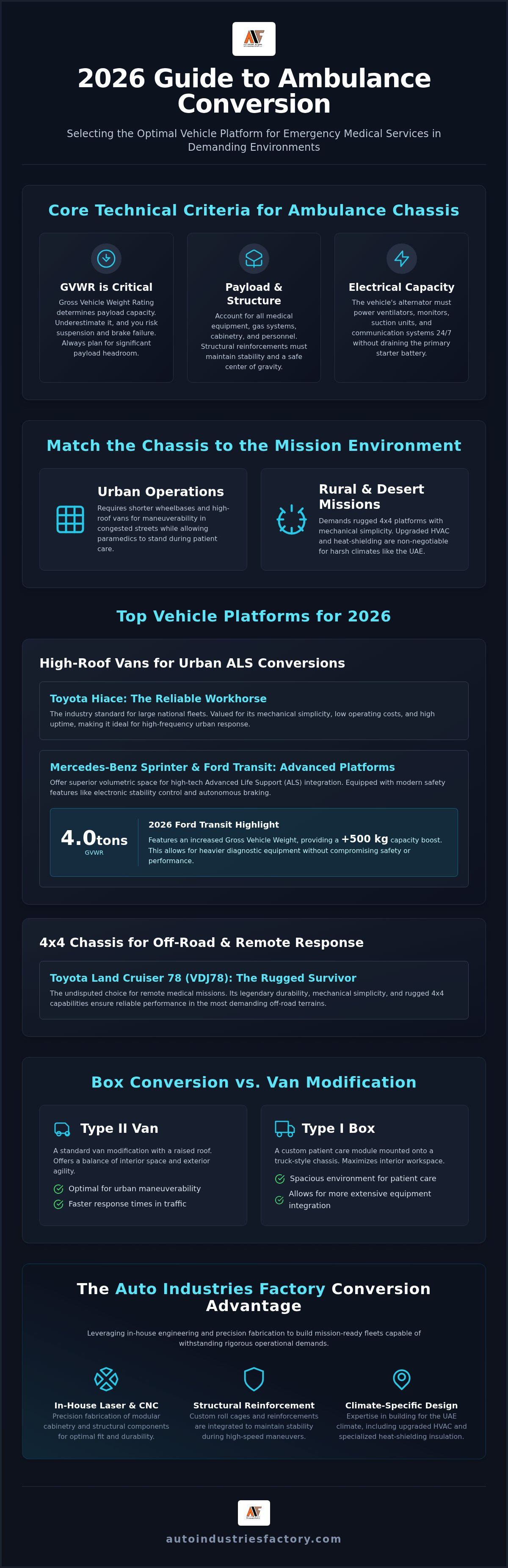
The Gross Vehicle Weight Rating (GVWR) is your most critical figure. Every kilogram of medical gas cylinders, custom cabinetry, and life-saving equipment eats into your payload. We recommend a chassis with significant payload headroom to prevent premature suspension wear and brake failure. For instance, the 2026 Ford Transit has increased its Gross Vehicle Weight to 4.0 tons, providing a 500 kg capacity boost over previous models. This extra headroom is non-negotiable for Advanced Life Support (ALS) builds where heavy diagnostic equipment is standard.
You must also balance interior care space with exterior maneuverability. A larger box offers more room for paramedics to move, but it can hinder response times in congested urban areas. Understanding the various Types of Ambulances helps in deciding between a nimble van-based Type II or a spacious Type I modular unit. Furthermore, the electrical system must have the alternator capacity to power ventilators, monitors, and suction units 24/7 without draining the primary starter battery.
Payload and Structural Integrity
Calculating the total mission weight is the first step in our specialized conversion process. We account for the static weight of medical gas systems and the dynamic weight of personnel. At Auto Industries Factory, we use in-house laser cutting and CNC machining to create structural reinforcements that don't compromise the vehicle's center of gravity. Heavy-duty fabrication, such as custom bull bars and internal roll cages, must be integrated with precision to maintain stability during high-speed emergency maneuvers.
Operational Environment Mapping
Top High-Roof Vans for Urban ALS Conversions
Urban environments present unique challenges for emergency medical services. They require a balance between narrow-street maneuverability and the vertical space necessary for Advanced Life Support (ALS). High-roof vans have emerged as the best vehicles for ambulance conversion in city centers. They allow paramedics to stand while performing life-saving procedures. For 2026, the market offers several distinct platforms, each catering to specific budget and technical requirements.
Toyota Hiace: The Reliable Workhorse
The Toyota Hiace remains the industry standard for national fleet operators across the UAE. Its reputation for mechanical simplicity and low operating costs makes it the preferred choice for high-frequency urban response. We specialize in customizing the high-roof variant; we use in-house CNC machining to install modular cabinetry that maximizes every square centimeter of the interior. By optimizing the layout for medical supply access, we transform this reliable platform into a mission-critical tool. The 2026 models continue to offer the best balance of uptime and maintenance ease for large-scale operations.
Advanced Van Platforms: Sprinter and Transit
For agencies requiring high-tech ALS integration, the Mercedes-Benz Sprinter and Ford Transit offer superior volumetric space. Choosing the best vehicles for ambulance conversion in this category often comes down to payload capacity. The 2026 Ford Transit is particularly notable. It now features an increased Gross Vehicle Weight of up to 4.0 tons. This 500 kg capacity boost allows for heavier diagnostic equipment without exceeding safety limits.
Safety is paramount during high-speed responses. These platforms come equipped with advanced electronic stability control and autonomous braking systems. When converting these vehicles, we ensure all interior components meet rigorous safety benchmarks, such as the NFPA 1917 ambulance standard. This ensures that every mount, cabinet, and oxygen rack remains secure during a 10G impact.
The Chevrolet Express provides a rugged alternative for those needing a heavy-duty American platform. Its body-on-frame construction is exceptionally durable for carrying heavy medical loads. If you're planning a fleet upgrade, our team can help you select the right chassis and design a custom conversion solution tailored to your specific urban medical mission.
Best 4x4 Vehicles for Off-Road Ambulance Conversion
Urban vans, while efficient in city centers, often fail when the pavement ends. For remote medical missions in the UAE, 4x4 platforms are the best vehicles for ambulance conversion. These rugged chassis provide the ground clearance and traction necessary to reach patients in deep sand or rocky wadis. However, converting a standard 4x4 into a life-saving unit requires specialized engineering. The added weight of medical equipment must not compromise the vehicle's off-road agility or safety.
The Toyota Land Cruiser VDJ78 Hardtop
The Toyota Land Cruiser VDJ78 remains the global benchmark for NGOs and remote clinics. Its mechanical simplicity is its greatest strength; it operates reliably in environments that would cripple more complex vehicles. We maximize this platform by engineering custom roof extensions that increase interior standing room without compromising structural integrity. This level of off-road durability is a core specialty of our conversion services. For more context on why this chassis is favored for extreme environments, you can view The Ultimate Guide to Safari Vehicle Conversions.
American 4x4 Platforms for Box Conversions
When the mission demands a mobile ICU or advanced life support in the wilderness, American heavy-duty chassis like the GMC Sierra and Chevrolet Silverado are the primary choices. These platforms are the best vehicles for ambulance conversion when planning Type I box-style builds. They offer the massive payload capacity required to carry extensive medical gas systems and heavy diagnostic equipment. Their high-torque engines are essential for maintaining speed while navigating difficult terrain under full load. We use in-house laser cutting to fabricate custom external storage compartments, keeping bulky rescue gear outside the sterile patient environment. If you are looking to source these types of heavy-duty American trucks or SUVs to begin your project, you can find out more about available pre-owned inventory.
Off-road survival also depends on protecting the vehicle itself. We install custom bull bars and brush guards to shield the radiator from desert debris. Suspension upgrades are equally vital to manage the high center of gravity inherent in box-type conversions. Every modification we perform aims to meet the new standard for ambulance design, ensuring patient and crew safety during rough-terrain transport. For desert rescue missions requiring high-speed agility, the Nissan Patrol offers an excellent alternative, blending immense power with the maneuverability needed for dune-based operations.
Box Conversions vs. Standard Van Modifications
Deciding between a modular box and a standard van modification is a strategic choice that dictates your fleet's operational capability. This decision impacts everything from patient care quality to long-term maintenance costs. While standard vans excel in urban agility, modular boxes are often the best vehicles for ambulance conversion when the mission involves critical care or long-distance transport. Understanding the structural and economic trade-offs is essential for identifying the best vehicles for ambulance conversion for your specific operational needs.
When to Choose a Box-Type Ambulance
Modular box conversions, classified as Type I or Type III, provide the maximum square footage required for complex ICU and neonatal missions. These units offer 36 more square feet of interior space on average than a standard van. This allows for 360-degree patient access; medical teams can work from all sides of the stretcher without restriction. We fabricate these modules using precision aluminum or composite materials to achieve significant weight reduction. The structural distinction is clear: a Type II is an integrated body, whereas Types I and III are separate modules mounted to a chassis-cab. This separation allows for superior vibration dampening and noise reduction in the patient compartment. The economic case is strong because the expensive medical module can be remounted onto a new chassis once the original engine reaches its mileage limit, effectively doubling the life of your medical asset.
The Efficiency of Van-Based Units
Standard van modifications, often referred to as Type II ambulances, are the most efficient choice for rapid response and patient transfer in congested urban environments. Their integrated bodies offer better fuel efficiency and a lower initial investment compared to modular units. Maintenance schedules are also simplified; the vehicle remains a single, cohesive unit from the original manufacturer. These units are highly effective for basic life support where the extreme space of a box is not required. For a technical breakdown of how these units are engineered, see our Ambulance Conversion: The Complete Guide.
Selecting the right platform depends on your medical payload and terrain. If your mission requires a balance of durability and advanced care capacity, we can help you design a custom ambulance conversion tailored to your specific fleet requirements. Our in-house engineering team ensures every build meets the highest national and international safety standards through rigorous fabrication and testing.
The Auto Industries Factory Conversion Advantage
Identifying the best vehicles for ambulance conversion is only the first step in fleet development. The true measure of a medical vehicle lies in its engineering execution. At Auto Industries Factory, we bridge the gap between a standard chassis and a mission-critical life-support system through a rigorous, in-house fabrication process. We don't outsource our core engineering; we control every variable from the initial CAD design to the final structural reinforcement.
Our facility utilizes advanced laser cutting and CNC machining to ensure that every internal component integrates seamlessly with the vehicle's frame. This precision is vital for the UAE’s operational environment, where extreme heat and rugged terrain demand more than just a basic upfit. We specialize in reinforcing the chassis to handle the increased weight of medical cabinetry and heavy-duty accessories like custom bull bars and roof racks, ensuring the vehicle remains stable under full load.
Precision Fabrication and Metalwork
We believe that the best vehicles for ambulance conversion require a master craftsman’s touch. Our technicians use CNC machining to produce medical equipment mounts with zero-tolerance fitment, preventing rattles and mechanical failures during high-speed transport. Beyond structural integrity, we prioritize longevity through professional painting and specialized protective coatings. These finishes aren't just for aesthetics; they provide essential resistance against the corrosive elements of the National climate. To learn more about our facility and engineering philosophy, you can visit our About Auto Industries Factory page.
Maintaining these specialized coatings and ensuring the vehicle's interior meets high sanitary standards is a continuous process. For fleet operators who value meticulous maintenance, Suds Detailing provides an example of the professional mobile services that help preserve the integrity of high-use medical assets.
Mission-Ready Customization
Every medical agency has unique requirements. We tailor our interior layouts to match specific hospital or emergency response protocols, ensuring that paramedics have intuitive access to life-saving tools. Our team integrates advanced communication and telemetry systems, turning the ambulance into a mobile data hub. This level of customization extends across our entire range of specialized vehicles. For insights into how we handle large-scale fleet requirements for other emergency sectors, view our guide on Police Vehicle Modifications.
Quality control is the final, non-negotiable stage of our process. We perform rigorous pressure testing on all medical oxygen lines and load-testing on every electrical circuit. By the time a vehicle leaves our factory, it isn't just an ambulance; it's a reliable, mission-hardened solution built to save lives under the most demanding conditions.
Strategic Fleet Planning for 2026 and Beyond
Building a mission-ready fleet requires more than picking a brand. It's a technical decision where Gross Vehicle Weight Rating and operational terrain dictate the final outcome. You've seen how urban missions benefit from the volumetric efficiency of high-roof vans, while remote desert response demands the rugged 4x4 capability of Toyota and GMC platforms. Selecting the best vehicles for ambulance conversion is the first step in ensuring your team delivers life-saving care without the risk of structural failure or excessive vehicle downtime.
At Auto Industries Factory, we turn your medical requirements into a high-performance reality. Our in-house laser cutting and CNC fabrication ensure every mount and reinforcement is engineered for extreme durability. We provide a full-service solution, managing everything from the initial design and structural metalwork to professional painting and electrical testing. Don't settle for a generic upfit when you can have a mission-specific tool built for the rigorous UAE climate.
Request a Technical Consultation for Your Ambulance Fleet today and secure the longevity of your emergency medical assets. Your mission deserves the highest standard of engineering precision.
Frequently Asked Questions
Which vehicle is best for an Advanced Life Support (ALS) ambulance?
High-roof vans like the 2026 Ford Transit or Mercedes-Benz Sprinter are the best vehicles for ambulance conversion when configuring ALS units. These platforms provide the necessary volumetric space for paramedics to stand and perform advanced procedures. The Ford Transit 350HD, with its 4.0-ton GVWR, allows for heavy diagnostic equipment and ventilators without compromising chassis integrity. We use in-house CNC machining to fabricate secure mounts for these critical care systems.
Can a 4x4 vehicle like the Land Cruiser be used for patient transport?
The Toyota Land Cruiser VDJ78 is specifically engineered for patient transport in remote or off-road environments. While it has a narrower body than a standard van, we install custom roof extensions to increase interior height for medical staff. It remains the global standard for desert rescue and remote clinics due to its mechanical simplicity. We reinforce the chassis and install custom bull bars to ensure survival in the most rigorous National terrains.
What is the difference between a Type I and Type II ambulance?
The primary difference lies in the body structure and mounting method. A Type II ambulance is a standard van with an integrated body, ideal for urban agility and fuel efficiency. A Type I ambulance utilizes a modular box mounted onto a truck chassis, such as a GMC Sierra. The modular box offers significantly more square footage and 360-degree patient access, making it superior for complex ICU or neonatal transport missions where space is critical.
How long does a professional ambulance conversion typically take?
A professional conversion typically takes between 4 to 8 months, depending on the complexity of the medical mission and chassis availability. This timeline ensures we can complete every stage of our in-house process, from CAD design and laser cutting to painting and electrical testing. Large fleet orders or highly specialized ICU units requiring extensive structural reinforcement may fall on the longer end of this range to maintain our rigorous quality control standards.
Are custom-converted ambulances as safe as factory-built units?
Custom-converted ambulances are often safer because they are engineered for specific medical payloads rather than general cargo. We follow international standards like NFPA 1917 and EN 1789, which include 10G crash testing for all interior components. Our in-house fabrication ensures that cabinetry and oxygen racks are structurally integrated into the vehicle’s frame. This level of precision provides protection that standard factory-built cargo vans simply cannot offer without professional modification.
What electrical upgrades are necessary for an ambulance conversion?
Every conversion requires a heavy-duty electrical overhaul to power life-saving equipment. We install high-output alternators and secondary battery systems to ensure medical tools like ventilators and monitors operate without draining the starter battery. Our process includes installing pure sine wave inverters and shore power connections for 24/7 readiness. We use in-house testing protocols to verify the integrity of every circuit, ensuring the best vehicles for ambulance conversion remain reliable in the field.
Do you provide international shipping for converted ambulances?
We manage logistics and shipping for our converted vehicles to clients across the globe. While our primary focus is the National market within the UAE, our engineering solutions are designed to meet international standards for global deployment. We handle the protective crating and documentation required for secure transport. Whether you need a single Toyota Land Cruiser conversion or a full fleet of GMC box ambulances, we ensure mission-ready delivery to your specific location.


