
Is your desert fleet an asset or a liability waiting for a failed RTA inspection? You know that a single structural failure or a safety violation doesn't just pause your operations; it puts your guests at risk and drains your bottom line through excessive maintenance. Substandard fabrication and heat-related component failure are the enemies of a profitable tour business. To secure a professional safari vehicle conversion UAE authorities will certify, you must look beyond the paint and focus on the engineering beneath the chassis.
We've designed this 2026 engineering guide to help you build a mission-ready fleet that survives the harshest dunes. You'll learn the technical requirements for certified Roll Over Protection Systems and the structural reinforcement needed for high-performance platforms like the Toyota Land Cruiser. This guide details how to navigate Federal Decree-Law No. 14 of 2024 and meet the latest RTA dune-bashing standards. From high-tensile steel welding to advanced cooling solutions, we'll show you how to reduce downtime and guarantee maximum safety for every passenger.
Key Takeaways
- Understand why factory-spec 4x4s fail under commercial desert stress and how to identify the structural weak points that cause excessive fleet downtime.
- Master the engineering requirements for a high-tensile steel safari vehicle conversion UAE tour operators need to meet 2026 safety and ROPS standards.
- Compare the technical advantages of open-sided versus enclosed configurations to determine which build best suits your specific tourism mission and guest comfort.
- Discover critical heat management strategies and custom fabrication techniques designed to protect mission-critical engine components from extreme thermal damage.
- Learn to navigate the national approval process to ensure every modified vehicle in your fleet remains fully compliant with RTA and insurance regulations.
Why Standard SUVs Fail: The Necessity of Professional Safari Conversion
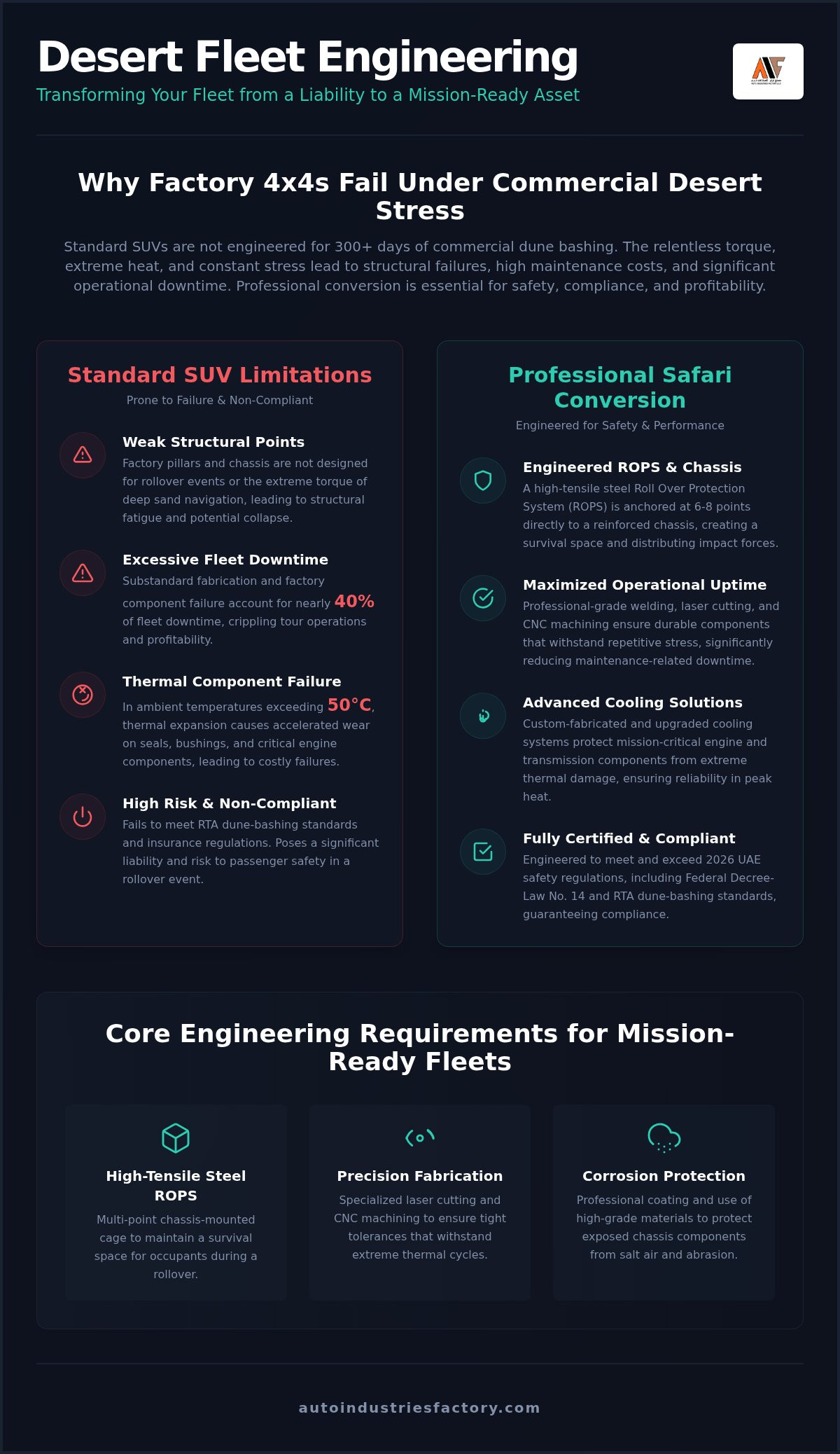
Factory 4x4 platforms like the Toyota Land Cruiser are engineered for durability, but they aren't designed for 300 days of commercial dune bashing. Standard suspension components and chassis points eventually yield under the relentless torque of deep sand navigation. When you invest in a safari vehicle conversion UAE specialists provide, you're addressing these factory weak points before they become catastrophic failures. Substandard fabrication often accounts for nearly 40% of fleet downtime, as poor welds and low-grade steel crack under the repetitive stress of high-speed desert excursions. Professional engineering is the only way to ensure your fleet remains operational and profitable.
To better understand the scope of professional modification, watch this helpful video:
Environmental Challenges for National Safari Fleets
National desert environments present a unique engineering hurdle: extreme heat. Ambient temperatures often exceed 50°C, causing significant thermal expansion in metal components. Without professional-grade machining, these changes lead to accelerated wear on seals and critical metal-to-metal contact points. Fine desert sand acts as a relentless abrasive, infiltrating factory bushings and destroying structural integrity over time. For fleets operating near the coast, salt air accelerates corrosion on exposed chassis components, making high-tensile steel and professional coating non-negotiable. Our builds use specialized laser cutting and CNC machining to ensure tolerances that withstand these extreme thermal cycles and abrasive conditions.
Commercial vs. Private Modification Standards
A private weekend build doesn't face the same liability or mechanical load as a commercial tour truck. Commercial vehicles require much higher safety factors to protect both the passengers and the tour operator's reputation. This is where Roll Over Protection Structures (ROPS) become essential for mission-ready status. A professional safari vehicle conversions partner balances the need for panoramic views with the absolute requirement for structural rigidity. We focus on maintaining a low center of gravity while reinforcing the chassis, ensuring the vehicle remains stable even when fully loaded with guests. This engineering precision is what separates a reliable fleet from a costly liability. Every weld and reinforcement is a calculated step toward maximum guest safety and reduced long-term maintenance costs.
Engineering Structural Safety: ROPS and Chassis Reinforcement
Every professional safari vehicle conversion UAE tour operators commission must prioritize occupant survival over aesthetics. While factory 4x4s are capable machines, the inherent limitations of standard SUVs mean their pillars aren't designed to support the vehicle's full weight during a high-speed, multi-roll desert event. We solve this through a mission-ready structural reimagining. This involves integrating high-tensile steel cages that distribute impact forces across the entire frame rather than concentrating stress on the roofline. By reinforcing the chassis, we ensure the vehicle handles the extreme torque of dune navigation without structural fatigue.
The Role of ROPS in Passenger Protection
A Roll Over Protection System (ROPS) is a specialized steel framework designed to maintain a survival space for occupants by preventing the vehicle roof from collapsing during a rollover. Unlike cosmetic bars, a commercial-grade ROPS requires a multi-point attachment strategy. We anchor these systems directly to the chassis at six or eight strategic points. This ensures that the energy from a dune-descent impact is absorbed by the strongest part of the vehicle frame. In the UAE, these systems must undergo rigorous biannual inspections to ensure they meet national safety and RTA standards for commercial dune-bashing certification.
Advanced Metalwork and Welding Standards
Precision is the difference between a safety system that holds and one that fails under pressure. We utilize in-house laser cutting and CNC machining to create structural components with sub-millimeter accuracy. This precision allows for tighter tolerances at the joints, which is critical for structural welding integrity. Standard workshop welding isn't sufficient for these applications; we employ specialized fabrication techniques to ensure deep penetration and zero porosity in every seam.
- High-Tensile Steel: We use specific steel grades that offer superior strength-to-weight ratios to avoid making the vehicle top-heavy or unstable.
- Structural Reinforcement: Custom gussets and plating are added to high-stress chassis areas to handle the repetitive G-forces of sand dune transitions.
- Corrosion Protection: Every cage receives specialized coatings to resist the salt air and fine sand that characterize the UAE's environment.
Balancing these safety measures with the guest experience is a technical challenge we've mastered. We design our cages to follow the interior contours of the Toyota Land Cruiser or Hilux platforms. This allows for maximum visibility through the windows while maintaining a rigid safety cell around the passengers. If you're looking to upgrade your fleet's safety profile, you can explore our specialized vehicle conversion services to see how we integrate these systems without compromising guest comfort.
Evaluating Build Configurations: Open-Sided vs. Enclosed Safari Vehicles
Selecting the ideal configuration for a safari vehicle conversion UAE project is a strategic decision based on your specific tour mission. The Toyota Land Cruiser and Hilux platforms serve as the foundation for these builds, favored for their unmatched durability in deep sand. However, the choice between an open-sided or enclosed configuration determines how your guests interact with the desert landscape and how the vehicle handles the UAE's environmental extremes.
The Open-Sided Advantage for Tourism
Open-sided conversions are the gold standard for premium tourism. They offer guests an immersive, 360-degree panoramic view that enclosed vehicles simply cannot match. This configuration is particularly effective for wildlife photography and high-end sunset tours where visibility is the primary selling point. From an engineering perspective, removing the factory roof and pillars requires a complete structural reimagining. We replace the original support system with a certified ROPS that maintains the vehicle's integrity. To handle variable weather, we integrate dust-mitigation systems and heavy-duty, removable weather protection panels. This allows operators to adapt to shifting conditions while maintaining a premium guest experience.
Enclosed Builds for Extreme Environments
Navigating the technical requirements for these different configurations requires a deep understanding of UAE vehicle modification regulations. Whether you need an open-cabin build for luxury tours or a reinforced enclosed truck for expeditions, our specialized vehicle conversion services provide the engineering precision needed for a mission-ready fleet. Every build is a balance of guest comfort, structural safety, and regulatory compliance.
Performance Upgrades: Heat Management and Custom Accessory Fabrication
Extreme heat is the primary cause of mechanical failure in the national desert environment. A mission-ready safari vehicle conversion UAE project requires a specialized approach to thermal management to ensure long-term fleet survival. High-load driving in deep sand forces engines to operate at high RPMs with minimal airflow, pushing factory cooling systems far beyond their original design limits. Without engineering intervention, this leads to transmission overheating and engine fatigue.
Thermal Management and Cooling Solutions
When ambient temperatures exceed 50°C, standard radiators cannot dissipate heat fast enough to protect the drivetrain. We replace these with high-efficiency, multi-core aluminum units and add secondary oil coolers for both the engine and transmission. Heat shielding is equally critical; we install reflective barriers to protect fuel lines and electrical looms from radiant exhaust heat. Additionally, air intake systems are modified with high-performance filtration and raised inlets to prevent sand ingestion. This prevents the internal engine scouring that often occurs during high-speed dune transitions. We also implement enhanced cooling for the braking system to maintain stopping power during repeated descents.
Custom Metal Accessory Integration
Structural protection is as much about engineering precision as it is about material durability. Our in-house laser cutting and CNC machining allow for the fabrication of custom bull bars and bumpers that optimize approach and departure angles. These aren't just aesthetic additions; they're calculated structural components that protect the vehicle's vital organs from impact. Rear bumpers are engineered with integrated swing-away carriers for dual spare tires and extra fuel, ensuring the vehicle remains balanced while carrying mission-critical supplies deep into the desert.
To handle the increased weight of these accessories and a full passenger load, we tune the suspension with heavy-duty springs and remote-reservoir shocks. This ensures the vehicle maintains its ride height and stability across varied desert terrain, preventing the "bottoming out" that damages the chassis. Every metal canopy and roof rack we build is designed to minimize aerodynamic drag while providing a secure platform for recovery gear. This precision engineering reduces long-term maintenance costs by preventing the stress-related failures common in substandard builds.
If you're ready to build a fleet that survives the heat and the dunes, view our specialized vehicle conversion solutions to start your project.
Compliance and Quality: Meeting National Standards for Modified Vehicles
Compliance is the final, most critical stage of any safari vehicle conversion UAE project. Without official certification, even the most robustly engineered vehicle remains a legal liability. National safety mandates for 2026, including Federal Decree-Law No. 14 of 2024, prohibit any structural modification without prior approval from the licensing authority. Failing to meet these standards doesn't just lead to fines starting at AED 1,000. It can result in vehicle impoundment for up to 30 days and severe penalties reaching AED 50,000 for major unauthorized changes. For a commercial fleet, these risks are unacceptable.
The Path to Full Regulatory Compliance
Navigating the approval process requires comprehensive technical documentation and precision engineering. This includes detailed drawings of the ROPS and proof of structural integrity for any chassis reinforcements. National authorities require safari vehicles to undergo an annual inspection, with a mandatory re-inspection every six months to maintain dune-bashing certification. These rigorous checks verify the condition of seatbelts, fire extinguishers, and the physical integrity of the roll cage. Professional certification is also vital for maintaining fleet insurance. If you modify a vehicle without informing your provider, they can deduct up to 20% from a claim payout or void the policy entirely. We ensure every build is documented to meet these strict requirements.
The Auto Industries Factory Engineering Process
We eliminate the risk of regulatory rejection by integrating compliance into our initial design phase. Our in-house conversion services start with 3D modeling and prototyping to ensure every component fits within the national regulatory framework. By using in-house laser cutting and CNC machining, we maintain total control over material tolerances and weld quality. This master-craftsman approach ensures that every mission-critical joint is robust and reliable.
- Quality Control: We implement strict protocols to ensure zero porosity in structural welds, using high-tensile steel that meets international safety grades.
- Prototyping: Every new configuration is modeled to verify the center of gravity and weight distribution before fabrication begins.
- Commissioning: Final testing includes stress-testing the cooling systems and verifying that all GPS tracking and safety equipment are fully operational.
This no-nonsense approach to engineering ensures that your fleet is mission-ready from day one. We don't just build vehicles; we provide certified solutions that protect your passengers and your business reputation. By aligning our fabrication with national standards, we reduce your long-term maintenance costs and guarantee a seamless registration process every year. It's about providing the peace of mind that comes with expert engineering and total compliance.
Secure Your Fleet's Future in the Desert
Operating a successful tour business in the UAE requires more than a passion for the dunes. It demands a vehicle that can withstand 50°C temperatures and the relentless structural stress of daily commercial use. We've explored how a professional safari vehicle conversion UAE project integrates certified ROPS and advanced cooling systems to prevent the costly downtime that plagues substandard builds. By prioritizing rugged, RTA-compliant engineering, you protect your passengers and your brand's reputation simultaneously.
At Auto Industries Factory LLC, we specialize in the Toyota Land Cruiser and Hilux platforms. Our in-house CNC and laser-cutting capabilities ensure that every structural modification meets the highest precision standards. We don't just add accessories; we engineer mission-ready solutions that thrive in the national desert environment. It's time to move beyond factory limitations and build a fleet designed for commercial survival.
Request a Consultation for Your Custom Safari Fleet to start your project. Your guests deserve the safety and comfort that only master-crafted engineering can provide. Let's build something that lasts.
Frequently Asked Questions
Is a roll cage (ROPS) mandatory for safari vehicles in the UAE?
A certified Roll Over Protection System (ROPS) is mandatory for any vehicle used for commercial dune bashing in the UAE. National safety standards require these cages to pass bi-annual inspections to ensure structural integrity. This framework must be anchored directly to the chassis to protect passengers during a rollover. Without a certified cage, your vehicle will fail the mandatory RTA inspection and won't receive a permit for desert operations.
Which vehicle platform is best for a safari conversion: Land Cruiser or Hilux?
The Toyota Land Cruiser remains the industry standard for high-capacity passenger tours due to its robust chassis and interior volume. However, the Toyota Hilux is an exceptional platform for specialized utility builds or smaller, more agile tour groups. Both platforms offer excellent durability in deep sand and extreme heat. Your choice depends on whether you prioritize maximum guest capacity or a more rugged, utility-focused configuration for your mission-ready fleet.
How long does a professional safari vehicle conversion typically take?
The timeline for a professional safari vehicle conversion UAE project depends on the build's complexity and the specific configuration required. A standard structural reinforcement with ROPS integration typically takes several weeks of precision fabrication. Custom projects involving open-sided conversions or advanced thermal management systems may require additional time for 3D modeling and final commissioning. We focus on engineering precision to ensure every build meets national safety mandates before it leaves our facility.
Can I convert my existing 4x4 into an open-sided safari truck?
You can convert an existing 4x4 into an open-sided configuration, provided the vehicle's chassis is structurally sound. This process involves removing the factory roof and pillars, which must be replaced by a certified, multi-point Roll Over Protection System. It's not a simple aesthetic change; it requires advanced laser cutting and CNC machining to maintain structural rigidity. We evaluate every platform to ensure it can support the mission-critical safety framework required for tourism.
What are the essential safety features required for RTA-compliant safari builds?
RTA-compliant safari builds must include a certified roll cage, high-visibility seatbelts for all passengers, and a securely mounted fire extinguisher. Additionally, vehicles must be equipped with a functional GPS tracking system and a comprehensive first aid kit. Every six months, these features undergo a mandatory re-inspection to verify they remain in peak condition. We ensure that every weld and attachment point on the safety framework meets the latest national requirements for commercial desert use.
How does a safari conversion affect the vehicle’s original warranty?
Structural modifications like a safari vehicle conversion UAE build typically void the manufacturer's warranty on the affected components. However, professional engineering and high-quality fabrication mitigate this risk by exceeding factory durability standards. It's vital to discuss these changes with your insurance provider to ensure your fleet remains covered. We focus on using high-tensile steel and precision welding to ensure your modified vehicle is more robust and reliable than the original factory-spec 4x4.
What maintenance is required for a modified safari fleet in high-heat conditions?
High-heat conditions require daily inspections of the cooling system, including radiator levels and oil cooler efficiency. You must also regularly clear fine desert sand from air intakes and suspension components to prevent abrasive wear. Structural maintenance involves checking ROPS mounting points and weld seams for stress fractures caused by repetitive dune impacts. Consistent maintenance ensures your fleet stays operational during the peak summer months when ambient temperatures often exceed 50°C.
Are there specific regulations for seating capacity in modified tour vehicles?
National regulations dictate seating capacity based on the vehicle's original gross weight and the structural integrity of the modified cabin. Every passenger seat must be anchored to reinforced floor points and equipped with certified safety belts. During the RTA approval process, the seating layout is inspected to ensure it doesn't compromise the vehicle's center of gravity. We design our configurations to maximize passenger comfort while strictly adhering to these national safety and load-bearing mandates.


