

Is your current ambulance fleet struggling to keep up with operational demands? Cramped patient compartments, insufficient storage for advanced life support equipment, and chassis that weren't built for the rugged conditions of Oman's diverse terrain can compromise patient care and crew safety. For emergency services facing these critical challenges, the standard van conversion is often no longer the optimal solution. The strategic shift towards a purpose-built box type ambulance offers a decisive advantage in durability, space, and mission-critical efficiency.
This definitive guide explores the core benefits of this advanced, heavy-duty design. We will detail how the robust, modular construction provides a safer, more ergonomic workspace for medics and a superior care environment for patients. You will discover the key factors in customizing a vehicle to your exact specifications-from interior layouts optimized for workflow to chassis selections engineered for longevity. Prepare to learn how to specify the perfect ambulance that meets rigorous safety standards and empowers your team to save lives more effectively, call after call.
What is a Box Type Ambulance? (And How It Differs)
A box type ambulance, officially classified as a Type I ambulance, represents the pinnacle of heavy-duty emergency vehicle design. Its core concept is straightforward yet powerful: a custom-fabricated patient compartment (the "box") is mounted onto a separate truck chassis cab. This modular construction is fundamentally different from other common Ambulance types and provides unparalleled strength and versatility.
This design allows for two primary cabin access configurations: a simple 'pass-through' window for communication and passing items, or a full 'walk-through' portal that allows crew members to move directly between the driver's cab and the patient module without exiting the vehicle. This flexibility is a key advantage for operational efficiency and safety.
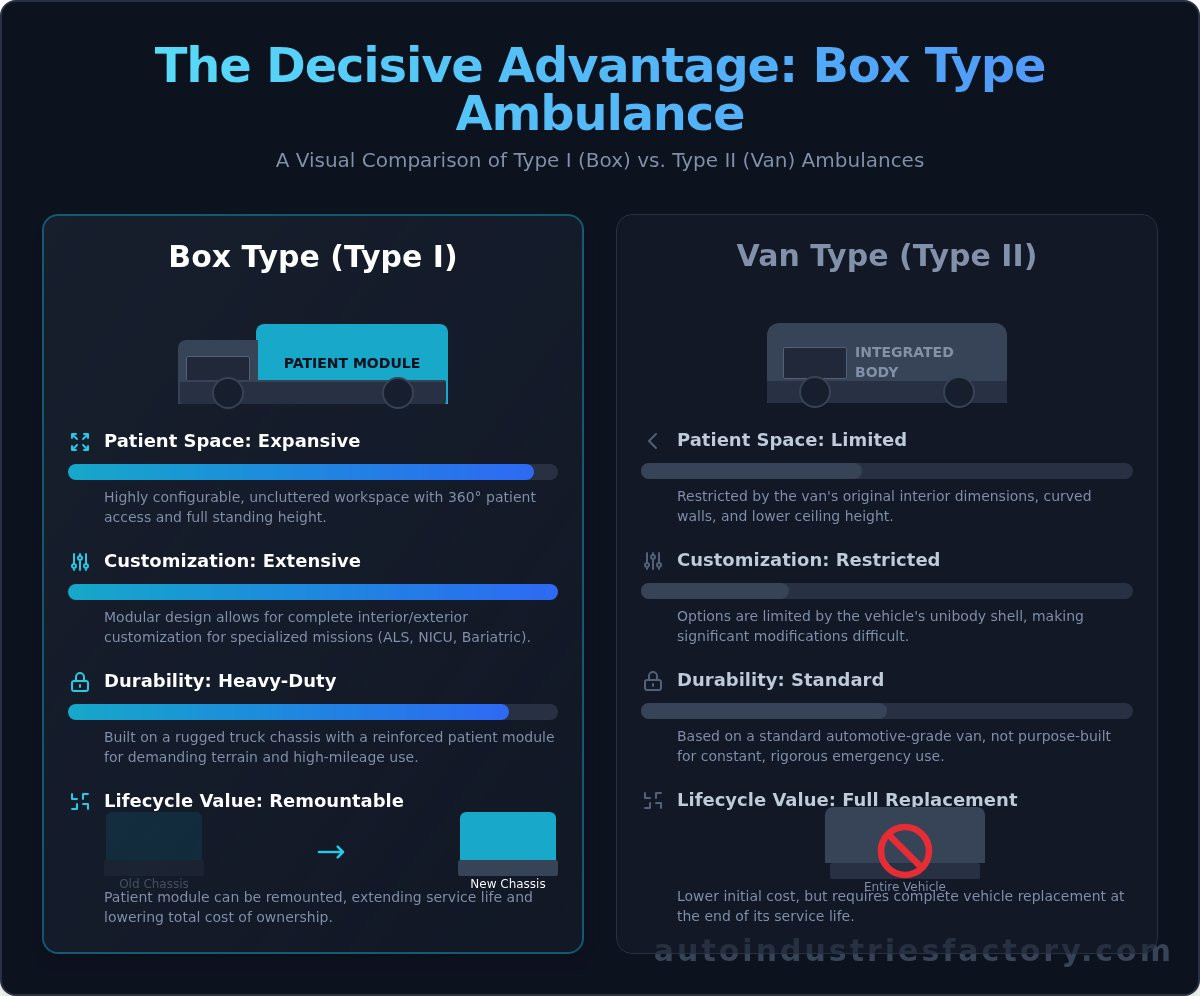
Box Type (Type I) vs. Van Type (Type II)
The most significant difference between a box type ambulance and its van-based (Type II) counterpart lies in its robust, non-integrated build. While van ambulances are conversions of a standard unibody vehicle, the Type I's separate components offer superior performance in critical areas.
The separate chassis provides a much higher Gross Vehicle Weight Rating (GVWR), enabling it to carry more life-saving equipment and specialized technology without compromising performance. Furthermore, the patient module can be refurbished and remounted onto a new chassis, extending its operational life and delivering an excellent long-term return on investment.
Ideal Use Cases and Applications
The superior design and rugged construction of the box type ambulance make it the definitive choice for demanding emergency services, especially in challenging environments like those found across Oman.
- Advanced Life Support (ALS): Provides the necessary space for the extensive equipment, supplies, and personnel required for critical pre-hospital care.
- Specialty Transport: Easily configured for unique missions, such as bariatric patient transport, mobile neonatal intensive care units (NICU), or mobile clinics.
- Rugged and Rural Operations: The heavy-duty truck chassis delivers the power, ground clearance, and reliability needed to navigate demanding off-road and remote terrain with confidence.
- Fleet Longevity: Perfect for governmental and private services seeking a cost-effective, long-term fleet solution where the high-value patient module can outlive multiple chassis.
The Strategic Advantages of a Box Body Construction
Choosing a box type ambulance is a strategic decision that prioritizes long-term value and operational excellence. Unlike standard van conversions, the box body design is engineered from the ground up as a mission-critical medical platform. Its advantages are built on three core pillars: unparalleled Space, robust Safety, and superior Serviceability. This purpose-built construction directly enhances crew efficiency and elevates the standard of patient care, making it a sound investment for any emergency service operating in demanding environments.
Unmatched Workspace and Layout Freedom
The primary advantage of a box body is the sheer volume of optimized workspace. The square, straight-walled interior eliminates the restrictive curves of a van, allowing for the logical and secure mounting of cabinets, life-support systems, and diagnostic equipment. This creates an uncluttered environment where medical teams have true 360-degree access to the patient. Higher ceilings provide essential headroom, allowing personnel to stand, move, and perform critical procedures without hindrance, dramatically improving ergonomics and reducing fatigue during transit.
Enhanced Structural Integrity and Safety
Safety is non-negotiable. The patient module of a box type ambulance is a purpose-built, reinforced structure engineered for maximum occupant protection. Because the box is separate from the vehicle chassis, it offers superior integrity in the event of a collision or rollover. This modular design allows for construction that meets and exceeds modern ambulance safety standards, which are based on rigorous testing and data. Furthermore, the construction allows for advanced thermal and acoustic insulation, protecting patients and crew from Oman's extreme heat and reducing road noise for a more stable care environment.
Durability, Longevity, and Remounting Potential
Built with heavy-duty materials, the patient box is designed to withstand the rigors of daily emergency response for years. Its robust construction means it is more resilient to wear and tear, and in the event of damage, repairs can often be isolated to a specific panel without compromising the entire vehicle. The most significant economic benefit is its remounting capability. When the base vehicle chassis reaches the end of its service life, the high-value, custom-outfitted medical module can be refurbished and transferred to a new chassis, extending your investment and significantly lowering the total cost of ownership over time. Build a durable fleet with our expert fabrication.
Anatomy of a Box Ambulance: Key Fabrication Elements
A world-class ambulance is more than just a vehicle; it's a precisely engineered mobile medical environment. At our state-of-the-art facility, we control every stage of fabrication, from initial design to final finishing. This behind-the-scenes look reveals how advanced materials and expert craftsmanship combine to create a box type ambulance built for reliability and performance in demanding conditions, from bustling city streets to remote rural landscapes.
The Subframe and Mounting System
The critical link between the vehicle chassis and the patient module is the subframe. We fabricate this foundation from heavy-duty steel or high-strength aluminum, ensuring maximum structural integrity. This is not just a simple mount; it incorporates advanced shock and vibration-dampening systems. This engineering is vital for protecting sensitive medical equipment and providing a stable, comfortable ride for patients, even on Oman's most challenging terrains.
Patient Compartment Construction
The patient module itself is a testament to purposeful design. The framework is constructed from a robust, welded aluminum or steel tube cage for ultimate occupant safety. For the exterior, we use smooth, single-piece aluminum or composite panels that resist corrosion and are easy to decontaminate. Inside, the focus is on safety and hygiene:
- Advanced Insulation: High-density foam board provides superior thermal control against Oman's extreme heat and dampens road noise for a calmer patient environment.
- Seamless Interior Surfaces: We utilize medical-grade, non-porous materials for walls, flooring, and cabinetry to eliminate seams where pathogens can hide, ensuring top-tier infection control.
Integrated Electrical and Medical Gas Systems
A modern ambulance is a hub of advanced technology. Our experts design and install a robust, independent electrical system with dedicated wiring harnesses to power life-support devices, communication systems, and lighting without fail. This system is isolated from the chassis's main electrics to prevent interference and ensure mission-critical reliability. All oxygen lines and electrical wiring are meticulously routed for safety, accessibility, and ease of service. Externally accessible compartments house batteries and oxygen tanks for rapid inspection and replacement, while a powerful, climate-controlled HVAC system maintains a stable environment for patients and crew-a non-negotiable feature in the Omani climate.
This integrated approach to fabrication, where every component is designed to work in harmony, is what defines a superior emergency vehicle. It ensures every box type ambulance we deliver is a fully cohesive, durable, and dependable life-saving platform, ready for immediate deployment across Oman.
Customization: Designing a Mission-Ready Interior
In emergency medical services, a standard, off-the-shelf vehicle is never the optimal solution. The interior of a box type ambulance must be a direct reflection of its intended mission, meticulously engineered to support the specific protocols of its crew. A thoughtfully designed layout is not a luxury; it is a mission-critical asset that enhances workflow, reduces equipment deployment times, and ultimately improves patient outcomes. This level of precision is achieved through close collaboration between expert fabricators and the frontline medical professionals who will operate the vehicle daily.
Layouts for Different Medical Missions
The operational demands of an ambulance dictate its internal architecture. We engineer custom layouts tailored for a range of specialized duties, ensuring every component is placed for maximum efficiency and safety. This mission-specific approach guarantees that crews have the tools and space they need, when they need them most.
- Advanced Life Support (ALS): Configured with multiple seating positions for a full medical team, extensive cabinetry for advanced medications, and stations for cardiac monitors and ventilators.
- Critical Care Transport (CCT): Designed with ample space and reinforced mounting points for specialized heavy-duty equipment like intra-aortic balloon pumps (IABP), ECMO machines, and multiple infusion pumps.
- Bariatric Transport: Features a wider floor plan, heavy-duty cot retention systems, and integrated winch and ramp systems for safe and dignified patient handling.
- Neonatal Units (NICU): Built with a specialized power supply, climate control, and a vibration-dampening mounting system for a transport incubator and its life-support equipment.
Cabinetry, Seating, and Equipment Mounting
The durability and functionality of an ambulance interior depend on superior materials and engineering. We utilize lightweight, high-strength aluminum for custom cabinetry, providing durable storage without adding unnecessary weight. All critical medical equipment-from cots to defibrillators-is secured using certified mounting tracks and brackets for safety during transit. Ergonomic, certified seating with integrated restraints protects the crew, while strategic LED lighting illuminates the patient area without creating glare, ensuring optimal conditions for patient care.
Material Selection and Infection Control
An effective ambulance design prioritizes a sterile environment. The interior of every box type ambulance we build is constructed with non-porous, chemical-resistant surfaces that can withstand rigorous cleaning protocols. We install seamless, medical-grade flooring with coved edges to eliminate seams where contaminants can gather. High-touch surfaces can be treated with antimicrobial coatings to further inhibit the growth of pathogens, ensuring the vehicle meets the stringent healthcare standards required in Oman and across the region. Discover more about our advanced fabrication capabilities at autoindustriesfactory.com.
Why Auto Industries Factory Excels in Box Ambulance Fabrication
Understanding the design and benefits of a box type ambulance is critical, but choosing the right fabricator is what guarantees performance, safety, and long-term value. At Auto Industries Factory, we move beyond theory to deliver proven, mission-ready emergency vehicles. Our state-of-the-art facility in the UAE is strategically positioned to serve clients across Oman, providing unmatched expertise in specialized vehicle conversion.
Precision In-House Fabrication
We maintain absolute control over every stage of the manufacturing process. From initial CAD design and precision CNC laser cutting to expert welding and flawless finishing, our entire workflow is managed in-house. Our technicians are masters in fabricating with heavy-duty steel and aluminum, ensuring every component meets our exacting standards. This commitment to quality results in a rugged and reliable box type ambulance body built to withstand the harshest operational demands year after year.
Engineered for Oman's Demanding Environment
Operating in Oman requires vehicles engineered for extreme heat, sand, and varied terrain. Our extensive experience in the GCC region means we build ambulances that are proven to perform here. Key advantages include:
- Superior Climate Control: We integrate high-output HVAC systems and advanced insulation packages to protect patients and sensitive medical equipment from desert heat.
- Robust Undercarriage: We provide expert recommendations for heavy-duty chassis and suspension upgrades to ensure reliability on both urban roads and rugged off-road tracks.
- Durable Construction: Our fabrication techniques and material choices are specifically selected to resist corrosion and wear associated with the local climate.
Commitment to International and Regional Standards
Safety and compliance are paramount. We have the proven capability to manufacture vehicles that meet stringent international standards, including European EN 1789 and regional GSO specifications. Our rigorous quality control protocols are enforced at every step of the build. We work closely with Omani government agencies and private healthcare providers to ensure every vehicle meets specific local requirements, delivering a fleet that is fully compliant and ready for immediate deployment.
Partner with an industry leader to build an ambulance fleet you can depend on. Request a free estimate for your custom box ambulance.
Your Premier Partner for Mission-Ready Ambulance Fabrication
Ultimately, the decision to invest in a box body ambulance is a strategic one. The design offers unparalleled advantages in patient care space, equipment storage, and crew safety, far surpassing the limitations of standard van conversions. However, translating these benefits from blueprint to reality demands meticulous engineering, premium materials, and an unwavering commitment to quality at every stage of fabrication.
At Auto Industries Factory, we specialize in delivering on that commitment. As a leading vehicle conversion specialist based in Ajman, UAE, we are proud to serve emergency service providers throughout Oman. Our complete in-house design, fabrication, and assembly capabilities give us total control over quality. This ensures every box type ambulance we build not only meets but exceeds the rigorous demands of EN 1789 and GSO standards.
Your fleet is the backbone of your life-saving operations. Ensure it is equipped with the most durable, reliable, and functional vehicles available. Discuss your ambulance fleet requirements with our specialists today. Let’s engineer a solution built for performance and dependability.
Frequently Asked Questions
What is the typical lifespan of a box type ambulance module?
A high-quality patient module, fabricated from durable materials like reinforced aluminum and composite panels, is engineered for extreme longevity. With proper maintenance and care, the box itself can last between 10 to 15 years, often outliving the original vehicle chassis. This robust construction ensures a long-term return on investment, as the module is designed to withstand the demanding operational conditions found in Oman's diverse environments.
How does the cost of a box type ambulance compare to a van conversion?
Initially, a box type ambulance represents a higher capital investment compared to a standard van conversion, with prices often starting from $65,000 to $90,000 USD depending on the chassis and medical fit-out. However, its superior long-term value comes from its larger workspace, higher payload capacity, and the crucial ability to be remounted onto a new chassis. This remounting capability significantly lowers the total cost of ownership over the vehicle's extended operational life.
Are box type ambulances more difficult to drive or maneuver?
While larger than van-based units, modern box type ambulances are engineered for superior handling and stability. Features like heavy-duty suspension upgrades, advanced braking systems, and optional 360-degree camera systems greatly enhance driver control. Drivers typically adapt quickly to the vehicle's dimensions, finding the commanding road presence and visibility to be significant advantages when responding to emergencies in challenging conditions across Oman.
What international safety and medical standards can a custom box ambulance meet?
Auto Industries Factory specializes in fabricating ambulances that comply with rigorous international standards. Our custom builds can be engineered to meet European Union specifications (EN 1789), American KKK-A-1822 standards, or Global Medical Response (GMR) guidelines. We work directly with clients, including Omani health authorities and private operators, to ensure every vehicle meets these global benchmarks and adheres to specific regional regulations for safety and equipment.
Can the patient box be transferred to a new truck chassis later?
Yes, absolutely. One of the most significant financial benefits of a box type ambulance is its remounting capability. The patient care module is a structurally independent unit designed to be transferred, or "remounted," onto a new, compatible truck chassis when the original vehicle reaches the end of its service life. This process saves organizations a substantial amount compared to purchasing an entirely new ambulance, maximizing the return on their initial investment.
What is the average production timeline for a custom-built box ambulance?
The production timeline for a custom-built box ambulance is contingent on chassis availability, the complexity of the medical interior, and the level of specialized equipment required. On average, a complete build from chassis arrival to final delivery takes between 90 to 120 days. Our streamlined fabrication process ensures efficiency without compromising our commitment to precision engineering and flawless quality, delivering a mission-ready vehicle built to your exact specifications.


