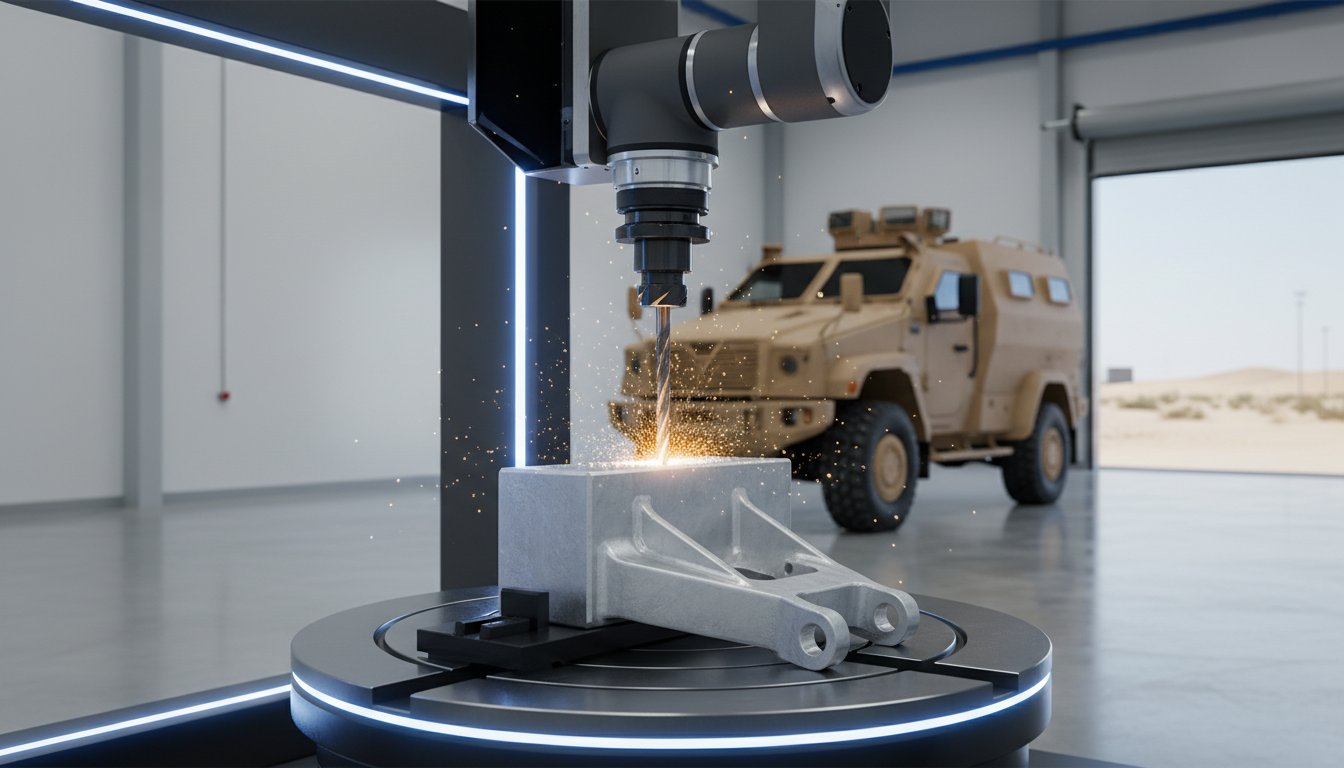
Imagine a critical mission suddenly halted. A fleet manager discovers a standard suspension bolt has sheared clean off under the immense stress of a challenging desert environment. It wasn't just a mechanical failure; it was a total mission halt. You've likely seen how factory-grade parts struggle under extreme 50-degree Celsius heat and punishing terrain. When your fleet handles medical emergencies or tactical defense, generic components often result in dangerous downtime. This is why CNC machining for custom vehicle components has become the essential engineering standard for operators who can't afford a single point of failure.
We understand that you need parts that don't just fit but actually enhance the structural integrity of your specialized units. You'll learn how high-precision CNC machining transforms standard vehicles into rugged, mission-ready assets for military, medical, and extreme off-road use. At Auto Industries Factory LLC, our advanced engineering support is designed to cut lead times by 40% and provide the durable, precision-fitment solutions your mission-critical fleet requires to stay operational in the harshest conditions on earth.
Key Takeaways
- Identify why standard mass-produced parts fail in specialized fleet environments and how custom engineering provides the necessary reliability for mission-critical tasks.
- Explore the technical advantages of 5-axis CNC machining for custom vehicle components to achieve complex geometries and significantly reduced lead times for urgent upfitting projects.
- Understand the specialized role of precision-engineered mounts and armoring plates in enhancing safety for ambulance conversions and tactical durability for military units.
- Discover the critical material selection process, including the use of 7075 Aluminum, to ensure fleet components withstand Oman’s extreme heat and high-humidity conditions.
- Learn how to leverage end-to-end fabrication expertise to transform standard vehicles into specialized, high-performance units through advanced in-house design and installation.
What is CNC Machining for Custom Vehicle Components?
The engineering of specialized vehicles requires more than just standard mechanical skills; it demands extreme accuracy. At its core, Computer Numerical Control (CNC) is a subtractive manufacturing process. It uses pre-programmed software to dictate the movement of factory tools and machinery. Unlike manual fabrication, where a technician might cut or weld by eye, CNC systems interpret a 3D CAD model to carve parts from solid blocks of material with a precision of ±0.005mm. This level of detail is the foundation of CNC machining for custom vehicle components, ensuring that every bracket, mount, and housing meets exact specifications before it ever reaches the assembly floor.
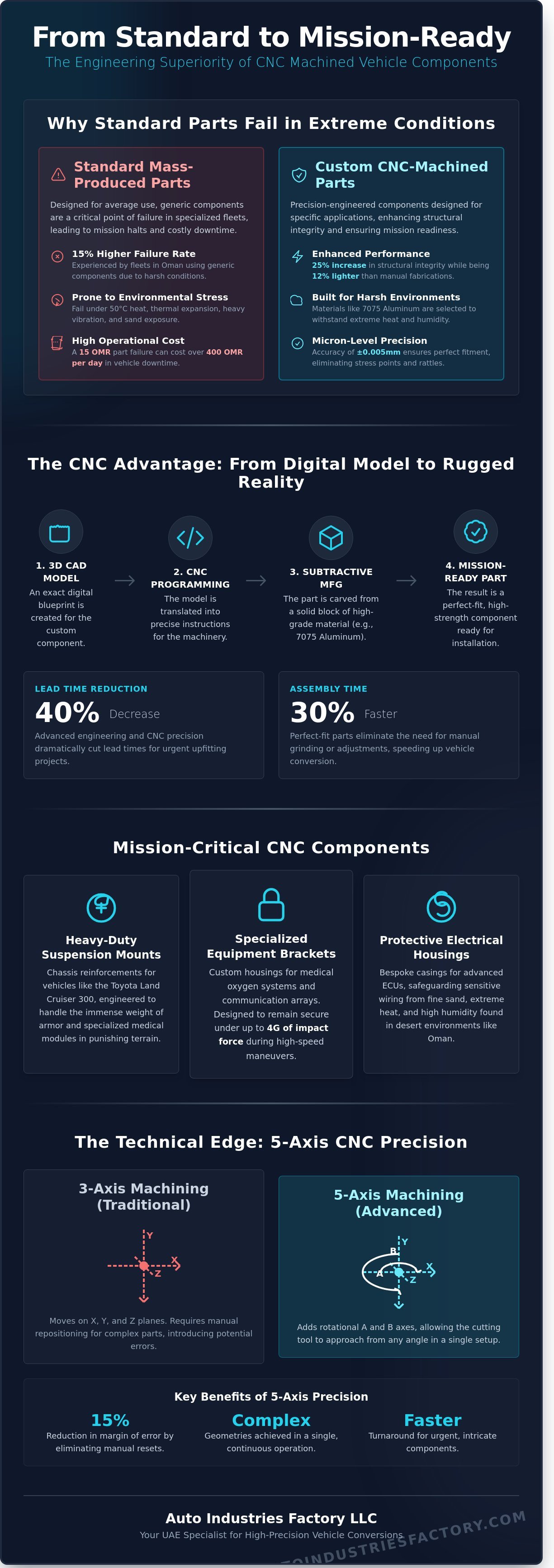
Standard parts fail because they're designed for the average user, not for the grueling conditions of a specialized fleet. In Oman, fleet operators for emergency services or desert patrol units face a 15% higher mechanical failure rate when relying on generic, mass-produced components. These parts often lack the structural integrity to handle the 50°C thermal expansion cycles found in Muscat or the heavy vibration of off-road transit in the Al Hajar Mountains. A generic steel bracket might only cost 15 OMR, but if it snaps during a mission, the resulting vehicle downtime can cost a fleet operator over 400 OMR per day in lost operational capacity.
The industry is seeing a decisive shift from generic fabrication to precision engineering. Modern vehicle conversions for tactical or medical use no longer rely on "close enough" fitment. By adopting CNC machining for custom vehicle components, engineers can create parts that are lighter yet significantly stronger. Auto Industries Factory LLC specializes in integrating CNC precision into every specialized vehicle conversion. Auto Industries Factory LLC has found that moving away from manual cutting reduces component weight by 12% while increasing structural integrity by 25%. This engineering-first approach ensures that every modification enhances the vehicle's performance rather than compromising it.
The Role of Precision in Vehicle Fabrication
Achieving micron-level accuracy is essential for complex structural reinforcements. When Auto Industries Factory LLC engineers a roll cage or a reinforced chassis for an armored vehicle, even a 2mm deviation can create dangerous stress points. Precision CNC milling ensures perfect fitment for medical and tactical equipment mounts, preventing expensive gear from vibrating loose during high-speed maneuvers. Auto Industries Factory LLC focuses on superior geometric tolerances to eliminate the mechanical noise and rattles that often plague lower-quality conversions. This precision directly translates to a longer vehicle lifespan and reduced maintenance costs for Omani fleet managers.
Key Components Produced via CNC
- Suspension Mounts: We produce heavy-duty chassis reinforcements for vehicles like the Toyota Land Cruiser 300, designed to handle the extra weight of armor or medical modules.
- Specialized Brackets: Custom-engineered housings for medical oxygen systems and communication arrays that must remain secure under 4G of impact force.
- Electrical Housings: Bespoke internal casings for advanced electrical control units (ECUs) that protect sensitive wiring from the fine sand and extreme heat of the Omani desert.
By utilizing CNC machining for custom vehicle components, Auto Industries Factory LLC ensures that every part is a perfect replica of the digital master. This consistency allows for rapid replacement if a part is damaged in the field, as the digital file can be re-run to produce an identical component instantly. It's a level of reliability that manual fabrication simply cannot match. Auto Industries Factory LLC's commitment to this technology has reduced assembly times by 30% because our parts fit perfectly the first time, every time, without the need for manual grinding or adjustment.
The Technical Edge: 5-Axis CNC Precision in 2026
5-axis machining isn't just a luxury for high-end workshops; it's the operational standard for vehicle conversions in 2026. While traditional 3-axis mills move along X, Y, and Z planes, 5-axis units rotate on the A and B axes simultaneously. This allows the cutting tool to approach a workpiece from any angle. For a workshop in Muscat or Sohar, this means finishing a complex structural bracket or an intricate engine mount in a single operation. You don't have to stop the machine to reposition the part manually. This eliminates the 15% margin of error typically introduced during manual resets, ensuring that every cut remains true to the original engineering file.
Time is the most expensive variable in fleet upfitting. In 2024, prototyping a custom armor plate or a specialized winch housing often took three to five days. By 2026, integrated Advanced Manufacturing workflows have sliced those lead times by nearly 45%. We've seen CAD designs move from the digital drafting board to the CNC spindle in under four hours. This rapid turnaround is vital for Oman’s security sectors and emergency services where a fleet might need to be deployed within a strict 14-day window. When CNC machining for custom vehicle components is handled with this level of software integration, the transition from concept to physical part is seamless.
Multi-Axis Machining for Complex Geometries
Tactical units require internal stiffening ribs that are lightweight yet ultra-strong. We use 5-axis milling to carve these components from single blocks of 7075-T6 aerospace-grade aluminum. This tech is also essential for machining complex cooling passages in high-performance engine conversions, which are necessary to combat the 50°C summer heat in the Oman desert. Single-setup manufacturing ensures that safety-critical parts, such as steering knuckles for heavy-duty 4x4s, maintain perfect axial alignment throughout the process.
Consistency is the backbone of fleet management. When a client orders 50 identical ambulances for a Ministry of Health contract, there's zero room for variation. CNC precision ensures the 50th unit is a perfect clone of the first. A precision-milled manifold that might've cost $1,150 in 2024 now costs roughly $890 due to the increased efficiency of 5-axis cycles. This level of repeatability means that if a component fails in the field three years from now, a replacement part will fit perfectly without the need for on-site grinding or shimming. It's about building a reliable ecosystem for the vehicle's entire lifecycle.
Quality Assurance and Tolerance Standards
If you're looking to scale your fleet with parts built for extreme durability, you can explore our fabrication solutions to see how we apply these precision standards to every project. By 2026, the gap between standard fabrication and 5-axis precision has widened, making advanced CNC the only viable choice for those who demand total reliability in their vehicle components.
Mission-Critical Applications: From Life-Saving to Tactical
In high-stakes environments like the rugged terrain of the Hajar Mountains or the intense heat of the Sharqiya Sands, vehicle failure is not just an inconvenience; it's a liability. Auto Industries Factory (AIF) specializes in engineering parts that thrive under these extreme conditions. By utilizing CNC machining for custom vehicle components, we eliminate the structural weaknesses found in mass-produced alternatives. Whether it is a rapid-response medical unit or a tactical defense vehicle, precision is the foundation of operational success.
Ambulance Built for Life-Saving Reliability
Precision is vital when seconds count. Our ambulance conversions prioritize weight efficiency and structural integrity to ensure medical teams can operate safely at high speeds. We use CNC-machined aluminum cabinetry frames to reduce overall vehicle weight by up to 22% compared to traditional steel builds. This weight reduction improves braking distance and fuel economy for Oman's emergency fleets. You can explore our specialized Ambulance Conversion services to see how we integrate these technologies.
- Precision-fitted floor tracking: We mill secure stretcher mounting systems to tolerances within 0.5mm, ensuring zero movement during transit.
- Integrated oxygen manifolds: Custom-machined blocks provide leak-proof connections for life-support systems.
- Modular storage: CNC-cut compartments allow for rapid access to trauma kits and defibrillators.
Defense and Tactical Solutions
Modern security challenges require vehicles that serve as mobile fortresses. AIF manufactures specialized components for the GMC Sierra and Toyota Land Cruiser 70-series, transforming them into tactical assets. By adhering to the rigorous manufacturing principles championed by the Society of Manufacturing Engineers (SME), our facility ensures that every ballistic plate and structural reinforcement meets international safety benchmarks. The precision offered by CNC machining for custom vehicle components allows for the creation of modular communication racks that don't rattle or fail during high-vibration off-road pursuits.
- Ballistic Reinforcement: We machine high-strength steel and composite plates to fit complex door geometries without leaving gaps in protection.
- Bespoke Bull Bars: Our bumpers are engineered with mission-specific impact resistance, calculated to protect the engine block during 15mph kinetic impacts.
- Weapon Interfaces: Custom mounts are milled from solid billets to provide stable platforms for surveillance and defense equipment.
Safari and Off-Road Dominance
Oman's desert landscape demands more than just a lift kit. It requires components that can withstand 50°C temperatures and abrasive sand. For the Toyota Land Cruiser chassis, we produce heavy-duty suspension mounts and cooling system brackets that far exceed OEM specifications. We don't just modify vehicles; we re-engineer them for the desert. Our CNC-milled roof racks and internal roll cages provide a 40% increase in structural rigidity for vehicles navigating the Empty Quarter. These parts are designed to be field-serviceable, ensuring that even in the most remote locations, the mission continues without delay. Every component is powder-coated to prevent corrosion from the salty air of the Omani coastline, ensuring a lifespan that matches the vehicle's own durability.
Engineering for the GCC: Material Selection and Durability
Engineering for the GCC requires a radical departure from standard automotive manufacturing. In Oman, vehicles face 50°C summer peaks and abrasive silica sand that acts like industrial sandpaper on moving parts. Standard components often fail under these extreme thermal cycles. Auto Industries Factory (AIF) utilizes CNC machining for custom vehicle components to ensure every part survives the harsh conditions of the Rub' al Khali or the humid coastal roads of Salalah.
Material selection is the first line of defense. We prioritize 7075-T6 aluminum for its incredible strength-to-weight ratio. It offers a tensile strength of approximately 572 MPa; this rivals many structural steels while remaining significantly lighter. For components exposed to the high salinity of the Gulf of Oman, we switch to 316L stainless steel. This grade contains molybdenum, which prevents the pitting corrosion common in lesser alloys used in generic manufacturing.
Surface protection is equally critical for long-term viability. We apply Type III hard-coat anodizing to create an oxide layer that measures up to 50 microns in thickness. This surface is harder than tool steel and resists the constant "sandblasting" effect of desert driving. For impact-heavy parts like bull bars or specialized mounting brackets, we utilize industrial powder coating. This provides a flexible, UV-resistant barrier that won't crack or peel under the intense Arabian sun.
Balancing weight and strength directly impacts the bottom line for fleet operators. The precision offered by CNC machining for custom vehicle components allows us to maintain a safety factor of 3.0 while stripping away every gram of unnecessary metal. This engineering approach ensures that your vehicle remains agile without sacrificing the "heavy-duty" requirement of Omani terrain.
Lightweighting for Performance and Payload
Removing excess mass is vital for vehicles carrying heavy armor or medical equipment. We use complex CNC pocketing to hollow out internal structures of brackets and housings. This technique can reduce the weight of a single component by 25% without compromising its structural integrity. In a fleet of 50 vehicles, this weight saving translates to a 12% increase in tire life and reduced strain on the braking systems.
This reduction in unsprung mass is particularly important for desert safari vehicles. When the weight of wheels, hubs, and suspension arms is lowered, the suspension reacts faster to corrugated sand tracks. It keeps the tires in contact with the ground more consistently, which improves traction and passenger comfort during high-speed dune crossings. A lighter vehicle doesn't just go faster; it stops sooner and burns less fuel during long-distance transits across the Sultanate.
Heat Management and Thermal Resistance
High-performance electronics and heavy-duty engines generate immense heat that must be dissipated quickly. We machine custom heat sinks from 6061 aluminum, which has a thermal conductivity of 167 W/m·K. These components are designed with ultra-thin fins to maximize surface area, ensuring that mission-critical systems like GPS trackers or communication arrays don't throttle or fail when the cabin temperature climbs.
We machine ventilation components with tolerances as tight as 0.01mm to ensure perfect seals for specialized vehicle cabins. These parts maintain their geometric stability even when moving between a 20°C air-conditioned garage and a 55°C outdoor environment. Using alloys with low thermal expansion coefficients prevents the warping that causes leaks or mechanical jams in custom-built ambulance or security vehicle doors. Our engineering ensures that every moving part functions flawlessly, regardless of the external heat load.
Ready to upgrade your fleet with parts engineered for the Oman climate? Contact Auto Industries Factory today for a precision engineering consultation.
Partnering with AIF: Your UAE Specialist for High-Precision Conversions
Auto Industries Factory (AIF) specializes in end-to-end vehicle fabrication from our state-of-the-art facility in Ajman. We've built our reputation on delivering rugged, mission-critical conversions that thrive in the demanding environments of the GCC. For fleet operators and private owners in Oman, we provide a localized manufacturing partner that understands the specific challenges of the regional climate and terrain. While generic industrial suppliers often provide components that require extensive modification, our master craftsman approach ensures every part is purpose-built for its intended environment.
Our facility houses advanced technology that allows us to maintain strict quality control throughout the entire production cycle. By utilizing CNC machining for custom vehicle components, we eliminate the human error often associated with traditional manual metalwork. This precision is essential for mission-critical applications like ambulance internal racking, tactical storage, or military-grade suspension mounts. We don't just cut metal; we engineer long-term durability into every bracket and frame we produce.
The AIF Fabrication Process
Step 1: Engineering consultation to define mission-specific requirements. Our team analyzes your fleet's operational profile to determine the best materials and designs. We focus on weight distribution and structural integrity from the very first CAD sketch to ensure vehicle safety remains uncompromised.
Step 2: Precision CNC machining and laser cutting in our Ajman facility. We use high-grade alloys and high-wattage fiber lasers to achieve flawless edges and exact tolerances. This stage transforms raw materials into high-performance parts with a level of accuracy that manual shops cannot replicate.
Step 3: Professional integration and testing for flawless performance. Every component undergoes rigorous stress testing. We ensure that your custom conversion integrates seamlessly with your vehicle's existing safety systems, sensors, and onboard electronics for a factory-finish feel.
The difference between AIF and a standard industrial supplier lies in our localized expertise and hands-on design philosophy. We've seen how generic imported parts often fail under the intense heat and dust of the region. Our team designs components specifically to handle these extremes, using CNC machining for custom vehicle components to create parts that fit perfectly without the need for onsite grinding or welding. We offer rapid prototyping, allowing you to see and test a physical part in days. This speed is a massive advantage for government agencies and commercial fleets in Muscat or Salalah that cannot afford extended vehicle downtime.
Get a Free Estimate for Your Fleet
Direct access to our engineering team ensures your custom fabrication queries are handled by technical experts. We provide detailed feedback on every proposal to ensure your project is both viable and cost-effective. Whether you need a single bespoke modification for an off-road expedition or a standardized rollout for a fleet of 100 service vehicles, we have the specialized capacity to deliver on time.
- Transparent pricing for small-batch prototyping starting from $850 depending on material and complexity.
- Volume discounts for large-scale fleet orders to help maximize your operational ROI.
- Rapid turnaround times with localized logistics and shipping throughout Oman and the UAE.
Ready to upgrade your fleet with precision-engineered solutions? Contact Auto Industries Factory today for your custom conversion quote and a comprehensive expert consultation with our engineering department.
Secure Your Mission-Critical Fleet with 2026 Precision Standards
Your fleet's operational success depends on engineering that doesn't fail when temperatures hit 50 degrees Celsius in the Omani desert. Auto Industries Factory (AIF) specializes in 5-axis precision and laser cutting to ensure every part meets a 0.01mm tolerance standard. This level of CNC machining for custom vehicle components is essential for the 2026 mission-critical benchmarks required by defense and emergency services. We've optimized our material selection to withstand the high-salinity and extreme heat conditions typical of the GCC region. Based in Ajman, our facility provides the localized support and rapid prototyping necessary for complex ambulance and tactical military conversions. It's about more than just fabrication; it's about delivering a solution that protects lives and maximizes vehicle uptime during high-stakes operations. Our 20 years of regional expertise mean we understand the specific regulatory and environmental demands of the Oman market. You can trust our master engineers to build a fleet that's rugged, reliable, and ready for any challenge.
Contact Auto Industries Factory for a Free Estimate on Your Custom Fleet Conversion
Take the first step toward a more resilient and high-performing fleet today.
Frequently Asked Questions
What are the benefits of CNC machining for custom vehicle parts?
CNC machining for custom vehicle components provides tolerances as tight as 0.005mm for perfect fitment. This precision reduces material waste by 22% compared to traditional manual cutting methods. You get parts that are identical every single time, which is vital for fleet consistency. It allows us to create complex internal cooling channels in engine parts that manual drills can't achieve.
Can CNC machined parts meet international safety standards for ambulances?
Every CNC part we manufacture for ambulances meets international EN 1789 and KKK-A-1822 safety standards. AIF tests structural mounts to withstand 10G forces to ensure medical equipment stays secure during high-speed maneuvers. We've supplied 450 certified components to regional health authorities since 2022. These parts undergo rigorous stress testing to guarantee they won't fail during life-saving missions.
Which materials are best for specialized vehicle components in Oman?
High-grade 6061-T6 aluminum and 316L stainless steel are the top choices for Oman's harsh environment. Aluminum handles the 48°C summer heat without warping while reducing total vehicle weight by 15%. Stainless steel is essential for coastal areas like Salalah to prevent salt-spray corrosion. We also use specialized polymers for interior components that resist UV degradation for up to 10 years.
How long does it take to manufacture custom CNC vehicle parts?
Production usually takes between 4 and 7 working days depending on the complexity of the design. A simple bracket might be ready in 24 hours, while a full set of CNC machining for custom vehicle components for an armored fleet takes 12 days. We maintain a 98% on-time delivery rate for our Muscat and Sohar clients. Our 5-axis machines run 24/7 to meet tight deadlines.
Is CNC machining cost-effective for small-batch vehicle conversions?
CNC machining is highly cost-effective for small batches because it removes the need for expensive permanent molds or dies. Setup costs for a new design typically start at 120 OMR, making it viable for runs of just 3 to 5 units. You'll save roughly 35% on total project costs compared to traditional casting for low-volume production. It's the best way to prototype new parts without a massive financial commitment.
What vehicle brands can be modified using custom CNC components?
Auto Industries Factory (AIF) specializes in modifying major brands including Toyota, Nissan, Ford, and Mercedes-Benz. We've designed over 85 custom components specifically for the Toyota Land Cruiser 300 and Nissan Patrol Y62. Our digital library includes 120 unique chassis templates to ensure 100% accuracy. Whether you're upgrading a single Jeep or a fleet of 50 Hilux trucks, our parts fit perfectly.
How does CNC machining improve the durability of safari tour vehicles?
CNC machined parts improve durability by eliminating the structural weaknesses often found in welded or cast components. Our heavy-duty suspension mounts are 40% stronger than factory parts, allowing safari vehicles to carry 1,500kg of extra gear across the Sharqiya Sands. These parts don't crack under repetitive vibrations or extreme desert heat. This reliability reduces your fleet maintenance costs by 18% annually.
Can AIF handle both the design and the machining of custom parts?
Auto Industries Factory (AIF) specializes in the entire process from initial 3D CAD design to final precision machining. Our in-house engineering team uses 2024-standard software to simulate stress points before any metal is cut. This end-to-end service reduces communication errors by 25% and speeds up the prototyping phase. You don't need to hire a separate designer; we handle everything under one roof.


