When standard components buckle under pressure and off-the-shelf solutions fail to meet your project's exact specifications, progress grinds to a halt. For mission-critical operations across the UAE's demanding industrial, defense, and commercial sectors, settling for 'good enough' is never an option. This is where the engineering precision of custom steel fabrication becomes the definitive solution, delivering components built for maximum durability and flawless performance in the harshest environments.
But how do you transform a complex design into a tangible, heavy-duty product? Finding a fabrication partner with the right expertise can feel as challenging as the project itself. This guide, brought to you by Auto Industries Factory LLC, provides the answers. We will walk you through the entire custom steel fabrication process, from initial consultation and material selection to advanced manufacturing and finishing. You will gain the clarity needed to source durable, precision-engineered parts and partner with confidence, ensuring your final product meets every critical performance and safety standard.
What is Custom Steel Fabrication? From Raw Material to Mission-Critical Part
In demanding operational environments, standard, off-the-shelf vehicle components are often the first point of failure. Custom steel fabrication is the definitive solution, moving beyond generic sizes and shapes to create parts engineered for a specific purpose. It is a precision-driven process that transforms raw steel into mission-critical components tailored for superior strength, optimized weight, and flawless performance. This is especially critical for vehicles operating in the rugged terrain and extreme climate conditions found across Oman, where standard parts simply cannot deliver the required durability.
This process transforms raw materials into highly specialized components, as shown in the video below:
It is essential to distinguish this advanced engineering from simple welding. While welding is a key technique for joining metal, true fabrication is a comprehensive discipline involving cutting, bending, forming, and assembling. To fully understand what is metal fabrication, it's best to view it as the complete journey from a technical drawing to a finished, high-integrity part. This capability is vital for industries like Defense, Oil & Gas, and specialized logistics, where equipment reliability directly impacts safety and operational success.
Understanding Steel Grades and Properties
The foundation of any durable component is the material itself. Selecting the correct grade of custom steel is a critical first step. Mild and carbon steels offer excellent versatility for general structures, while High-Strength Low-Alloy (HSLA) steel provides an exceptional strength-to-weight ratio, ideal for heavy-duty bull bars and chassis reinforcements. For applications demanding corrosion resistance, particularly in Oman's coastal regions, stainless steel is the premium choice. For security and defense vehicles, specialized armored steel delivers certified ballistic protection where it matters most.
When to Choose Custom Fabrication Over Standard Parts
Opting for custom fabrication is a strategic decision driven by the need for performance without compromise. It is the only viable path forward in several key scenarios:
- Unique Specifications: When a project requires a component with non-standard dimensions, angles, or shapes that are not available on the mass market.
- Superior Durability: For applications where the component will be subjected to extreme stress, impact, or environmental conditions that would cause standard parts to fail prematurely.
- Seamless Integration: When a new part must fit perfectly into an existing vehicle system or complex assembly, ensuring flawless operation and structural integrity.
- Prototyping & Low-Volume Production: For developing and testing new designs or manufacturing specialized equipment in limited quantities where mass production is not feasible.
The Fabrication Process: A Step-by-Step Journey from Concept to Creation
Transforming a concept into a heavy-duty physical component is a meticulous, multi-stage process defined by precision engineering and client collaboration. At every step, from the initial blueprint to the final inspection, our focus is on achieving flawless execution. This journey ensures that every piece of custom steel fabrication not only meets but exceeds the demanding specifications required for enhanced vehicle durability and performance in Oman's challenging environments. Our process is a guarantee of quality, strength, and a perfect fit.
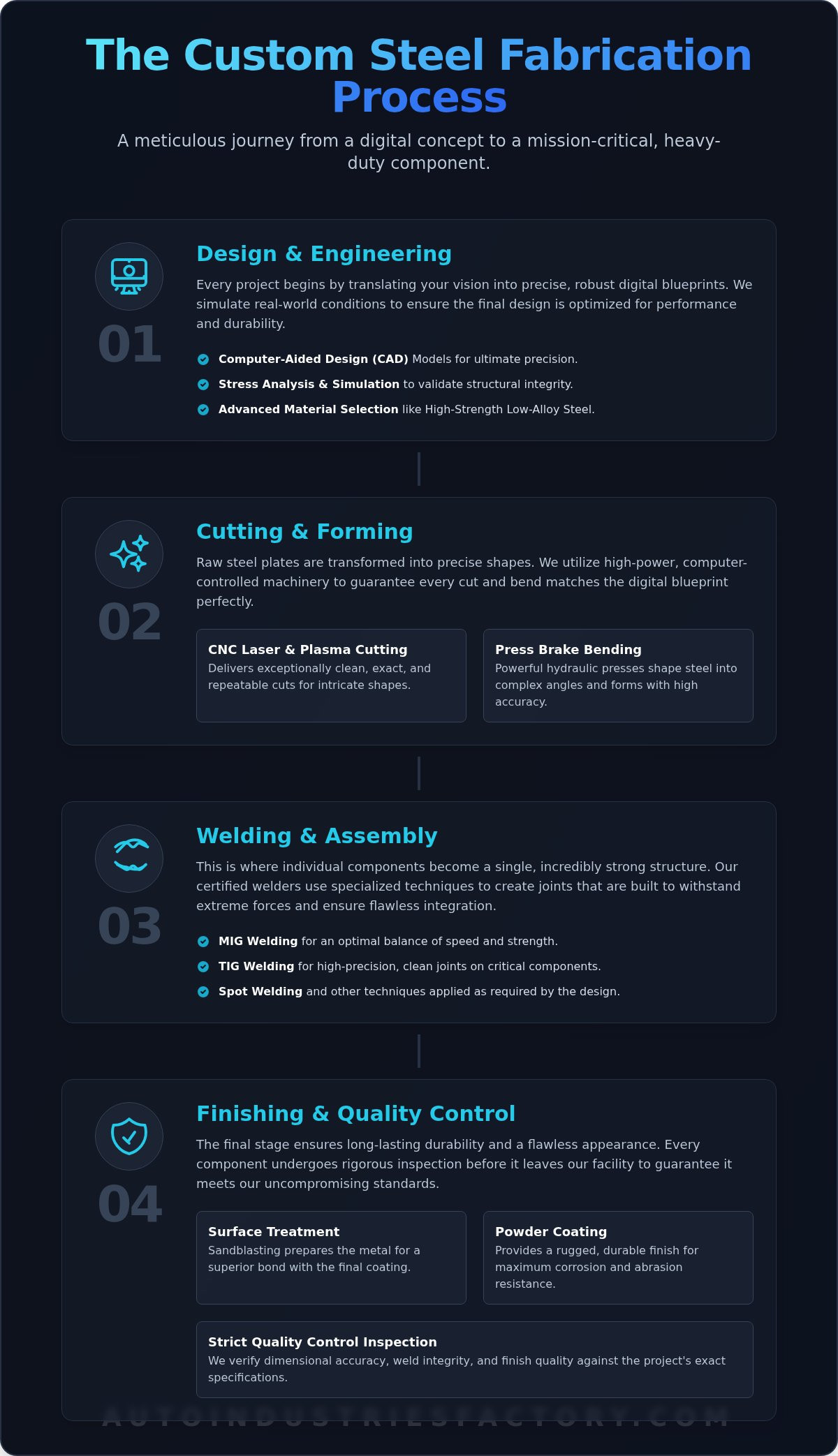
Phase 1: Design and Engineering
Every project begins with your vision. Our engineers collaborate closely with you to translate your requirements into precise Computer-Aided Design (CAD) models. We conduct rigorous stress analysis to simulate real-world conditions, ensuring the design is robust and fit for purpose. Material selection is critical; we often specify Advanced high-strength steel for its exceptional strength-to-weight ratio, ensuring maximum protection without unnecessary bulk. A prototype is then created for validation before full-scale production commences.
Phase 2: Cutting and Forming
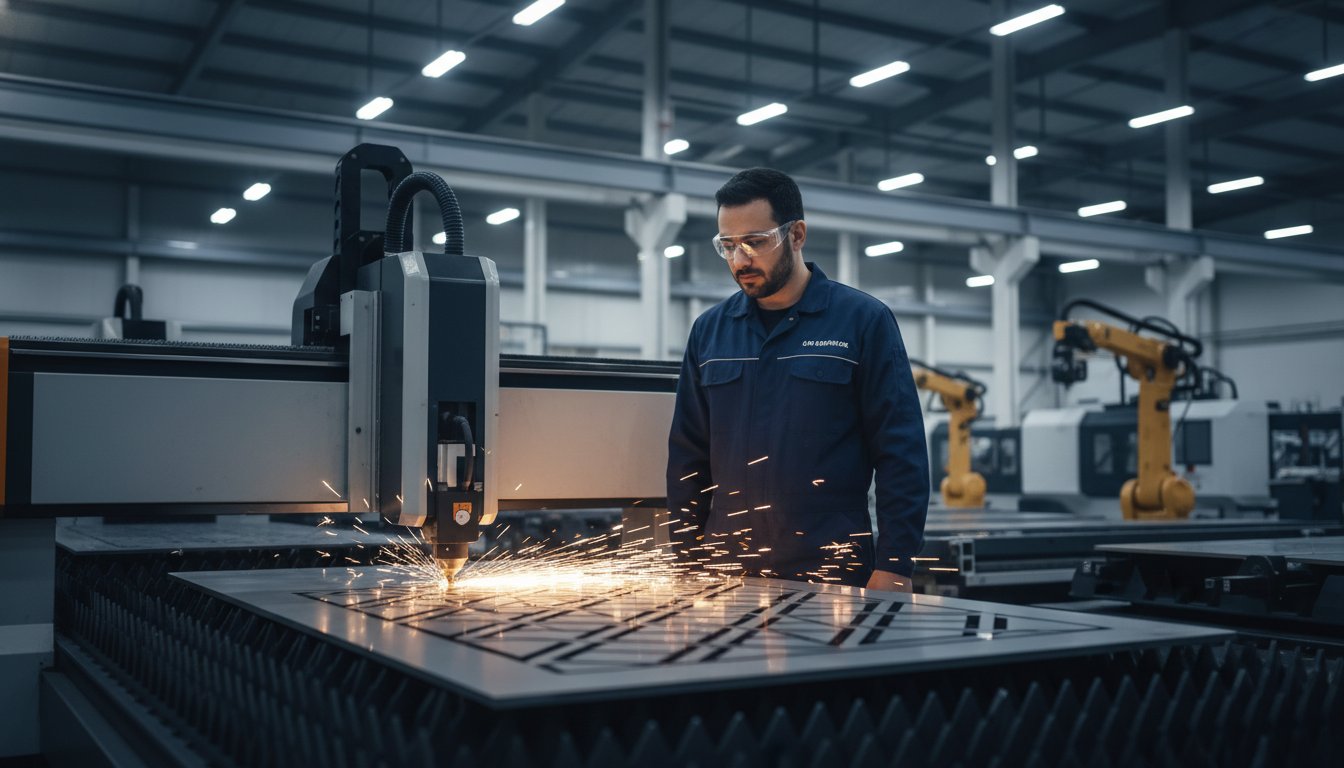
With a validated design, raw steel is moved to our advanced cutting and forming stations. We utilize high-precision machinery to guarantee accuracy down to the millimeter.
- CNC Laser & Plasma Cutting: For clean, exact cuts that match the digital blueprint perfectly.
- Press Brake Bending: Powerful hydraulic presses bend and shape the steel into complex forms with consistent, repeatable accuracy.
This technology is essential for achieving the tight tolerances required for seamless vehicle integration.
Phase 3: Welding and Assembly
Once all components are cut and formed, our certified welders expertly join them to create the final structure. We employ specific welding techniques based on the application's needs for structural integrity and a clean finish. This includes MIG welding for speed and strength, TIG for high-precision joints, and spot welding where required. This phase is where individual parts become a single, incredibly strong custom steel assembly, built to withstand extreme forces.
Phase 4: Finishing and Quality Control
The final stage ensures long-lasting durability and a flawless appearance. Components undergo surface treatments like sandblasting to prepare the metal, followed by a rugged powder-coated finish for superior corrosion and abrasion resistance. Before any product leaves our facility, it passes a strict quality control inspection. We verify dimensional accuracy, weld integrity, and finish quality to ensure it meets our uncompromising standards and your exact specifications.
Applications of Custom Steel in High-Performance Vehicles
While steel is a cornerstone of construction, its true potential is unlocked in specialized automotive applications where standard materials fail. For high-performance, security, and special-purpose vehicles operating in demanding environments like those found across Oman, advanced fabrication transforms this raw material into mission-critical components. The strategic use of custom steel upgrades is fundamental to enhancing a vehicle's safety, core utility, and long-term durability against extreme stress.
Ballistic Protection and Vehicle Armoring
In the defense and security sectors, steel is the primary material for saving lives. Auto Industries Factory LLC specializes in the precision engineering required to integrate armored solutions without compromising vehicle performance. This involves more than just adding plates; it's a comprehensive structural upgrade.
- Hardened Steel Panels: Fabricating and installing ballistic-grade steel panels to protect occupants in military, police, and private security vehicles.
- Chassis Reinforcement: Systematically strengthening the vehicle's frame and suspension to safely handle the significant additional weight of armor.
- Custom Tactical Mounts: Designing and building robust mounting points for specialized tactical and communications equipment.
Custom 4x4 and Off-Road Accessories
For navigating Oman's rugged wadis and dunes, factory-standard protection is often insufficient. Custom steel accessories provide the rugged defense and enhanced capability needed for both recreational off-roading and commercial field operations. Each component is engineered for a flawless fit and maximum resilience.
- Heavy-Duty Bull Bars: Designing aggressive, heavy-duty bull bars that offer superior front-end protection from impacts.
- Utility Roof Racks & Canopies: Building durable, high-load-capacity roof racks and canopies essential for carrying expedition gear or work equipment.
- Rock Sliders & Bumpers: Fabricating premium rock sliders and bumpers to shield the vehicle’s body and undercarriage from punishing terrain.
Structural Reinforcement for Special Purpose Vehicles
Vehicle conversion requires a deep understanding of structural engineering. When a vehicle is repurposed for a new, demanding role-such as an ambulance or a safari truck-its original body must be expertly modified with steel reinforcements to ensure safety and functionality. This is a core area of our expertise.
- Ambulance Conversions: Modifying vehicle bodies with internal steel frames to support the weight and operational stress of medical equipment and patient transport.
- Internal Equipment Frames: Building custom internal structures to safely secure heavy or sensitive equipment for mobile workshops or broadcast units.
- Safari Tour Roll Cages: Engineering and installing robust roll cages for tour vehicles, providing critical occupant protection that meets strict safety standards.
See examples of our advanced engineering in our gallery of custom vehicle fabrication solutions.
Choosing the Right Custom Steel Fabricator: Key Questions to Ask
Selecting a fabrication partner is the most critical step in ensuring your vehicle upgrades deliver maximum durability and performance. Not all workshops in Oman possess the same level of technology, material expertise, or industry-specific knowledge. For vehicles operating in demanding conditions, from rugged off-road tracks to critical security roles, choosing a fabricator who understands these challenges is non-negotiable. Asking the right questions upfront guarantees you receive a high-quality, reliable product built for longevity.
In-House Capabilities and Technology
A fabricator's equipment directly impacts the precision and quality of the final product. Before committing, verify their technological capabilities. Key questions include:
- Do they utilize modern CNC laser cutting and press brakes for flawless accuracy and clean finishes?
- What welding certifications do their technicians hold (e.g., AWS standards)?
- Can they manage the entire process in-house, from initial design and fabrication to final finishing like sandblasting and powder coating? A comprehensive provider ensures seamless quality control.
Material Expertise and Sourcing
The strength of your upgrade begins with the raw material. A premier fabricator should be an expert in metallurgy, not just assembly. Inquire about their experience with various grades of steel, including specialized materials like high-strength alloys or armored steel for security applications. Ask how they source and verify their materials to prevent the use of substandard alternatives. An expert partner can recommend the ideal material for your custom steel application, balancing strength, weight, and corrosion resistance for the local climate.
Proven Experience and Quality Control
An established track record is your best assurance of quality. Always request a portfolio of completed projects, paying close attention to work that is similar in complexity to your own. A workshop confident in its abilities will be transparent about its quality assurance procedures. Look for a partner with proven expertise in demanding vehicle modifications, like the advanced projects showcased by Auto Industries Factory. This documented experience is proof they can deliver on their promises, ensuring your investment enhances your vehicle’s capability and safety for years to come.
Your Partner in Precision Steel Fabrication
From raw material to mission-critical component, understanding the fabrication process is key to achieving superior performance and durability. The journey from concept to creation requires not only advanced technology but a partner with proven expertise. Ultimately, the success of your high-performance vehicle project hinges on the quality of the Custom steel components and the skill of the team behind them.
At Auto Industries Factory, we specialize in transforming high-strength and armored steel into rugged, reliable solutions. With advanced in-house CNC laser, press brake, and welding technology, we deliver precision for the most demanding applications, including military, police, and ambulance vehicle conversions. Our expertise is your guarantee of quality and performance. When your project demands flawless execution and heavy-duty results, trust the specialists.
Ready to transform your concept into a durable reality? Get a Free Estimate for Your Custom Fabrication Project today and let’s engineer a solution built to last.
Frequently Asked Questions About Custom Steel Fabrication
What is the difference between mild steel and high-strength steel for fabrication?
Mild steel is a versatile and cost-effective choice, ideal for brackets and non-structural components due to its excellent workability. High-strength steel, however, provides a significantly higher strength-to-weight ratio. This makes it the superior material for heavy-duty applications like protective bull bars, rock sliders, and chassis reinforcements where maximum durability and impact resistance are mission-critical. Our engineers recommend the optimal material based on your vehicle's specific operational demands in Oman's challenging environments.
How much does a typical custom steel fabrication project cost?
Project costs are determined by material choice, design complexity, component size, and the selected finish. A simple, custom-fabricated bracket might start from $150, whereas a heavy-duty, high-strength steel bull bar for a vehicle like a Toyota Land Cruiser could range from $800 to $1,500 or more. For a precise and competitive quote tailored to your specific requirements, we recommend submitting your design for a detailed evaluation by our engineering team.
What information do I need to provide to get an accurate quote?
To ensure a precise and rapid quote, please provide as much detail as possible. This includes detailed drawings or sketches with clear dimensions, the specific type of steel required (mild or high-strength), the desired finish such as powder coating and its color, and the total quantity needed. Additionally, specifying the vehicle's make, model, and year is essential for ensuring perfect fitment. The more information you provide, the more accurate your initial estimate will be.
What is the average lead time for a custom fabricated steel component?
Lead times vary based on project complexity and our current production schedule. A straightforward component may take 5-7 business days from design approval. More complex assemblies, such as a full custom roof rack or bumper, typically require 2-4 weeks for fabrication, finishing, and quality control. We provide a firm delivery timeline with every formal quotation, ensuring clarity and allowing you to plan your vehicle upgrade effectively. Our commitment is to precision engineering without compromising delivery speed.
Can you fabricate a part from a simple sketch or an existing part?
Yes. Our expert engineers excel at reverse-engineering from an existing part or translating a simple hand sketch into a precise, production-ready design. We utilize advanced CAD software to create a detailed digital model for your approval before any cutting or welding begins. This process guarantees that the final custom steel component meets your exact specifications for fit, form, and function, ensuring a flawless integration with your vehicle. We turn concepts into heavy-duty reality.
What are the benefits of powder coating versus painting for steel parts?
Powder coating offers significantly superior durability compared to traditional painting. It creates a thick, uniform, and hard-wearing finish that is highly resistant to chipping, scratching, and fading. This robust protection is essential for vehicle components exposed to Oman's harsh sun and potential off-road impacts. While liquid paint can be suitable for some applications, powder coating provides the ultimate defense against corrosion and wear, ensuring your steel upgrades maintain their integrity and appearance for years.


