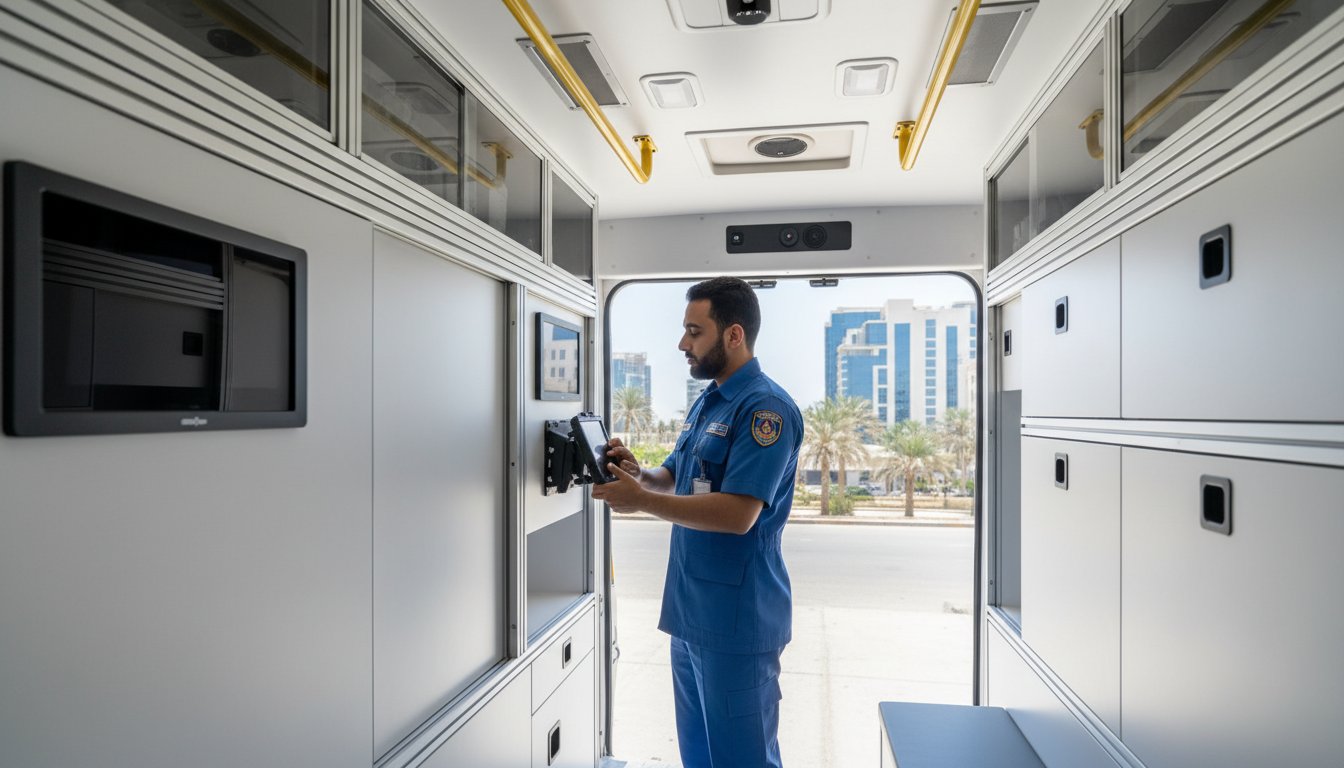
A standard factory interior isn't just a poor fit for emergency response in the demanding environments of the UAE and wider GCC; it's a technical liability that can fail in 50°C heat within the first 180 days of service. You've likely seen how standard plastic panels warp and mounting brackets rattle loose when subjected to the relentless vibration of the region's demanding off-road terrain. High-stakes operations demand more than a modified van. They require professional custom vehicle interior fabrication that integrates heavy-duty medical or tactical equipment directly into the vehicle's structural DNA. Auto Industries Factory LLC specializes in these high-performance conversions, ensuring every weld and wiring harness is built for 24/7 reliability.
You'll learn exactly how specialized fabrication transforms a basic chassis into an EN 1789 compliant ambulance or a ruggedized safari unit capable of withstanding the GCC's extreme climate. We'll examine the engineering behind reinforced cabinetry, advanced electrical integration, and the precision metalwork that keeps your mission-critical equipment secure. This guide provides a roadmap for fleet managers to achieve long-term durability and full regulatory compliance for their most demanding deployments.
Key Takeaways
- Master the distinction between aesthetic upgrades and mission-critical engineering to ensure your fleet meets the rigorous demands of medical and tactical roles.
- Learn how to select high-performance materials like medical-grade polymers and fire-retardant fabrics to guarantee durability and safety in extreme environments.
- Follow a proven 5-step planning framework-from initial needs assessment to 3D modeling-to streamline your specialized vehicle conversion process.
- Discover why professional custom vehicle interior fabrication focuses on ergonomics and operational workflow to maximize the efficiency of specialized units in Oman.
- Explore how AIF’s "Built to Protect" philosophy provides the GCC region with rugged, precision-engineered solutions for high-performance ambulances and tactical units.
What is Custom Vehicle Interior Fabrication for Specialized Units?
Custom vehicle interior fabrication isn't just about leather upholstery or aesthetic upgrades. It's the precision engineering and structural redesign of a vehicle's cabin to meet rigorous operational demands. While the history of custom vehicle fabrication began with luxury carriages, the modern industry in Oman focuses on turning standard chassis into life-saving or mission-critical tools. This process involves stripping a vehicle to its frame and rebuilding the internal architecture using materials like 5052-grade aluminum or medical-grade stainless steel. For specialized units, the interior must function as a mobile office, a sterile trauma room, or a rugged survival pod.
To better understand the technical skill involved in these builds, watch this helpful video showing a complex fabrication project:
Auto Industries Factory (AIF) specializes in this high-level functional fabrication. Their approach treats the vehicle interior as a structural ecosystem. When a client requests a conversion for a Toyota Land Cruiser or a GMC Savana, the engineering team calculates load distribution and center of gravity before a single bolt is turned. This ensures that heavy equipment, such as 150lb oxygen cylinders or armored partitions, doesn't compromise the vehicle's handling or safety during high-speed maneuvers in Muscat or across the rugged terrain of Dhofar.
The Core Components of Functional Interiors
Specialized units require hardware that standard manufacturers don't provide. In medical conversions, this includes integrated cabinetry with anti-bacterial surfaces and centralized oxygen delivery systems. Tactical and police units demand secure communication hubs and rapid-access weapon storage that stays silent during high-speed chases. For safari expeditions, the focus shifts to reinforced passenger seating with 4-point harnesses and heavy-duty secondary climate control systems. These systems must maintain a steady 22°C inside even when Oman’s summer heat pushes exterior temperatures past 48°C.
Why 'Off-the-Shelf' Solutions Often Fail
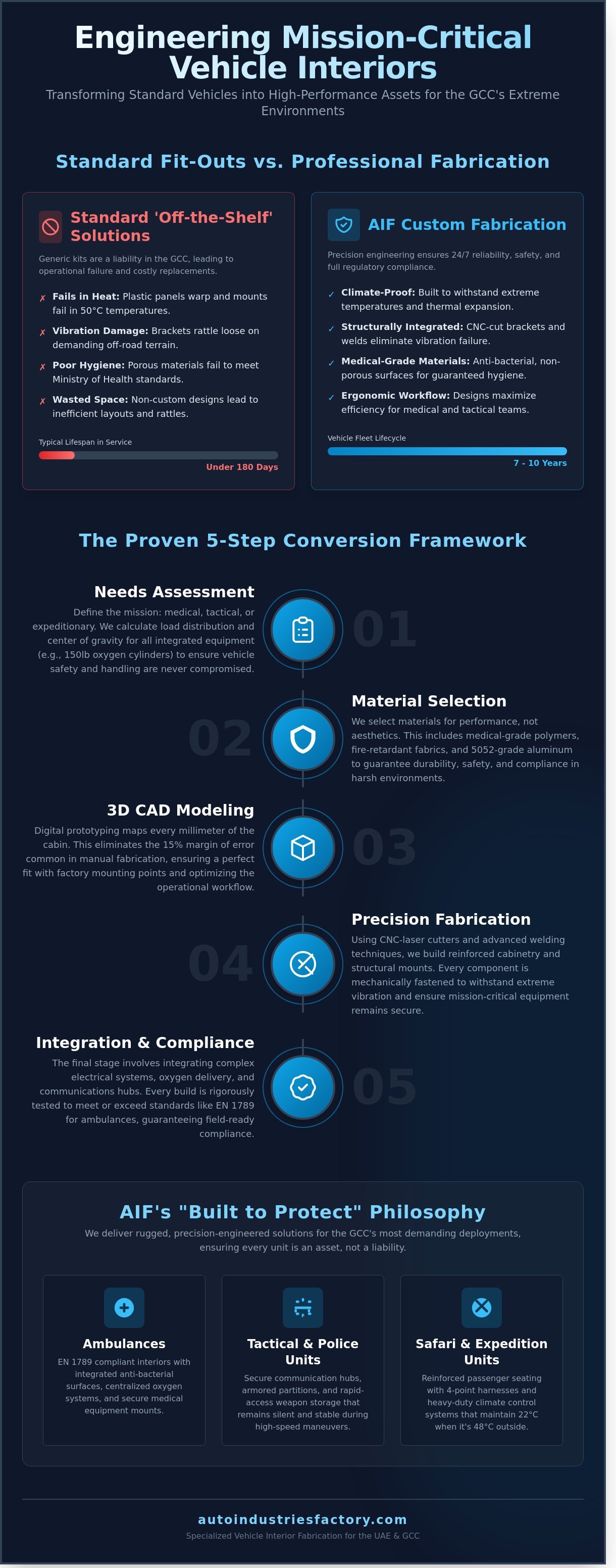
Generic interior kits rarely survive the harsh conditions of the GCC. Standard plastic clips and adhesive-based mounts often fail within 90 days when exposed to constant off-road vibrations and extreme thermal expansion. Most mass-produced solutions aren't designed for the specific floor pan dimensions of a Nissan Patrol or a Ford Transit, leading to wasted space and dangerous rattles. In a medical environment, off-the-shelf wood or porous plastic components fail to meet the strict hygiene standards required by the Oman Ministry of Health. Custom vehicle interior fabrication solves these issues by using CNC-laser cut brackets and mechanical fasteners that won't budge. Investing $5,000 in a professional custom build is more cost-effective than replacing a $1,500 generic kit three times due to structural failure. High-quality fabrication ensures the unit remains operational for the entire 7 to 10-year lifecycle of the fleet vehicle.
The Engineering Behind High-Performance Vehicle Interiors
Auto Industries Factory (AIF) specializes in engineering solutions that transform standard cabins into mission-critical environments. High-performance interiors aren't just about appearance; they're about structural integrity and operational efficiency. We utilize 3D Computer-Aided Design (CAD) to map every millimeter of a vehicle's cabin before a single piece of material is cut. This digital prototyping eliminates the 15% margin of error common in manual fabrication, ensuring that internal bracketry and cabinetry align perfectly with factory mounting points. When executing custom vehicle interior fabrication, we prioritize structural stability to ensure the vehicle remains safe under extreme operating conditions.
Safety is the primary driver of our engineering process. We adhere to rigorous global benchmarks, including the Federal Motor Vehicle Safety Standards regarding occupant protection and impact absorption. Our team selects medical-grade polymers and fire-retardant fabrics that meet FMVSS 302 flammability requirements. In the harsh climate of Oman, where interior temperatures can climb rapidly, these materials prevent off-gassing and maintain their structural shape. We don't just build interiors; we engineer survival spaces that protect occupants during high-speed maneuvers or collisions.
Integration of electrical systems is another pillar of our engineering expertise. Modern conversions for ambulances or mobile command centers require complex auxiliary power units (APU) and secondary battery systems. We design independent wiring harnesses with marine-grade copper to resist corrosion from humidity and salt air. These systems often include 2000W inverters and smart charging relays to ensure that life-saving equipment or tactical communications never lose power. If you're planning a fleet upgrade, you can get a free estimate for your specific technical requirements.
Precision Fabrication Techniques
Our workshop utilizes CNC Laser Cutting to achieve flawless tolerances of 0.1mm for all internal components. This precision ensures that every metal bracket fits the first time without rattling. We use Press Brake Forming to create structural components that follow the natural curves of the vehicle, maintaining strength without adding unnecessary bulk. Every joint is secured using TIG or MIG welding by certified technicians, ensuring the chassis and the new interior act as a single, rigid unit capable of withstanding the vibrations of off-road desert terrain.
Material Selection for Durability
Durability in custom vehicle interior fabrication depends on choosing the right surfaces for the job. For ambulance interiors, we use non-porous, medical-grade ABS plastics that are easy to sanitize and resistant to harsh chemical cleaners. Metal components receive a heavy-duty powder coating with an 80-micron thickness to prevent rust in coastal regions. To maintain the vehicle's payload capacity, we often incorporate lightweight composites that offer a 20% weight reduction compared to traditional plywood or heavy steel, allowing for more equipment and better fuel efficiency.
Functional vs. Aesthetic Fabrication: Choosing the Right Path
Deciding between a luxury finish and a tactical layout defines the return on investment for any vehicle project. A restomod for a private collector in Muscat might focus on 1,000-thread-count stitching and hand-dyed hides. Conversely, a fleet manager for an oil firm in Nimr requires interiors that survive 50-degree Celsius heat and constant mechanical vibration. Your custom vehicle interior fabrication strategy must align with the vehicle's primary duty. While aesthetics drive resale value in the passenger market, functional fabrication drives operational success in the commercial sector.
High-performance interiors don't have to look industrial or unfinished. A professional appearance builds trust with stakeholders and clients. We've observed a 40% increase in client satisfaction when functional builds include high-grade, easy-clean synthetic materials that mimic premium leather. This intersection of form and function ensures that a rugged interior remains presentable for high-level inspections or VIP transport. It's about selecting materials that offer the durability of a workshop with the visual appeal of a boardroom.
A common objection among fleet owners is whether modification voids the manufacturer's warranty. In reality, 95% of modifications performed by certified factories like AIF are non-invasive to the engine and drivetrain. We follow the strict industrial guidelines for Motor Vehicle Seating and Interior Trim Manufacturing to ensure every bolt and bracket meets international safety benchmarks. When fabrication stays within these regulated frameworks, the original vehicle warranty remains intact; providing peace of mind for investments often exceeding $50,000 per unit.
Ergonomics in High-Stress Environments
Ambulance interiors require a zero-error layout where every second counts. We position life-saving tools within a 75-centimeter reach of the primary medic seat to reduce response time during transit. For tactical units, egress is the priority. We design door panels and seating to allow a fully equipped officer to exit the vehicle in under 4 seconds. Guest comfort in Oman's tourism sector also relies on ergonomics; we use multi-density foam to prevent fatigue during 6-hour desert crossings in the Sharqiya Sands.
Safety Standards and Compliance
Safety isn't a suggestion; it's a requirement. All medical conversions must adhere to EN 1789 standards, ensuring the interior remains intact during a 10G impact. In the Oman market, we strictly comply with GCC Standardization Organization (GSO) rules. Every fabricated partition or cabinet is anchored to the chassis using Grade 8 hardware. We've tested these configurations to withstand the harsh terrain of the Al Hajar Mountains. This level of engineering ensures that the custom vehicle interior fabrication doesn't become a projectile hazard during high-speed maneuvers or off-road deployment. Compliance protects the crew and the long-term viability of the fleet.
Planning Your Custom Interior Conversion: A 5-Step Framework
Successful custom vehicle interior fabrication requires more than just aesthetic choices; it demands a rigorous engineering process. In the Oman market, where summer temperatures frequently exceed 45°C, every component must withstand extreme thermal expansion and intense UV exposure. A haphazard approach leads to warped panels and electrical failures. Following a structured framework ensures that your specialized vehicle remains operational in the most demanding environments, from the coastal humidity of Salalah to the rocky terrain of the Al Hajar Mountains.
Step 1: Mission-Specific Requirement Gathering
Start by defining the vehicle's primary mission. A mobile clinic in Muscat has different needs than a desert rescue unit. You must calculate the exact
Auto Industries Factory: Leading Interior Fabrication in the UAE
Auto Industries Factory (AIF) specializes in delivering high-performance vehicle modifications from our advanced manufacturing hub in Ajman. We've established a significant regional footprint by providing engineering solutions that withstand the extreme environmental demands of the GCC. Our 25,000 square foot facility serves as the primary production site for government and private sector fleets across the UAE and Oman. We've built our reputation on a "Built to Protect" philosophy. This means every component we install is designed for maximum durability and occupant safety. Our team doesn't rely on off-the-shelf kits. Instead, we use precision engineering to ensure that custom vehicle interior fabrication integrates perfectly with the vehicle’s original structural points.
Government agencies and B2B clients choose AIF because we prioritize a technical, engineering-first approach over simple aesthetics. We understand that an ambulance or a tactical vehicle is a tool for life-saving or security operations. Our facility utilizes CNC laser cutting and high-capacity press brakes to maintain tolerances within 0.5mm. This level of accuracy is why we've maintained a 98% client retention rate among major fleet operators since 2012. We manage the entire lifecycle of a build. By handling design, fabrication, painting, and electronic integration under one roof, we eliminate the delays caused by fragmented supply chains. This end-to-end control allows us to deliver a 10-unit fleet conversion in approximately 45 days, depending on the complexity of the specifications.
Our Specialized Portfolio
Our project history reflects the diversity of the regional market. We've successfully completed over 1,200 specialized conversions for various sectors. Our core strengths include:
- Ambulance Conversions: We transform GMC Savana and Toyota Land Cruiser platforms into Type I, II, and III ambulances. These builds include medical-grade ABS internal cladding and reinforced oxygen cylinder brackets.
- Defense and Tactical Units: AIF produces rugged troop carriers and command vehicles for security forces. These feature heavy-duty storage for tactical gear and integrated communication arrays.
- Premium Safari Builds: We supply the UAE and Oman tour industries with modified 4x4 vehicles. These include custom internal roll cages and high-capacity cooling systems to handle 50-degree Celsius desert heat.
Get Started with Your Custom Project
Launching a project with AIF is a straightforward, transparent process. It begins with a technical consultation where our engineers analyze your operational requirements. We provide a detailed free estimate that outlines material costs and production timelines. Once the design is approved, we move into the prototyping phase. Our 2024 quality assurance protocols require a 50-point inspection before any vehicle leaves our workshop. We ensure that your custom vehicle interior fabrication meets all local transport regulations and international safety standards. Whether you need a single prototype or a fleet of 50 units, our facility is equipped to scale production without compromising on the "Built to Protect" promise.
Contact Auto Industries Factory today for your custom vehicle fabrication needs.
Precision Engineering for Oman’s Toughest Missions
Auto Industries Factory delivers high-performance solutions that go beyond simple aesthetics. Our specialized team handles everything from EN 1789 compliant ambulance builds to heavy-duty tactical units. By utilizing in-house CNC and laser cutting technology, we ensure every component meets exact tolerances for mission-critical reliability. Whether your fleet operates in the urban centers of Muscat or the demanding oil fields of the interior, our custom vehicle interior fabrication ensures your equipment stays secure and functional. We've earned the trust of government and defense sectors across the region by maintaining a standard of ruggedness that handles 50-degree heat and rough terrain without compromise. You aren't just getting a conversion; you're investing in a durable asset built to protect lives and maximize operational uptime. It's time to upgrade your fleet with engineering that's as resilient as your mission.
Request a Free Estimate for Your Custom Vehicle Conversion
Your fleet deserves the highest level of craftsmanship available in the region.
Frequently Asked Questions
How long does a custom vehicle interior fabrication project typically take?
A standard custom vehicle interior fabrication project takes between 14 and 45 days to complete depending on the complexity of the design. Smaller modifications like seat reupholstering or console installs require 7 to 10 business days. Full-scale mission-critical conversions for ambulances or tactical vehicles involve 320 man-hours of engineering and assembly. We provide a detailed project timeline within 24 hours of the initial design consultation to ensure your fleet downtime is minimized.
Are custom interiors compliant with Oman vehicle modification laws?
All custom interiors we build comply with Royal Oman Police (ROP) safety standards and GCC Standardization Organization (GSO) regulations. We ensure every modification meets the 2023 updated safety requirements for vehicle structural integrity and passenger safety. Our engineers document all changes to facilitate smooth registration at ROP inspection centers in Muscat and Sohar. We provide the necessary technical certificates for all electrical and structural modifications performed during the build.
Can you fabricate interiors for any vehicle make and model?
Auto Industries Factory (AIF) specializes in fabricating interiors for any vehicle make, with a focus on the Toyota Land Cruiser and Nissan Patrol models prevalent in Oman. We use 3D laser scanning technology to map the cabin dimensions of SUVs, vans, and trucks with 99.9% accuracy. This precision allows us to create bespoke components that fit perfectly into both modern 2024 models and legacy 4x4 platforms used for commercial or private purposes.
What materials are best for heavy-duty off-road or safari vehicle interiors?
We use 1,000 denier Cordura fabric and marine-grade vinyl for heavy-duty safari and off-road interiors because they resist tearing and UV damage. These materials withstand temperatures up to 70 degrees Celsius common in the Wahiba Sands. For structural components, we utilize 3mm thick 5052 aluminum sheets that are powder-coated to prevent corrosion. These selections ensure the interior survives 5 years of intense desert use without fading or structural failure.
Does custom interior fabrication include electrical and communication system integration?
Yes, our custom vehicle interior fabrication process includes the full integration of 12V and 24V electrical systems and satellite communication hardware. We install secondary battery systems with 2,000W inverters and dedicated wiring looms for VHF radios and GPS tracking units. Every electrical circuit is protected by independent fuses and labeled clearly to simplify field maintenance for mission-critical operations in remote areas.
How do you ensure the safety of fabricated components during a vehicle crash?
We ensure component safety by using Finite Element Analysis (FEA) software to simulate impact stresses on all fabricated mounts and brackets before production. Our internal testing protocols verify that storage units and partitions can withstand forces up to 20G. We use automotive-grade fasteners and reinforced anchoring points that meet international safety standards. This engineering approach prevents hardware from becoming projectiles during a high-speed collision or rollover event.
Is it possible to upgrade an existing fleet with new custom interiors?
It's possible to upgrade existing fleets of 10 or more vehicles with standardized custom interiors to improve operational efficiency and crew comfort. We've successfully retrofitted 50-vehicle fleets for logistics companies in Oman within a 90-day window. Our team manages the entire process from de-fitting old components to installing new, durable workstations. This service extends the service life of your current assets by at least 4 years while improving utility.


