

Choosing the right ambulance for Oman's demanding terrain is more than a procurement decision-it's a commitment to saving lives. When every second counts, concerns about sufficient interior height for medics, vehicle stability on winding roads, and overall durability can be overwhelming. This is precisely where a professionally engineered extended rooftop ambulance provides a definitive advantage, offering a superior balance of workspace and agility without the compromises of a traditional box-body conversion.
But how can you be certain the modification is structurally sound, weatherproof, and compliant with strict GSO and EN 1789 standards? This comprehensive guide is engineered to eliminate that uncertainty. We will delve into the critical design principles, material science, and safety testing that define a mission-ready conversion. You will discover the key benefits for your fleet, explore customization options for rugged base vehicles like the Toyota Land Cruiser, and gain the confidence to select a manufacturing partner in the UAE that delivers uncompromising quality. Prepare to make an informed decision that enhances your operational capability and protects your crew.
Why an Extended Rooftop? Key Advantages Over Other Ambulance Types
Selecting the right vehicle chassis and body type is a critical first step in ambulance design. While various configurations exist, the extended rooftop ambulance offers a superior balance of interior workspace, operational agility, and cost-efficiency, making it an ideal solution for emergency services operating in Oman’s diverse urban and off-road environments.
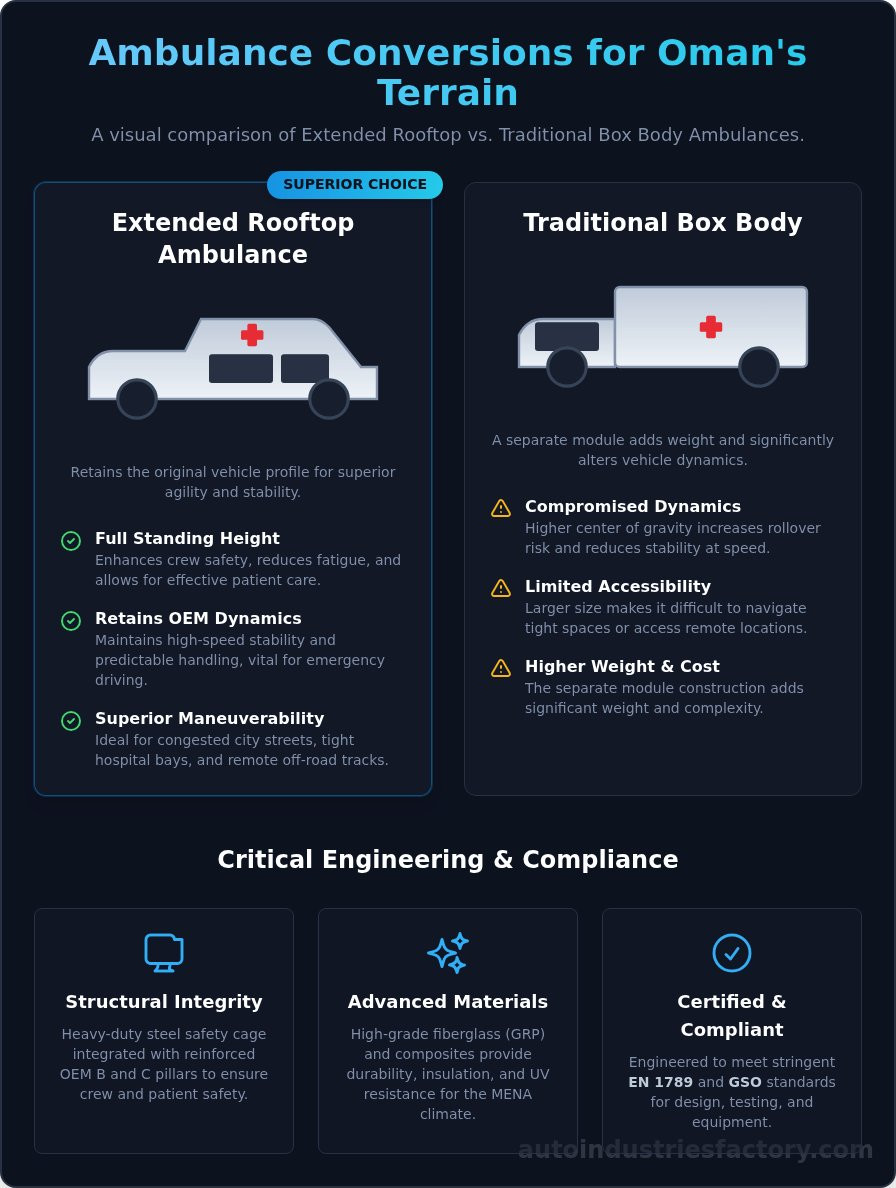
The primary advantage is clear: achieving full standing height within the patient compartment. This single modification transforms the vehicle from a simple transport unit into a fully functional mobile medical environment. It directly enhances crew safety, reduces physical strain, and allows for more effective patient care during critical transit periods. Unlike larger, cumbersome modules, this conversion retains the core strengths of the original vehicle platform.
Maximizing Interior Workspace and Headroom
The additional vertical space is not just for comfort; it is a tactical advantage. A higher ceiling allows for the optimal placement of medical equipment, such as IV hooks and storage cabinets, keeping them accessible yet out of the immediate workspace. This improved ergonomics translates directly to mission effectiveness:
- Reduced Crew Fatigue: Paramedics can stand, move, and perform procedures without crouching, minimizing physical strain during long transports.
- Enhanced Procedural Efficiency: Full mobility facilitates easier patient loading, assessment, and the administration of life-saving interventions in transit.
- Improved Safety: A less cramped environment reduces the risk of trips and allows for more stable footing while the vehicle is in motion.
Comparing Extended Roof vs. Box Body Ambulances
When evaluating different Ambulance Types, the choice between an extended roof and a full box body is crucial. An Extended rooftop ambulance maintains the original vehicle’s profile, offering superior maneuverability in Muscat’s congested streets or on challenging rural tracks. It is less conspicuous than a large box truck, allowing for more discreet operations when necessary. Furthermore, this conversion utilizes the proven, heavy-duty OEM chassis and body structure as its foundation, ensuring robust durability and reliability without the added weight and altered dynamics of a separate module. This makes it the premier choice for rapid response and patient transfers, whereas box bodies are often better suited for use as mobile clinics.
Retaining OEM Vehicle Dynamics and Maneuverability
A precision-engineered roof extension is designed to minimize its impact on the vehicle's center of gravity. This careful engineering ensures that the ambulance retains its high-speed stability and predictable handling characteristics, which are vital during emergency driving. The benefits are practical and immediate: the vehicle is easier to park in tight hospital bays, navigate through dense traffic, and access remote locations that would be inaccessible to larger, wider box-body ambulances. This retention of OEM dynamics ensures your fleet remains agile, responsive, and capable of reaching any patient, anywhere.
Critical Engineering & Design Principles for Extended Roofs
The transformation of a standard vehicle into a high-functioning ambulance with an extended roof is a discipline of precision engineering, not mere modification. The process begins with selecting a robust base vehicle, such as the proven Toyota Land Cruiser or GMC Savana, renowned for their durability in Oman's demanding conditions. From this foundation, every design choice must prioritize safety, functionality, and longevity, ensuring the final product is a seamless, integrated life-saving asset.
Structural Integrity and Reinforcement
The core of a safe conversion is an uncompromised structure. We integrate a heavy-duty steel safety cage that acts as the backbone for the extended roof, transferring loads safely through the vehicle's chassis. This involves systematically reinforcing the vehicle's original B and C pillars to bear the additional weight and maintain structural rigidity. Our engineering process ensures these modifications align with crashworthiness principles, a science that has evolved significantly as outlined in historical reviews of Ambulance Safety Standards. Advanced bonding agents and precision welding techniques are used to fuse the new roof to the OEM body, creating a single, robust unit.
Material Selection: Fiberglass vs. Advanced Composites
Material science is critical in building a durable yet efficient extended rooftop ambulance. We primarily utilize high-grade fiberglass (GRP) for its exceptional durability, ease of repair, and inherent insulation properties. For applications requiring maximum strength with minimal weight penalty, advanced composite materials are employed. All exterior materials are treated for high UV resistance and thermal stability, essential for performance under the intense MENA sun. Inside, the cabin is lined with non-porous, medical-grade materials that are easy to sanitize and resistant to harsh cleaning agents.
Compliance with EN 1789 and Regional Standards
Adherence to international and regional standards is non-negotiable. Our designs are engineered to meet the stringent requirements of EN 1789, the European standard that governs ambulance design, testing, and equipment. This includes everything from the structural integrity of the patient compartment to the secure, certified anchor points for stretchers and medical devices. Critically, we also ensure full compliance with Gulf Standardization Organization (GSO) standards, which are mandatory for vehicles operating in Oman and the GCC. Discuss your fleet's compliance needs with our experts.
Choosing the Optimal Chassis: Popular Platforms for Conversion
The foundation of any high-performance ambulance is its chassis. This single choice dictates everything from off-road capability to patient care efficiency and crew comfort. In a country with terrain as diverse as Oman-spanning from the city streets of Muscat to the rugged Al Hajar mountains-selecting the right platform is the most critical decision in the conversion process.
The SUV Platform: Toyota Land Cruiser & GMC Yukon
For missions in rugged, rural, and off-road environments, SUV platforms are the superior choice. The Toyota Land Cruiser is legendary across the region for its extreme durability and readily available parts, ensuring operational reliability far from service centers. Alternatively, the GMC Yukon provides robust V8 power and enhanced comfort for long-distance patient transfers. For any emergency vehicle intended for remote rescue, a true 4x4 drivetrain is not an option-it is an essential, life-saving requirement.
The Van Platform: Toyota Hiace Advantages
When maximizing usable patient cabin space on a compact footprint is the primary goal, van-based platforms like the Toyota Hiace excel. The design of an extended rooftop ambulance on this chassis creates a spacious and ergonomic patient compartment with ample headroom. Its lower floor height and wide sliding doors vastly improve accessibility, simplifying patient loading and unloading in tight urban spaces. These ergonomic principles are critical for crew safety and efficiency, as outlined in guides like the Ambulance Patient Compartment Human Factors Design Guidebook.
Payload and Drivetrain Considerations
A successful conversion demands precision engineering to manage the vehicle's final weight and power dynamics. Before fabrication, it is vital to calculate the total payload, accounting for the conversion structure, heavy-duty medical equipment, oxygen tanks, crew, and patient. This calculation directly informs the necessary mechanical upgrades.
- Suspension & Brakes: Upgrading to heavy-duty components is mandatory to safely handle the increased Gross Vehicle Weight (GVW) and ensure stable handling during emergency maneuvers.
- Drivetrain: A choice must be made between a 4x2 system for optimal fuel efficiency in primarily urban operations or a robust 4x4 system for the all-terrain access required by a versatile extended rooftop ambulance.
- Engine Power: The engine must be verified to provide sufficient torque and horsepower to ensure responsive acceleration and performance after adding hundreds of kilograms of mission-critical weight.
The Conversion Process: From Stock Vehicle to Life-Saving Unit
Transforming a standard vehicle into a mission-ready Extended rooftop ambulance is a process of precision engineering, executed entirely within our advanced in-house facilities. It's a journey from a factory model to a fully equipped, life-saving unit, governed by meticulous craftsmanship and relentless quality control. Every weld, wire, and panel is scrutinized to ensure the final product meets the demanding standards required for emergency services in Oman.
Step 1: Design, Deconstruction, and Structural Preparation
The conversion begins with a detailed client consultation, where we translate specific operational needs into a functional design using advanced 3D CAD modeling. Once the blueprint is approved, our technicians carefully deconstruct the base vehicle, stripping the interior and removing the original roof panel. The vehicle’s body and chassis are then strategically reinforced to support the new, larger structure, ensuring uncompromised stability and safety. This foundational stage also includes the pre-wiring for all electrical, communication, and medical systems.
Step 2: Roof Fabrication and Seamless Integration
Our master fabricators expertly mold the high-grade fiberglass or composite roof shell, engineered for maximum durability and minimal weight. This custom roof is then precisely fitted to the vehicle body, where it is integrated with a heavy-duty internal steel safety cage for superior structural integrity and occupant protection. Our bodywork specialists ensure a flawless, factory-quality finish and a completely waterproof seal. The process is completed with the application of a premium, multi-layer paint that perfectly matches the original vehicle body.
Step 3: Interior Outfitting and Systems Installation
In the final stage, the empty cabin is transformed into a state-of-the-art patient compartment. We focus on functionality, safety, and hygiene, installing essential components that define a modern ambulance.
- Medical Environment: Installation of medical-grade, non-slip flooring, seamless wall panels for easy sterilization, and custom-built cabinetry for secure equipment storage.
- Life Support Systems: Integration of centralized oxygen lines, powerful suction units, and a network of electrical outlets for critical medical devices.
- Operational Equipment: Fitting of high-intensity LED emergency lighting, sirens, advanced communication systems, and a dedicated HVAC unit for climate control.
- Patient & Crew Safety: Secure installation of the primary stretcher mount, attendant seating with safety restraints, and IV hooks.
This comprehensive outfitting ensures every Extended rooftop ambulance we produce is ready for immediate deployment. To see our finished projects, visit us at autoindustriesfactory.com.
Interior Customization: Leveraging Vertical Space for Medical Efficiency
The true advantage of an extended rooftop ambulance is not merely the additional headroom, but the complete transformation of the interior into a highly efficient mobile medical workspace. This vertical space unlocks a new level of design freedom, allowing for interior layouts that are custom-engineered around your specific operational needs. Whether your mission requires a Basic Life Support (BLS) configuration for patient transport or a fully equipped Mobile Intensive Care Unit (ICU), the interior is a blank canvas for precision and performance.
Advanced Life Support (ALS) Equipment Layouts
For critical care transport, every second counts. Our designs prioritize immediate access to mission-critical ALS equipment. We integrate secure, vibration-dampening mounts and dedicated power sources for defibrillators, multi-parameter monitors, ventilators, and infusion pumps. The strategic placement of this equipment ensures it is within arm's reach. Crucially, the full standing height allows paramedics to perform complex procedures like intubation or CPR more effectively and with less physical strain, improving patient outcomes during transit.
Ergonomics for Paramedics: Patient Access and Safety
A well-designed interior protects both the patient and the crew. Our layouts are engineered to provide 360-degree patient access, enabling medics to work unobstructed from any position around the stretcher. Key safety and ergonomic features include:
- Attendant Seating: Strategically placed seats with safety harnesses provide stability and a clear view of the patient and monitoring equipment.
- Medical-Grade Flooring: We install heavy-duty, non-slip, and seamless flooring that is easy to clean and disinfect, ensuring a secure footing even in fast-moving situations.
- Interior Grab Rails: Robust grab rails and handles are mounted throughout the cabin to ensure crew stability while the vehicle is in motion.
Integrated Cabinetry, Lighting, and Climate Control
A functional ambulance interior is a system of integrated components. We fabricate custom-built aluminum cabinets that are both lightweight and exceptionally durable, providing organized storage for medical supplies without compromising vehicle performance. The patient care area is illuminated by high-intensity, shadowless LED lighting for clear visibility during assessment and treatment. Recognizing the demanding climate in Oman, every extended rooftop ambulance is fitted with a powerful, independent HVAC system for the patient compartment, ensuring a stable temperature for patient comfort and sensitive medical equipment.
Every element is engineered for performance and reliability. Design the perfect interior layout for your ambulance.
Your Partner in Advanced Ambulance Solutions
The decision to invest in an extended rooftop ambulance is a strategic move towards superior medical efficiency and crew safety. This conversion provides critical vertical space for advanced life support and hinges on precision engineering to meet the demanding operational conditions in Oman. It’s not just about adding height; it’s about fundamentally upgrading a vehicle’s life-saving potential.
As a leading vehicle conversion specialist based in Ajman, UAE, Auto Industries Factory is the trusted partner for government and private sector clients throughout the MENA region. Our in-house expertise in design, fabrication, and systems integration ensures every vehicle is rugged, reliable, and mission-ready. We deliver premium, heavy-duty solutions built to perform under pressure.
Ready to equip your fleet with ambulances built for life-saving reliability? Request a Professional Consultation for Your Ambulance Fleet and let our specialists design a solution tailored to your exact operational needs.
Frequently Asked Questions
What is the typical manufacturing lead time for an extended rooftop ambulance?
The standard manufacturing lead time for an extended rooftop ambulance is approximately 4 to 6 weeks from the confirmation of the final design and receipt of the base vehicle. This timeline can vary based on the complexity of the medical fit-out and the level of customization required. We prioritize efficient, high-quality production at our UAE facility to ensure your mission-ready vehicle is delivered promptly without compromising our rigorous engineering and safety standards.
Can you export converted ambulances to countries outside the UAE?
Yes, Auto Industries Factory (AIF) specializes in the export of converted vehicles across the GCC and globally. We have extensive experience managing the logistics and documentation required for exporting our ambulances to Oman and other international markets. Our team ensures a seamless process, from production in our Ajman facility to final delivery at your specified port, guaranteeing your vehicle arrives ready for immediate deployment and service in your country.
How does the extended roof modification affect the vehicle's original warranty?
Modifying the vehicle's structure by adding an extended roof will typically void the original manufacturer's warranty on the body shell and any directly altered components. However, the warranty on the vehicle’s powertrain, chassis, and other unmodified mechanical parts generally remains intact. We recommend consulting the specific terms of your vehicle’s manufacturer warranty. Our team provides transparent information regarding all modifications and their potential impact on factory warranties before any work begins.
What kind of warranty do you provide on the conversion work and the extended roof?
Auto Industries Factory provides a comprehensive warranty on all conversion work. The heavy-duty extended roof structure and all fabrication are covered for 2 years against manufacturing defects. The medical interior conversion, electrical systems, and installed equipment are covered by a 1-year warranty. Our commitment is to deliver durable, reliable vehicles, and our warranty reflects our confidence in the quality of our materials and precision craftsmanship for every ambulance we build.
How is the extended roof tested to ensure it is 100% waterproof and dustproof?
Every extended roof installation undergoes a rigorous, multi-stage testing protocol to guarantee a perfect seal. First, the vehicle is subjected to a high-pressure water test, where powerful jets are aimed at all seams and joints from multiple angles for an extended period. This is followed by a simulated environmental test to ensure it is completely dustproof for rugged conditions. This meticulous process ensures the patient cabin remains sterile, dry, and secure in any operational environment.
What is the approximate cost difference between an extended roof and a box-body ambulance?
An extended roof conversion offers a significant cost advantage. Typically, this conversion is 30-40% more cost-effective than manufacturing a full box-body ambulance. Depending on the base vehicle, such as a Toyota Land Cruiser or Nissan Patrol, this can translate to a saving of approximately $15,000 to $25,000. This makes the extended roof model an excellent solution for organizations seeking enhanced functionality and interior height without the higher investment of a box-body design.
Can you install customer-specified medical equipment during the conversion?
Absolutely. We are equipped to integrate customer-specified or supplied medical equipment into the ambulance design. Our engineers will work with you to ensure the equipment is seamlessly installed, properly secured to meet safety standards, and fully integrated with the vehicle’s electrical and oxygen systems. We require that all client-provided equipment meets the necessary medical certifications to ensure the final build is compliant, safe, and fully mission-capable upon delivery.


