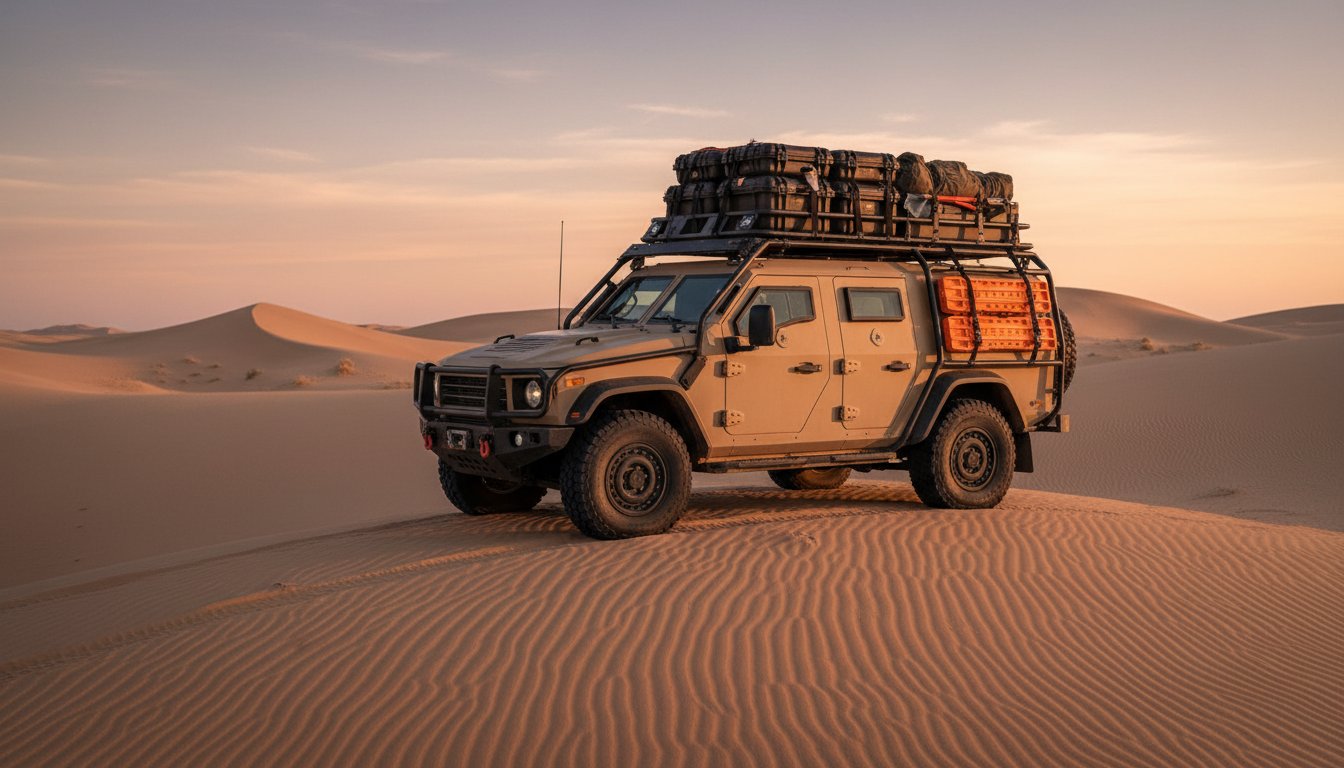
Your tactical vehicle is engineered for Oman's most demanding terrain. Your commercial fleet operates under the relentless desert sun. But when the mission-critical equipment on your roof is secured by a standard, off-the-shelf rack, you're introducing a critical point of failure. Standard solutions buckle under extreme loads, corrode in the coastal humidity, and rarely fit a modified vehicle chassis correctly. This is where the superior engineering and fabrication of genuine heavy-duty roof racks becomes not just an upgrade, but a mission essential.
This buyer's guide is your definitive resource for acquiring a roof rack system built for absolute dependability. We will detail the key factors for selecting or commissioning a custom solution that meets the unique operational demands in Oman. Learn how to specify materials that defeat corrosion, designs that integrate flawlessly with your specialized equipment, and load ratings that guarantee performance. Our goal is to equip you with the knowledge to secure a rugged, perfectly fitted rack that will never let you down, from Muscat's industrial zones to the remote interior.
Beyond Recreation: What Defines a True Heavy-Duty Roof Rack?
In the world of vehicle accessories, the term 'heavy-duty' is often used liberally. A rack designed for a weekend camping trip is fundamentally different from one engineered for commercial or tactical operations. While consumer-grade racks serve their purpose, a true professional system is defined not by marketing claims but by its engineering, load capacity, and mission-specific design. For fleets in Oman operating in demanding environments, from urban logistics to rugged desert patrols, understanding this distinction is critical for safety, efficiency, and vehicle longevity.
Understanding Load Capacity for Professional Use
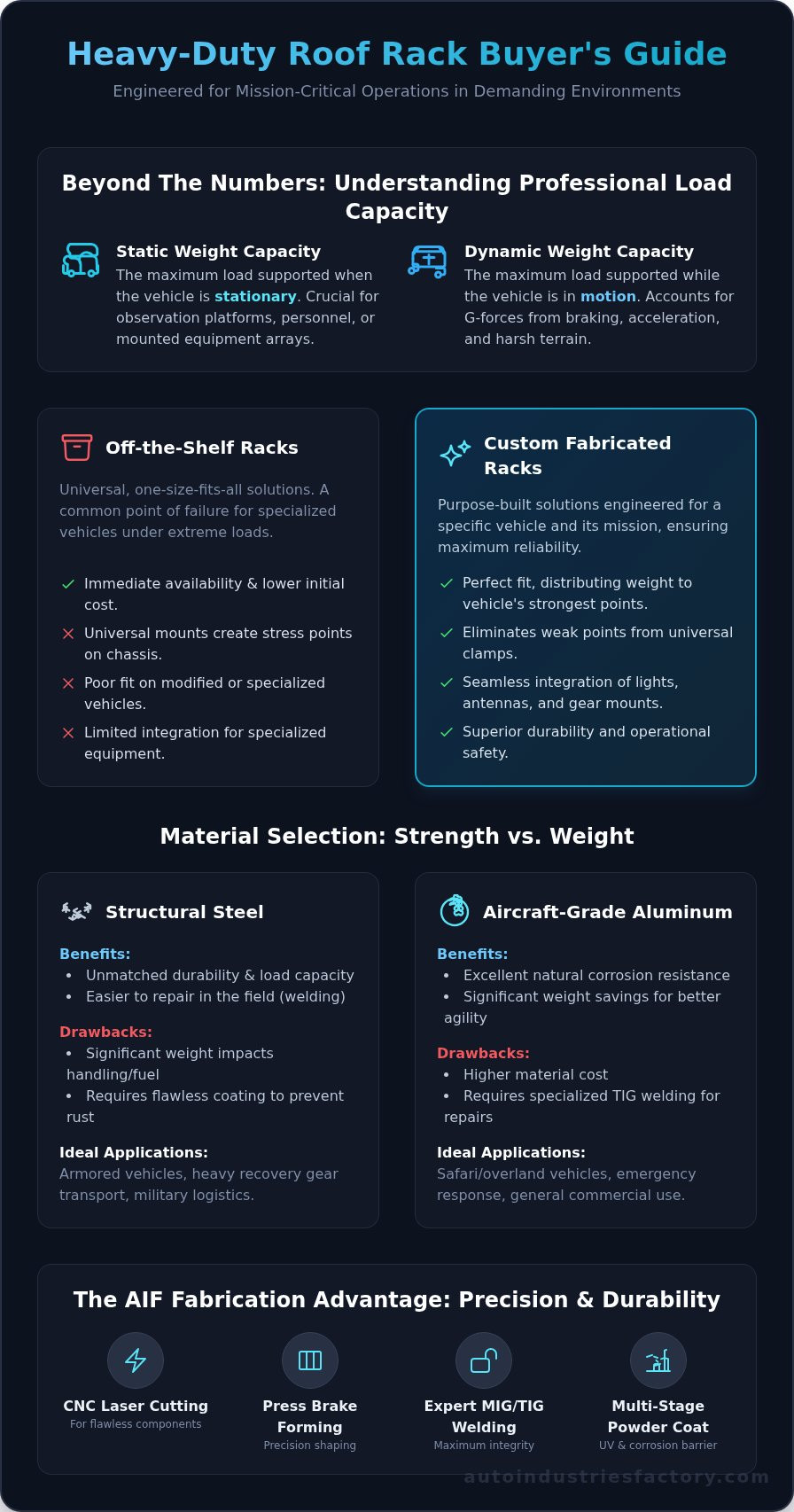
The most critical differentiator is how a rack manages weight. This is broken down into two key ratings that go far beyond what is listed for recreational equipment:
- Static Weight Capacity: This is the maximum load the rack can support when the vehicle is stationary. It's essential for applications like rooftop observation platforms, communication equipment arrays, or supporting personnel.
- Dynamic Weight Capacity: This is the maximum load the rack can safely handle while the vehicle is in motion. This rating is paramount, as it accounts for the immense forces of acceleration, braking, and side-to-side torsion experienced on highways or harsh off-road tracks.
Published consumer ratings are often insufficient because they don't account for the sustained vibrations and severe G-forces of daily commercial use. Ultimately, the vehicle's own roof structure is the final limiting factor, a constraint that professional installers always engineer around.
Off-the-Shelf vs. Custom Fabricated Racks
Modular, off-the-shelf systems offer immediate availability and can be a cost-effective choice for standard fleet vehicles. However, their universal-fit nature is also their primary weakness. While these systems use standardized mounting points and the common components of a roof rack system, their one-size-fits-all design can create stress points on specialized or modified vehicles, leading to potential failure under extreme load.
For ambulances, security vehicles, or custom-built overlanders, custom fabrication is the superior solution. A purpose-built design ensures a perfect fit that distributes weight directly to the vehicle's strongest structural points, such as the A, B, and C pillars. This approach eliminates the weak points inherent in universal clamps and mounts. Custom-fabricated heavy-duty roof racks also allow for the seamless integration of essential features like LED light bars, communication antennas, and specialized equipment mounts, creating a cohesive and exceptionally durable system built for a specific operational role.
Material & Fabrication: Steel vs. Aluminum in Demanding Environments
The material integrity of a roof rack is the foundation of its performance. For commercial and tactical applications, the choice between steel and aluminum is not about preference, but about mission-specific requirements. Both materials can be used to construct premium heavy-duty roof racks, but their inherent properties dictate their ideal use, especially in the demanding climate of Oman, where intense heat and coastal humidity accelerate wear and corrosion.
Structural Steel: The Choice for Maximum Strength
When absolute load capacity is the priority, structural steel is the undisputed leader. Its rugged nature makes it the go-to for vehicles bearing extreme weight or operating in the harshest conditions.
- Benefits: Unmatched durability and load-bearing capacity. Steel is also easier to repair in the field with common welding equipment.
- Drawbacks: Its significant weight can impact vehicle handling and fuel efficiency. Without a flawless protective layer, it is susceptible to rust.
- Ideal Applications: Armored vehicles, heavy recovery gear transport, and military logistics.
A robust, multi-stage powder coating is not optional-it is essential for protecting steel from the corrosive elements prevalent in Oman.
Aircraft-Grade Aluminum: Lightweight Strength
Modern aluminum alloys offer a remarkable balance of strength and low weight. This makes them an excellent choice for a wide range of professional applications where vehicle agility and efficiency are critical.
- Benefits: Excellent natural corrosion resistance and significant weight savings, which improves fuel economy and reduces stress on the vehicle's suspension.
- Drawbacks: Higher material cost and the need for specialized TIG welding for repairs and fabrication.
- Ideal Applications: Safari and overland vehicles, emergency response fleets, and general commercial use.
Through advanced design and fabrication, an aluminum rack can achieve strength comparable to steel. This is a complex engineering solution that balances alloy composition with structural geometry to maximize performance without the weight penalty.
The AIF Fabrication Advantage
The material choice is only half the story; superior fabrication determines the final quality of our heavy-duty roof racks. At Auto Industries Factory, we leverage advanced technology and expert craftsmanship to build products that last. Our process includes precision CNC laser cutting and press brake forming for flawless components, followed by expert MIG (for steel) and TIG (for aluminum) welding to ensure maximum structural integrity. Every rack is finished with our multi-stage powder coating process, creating a durable barrier against UV radiation, abrasion, and corrosion. See our fabrication capabilities in action.
Design Considerations for Specialized Vehicle Applications
A one-size-fits-all approach fails when outfitting specialized vehicles with heavy-duty roof racks. The design must be a direct extension of the vehicle's mission, transforming it from a simple cargo carrier into a mission-critical platform. Every custom fabrication decision-from material choice to mounting points-is dictated by operational demands and environmental challenges. This precision engineering ensures functionality is maximized without compromising vehicle safety. Any aftermarket modification must be carefully planned to avoid interfering with existing safety features, a principle supported by international guidelines like the NHTSA safety standards for vehicle equipment.
Safari & Tour Vehicles (e.g., Land Cruiser, Patrol)
For safari and tour operators navigating Oman's demanding landscapes, the roof rack is a multi-functional platform. Designs must prioritize passenger safety with integrated grab rails and secure, raised viewing platforms. We engineer robust mounting points for essential expedition gear like full-size awnings, spare wheels, and high-lift jacks. Structural integrity is paramount, especially for supporting pop-up roofs, while ensuring precise weight distribution to maintain the vehicle's crucial off-road stability and handling performance.
Military, Police & Security Vehicles
Tactical applications demand absolute reliability and operational discretion. Roof rack designs for these vehicles often feature low-profile, non-reflective finishes to reduce visibility. Secure, vibration-dampened mounting points are fabricated for sensitive equipment like communications antennas, surveillance gear, and infrared light bars. The construction is heavily reinforced to withstand extreme dynamic loads and harsh conditions, integrating seamlessly with vehicle armoring and other mission-specific modifications without creating vulnerabilities.
Commercial & Fleet Vehicles
In the commercial sector, efficiency and durability are non-negotiable. Our heavy-duty roof racks are engineered to maximize cargo capacity for bulky items like ladders, pipes, and construction materials. We incorporate mission-specific features like full-length side rails, configurable tie-down points, and heavy-gauge load rollers to simplify daily operations and protect assets. Built for constant, high-intensity use across an entire fleet, these racks are a durable investment designed to enhance productivity and withstand the rigors of the job site.
The Custom Fabrication Process: From Your Need to Final Installation
When standard, off-the-shelf products fail to meet the demanding requirements of your commercial or tactical operations, a bespoke solution is the only path forward. At Auto Industries Factory, we have engineered a transparent and collaborative process to transform your specific needs into a precision-built, mission-ready roof rack. This structured workflow ensures that the final product is a perfect extension of your vehicle's capabilities, built to withstand the harshest conditions in Oman and beyond.
Step 1: Consultation and Requirements Analysis
Every project begins with a detailed consultation with our engineering team. This critical first step is about understanding the full scope of your operational challenge. We don't just build a rack; we engineer a load-bearing solution. Key discussion points include:
- Vehicle Platform: We analyze your specific vehicle, whether it's a Toyota Land Cruiser, a Nissan Patrol, or a specialized commercial truck, including any existing modifications.
- Load Requirements: Defining the exact type, dimensions, and weight of the equipment you need to carry, from sensitive communications gear to heavy recovery tools.
- Operational Environment: Understanding where you operate-be it rugged mountain wadis, the vast desert expanses of the Empty Quarter, or demanding on-road logistics routes.
- Project Parameters: Establishing clear budget and timeline expectations to ensure the project aligns with your resources.
Step 2: 3D CAD Design and Engineering Approval
Once your requirements are defined, our engineers create a precise 3D CAD (Computer-Aided Design) model of the proposed roof rack. This digital blueprint allows you to visualize the final product and its integration with your vehicle. The design is meticulously optimized for load distribution, structural strength, and aerodynamics to minimize wind noise and impact on fuel efficiency. Crucially, no metal is cut until you have reviewed and formally approved the digital design, guaranteeing a flawless fit and function.
Step 3: Precision Fabrication, Finishing, and Installation
With your approval, the design moves to our state-of-the-art fabrication facility. Using CNC machinery for unparalleled accuracy and expert welders to ensure maximum strength, we bring the approved design to life. Each of our heavy-duty roof racks is then finished with a durable, multi-stage powder coat. This provides superior protection against abrasion, UV degradation, and corrosion from coastal humidity-essential for longevity in Oman's climate. The final stage is professional installation, where our technicians securely mount the rack to your vehicle's structural points, followed by rigorous quality control checks.
Get Started on Your Custom Solution
Whether you are outfitting a single response vehicle or upgrading an entire fleet, our team is ready to engineer a solution for your unique challenge. We provide comprehensive, end-to-end support to ensure your equipment delivers uncompromising performance when it matters most. Request a free estimate for your custom project today.
Your Mission-Ready Solution for Heavy-Duty Racks
Selecting the right cargo system is a critical decision that impacts performance and safety. As we've covered, the difference between a standard rack and a mission-capable one lies in precision engineering, material integrity, and application-specific design. True heavy-duty roof racks are not off-the-shelf accessories; they are purpose-built assets, custom-fabricated from rugged steel or high-grade aluminum to meet the unique demands of tactical, commercial, and emergency vehicles. This tailored approach ensures maximum payload, operational efficiency, and uncompromising durability in the field.
At Auto Industries Factory, our team transforms your requirements into engineered reality. With proven expertise in military, ambulance, and safari vehicle conversions, we leverage in-house engineering and 3D CAD design to deliver flawless results. Every rack is finished with a durable powder coating, specifically chosen to withstand the harsh Omani climate. Don't compromise with a standard solution when your mission demands a custom one. Get a Quote for a Custom-Fabricated Heavy-Duty Roof Rack and equip your fleet for any challenge ahead.
Frequently Asked Questions
How much weight can a custom heavy-duty roof rack actually hold?
The load capacity is engineered specifically for your vehicle and intended use. It's determined not just by the rack itself, but by the vehicle manufacturer's specified roof load limit. Our custom heavy-duty roof racks are designed to maximize this limit, often supporting dynamic (moving) loads of 150kg+ and static (stationary) loads exceeding 300kg for robust platforms like the Nissan Patrol or Toyota Land Cruiser. We engineer each solution for optimal safety and performance.
What is the difference between static and dynamic load capacity, and why does it matter?
Dynamic load capacity is the maximum weight your roof rack can safely handle while the vehicle is in motion, accounting for forces like braking, cornering, and rough terrain. Static load capacity is the weight it can support when parked, which is typically much higher. This distinction is critical for safety; exceeding the dynamic limit can compromise vehicle stability, while the static limit determines your capacity for equipment like rooftop tents or work platforms when stationary.
How long does it take to design and fabricate a custom roof rack?
Our precision fabrication process is thorough to ensure flawless results. A typical project, from initial consultation and 3D CAD design to fabrication and finishing, takes approximately 2 to 4 weeks. This timeline can vary based on the complexity of the design, the specific vehicle requirements, and our current production schedule. We prioritize quality engineering and will provide a more precise timeline after the initial design consultation is complete and approved by you.
Can you fabricate a roof rack for a highly modified or armored vehicle?
Absolutely. This is a core area of our expertise. Auto Industries Factory (AIF) specializes in creating bespoke heavy-duty roof racks for armored, tactical, and highly modified vehicles. Using advanced 3D scanning and precision engineering, we design custom mounting systems that integrate perfectly with non-standard rooflines, additional armor plating, or existing equipment. We ensure the rack's structural integrity matches the vehicle's mission-critical demands, delivering a rugged and reliable solution.
What is the advantage of powder coating over standard paint for a roof rack in Oman?
For the demanding climate in Oman, powder coating offers vastly superior durability. Unlike standard paint, it creates a thick, uniform, and hardened polymer finish that is highly resistant to chipping from gravel, scratching from gear, and fading from intense UV exposure. This finish provides exceptional protection against corrosion, which is crucial in coastal areas with humid, salty air. A powder-coated rack maintains its integrity and appearance for far longer with minimal maintenance.
How does a custom rack mount to the vehicle to ensure it's secure?
We ensure maximum security by engineering mounting systems specific to your vehicle's chassis. Our process utilizes the vehicle's strongest factory mounting points, such as those in the rain gutters or pre-threaded roof inserts. For vehicles without these points, we fabricate custom, load-distributing brackets that securely fasten to the vehicle's internal frame. This direct-to-chassis approach provides a rigid, vibration-free foundation that is essential for heavy loads and off-road conditions.


