
A mission-ready emergency vehicle starts with a clear specification, not just a list of equipment. Emergency vehicle upfitting specifications define the vehicle’s role, the systems it must power, and how each item will be installed and tested. Careful planning helps prevent conflicts involving equipment, electrical capacity, space, and daily operations.
It’s easy to focus on visible features such as warning lights, radios, and storage. Less visible decisions matter just as much: total electrical demand, circuit protection, equipment mounting, vehicle weight, and maintenance access. Every choice should support the vehicle’s actual role.
This guide explains how a professional upfitter turns operational needs into a build plan. Learn how to define the mission, assess electrical loads, match equipment to the vehicle and its role, and prepare procurement specifications with clear acceptance criteria. It also covers documentation and testing for a dependable build suited to UAE operating conditions.
Key Takeaways
- Start with the vehicle’s mission and operating conditions so each upfit choice serves a clear purpose.
- Plan electrical demand across equipment that may operate at the same time, then specify suitable power distribution and circuit protection.
- Match equipment, mounting, and storage to the vehicle’s body type and the work its crew performs.
- Write procurement specifications around performance, documentation, and acceptance criteria, not just a list of components.
- Include functional testing and maintenance information so the completed build is ready for service and easier to support.
What Is Vehicle Upfitting?
Vehicle upfitting adapts a vehicle for a defined operational role by integrating specialist equipment. Lighting and siren requirements vary by jurisdiction and application, so the right setup depends on the vehicle’s authorized use and the department’s needs.
Work with Your Upfitter to Identify Lighting and Siren Needs
Describe the vehicle’s intended role, operating conditions, and required warning functions before selecting equipment. For example, specify whether crews need forward warning, side visibility, rear warning, or illumination around a stopped vehicle. These details help determine lighting placement and how the siren and speakers should support the vehicle’s work.
Separate required functions from preferred features. A department might need warning lights visible from several directions, while takedown or alley lights improve visibility beside the vehicle. Specify how crews will activate each function and whether nighttime operation requires a reduced-output mode. Clear requirements help the upfitter plan equipment, controller inputs, and wiring together.
Have Emergency Lighting and Sirens Professionally Integrated
Have the upfitter integrate the lighting, speakers, sirens, controller, and wiring as one operating system. Sirens and speakers alert nearby drivers and others, while warning lights signal the vehicle’s presence. Placement and activation should suit the layout without obstructing the driver’s view or access to essential controls.
Specify how the system should behave in distinct operating states. Park-kill, available on most sirens since the 1990s, automatically switches the siren off when the vehicle shifts into park. A controller can also manage individual lightheads and select lighting configurations according to operating conditions. Include those behaviors in the build requirements so the installed system matches crew procedures.
Request functional testing of every lighting mode and siren function after installation. The check should cover the interior controls as well as the exterior lights and speakers. This can reveal a mismatched control, inactive lighthead, or unresponsive speaker before the vehicle enters service.
Confirm Applicable Lighting Laws and Standards With Your Upfitter
Identify the rules that apply to the vehicle’s jurisdiction, role, and intended operation. Warning-light colors, configurations, operating conditions, and vehicle authorizations vary by jurisdiction and application. Don’t assume a setup used elsewhere automatically applies in the UAE. Record the applicable requirements in the build specification.
Map each requirement to a specific system function. For example, document which lighting modes are available while driving, when stopped, and at night. Many modern warning lights offer a low-power mode that reduces output at night, helping motorists pass a stopped emergency vehicle more safely. Confirm how the controller selects this mode and how crews operate it.
Include weather conditions in the specification. Emergency lighting should function in all weather, and programmable systems can provide different intensities and patterns. A precise requirements list gives the department and upfitter a shared basis for installation and acceptance, without assumptions about colors or operating permissions.
Electrical load calculations and power management
A professional upfitter inventories the vehicle, equipment, occupants, and mission cargo. The finished load and equipment positions inform payload, weight distribution, and center-of-gravity assessments.
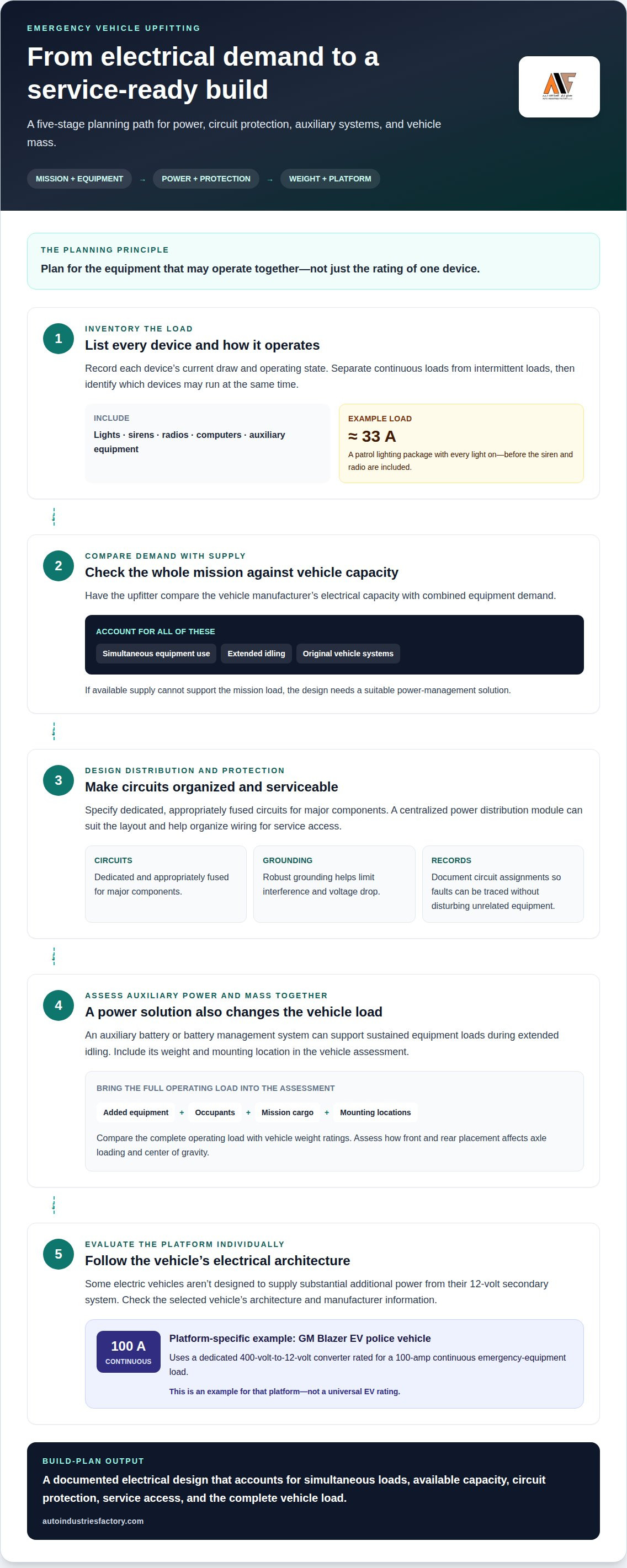
- Inventory every electrical load. List each device, its current draw, and its operating state, including lights, sirens, radios, computers, and auxiliary equipment. Separate continuous loads from intermittent loads, then identify which devices may run together. A patrol lighting package drawing about 33 A with every light on reaches that figure before the siren and radio are included.
- Compare demand with available power. The upfitter reviews the vehicle manufacturer’s electrical capacity against the equipment’s combined demand. Don’t size a system based on one component’s rating alone. Account for simultaneous operation, extended idling, and the power required by original vehicle systems. If available supply cannot support the mission load, the design needs a suitable power-management solution.
- Plan distribution and protection. Use dedicated, appropriately fused circuits for major components, with a centralized power distribution module where the layout suits it. This organizes wiring and supports service access. Robust grounding helps limit electrical interference and voltage drop. Document circuit assignments so technicians can trace a lighting, radio, or computer fault without disturbing unrelated equipment.
- Assess auxiliary power and vehicle mass together. An auxiliary battery or battery management system can support sustained equipment loads during extended idling. Record the weight and mounting location of each added component, along with occupants and mission cargo. Compare the complete operating load with the vehicle’s weight ratings, then assess how front and rear placement affects axle loading and center of gravity.
- Evaluate hybrid and electric platforms individually. Some electric vehicles aren’t designed to supply substantial additional power from their 12-volt secondary system. The GM Blazer EV police vehicle uses a dedicated 400-volt-to-12-volt converter rated for 100 amps of continuous emergency-equipment load. Treat that as a platform-specific example, not a universal EV rating. Follow the selected vehicle’s electrical architecture and manufacturer information.
- Test the completed system under operating conditions. Activate electrical systems simultaneously to check stability, then test equipment with the engine running and during extended idling where relevant to the mission. Confirm circuits remain functional and added loads don’t disrupt vehicle systems. Record the tested configuration and wiring details. For fleet procurement, repeat the same acceptance test for each vehicle build specification.
Matching equipment to vehicle type and emergency-service role
- Define each vehicle’s function before selecting equipment. Match the package to the department’s work, not simply to a standard inventory. A fire truck may need a hose reel and water pump, while an ambulance needs medical supplies. A police vehicle may require secure storage and accessible communications equipment. Document what crews carry, operate, and access during a typical assignment.
- Match equipment and mounting to the vehicle body. Vehicle size and body type affect what fits, where it can go, and which mounts are suitable. A console, camera, or storage unit must fit the cabin without obstructing essential controls or crew movement. Specify the vehicle configuration and intended equipment locations so installation can be planned around usable space.
- Inspect existing equipment before deciding what stays. Test each reused light, radio, camera, and storage component for proper operation. Compare its condition and function with current mission requirements. Replace or upgrade equipment that no longer meets requirements, and confirm retained components will work with the new layout. Specify secure camera mounting that keeps the unit in place and captures clear footage.
- Coordinate communications requirements before installation. Give the radio shop clear specifications and performance expectations before work begins. Identify required channels, operating positions, and how officers will use the radio alongside other equipment. During acceptance testing, verify that communications systems transmit and receive on every programmed channel. This makes radio function part of the build plan, not a late addition.
- Document reused parts, warranty coverage, and substitutions. Equipment-manufacturer warranties, vehicle-manufacturer warranties, and installation workmanship coverage are separate matters. Record which components are reused and which are newly installed, then identify the applicable coverage for each. Require written approval for material product substitutions so the delivered package matches the agreed specification and performance expectations.
- Test the complete integrated layout against its intended use. Check that secure storage is reachable, mounted equipment remains stable, and controls are accessible from their operating positions. Test the radio on every programmed channel and confirm cameras capture clear footage. Inspect the finished arrangement as a working system, including how equipment shares cabin space. Schedule periodic inspections during the vehicle’s service life to identify wear, movement, or changes in function.
Build specifications and procurement
- Start with the exact vehicle configuration. Identify the make, model, model year, body type, and factory options in the procurement document. Manufacturer resources, such as GM Body Builder Manuals, provide vehicle-specific electrical schematics and body dimensions. Use these details to plan equipment locations and avoid components that conflict with the selected configuration.
- Translate the mission into a complete equipment schedule. List each component, its function and location, mounting requirements, and required operating conditions. A mobile command vehicle might need communications equipment, work surfaces, storage, and warning lights. A patrol build may prioritize a console, secure storage, and warning equipment. State which items are essential and document approved alternatives or substitutions.
- Set payload and weight limits in the specification. Account for the upfit, occupants, and operational loads, then compare the completed vehicle’s weight with its ratings. Record the planned location of heavier equipment because placement affects weight distribution. Include partitions, consoles, storage, and other fixed components in the build plan before procurement, rather than treating their weight as an afterthought.
- Define the quote by line item and scope. Request a representative build quote that separates the vehicle, equipment, fabrication, installation, and documentation. For example, a mobile command build can list communications, interior work surfaces, partitions, and warning systems as separate scope items. Clearly specify reused equipment and exclusions so procurement can compare bids against the same functional package, not a vague total.
- Set performance and acceptance criteria before work begins. Describe how each system must perform and how completion will be evaluated. Include functional checks for warning equipment, communications, storage access, and interior fit. Require wiring diagrams and owner materials at vehicle handover. If procurement calls for compliance documentation, identify applicable references in the contract, such as FMVSS, NFPA, or GSA, without assuming every reference applies to every UAE vehicle.
- Build delivery dependencies into the procurement schedule. Emergency lighting, communications hardware, and custom-fabricated consoles can have lead times of weeks or months. Installation can take from a day to several weeks, depending on build complexity. Schedule around fleet operating needs and coordinate equipment arrival, factory vehicle availability, installation, and acceptance testing. A complex command build needs more integration planning than a limited equipment package.
- Control changes during production. Require written approval for material substitutions and document the reason, revised component, and effect on function. Keep the approved specification, wiring diagrams, and handover materials together as the final build record. This gives fleet staff a clear reference for inspection, maintenance, and future procurement of matching vehicles.
Defining vehicle missions and operational requirements
- Describe the vehicle’s actual duty cycle. Record where it operates, how crews use it, and when it must remain available. A squad car expected to work three shifts a day has different demands from one used occasionally for planned events. Include fleet operating needs and busy periods so procurement can schedule the build without removing essential vehicles from service.
- Map tasks to equipment and performance. List the actions the crew must perform, then connect each task to an equipment function. A patrol vehicle may need communications and cameras; a command vehicle may support coordination from a fixed location. Specify where officers operate equipment, what information they need, and how each system should perform during the mission.
- Bring operational stakeholders into specification development. The NTEA Vehicle Specification Process Guide emphasizes defining missions, involving relevant stakeholders, and preparing clear specifications before procurement. Gather input from fleet managers, drivers, operations staff, and maintenance personnel. Their combined requirements can reveal conflicts, such as camera placement affecting visibility or communications controls being difficult to reach.
- Document environmental and route conditions. Describe the terrain, weather, and operating locations the finished vehicle will encounter. These conditions influence equipment protection, mounting choices, and access for routine service. For UAE operations, include actual routes and environments in the mission brief rather than relying on a generic emergency-vehicle package.
- Identify applicable requirements by operating jurisdiction. Build specifications should account for relevant local, state, and federal requirements, alongside the vehicle’s application and operating conditions. For a UAE fleet, identify requirements applicable to its intended use and locations. Record required documentation and acceptance criteria in the procurement package rather than assuming a specification from another jurisdiction applies unchanged.
- Set bidder insurance requirements in the tender. State the coverage evidence bidders must provide, the work and responsibilities it must address, and how the evidence will be assessed. Keep these criteria consistent across procurement documents and bidders. Align them with the agency’s procurement requirements, without adding unsupported coverage amounts or treating one insurer’s terms as a universal standard.
- Use the mission brief to control the finished build. Connect each approved task to its equipment, operating location, and acceptance test. For example, a communications requirement should specify the required function and how crews will test it. Keep changes tied to documented approval, then use the same mission requirements during handover and fleet planning. For mission-specific modifications, discuss your vehicle requirements.
Auto Industries Factory
Auto Industries Factory LLC helps fleets across the UAE turn defined vehicle roles into specialized conversions and modifications. When procurement calls for ambulance conversions, police and military vehicle modifications, safari vehicle conversions, or metal canopies and roof racks, its fabrication work supports the vehicle’s intended use. A clear mission brief and equipment schedule provide a practical starting point, including vehicle type, required functions, and operating conditions.
Bring your planned use and build requirements together before finalizing procurement. This helps align the selected conversion or modification with the vehicle’s role instead of treating every fleet build as the same package. To discuss a project, contact Auto Industries Factory LLC.
Turn Your Requirements Into a Build Plan
The next step is to turn your operational priorities into a clear project brief. Define what the vehicle must do, which equipment supports that role, and how the finished build will be assessed. This gives your team a practical basis for procurement planning and a discussion with a specialist.
For fleets planning an ambulance conversion, police or military vehicle modification, or safari vehicle conversion, align the requested work with the vehicle’s mission from the outset. Clear emergency vehicle upfitting specifications keep decisions focused on practical function and fit.
Auto Industries Factory LLC works on these specialist vehicle conversions and modifications. Discuss your vehicle requirements with Auto Industries Factory LLC and take the next step toward a purpose-built vehicle.
Frequently Asked Questions
Can Existing Equipment Be Reused?
Yes, existing equipment can be reused if it remains functional and suits the new vehicle and mission. For example, a radio may work correctly but need a different mount or wiring connection in another cabin layout. Assess compatibility, condition, and installation needs before assigning it to the build. Record reused components separately so maintenance staff can identify their history and coverage.
Can the Same Configuration Be Repeated Across Several Vehicles?
Yes, a fleet can use a common baseline configuration, with documented changes for different vehicle models or duties. A shared equipment schedule supports consistent operation and procurement, while mounting and electrical arrangements may still differ by model. Record each approved variation, including its reason and acceptance check. This helps fleet staff compare completed vehicles and order compatible replacements without assuming every unit is identical.
How Will Modifications Affect the Vehicle?
Modifications can change available payload, equipment access, cabin space, and maintenance needs. A fitted console or storage unit may affect how occupants reach controls, while added equipment contributes to the vehicle’s operating load. Keep the final build records with the vehicle, including wiring diagrams and owner materials. Distinguish equipment-manufacturer warranty, vehicle-manufacturer warranty, and installation workmanship coverage, since they are not necessarily the same.
What Specifications Are Required for Emergency Vehicle Upfitting?
Specifications should state the vehicle platform, its mission, required equipment functions, installation locations, and acceptance checks. Include operating conditions and any required procurement documentation. For example, define how a camera should be positioned and tested, rather than listing “camera” alone. Clear emergency vehicle upfitting specifications also record approved substitutions and the expected handover materials, giving procurement and fleet teams a shared reference for the finished vehicle.
Which NFPA, SAE, and Vehicle Manufacturer Standards Apply to Emergency Vehicle Upfitting?
Applicable references depend on the vehicle role, jurisdiction, and procurement requirements. NFPA 1900 replaced separate standards for fire apparatus, wildland apparatus, and ambulances effective January 1, 2024. Procurement documents may identify FMVSS, NFPA, and GSA documentation where relevant. Use the vehicle manufacturer’s manuals for platform-specific dimensions and electrical information, and list any applicable SAE references against the relevant system in the specification.
How Do Upfitting Specifications Differ for Police, Fire, and Ambulance Vehicles?
They differ according to crew tasks and equipment carried. Police builds can prioritize patrol communications, cameras, and accessible secure storage. Fire apparatus may require a hose reel and water pump, while ambulances need medical supplies. The specification should connect each item to its function, location, and operating conditions. For mixed-purpose vehicles, describe each task separately so storage, access, and equipment priorities don’t conflict.
What Electrical System, Battery, and Alternator Capacity Is Needed for Emergency Vehicle Equipment?
Capacity must match the installed equipment and the loads expected to operate together, not a universal vehicle-wide figure. The upfitter evaluates the selected platform’s electrical architecture and the package’s operating demands. Hybrid and electric vehicles need particular attention because their secondary electrical systems differ. Include engine-off or extended-idling use in the load profile, then specify the power arrangement and tests needed for that operating pattern.
What Is the Typical Cost and Lead Time for Emergency Vehicle Upfitting?
Price depends on the vehicle, equipment, fabrication, installation, and reused components, so there isn’t one reliable cost for every build. Lead times for emergency lighting, communications hardware, and custom-fabricated consoles can extend for weeks or months. Installation can range from a day to several weeks, depending on build complexity and equipment integration.