

The right ambulance base is determined by the mission, not just the vehicle badge. When choosing a base vehicle for ambulance conversion, match the chassis to the ambulance type, operating environment, patient-transfer needs and equipment layout. Type I ambulances commonly use a heavy truck chassis, while Type II conversions often use a heavy-duty van; the Mercedes-Benz Sprinter is one commonly used van platform.
That distinction matters because the base vehicle determines the space available for the patient compartment, how the ambulance handles its routes, and which equipment can be integrated effectively. The platform must suit the service it will perform.
This guide explains how to identify the right ambulance type and compare van, truck and other chassis options for UAE operations. It also covers the practical factors that influence the choice, including terrain, payload, clearance, 4×4 capability and equipment requirements, so you can approach a professional conversion with a clear operational brief.
Key Takeaways
- Start with the ambulance’s care and transfer role, then shape the patient-compartment layout around the work the vehicle must perform.
- The Mercedes-Benz Sprinter is a commonly used van platform; its wheelbase and conversion layout should suit the required space and equipment.
- Match each ambulance type to a chassis that can support its intended configuration, operating environment and access needs.
- Compare van, truck and bus platforms by how well each fits the route, terrain and operational demands, not by vehicle size alone.
- Account for the completed fit-out when assessing payload and gross vehicle weight rating, alongside clearance and any need for four-wheel drive.
Mercedes-Benz Sprinter as an ambulance-conversion chassis
The Mercedes-Benz Sprinter is a commonly used commercial van platform for ambulance conversions. Its suitability depends on the ambulance type, patient-care role, and space needed for the equipment layout.
Sprinter Chassis-Cab Patient Space
A Sprinter chassis-cab provides a platform for a separately built patient compartment. The key question is how that compartment will support the care team’s tasks, patient access, and equipment placement. A conversion specialist plans the interior arrangement before selecting the body configuration, since cabinets, seating, and stretcher access all use the same available space.
With a chassis-cab ambulance, the patient compartment can be designed for its intended service rather than treated as general cargo space. The specialist considers how medical equipment and storage will fit alongside the patient area. The care role therefore guides the layout: an ambulance for advanced care needs a different working arrangement from one focused on basic transfers.
Type II and Type III Van-Chassis Layouts
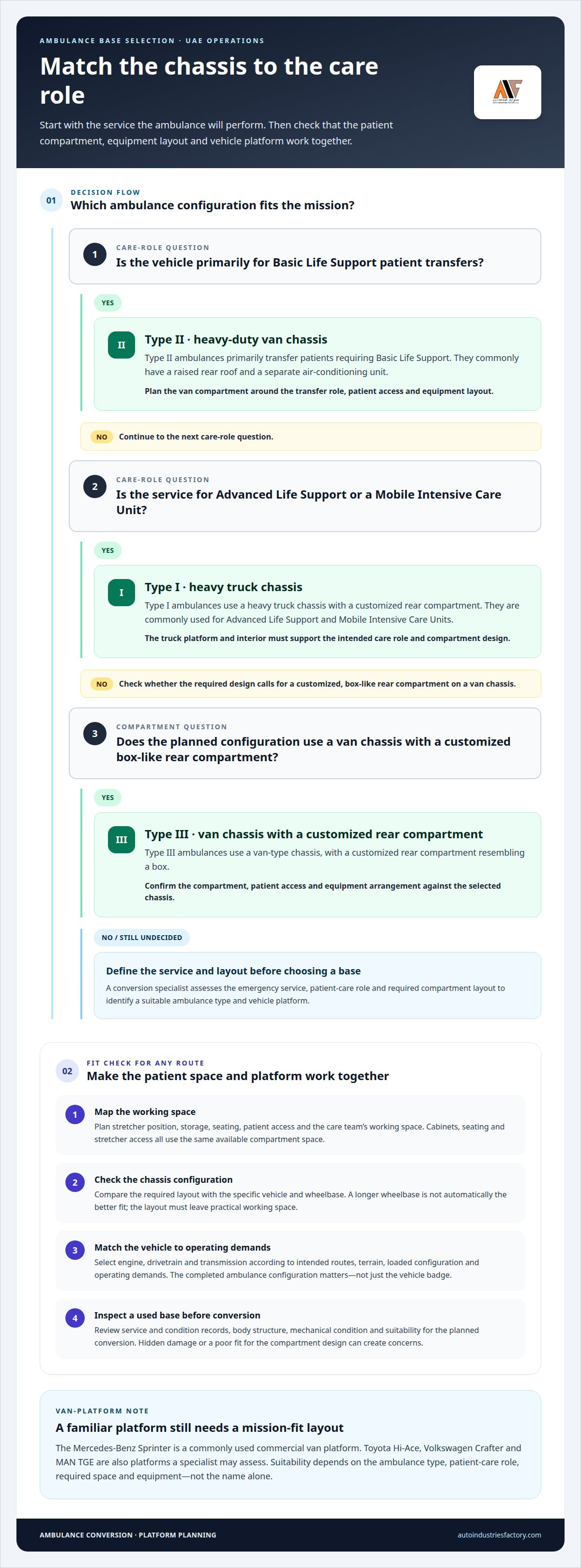
Type II ambulances use a heavy-duty van-type chassis and commonly have a raised rear roof and a separate air-conditioning unit. They primarily transfer patients requiring Basic Life Support. A Sprinter conversion must accommodate this transfer role while keeping the compartment and equipment layout functional.
Type III ambulances also use a van-type chassis, but have a customized rear compartment resembling a box. That distinction affects how the specialist plans the body and patient space. The Mercedes-Benz Sprinter is one possible commercial van platform, alongside vehicles such as the Toyota Hi-Ace. The right layout depends on the required compartment, access, and equipment.
Type I Truck-Chassis Ambulances
Type I ambulances use a heavy truck chassis with a customized rear compartment. They are commonly used for Advanced Life Support and Mobile Intensive Care Units, so the base vehicle and interior must support a more demanding care role. A Sprinter van chassis is a different platform: the truck chassis supports a distinct rear-compartment design. The intended service helps determine the appropriate configuration.
Matching the Sprinter to the Conversion
Start the conversion process with the mission. A specialist identifies whether the vehicle will mainly provide Basic Life Support transfers, advanced care, or another defined patient service. That decision guides the choice between a van-based Type II or Type III layout and a truck-based Type I configuration.
The specialist then plans the patient compartment around the equipment and working space required for the service. Ambulance conversions involve stripping down the selected vehicle and fitting medical equipment and other components for patient transfers. The Sprinter’s name alone does not determine its suitability: the chassis, ambulance type, and finished interior plan must work together.
How Can a Conversion Specialist Help Identify the Right Type of Ambulance for You?
A conversion specialist begins with the emergency service, patient-care role, and required compartment layout. For a Mercedes-Benz Sprinter or another platform, the vehicle and interior plan must work together.
The assessment also considers the UAE operating environment, vehicle condition and long-term fleet needs. These factors guide decisions about wheelbase, engine, driveline, transmission and equipment space.
Wheelbase and Patient-Compartment Configuration
Sprinter wheelbase affects the length available for the patient compartment and its equipment layout. A specialist compares the required stretcher position, storage, seating, and access with the specific chassis configuration, rather than assuming a longer wheelbase is automatically better. The layout must leave practical working space for the care team.
A new or used base vehicle’s purchase cost in the UAE varies by model, age, condition and specification. Conversion pricing depends on the vehicle, equipment, finish and fabrication, and is provided after a quote request.
Ambulance Ergonomics and Model Compatibility
Compartment ergonomics determine how the care team reaches the patient and uses equipment during transfers. A specialist plans access routes, storage, and seating around the intended work, then checks that the layout fits the chosen chassis. A Sprinter, Toyota Hi-Ace, Volkswagen Crafter, or MAN TGE can each provide a different starting platform for that assessment.
For a used base vehicle, the specialist assesses its service and condition records, body structure, mechanical condition, and suitability for the planned conversion. Risks include hidden damage, a poor fit for the compartment design, and limited appeal to future fleet buyers. A sound inspection helps identify concerns before conversion work begins.
Engine, Drivetrain, and Transmission Choices for an Ambulance Conversion
The specialist selects engine, drivetrain and transmission options according to the vehicle’s intended routes, terrain, loaded configuration and operating demands. Listed Sprinter engine options include a 2.1 L I4 diesel producing 148 hp and 243 lb-ft of torque, a 3.0 L V6 diesel producing 181 hp and 295 lb-ft, and a 3.5 L V6 petrol producing 254 hp and 251 lb-ft.
These figures describe listed engine options, not a recommendation for every fleet. Route conditions and the completed ambulance configuration guide the choice. The transmission and drivetrain must also suit the operating plan.
Fuel Economy, Maintenance, and Parts Availability for Ambulance Base Vehicles
Fuel economy matters across repeated emergency response and patient-transfer routes, while maintenance affects vehicle availability over its working life. The specialist weighs expected use against engine choice and service needs. Regional parts availability also matters: a base vehicle with accessible parts and maintenance support can simplify fleet planning.
These factors should be considered together, not as isolated specifications. A platform with attractive fuel use may still be a poor fit if its parts are difficult to source or its configuration does not support the compartment. For ambulance conversion planning, the intended use, chassis and fit-out requirements provide the starting point for a practical assessment.
How a Conversion Specialist Chooses a Vehicle Base for Each Ambulance Type
A conversion specialist matches the chassis to the ambulance’s care role, operating environment, and compartment requirements. When choosing a base vehicle for ambulance conversion, consider not only vehicle type but also terrain, access, payload, and parts support.
Classification systems describe different things. Type I, II, III and IV refer to vehicle types and specifications, while EN 1789:2020+A1:2024 classifies road ambulances as types A, B and C according to the level of care they must provide.
Van-Chassis Comparisons
For urban routes, a smaller, more manoeuvrable van may suit narrow streets and frequent stops. Type II ambulances use a heavy-duty van chassis and primarily transfer patients requiring Basic Life Support. Type III ambulances also use a van chassis, with a customized rear compartment resembling a box.
The specialist compares the required patient compartment and equipment with the available platform. Mercedes-Benz Sprinter, Toyota Hi-Ace, MAN TGE and Volkswagen Crafter are examples of listed van-based platforms. The choice depends on the intended configuration, operating routes and regional parts availability.
Truck-Chassis Comparisons
Type I ambulances use a heavy truck chassis and a customized rear compartment. This configuration is commonly associated with Advanced Life Support and Mobile Intensive Care Units. A specialist assesses whether the truck platform and body layout can support the planned service, patient access, and equipment fit-out.
For rural routes or mining operations, a larger chassis or 4×4 platform may better suit the terrain. The specialist weighs these needs against route access and height clearance. A truck’s size alone does not make it the right choice; the operational brief must justify its platform and rear-compartment configuration.
Next, the specialist maps the operating profile. Urban emergency response may make manoeuvrability a priority, while remote routes can make terrain capability and access more important. Geography, patient-transfer frequency, and care level all influence the recommended base vehicle.
For transfers to locations that larger ambulances may struggle to reach, Type IV mini ambulances are another configuration to consider. The specialist matches vehicle dimensions and access needs to the locations it must serve. This avoids choosing a chassis based only on patient-compartment size.
Regional conditions also shape fleet suitability. Budget, driver licensing requirements, and parts availability affect the practical choice. For Type A conversions, base-vehicle selection generally reflects fleet preferences and regional service availability rather than requirements set by the ambulance standard.
Country requirements matter, too. Ambulance classification criteria can vary, so the intended operating location should inform the conversion plan. A specialist aligns the vehicle type, care role, and configuration with the destination country’s emergency-vehicle requirements, rather than assuming one classification applies everywhere.
The final choice brings together four factors: ambulance type, care level, operating terrain, and patient-compartment needs. A van chassis can suit a Type II or Type III layout, while a heavy truck chassis supports the Type I configuration. To choose a base vehicle for ambulance conversion, the specialist uses the operational brief to determine which platform best fits the service.
How Can a Conversion Specialist Compare Van, Truck, and Bus Chassis for Ambulance Conversions?
A specialist compares each chassis against the ambulance’s care role, operating routes and required patient space. For UAE fleets, terrain, access, payload and height clearance help narrow the options.
Van Chassis
A van chassis can suit an ambulance conversion when a contained patient compartment and flexible fit-out meet the service brief. The Mercedes-Benz Sprinter and Toyota Hi-Ace are examples of commercial van platforms used for conversions. The specialist compares the intended layout, equipment, and patient access with the selected vehicle, rather than choosing by model name alone.
Van conversions are described as a cost-effective way to build an emergency fleet, with flexible specifications and faster lead times than purpose-built chassis. Those advantages do not settle the decision. Route conditions, required equipment, and the completed vehicle’s payload still determine whether a van platform fits the operation.
Truck Chassis
A truck chassis supports a different conversion approach. Type I ambulances use a heavy truck chassis with a customized rear compartment, making this configuration relevant when the intended service requires that vehicle type and body arrangement. The specialist considers compartment requirements, patient access, and equipment fit-out together.
For rural or mining operations, a larger chassis or 4×4 platform may better suit the terrain. The specialist weighs these needs against route access and height clearance. A truck’s size alone does not make it the right choice; the operational brief must justify its platform and rear-compartment configuration.
Bus Chassis
A bus chassis needs an individual assessment against the required ambulance layout and operating role. The specialist considers whether its interior can accommodate the patient compartment, equipment, and access required for the service. Routes and clearance also matter, especially where the vehicle must pass through constrained areas.
The European Union notes that ambulance box-body adaptations can be based on standard vans or Unimog multi-purpose four-wheel-drive lorries. This illustrates why the conversion brief should guide platform choice. A bus, van, or truck must be assessed in relation to the specific body and patient-care arrangement.
Comparing the Platforms
A conversion specialist can structure the comparison around four practical questions:
- Care role: Does the ambulance type call for a van, truck or another platform?
- Operating environment: Will the vehicle work mainly in urban areas, rural routes or mining locations?
- Conversion fit: Can the chassis support the intended patient compartment and equipment arrangement?
- Vehicle constraints: How do payload, height clearance and 4×4 capability affect the proposed build?
For example, an urban service may favour a smaller, manoeuvrable van, while remote terrain may point toward a larger or 4×4 platform. A specialist then aligns the chassis, conversion layout and operating needs before recommending a base vehicle.
How does a conversion specialist determine the payload capacity and gross vehicle weight rating needed for an ambulance build?
A conversion specialist starts with the finished ambulance, not the empty base vehicle. The chassis must accommodate the patient compartment, crew, equipment, and operating load while remaining within its gross vehicle weight rating (GVWR). Payload capacity and GVWR are related, but describe different parts of the vehicle’s load limits.
Build a Complete Load Schedule
First, list the components planned for the conversion: the body or compartment, cabinets, stretcher, patient-care equipment, crew seating, and occupants. The schedule should also account for installed systems and supplies carried during normal operations. A box-type layout, for example, adds a compartment whose mass must be included in the completed vehicle’s load plan.
Every item contributes to the vehicle’s operating mass. Omitting equipment or occupants can make the available payload look greater than it will be in service. The specialist therefore works from the intended fit-out and patient-care role, rather than relying on the empty chassis specification alone.
Relate Payload to GVWR
GVWR is the vehicle maker’s maximum permitted total loaded weight. Payload is the capacity available for the load carried or added to the base vehicle. The specialist compares the base vehicle’s weight with its GVWR, then accounts for conversion work and the planned operating load. The remaining capacity must suit the completed ambulance configuration.
This comparison distinguishes a chassis that appears suitable from one with enough capacity after conversion. A van carrying a patient compartment, stretcher, cabinets, crew, and equipment has a different load profile from an unconverted van. The same process applies to a truck chassis with a customized rear body.
Check Distribution and Operating Conditions
Total weight is only part of the assessment. The specialist considers how the compartment and equipment load sit across the chassis, because placement affects the completed vehicle’s balance. The plan also reflects route conditions, height clearance and whether the ambulance needs 4×4 capability. These factors influence the base vehicle choice alongside payload.
For operations, the route profile helps define the expected configuration. A vehicle serving urban routes may need a different layout from one intended for rural or mining terrain. The conversion specialist assesses the vehicle and its complete fit-out as one system, using the operating brief.
Confirm the Finished Configuration
Before finalizing the base vehicle, the specialist checks the proposed equipment and compartment against its load capacity. Changes to cabinets, body construction, or installed equipment can alter the load plan. A revised fit-out therefore requires a revised assessment, rather than relying on an earlier estimate.
For a project-specific ambulance conversion assessment, start with the required patient-care layout and equipment list. This connects the chassis rating to the completed build, rather than treating payload as an isolated specification.
Auto Industries Factory
Auto Industries Factory LLC is a practical next step when your fleet needs an ambulance conversion and the base vehicle must suit its intended role. The right choice depends on the ambulance type, operating environment, patient-compartment requirements, and equipment fit-out. Bringing these requirements together creates a conversion brief based on how the vehicle will be used.
Share the base vehicle you’re considering, the routes it will serve, and the required patient-care configuration. Auto Industries Factory LLC also undertakes police and military vehicle modifications, safari vehicle conversions, and metal canopy and roof-rack fabrication for specialized vehicle projects.
Contact Auto Industries Factory LLC to discuss your ambulance conversion requirements.
Move from Vehicle Brief to Conversion Planning
An ambulance fleet plan is easier to advance when operational priorities are set out in a practical vehicle brief. Define the intended patient-care role, routes, equipment needs, and fleet requirements, then use that brief to align procurement and conversion decisions. This gives each decision a clear operational reference point.
Choosing a base vehicle for ambulance conversion means matching the platform to the service it must support. Keep the brief available as specifications are discussed, so changes to equipment or compartment requirements are considered alongside the vehicle choice. A clear starting point moves the project from broad requirements toward a build plan and keeps decisions focused on how the finished unit will be used.
Auto Industries Factory LLC can support organizations planning specialized vehicle modifications, including ambulance projects. If you’re ready to discuss your fleet requirements, contact Auto Industries Factory LLC. Bring your operational priorities into the conversation and take the next step with a clear direction.
Frequently Asked Questions
What vehicle types are commonly used as ambulance conversion base vehicles?
Commercial vans and heavy truck chassis are common starting points, with the intended ambulance configuration guiding the choice. The Mercedes-Benz Sprinter and Toyota Hi-Ace are examples of van platforms. Type I ambulances use a heavy truck chassis, while van-based layouts support other configurations. Before settling on a vehicle type, a conversion brief can compare platform size and access requirements with the fleet’s operating routes.
What interior dimensions and roof height are needed for ambulance patient compartments?
No single interior measurement suits every patient compartment. The required space depends on the stretcher arrangement, patient-care equipment, crew access, and storage layout. A raised rear roof, for example, is common on Type II van ambulances, but that feature alone does not determine the required interior height. The conversion layout should account for how staff reach the patient and use equipment within the available space.
What UAE regulations and vehicle approval requirements apply to ambulance conversions?
Ambulance approval depends on the applicable UAE requirements for the vehicle’s intended use and classification. A technical standard such as EN 1789 shouldn’t be treated as automatic proof of local vehicle approval. Ambulance classifications and requirements can vary by country. Keep the base vehicle details and conversion specification aligned with the approval process that applies to the intended UAE operation, including the completed vehicle’s configuration and equipment.


