

A rear step that works on level ground can become the lowest point at the back of a high-clearance ambulance. Effective rear step design for high-clearance box ambulances balances a usable entry with ground clearance, so the step can fold away when the vehicle is moving.
That balance matters: a high patient-compartment floor makes the climb more demanding, while an exposed step can reduce rear clearance. An automatically folding step paired with a hinged rear door is one option to consider, along with well-positioned grab rails.
This guide explains how floor height and ground clearance shape rear access, what to consider when selecting step height and depth, and how the door and folding mechanism work together. It also covers the details that influence a professionally fabricated ambulance conversion, helping you make a practical decision for your vehicle and its intended use.
Key Takeaways
- Plan rear access around the patient-compartment floor height, with appropriately positioned grab rails to support entry and exit.
- Balance a usable step with rear ground clearance so the access system does not compromise the vehicle’s clearance when stowed.
- Coordinate the hinged rear door and automatically folding step as one access arrangement, considering how each moves during use.
- Choose step height and depth for the vehicle’s layout and intended access needs rather than assuming one size suits every box ambulance.
- Compare fixed, folding, and retractable step designs by how they affect access and clearance in the ambulance’s operating conditions.
High floor height and ergonomic loading
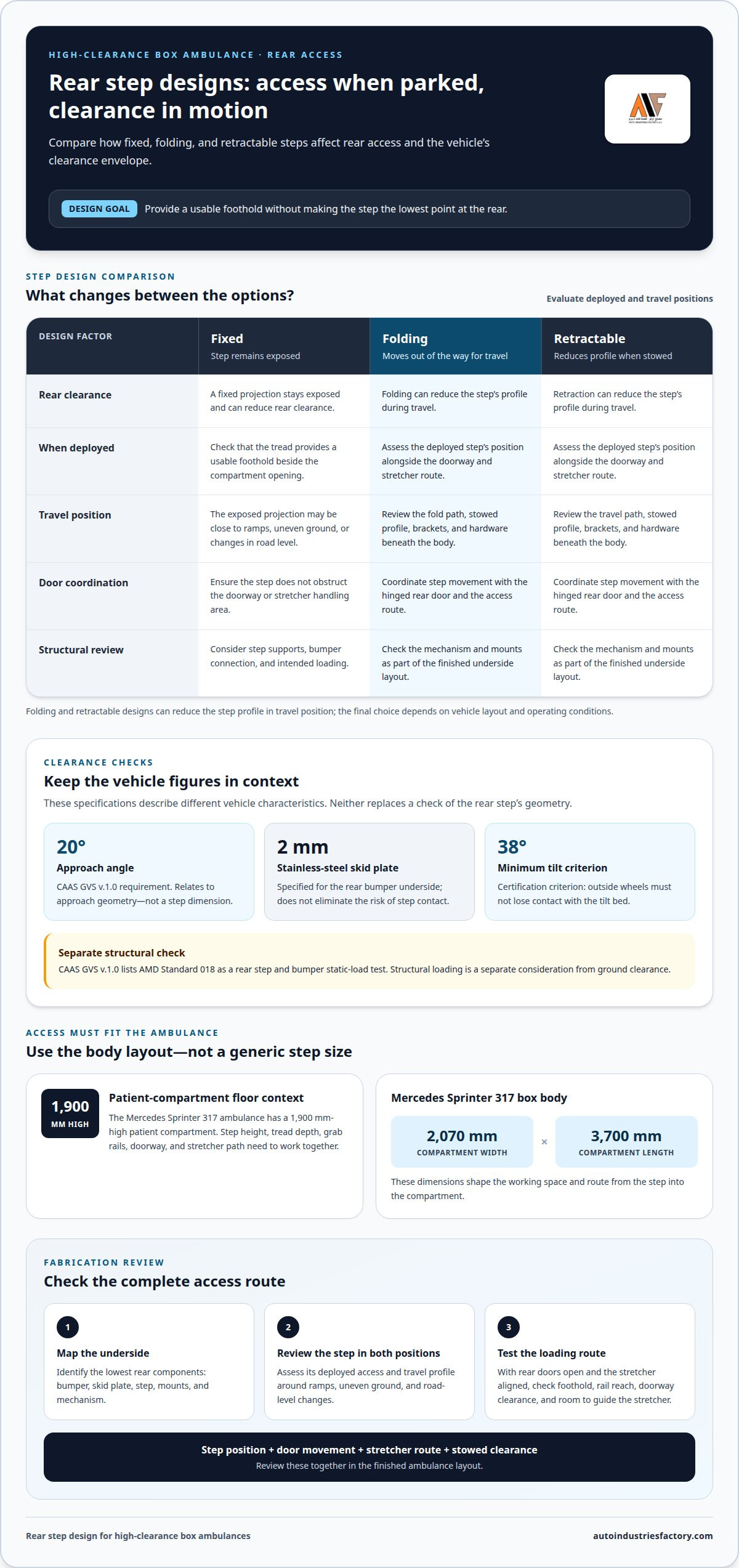
A high patient floor makes rear access part of the loading route, not just a foothold. In the Mercedes Sprinter 317 ambulance, the patient compartment is 1,900 mm high, so the step, grab rails, and stretcher path need to work together.
Stretcher Loading and Unloading
During stretcher loading, the rear step gives crew members a stable position beside the compartment opening. Its placement should create a clear route between the ground and patient floor, without obstructing the doorway or forcing the stretcher team to work around it. For unloading, the layout should leave room to control the stretcher as it moves outward. Well-positioned grab rails support access around the opening.
Step Height and Depth
Step height determines how the crew moves between the ground and the elevated patient floor; depth affects how much foot support the tread offers. The Mercedes Sprinter 317’s 1,900 mm compartment height illustrates why the access arrangement must be designed around the vehicle, rather than selected as a generic accessory. The fabricator should consider the floor level, doorway, step position, and stretcher route as connected dimensions.
Durable Slip-Resistant Surfaces
For a durable, slip-resistant step, specify a robust metal tread with a formed or applied texture that gives footwear grip. A wear-resistant finish can help protect the tread, while a surface that is practical to clean supports routine use. The material and treatment should suit the step’s exposure and construction. Avoid a smooth finish that can become slippery when dusty or wet.
Ergonomic loading also depends on the space around the tread. Crew members should be able to reach a grab rail while stepping up, then move clear of the stretcher’s path. The specified ambulances must have sufficient, appropriately positioned grab rails and retractable side steps to the rear compartment. Coordinate their positions with the door opening and the points where staff handle the stretcher.
For a box-type ambulance, the entry arrangement must fit the rear body, not only the chassis. The Mercedes Sprinter 317 box ambulance has a patient-compartment width of 2,070 mm and length of 3,700 mm. Those dimensions shape the working space behind the vehicle and the route from the step into the compartment. A projecting tread or poorly placed rail can interfere with that route, so each component needs to be considered in the finished layout.
During fabrication, assess access with the rear doors open and the stretcher aligned with the compartment. This reveals whether the step provides a usable foothold without narrowing the handling area, and whether grab rails remain within reach as staff guide the stretcher over the threshold. For high-floor vehicles, this coordinated review is central to practical rear access.
High ground clearance
A rear step must provide access without becoming the lowest point beneath a box ambulance. Its position, mounting, and stowed profile affect how the vehicle handles ramps, uneven ground, and changes in road level. Effective rear step design for high clearance box ambulances accounts for these conditions as well as the rear access route.
Ground clearance is not determined by one rear-step measurement. The finished arrangement depends on the chassis, rear body, bumper, step mechanism, and vehicle approach angle. A step that projects below the bumper can reduce rear clearance, even when the main chassis sits high. Evaluate the step in both deployed and travel positions.
Approach angle describes how steep an incline a vehicle can meet before its front underside contacts the surface. The CAAS GVS v.1.0 ambulance specification sets a 20° approach-angle requirement. That figure concerns the vehicle’s approach geometry, not a recommended step dimension. It illustrates why rear equipment should be considered within the vehicle’s overall clearance envelope.
Rear geometry matters too. A ramp, raised threshold, or uneven track can bring the bumper and step close to the ground as the vehicle moves. A fixed projection stays exposed in these conditions. A folding or retractable step can reduce its profile during travel, but its brackets and surrounding hardware must also be considered in the underside layout.
The CAAS GVS v.1.0 also lists AMD Standard 018 as a rear step and bumper static-load test. This identifies structural loading as a separate design consideration from ground clearance. The step must occupy a suitable position while its supports and bumper connection accommodate the intended loading. A low-profile arrangement is not useful if its mounting compromises the step’s structural function.
Specified ambulance rear bumpers must have underside stainless-steel skid plates with a thickness of 2 mm. The plate protects the underside area, but it does not make a projecting step immune to contact with the ground. The step, bumper, and skid plate should therefore be reviewed together, especially where the step sits near the bumper’s lower edge.
Certification for the specified ambulances must demonstrate a minimum tilt of 38 degrees without outside wheels losing contact with the tilt bed. This is a vehicle-stability criterion, not a rear-step clearance figure. It reinforces the need to assess the completed ambulance as a whole rather than treating the step as an isolated component.
During layout, map the lowest rear components, then assess the step’s travel path and stowed position. Include the bumper, skid plate, mounts, and any mechanism beneath the body. This review helps preserve clearance while keeping the step accessible when deployed. The 20° approach requirement and 38-degree tilt criterion address different vehicle characteristics, so neither should be treated as a substitute for checking rear-step geometry. This is a core consideration in rear step design for high clearance box ambulances.
Hinged rear door with an automatically folding step
A hinged rear door and automatically folding step should operate as one access system. The door opening, step movement, mounting points, and travel position all affect how the crew uses the rear compartment.
With the doors closed, the step should sit in its intended stowed position without creating an unnecessary projection beneath the rear body. With the doors open, its deployed position should provide access without blocking the doorway or stretcher route. Coordinate the mechanism’s travel with the door swing so neither component obstructs the other.
A step’s load rating should reflect its intended use and the forces its structure and mounts must carry. The design should demonstrate those capabilities through an applicable static-load test. The CAAS GVS v.1.0 lists AMD Standard 018 as a rear step and bumper static-load test; it does not provide a load rating or safety-factor value here.
For ambulance work in the UAE, distinguish technical references from local legal requirements. CAAS GVS v.1.0 and AMD Standard 018 are named technical references, but they should not be described as UAE regulations based on these facts. The ambulance’s applicable approval criteria must guide regulatory decisions for its intended use.
To mount a step without compromising a box chassis, professional fabricators assess the body support structure and connect the assembly through suitable structural mounting points. The Mercedes box ambulance chassis flanges are fastened with 12 mm grade 9.8 bolts, each with a stated load-carrying capacity of 5480 kg. Those chassis details are not a step-load rating; the step attachment must be engineered for its own loads.
Well-positioned grab rails support rear access, while lighting can make the tread and doorway visible in low light. The specified ambulances must have sufficient, appropriately positioned grab rails and retractable side steps to the rear compartment. Coordinate handholds and lights with the deployed step, door swing, and stretcher route to keep the working area clear.
Inspect the tread, hinges, mounting points, fasteners, and full folding movement. Look for looseness, deformation, corrosion, surface damage, or binding that prevents the step reaching its intended position. Follow the vehicle’s applicable service schedule, paying attention to visible wear and operating faults.
Before completion, operate the rear doors and step through their full movement, then assess the assembly in both deployed and stowed positions. Review the connections, clearances, and access path together. This practical sequence can reveal interference between the door, step, bumper, and bodywork before the ambulance enters service.
What step height and depth are recommended for ambulance rear access?
No single step height or tread depth suits every box ambulance. The right dimensions depend on the patient-floor level, rear opening, ground clearance, and how crew members handle a stretcher. The specified ambulances must be box-type vehicles, so the step must fit the completed body and access route.
Set the step height by considering the transition from ground level to the ambulance floor. A large vertical gap can make entry more difficult, while a step positioned too low may project beneath the rear body. The design must balance these demands with the vehicle’s clearance and the step’s stowed position. In a high-floor compartment, the ground, tread, and doorway should form a usable sequence.
Tread depth determines how much space a boot has to land securely. A shallow tread can limit foot placement, while excessive projection can reduce rear clearance or interfere with nearby bodywork. The right depth supports a stable step while fitting the bumper, door swing, and underside layout. Consider these dimensions together rather than selecting them independently.
Stretcher movement adds another practical test. With the rear doors open, the crew needs a clear route from the ground through the doorway. The step should support staff positioning without narrowing the stretcher path or creating an awkward transition at the threshold. Review the layout with the stretcher aligned for loading and unloading, including room to guide it past the step.
Ground conditions also affect the design choice. The deployed tread should offer a usable foothold, while the travel position should limit unnecessary projection beneath the body. If the step folds or retracts, assess its movement and final position alongside the bumper and rear door. The design must provide access while stationary and preserve the vehicle’s intended clearance in motion.
Grab rails provide another reference point for positioning the step. They should let crew members maintain a handhold while moving between the tread and compartment. A rail too far from the natural access route may not support that movement; one that obstructs the doorway can complicate stretcher handling. Review the rail, tread, and opening as one coordinated layout.
During fabrication, establish the floor level, doorway geometry, bumper position, and step travel path before setting final dimensions. Then assess the completed arrangement in deployed and stowed positions. This gives the designer a practical basis for choosing height and depth, rather than relying on a generic measurement that may not suit the ambulance body or operating conditions.
How do folding, fixed, and retractable ambulance rear steps compare?
Each step type balances access, rear clearance, and mechanical complexity differently. Compare how it supports crew movement when parked and how far it projects beneath the ambulance during travel.
A fixed step stays in one position and has no folding or sliding mechanism. Its simple construction can provide a consistent foothold at the rear doorway, but it remains exposed while the vehicle is moving. On a high-clearance box ambulance, assess its lowest point against the bumper and other underside components. A fixed design may suit a layout where its projection fits the vehicle’s operating conditions.
A folding step pivots between deployed and stowed positions. This can reduce its projection when not in use while providing a standing surface at the rear opening. Its hinge and mounting points are essential parts of the design. During fabrication, assess whether the step clears the hinged doors, reaches its intended position, and remains stable under its designed loading.
A retractable step moves out of the way when stowed. It may retract by pivoting or sliding, so the term describes a change of position rather than one specific mechanism. The specified ambulances must have retractable side steps to the rear compartment. Coordinate the deployed tread with the doorway, grab rails, and stretcher route.
- Fixed: A direct construction, with a permanent rear projection to account for.
- Folding: A pivoting tread that stows, with hinges and movement requiring attention.
- Retractable: A step that withdraws from its access position, with its travel path integrated into the body layout.
For all three designs, evaluate the same sequence: approach the rear, open the doors, deploy the step if needed, and guide the stretcher through the opening. Then consider the reverse sequence before travel. A step that obstructs the doorway or interferes with stretcher handling is unsuitable for the access task, even if its stowed profile is compact.
Ground clearance also changes the comparison. A fixed step remains below the body, while folding and retractable designs can move from their deployed positions. The mechanism still needs space beneath or beside the ambulance, and its mounts remain part of the underside layout. Compare the full assembly, not just the visible tread.
Choose the design by matching its movement, mounting, and access position to the completed box body. Explore ambulance conversion services for a rear-access layout integrated with the vehicle.
Consider electrical routing when integrating any powered step mechanism.
Auto Industries Factory
Auto Industries Factory LLC provides ambulance conversions for teams planning rear access in a box ambulance. Turn to the company when the step, hinged door, clearance, and stretcher route need to be considered together as part of the vehicle conversion.
A useful project discussion starts with the base vehicle, patient-compartment layout, and intended operating conditions. These details help shape a conversion that addresses rear access as part of the completed ambulance, rather than treating the step as an isolated part. The access arrangement should suit the vehicle’s body and practical use.
For a broader view of the work involved, explore ambulance conversion services. When you’re ready to discuss your vehicle and rear-access requirements, contact Auto Industries Factory LLC.
Move your ambulance conversion forward
Include rear access in the vehicle conversion brief from the start. A clear decision about operating conditions, body layout, and access priorities gives the fabrication team a practical basis for integrating the step into the completed vehicle. That is the next move for rear step design for high-clearance box ambulances: plan the access solution as part of the full conversion, not as a late addition.
Auto Industries Factory offers ambulance conversions, as well as police and military vehicle modifications and safari vehicle conversions. If you’re planning a new ambulance build or refining an existing conversion, share your vehicle and project requirements to start a focused discussion.
Contact Auto Industries Factory to discuss your conversion. A well-defined project brief is a strong starting point for a practical rear-access solution.
Frequently Asked Questions
What rear step designs are suitable for high-clearance box ambulances?
Fixed, folding, and retractable steps can all suit a high-clearance box ambulance, depending on how the vehicle operates. A fixed tread offers direct access when its permanent projection fits the rear layout. Folding or retractable designs move out of the way during travel. For example, a vehicle regularly crossing uneven access routes may benefit from a step that stows, provided the mechanism suits the body and door arrangement.
What clearance, approach angle, and ground-contact risks should be checked in rear-step design?
Assess the step’s lowest point alongside the bumper and underbody, both deployed and stowed. A ramp or abrupt change in ground level can bring rear components close to the surface, especially as the vehicle transitions over it. The CAAS GVS v.1.0 specifies a 20° approach angle, but this does not define rear-step clearance. Review the completed vehicle’s geometry and test the step through its full movement.
How can rear steps accommodate stretcher loading and emergency access?
Keep the step, doorway, and stretcher route clear as one working area. During a roadside transfer, for example, crew members need room to position themselves and guide the stretcher without the tread or handholds obstructing movement. A retractable step can move out of the access path when needed. The finished layout should also let the crew deploy the step promptly and reach appropriate grab rails.
What load rating and safety factor should a rear ambulance step meet?
Base the step’s load rating on its intended use and the forces its structure and mounts must carry, then demonstrate its capacity through an applicable static-load test such as AMD Standard 018.


