What if a 0.5mm misalignment in a heavy-duty steel bracket could compromise the safety of an entire tactical fleet operating in the extreme 50°C heat of the UAE's desert regions? You've likely seen how poor SHEET CUTTING quality results in weak weld joints and frustrating assembly errors that stall production for weeks. At Auto Industries Factory LLC, we understand that for mission-critical vehicles across the UAE, precision isn't a luxury; it's a non-negotiable requirement for operational success.
You're right to demand components that fit perfectly the first time to avoid the 25% material waste often seen in outdated manual fabrication processes. This article shows you how our advanced CNC laser and plasma systems transform raw metal into high-performance parts with flawless accuracy. We'll examine how these technologies provide a 40% faster turnaround for specialized vehicle conversions while ensuring every component meets the rugged demands of the UAE's challenging environment.
Key Takeaways
- Understand why precision at the initial fabrication stage is the foundation for the structural integrity of mission-critical vehicles in Oman’s demanding environments.
- Evaluate the technical advantages of CNC fiber laser versus plasma systems to determine the most efficient SHEET CUTTING method for your specific material thickness.
- Learn how to match specialized metal alloys, including armored steel and lightweight aluminum, to the rigorous performance requirements of military and emergency fleets.
- Discover how digital CAD/CAM blueprinting and nesting simulations optimize material usage to ensure maximum cost-efficiency during the engineering workflow.
- Identify the benefits of an integrated "Design-Cut-Build" approach at a professional facility to streamline production timelines and enhance final build quality.
What is Industrial Sheet Cutting in Vehicle Fabrication?
Industrial SHEET CUTTING is the foundational stage of specialized vehicle conversion. It involves the precise separation of raw materials into the specific geometries required for body panels, internal cabinetry, and reinforced structural frames. In the Oman fabrication market, this process transforms a standard chassis into a mission-critical asset, such as a high-clearance safari truck or a ballistic-protected military unit. Auto Industries Factory (AIF) specializes in this initial phase because every subsequent step, from heavy-duty welding to final automotive painting, relies on the mathematical accuracy of the first cut.
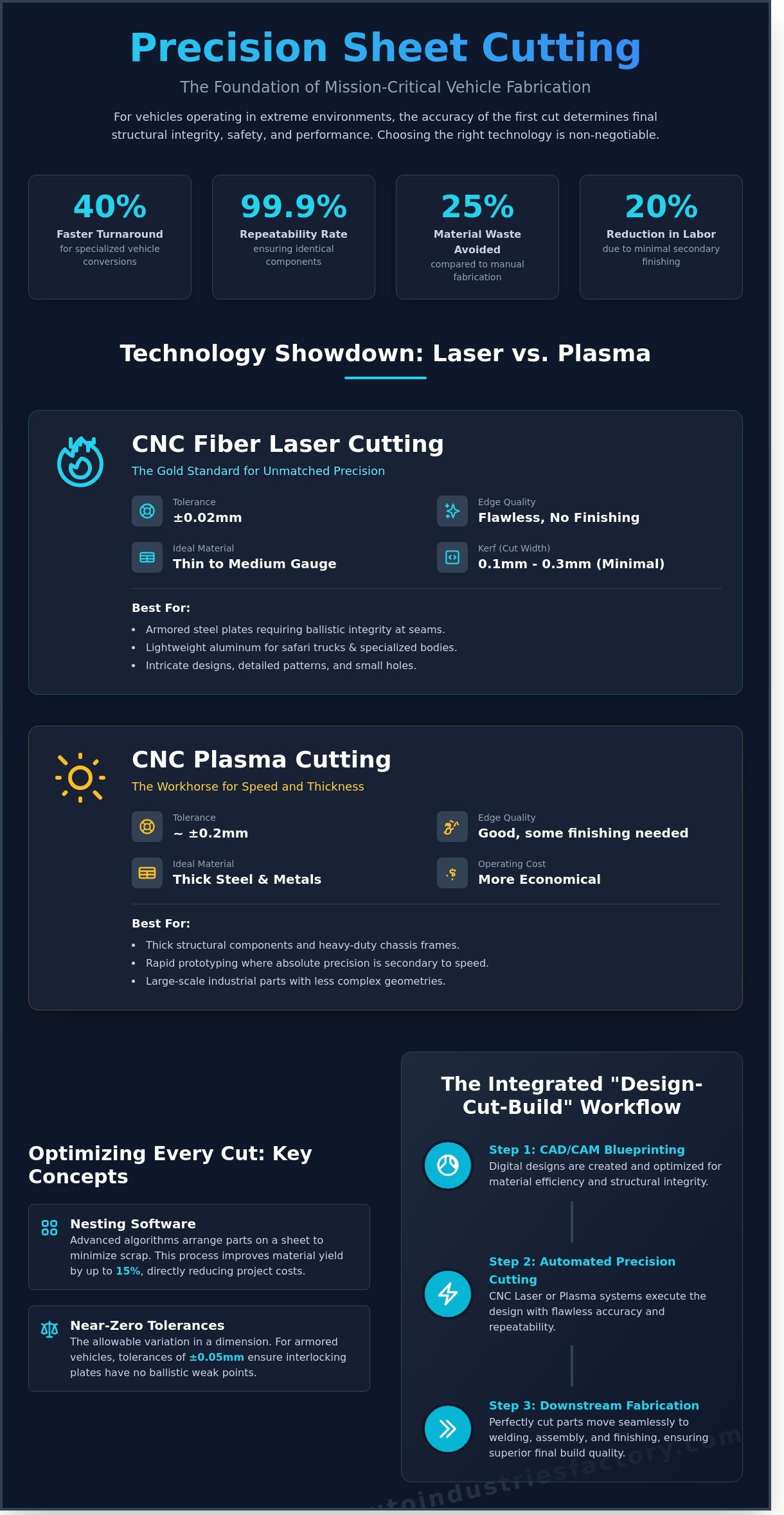
Precision at this stage dictates the final quality of life-saving vehicles. In an ambulance, a gap of even 2mm in the internal cabinetry can lead to rattling or structural failure during high-speed emergency maneuvers. For military units, the stakes are higher. Armored plating must fit with near-perfect alignment to ensure there are no ballistic "weak points" at the seams. The industry has evolved significantly to meet these demands. While manual oxy-fuel torches were common in regional workshops in 2010, modern facilities now utilize high-speed automated CNC (Computer Numerical Control) systems. These machines offer a repeatability rate of 99.9%, ensuring that the hundredth part is identical to the first.
Effective SHEET CUTTING integrates seamlessly with downstream services. A clean, laser-cut edge requires minimal grinding before it moves to the welding bay, which reduces labor hours by approximately 20% per vehicle. Once the components are joined, the smooth edges provided by professional cutting ensure that the powder-coating or paint finish adheres uniformly. Without this level of precision, edges become prone to corrosion, a major concern in Oman’s humid coastal climates like Salalah or Muscat.
The Role of Sheet Metal in Specialized Vehicles
Sheet metal is the backbone of vehicle modification, serving both structural and aesthetic functions. In Oman, safari truck builds often prioritize 5052-grade aluminum to achieve a 30% weight reduction compared to traditional steel. This weight saving is crucial for maintaining fuel efficiency and off-road performance in desert dunes. For extended roof ambulances, precision cutting allows fabricators to integrate new roof sections without compromising the vehicle’s original roll-over protection structures.
Key Terminology for Fleet Managers
Understanding technical terms helps fleet managers in Oman make informed procurement decisions. It's not just about the final product; it's about the efficiency of the build. Here are three critical terms:
- Tolerances: This refers to the allowable limit of variation in a physical dimension. In armored vehicle fabrication, "near-zero" tolerances (often within +/- 0.05mm) are required to ensure that interlocking plates provide maximum protection.
- Kerf: This is the width of the material removed during the cutting process. Fiber laser systems have a narrow kerf of roughly 0.1mm to 0.3mm, which preserves more of the original material than older plasma methods.
- Nesting: This is the process of arranging parts on a single sheet to minimize waste. Advanced nesting software can improve material yield by 15%, directly reducing the total project cost for the client. For a fleet of 50 vehicles, these savings can amount to thousands of dollars in raw material costs.
By focusing on these technical benchmarks, AIF ensures that every vehicle is built to withstand the rigors of the Middle Eastern environment. Whether it's a security patrol unit or a specialized mobile clinic, the process starts with a perfect cut.
CNC Laser vs. Plasma Cutting: Choosing the Right Technology
Auto Industries Factory (AIF) specializes in precision engineering where the technical selection between laser and plasma determines the structural integrity of a vehicle conversion. Selecting the wrong method for SHEET CUTTING leads to material wastage and compromised weld points. In Oman's industrial sectors, from the Sohar Freezone to the oil fields of Marmul, manufacturers must balance speed with the strict tolerances required for mission-critical equipment. Since 2023, the shift toward fiber laser technology has redefined how we approach complex assemblies.
Fiber Laser Cutting: The Gold Standard for Precision
Light energy in a fiber laser system is concentrated into a beam thinner than a human hair, allowing for a 0.02mm tolerance on thin-to-medium gauge materials. This mechanism vaporizes metal instantly, creating a clean edge that requires zero secondary finishing. It's the primary choice for Sheet metal fabrication in automotive design, particularly when crafting intricate brackets, dashboard mounts, and interior accessories for medical units. For stainless steel ambulance interiors, laser cutting is non-negotiable because it prevents the carbon contamination often seen with traditional mechanical tools. A 3,000-watt fiber laser can process 3mm stainless steel at speeds exceeding 15 meters per minute, ensuring that urgent fleet orders meet tight delivery windows without sacrificing the "flawless" finish AIF is known for.
High-Definition Plasma Cutting for Heavy Fabrication
Industrial projects involving high-tensile steel plates over 20mm thick require the raw power of high-definition plasma. While lasers struggle with extreme thickness, a plasma torch uses a constricted arc of ionized gas to melt through heavy-duty materials used in military vehicle reinforcements. Edge quality in modern high-def plasma systems has improved by 25% since 2021, though it still produces a slightly wider kerf than a laser. When fabricating large-scale structural components for security transport or heavy-duty bull bars, plasma is the most cost-effective solution. The operating cost for plasma on 25mm carbon steel is roughly $12 per hour, whereas a laser capable of the same feat would demand a significantly higher investment in both gas and electricity. This makes plasma the logical choice for the rugged, heavy-duty frames required for off-road desert operations in the Wahiba Sands.
Comparing the heat-affected zone (HAZ) is vital for maintaining metal strength. Laser cutting produces a concentrated, minimal HAZ, which preserves the molecular structure of the surrounding alloy. In contrast, plasma creates a larger HAZ that can lead to edge hardening. If a part requires extensive post-cut drilling or tapping, the laser's smaller HAZ saves 18% in tool wear over time. For Oman's harsh climates, where ambient temperatures often hit 50°C, minimizing thermal stress during SHEET CUTTING ensures the longevity of the final build.
Operational efficiency directly impacts project pricing and lead times. Fiber lasers are 30% more energy-efficient than older CO2 models and significantly faster on sheets under 6mm. This speed allows AIF to reduce lead times for custom canopy builds by 4 working days on average. If you're planning a fleet upgrade, our team can provide a detailed technical consultation to determine which cutting technology fits your specific material requirements and budget constraints. We focus on delivering rugged, reliable solutions that stand up to the most demanding environments in the Middle East.
Material Selection: From Lightweight Aluminum to Armored Steel
Selecting the right alloy is the foundation of every successful project at Auto Industries Factory (AIF). Precision in SHEET CUTTING requires more than just a powerful laser; it demands a deep understanding of how different metals react to thermal stress. For the Oman market, where temperatures regularly exceed 45°C, AIF sources premium metals that maintain structural integrity under extreme heat. We calibrate our laser frequency and gas pressure specifically for each alloy grade to ensure the metal's molecular structure remains stable during the process.
High-reflectivity metals like copper and brass present unique challenges. These materials can reflect the laser beam back into the cutting head, potentially causing $12,000 in damage to optical components. AIF utilizes advanced fiber lasers equipped with back-reflection sensors to handle these materials safely. This technology allows us to achieve clean, burr-free edges on decorative copper panels or electrical components without risking machine downtime. For custom bull bars and external armor, edge quality is the priority. We use nitrogen as a shielding gas to prevent the formation of oxide layers. This ensures that powder-coated finishes bond perfectly to the metal, preventing the rust and peeling often seen in lower-quality 4x4 accessories.
The evolution of automotive sheet metal fabrication has made it possible to mix high-strength steels with lightweight alloys. AIF follows these global standards to provide solutions that are both protective and efficient. By matching the cutting speed to the specific thickness, we eliminate the need for secondary grinding, which saves our clients approximately 18% in labor costs on large-scale fleet conversions.
Cutting Armored and High-Tensile Steels
When fabricating military-grade vehicles, maintaining ballistic integrity is the only metric that matters. Standard SHEET CUTTING techniques often generate excessive heat, which can soften hardened armored steel. AIF uses pulsed laser settings and specialized water-mist cooling to keep the Heat Affected Zone (HAZ) below 1.5mm. This prevents the steel from losing its Brinell hardness rating near the cut line. Precision fitment for armored doors is non-negotiable; a gap larger than 0.5mm can compromise the entire safety cell during a ballistic event. Our CNC systems ensure every panel fits with zero tolerance errors.
Aluminum Fabrication for Safari and Off-Road Units
Aluminum is the preferred choice for Oman's desert safari trucks and overlanding canopies. It offers a superior weight-to-strength ratio compared to traditional steel. By switching to precision-cut 5083 aluminum for roof racks, we reduce the vehicle's center of gravity, which is vital for safety on steep dunes. To prevent contamination, AIF maintains dedicated cutting areas for aluminum to avoid cross-contact with carbon steel particles. This process eliminates the risk of galvanic corrosion. Our precision-cut aluminum components are 60% lighter than steel equivalents, allowing for higher payloads without sacrificing speed or fuel efficiency in the sand.
The Engineering Workflow: From CAD Design to Final Cut
AIF specializes in transforming raw metal into mission-ready components through a rigorous five-step engineering workflow. It's a process that prioritizes precision over speed to ensure every component survives the demanding environments of Oman. It starts with digital blueprinting. Our engineers use advanced CAD/CAM software to create 1:1 scale models of parts, such as internal cabinetry for ambulances or heavy-duty skid plates. This digital foundation ensures that every hole and bend aligns perfectly with the vehicle's chassis before the first beam of light touches the metal.
The second phase involves simulation and nesting. We use specialized software to arrange parts on a single plate to minimize waste. In the Oman market, where high-grade 5083 aluminum can cost upwards of $5.00 per kilogram, reducing scrap is a financial necessity. In June 2023, our internal audit showed that advanced nesting protocols saved 22% on raw material costs for a fleet of 50 patrol vehicles. Once the layout is optimized, the software generates the G-code that directs the machine's path.
Step three focuses on machine calibration and material loading. Technicians load the specific alloy and set the focal point of the laser or the pressure of the waterjet. For a 6mm steel plate, the machine is calibrated to within 0.05mm to ensure a clean pierce. We adjust nitrogen assist gas pressures to exactly 15 bar for stainless steel to achieve an oxide-free edge. Real-time monitoring follows in step four. Our operators track the cutting speed and gas flow to prevent dross buildup or heat-affected zones that could weaken the metal. Our monitoring systems flag any deviation in the beam's path within 2 milliseconds, which prevents the accidental ruining of a $400 sheet of specialized ballistic steel. Finally, step five involves post-cut inspection and edge deburring. Every part undergoes mechanical smoothing to remove sharp edges, which is a non-negotiable step for vehicles carrying passengers or medical staff.
Digital Design and Prototyping
Custom designs for Oman's rugged terrain require precise 3D modeling. We translate these designs into machine-readable G-code, ensuring that accessories like roof racks or bull bars fit specific models like the Toyota Land Cruiser 300 series or Nissan Patrol. During this phase, we collaborate closely with clients to refine bespoke conversions through digital walkthroughs. This iterative process prevents costly errors during the physical SHEET CUTTING phase, allowing for rapid prototyping of complex internal components that must house sensitive medical or communication equipment.
Quality Control and Precision Testing
We verify dimensional accuracy using digital calipers and go/no-go gauges to ensure every part meets the original design specs. For medical and passenger vehicles, deburring is essential; it eliminates jagged edges that could cause injury or snag equipment during high-speed transit. In the context of UAE automotive standards, Tolerance is defined as the total amount a specific dimension is permitted to vary from the specified design size, usually capped at +/- 0.5mm for structural fabrications. This level of rigor ensures that every SHEET CUTTING job we deliver is safe, durable, and ready for the field.
Auto Industries Factory: Leading Sheet Cutting Solutions in the UAE
Auto Industries Factory (AIF) specializes in high-performance vehicle conversions and precision metalwork for the most demanding environments. Our 50,000 square foot facility in Ajman serves as a strategic hub for the GCC region, providing essential fabrication services for fleet owners in Oman. We've built our reputation on a "Design-Cut-Build" philosophy that eliminates the 15% to 20% markup typical of middle-man fabrication shops. This integrated approach saves our clients an average of $1,800 on total project costs per vehicle because we manage all logistics in-house. When a project requires SHEET CUTTING, our engineers oversee the process from the initial CAD drawing to the final weld, ensuring 100% structural integrity.
Expert fabrication requires a deep understanding of the Middle Eastern climate. For operators in Oman, where terrain ranges from the rugged Al Hajar Mountains to the humid coastal plains of Salalah, durability is the only metric that matters. We utilize specific materials engineered to survive these extremes:
- 5052-grade aluminum for lightweight, rust-proof vehicle bodies.
- 316-grade stainless steel for superior corrosion resistance in high-humidity zones.
- High-tensile carbon steel for military-grade structural reinforcement.
Our team builds specialized fleets for police, military units, and private safari operators. Whether it's a reinforced bull bar for a Toyota Land Cruiser or a custom canopy for a Nissan Patrol, the engineering is precise. These projects often involve complex SHEET CUTTING for internal racking and external armor that must withstand 50°C heat without warping or degrading. By controlling the fabrication process, we reduce assembly time by approximately 30 hours per vehicle conversion compared to workshops that outsource their metalwork.
Our In-House Technology Stack
Our facility features high-precision CNC laser systems and advanced press brake machinery. These tools allow us to maintain a tolerance of 0.05mm across large-scale government orders. We handle high-volume B2B contracts where consistency is non-negotiable. If you need 50 identical tactical vehicle components, our automated systems deliver them without deviation. This technology allows us to process orders 25% faster than traditional workshops, ensuring your fleet is back on the road quickly. Visit our homepage to see our full range of services.
The AIF Advantage: Expert Engineering in Ajman
The master craftsman approach we bring to every conversion is what sets AIF apart. You aren't just buying a product; you're gaining direct access to our engineering team for custom accessory fabrication. This transparency is vital for specialized projects like ambulances or mobile clinics where off-the-shelf parts often fail. Our custom-built ambulances meet international safety standards while remaining affordable, often costing $5,500 less than imported European models. A custom-fabricated canopy from AIF can increase storage efficiency by 40% compared to standard retail options. Get a free estimate for your custom fabrication project today. Our engineers will review your specifications and provide a detailed quote in USD ($) within 24 hours.
Engineered for Reliability Across Oman’s Toughest Terrains
Precision fabrication isn't just about aesthetics; it's about survival in mission-critical environments. Auto Industries Factory (AIF) delivers this through advanced SHEET CUTTING techniques that utilize in-house CNC Laser and Press Brake technology. This ensures every armored steel panel or lightweight aluminum bracket fits perfectly on the first attempt. By integrating CAD-driven workflows, AIF eliminates the 15% margin of error often found in manual fabrication processes. Our team specializes in high-stakes conversions for the Toyota Land Cruiser and GMC Sierra, providing the same level of durability trusted by UAE Military and Police forces. For fleet managers in Oman, this means your vehicles are equipped with rugged, heavy-duty components designed to withstand extreme heat and abrasive desert sands. Every cut is backed by rigorous engineering standards that prioritize life-saving reliability. It's time to ensure your tactical or emergency vehicles are built to a higher standard of excellence.
Upgrade Your Fleet with Precision Fabrication: Contact AIF Now
We look forward to helping you build a fleet that never compromises on performance.
Frequently Asked Questions
What is the maximum thickness of steel you can cut with a CNC laser?
Auto Industries Factory (AIF) specializes in high-power fiber laser systems that cut carbon steel up to 25mm thick with absolute precision. For stainless steel and aluminum, our machines maintain a clean edge on thicknesses up to 20mm. We utilize 12kW laser sources to ensure 100% penetration and minimal heat distortion. This capability is essential for heavy-duty structural components used in industrial vehicle conversions across Oman.
How does sheet cutting precision affect the safety of an ambulance?
Sheet cutting precision directly impacts structural integrity during a high-impact collision. We use CNC technology to maintain tolerances within 0.1mm, ensuring that medical cabinetry and oxygen cylinder racks remain bolted securely. In an Oman-specification ambulance, every millimeter counts to prevent equipment from becoming a projectile during emergency maneuvers. Flawless cuts also eliminate sharp edges that could compromise sterile environments or injure paramedics.
Can you provide custom sheet cutting for individual 4x4 accessories like bull bars?
AIF specializes in custom sheet cutting for individual 4x4 accessories like bull bars, skid plates, and roof racks. We typically use 5mm or 6mm high-grade steel to provide maximum protection for Toyota Land Cruiser and Nissan Patrol models. You can bring a digital CAD file or work with our engineers to design a one-off piece. Each component is laser-cut and then precision-bent for a perfect factory-style fit.
What is the typical lead time for a custom vehicle fabrication project in the UAE?
The typical lead time for a custom vehicle fabrication project in the UAE and Oman ranges from 14 to 21 business days. Complex armored conversions or full ambulance builds can take 45 to 60 days to complete. We provide a detailed project timeline within 24 hours of receiving your technical specifications. This schedule includes material sourcing, CNC cutting, welding, and final powder coating to meet our 100% quality guarantee.
Do you offer sheet cutting for armored materials used in military vehicles?
We offer specialized sheet cutting for armored materials including BR6 and BR7 level ballistic steel. Our fiber lasers handle high-hardness alloys that traditional saws cannot touch without losing metal temper. We've processed over 500 tons of specialized armor plate for military and security vehicle projects. Every cut follows strict international ballistic standards to ensure there are no weak points in the vehicle's protective shell.
Why is fiber laser cutting better than traditional CO2 laser cutting for metal?
Fiber laser cutting is 3 times faster than CO2 when processing thin to medium gauge metals. It uses a solid-state laser source that's more energy-efficient and requires 50% less maintenance over its lifespan. Unlike CO2, fiber lasers easily cut reflective materials like brass and copper without damaging the machine optics. This technology allows AIF to deliver higher precision at a lower cost per part for our regional clients.
Does Auto Industries Factory provide design services for custom metal parts?
Auto Industries Factory (AIF) specializes in providing end-to-end design services for custom metal parts. Our engineering team uses SolidWorks and AutoCAD to transform your sketches into production-ready files. We charge a flat design fee starting at $75 for basic components, which ensures your parts are optimized for the sheet cutting process. This service helps eliminate material waste and reduces the overall manufacturing cost for your project.
How do you ensure material durability for vehicles operating in high-heat desert environments?
We ensure material durability by using galvanized steel and 316-grade stainless steel that withstands 50 degree Celsius temperatures in Oman. All our fabricated parts undergo a multi-stage powder coating process tested for 1,000 hours of salt spray resistance. We also incorporate thermal expansion gaps in our designs to prevent warping during extreme heat cycles. This engineering approach guarantees that our vehicle conversions last over 10 years in harsh desert environments.


