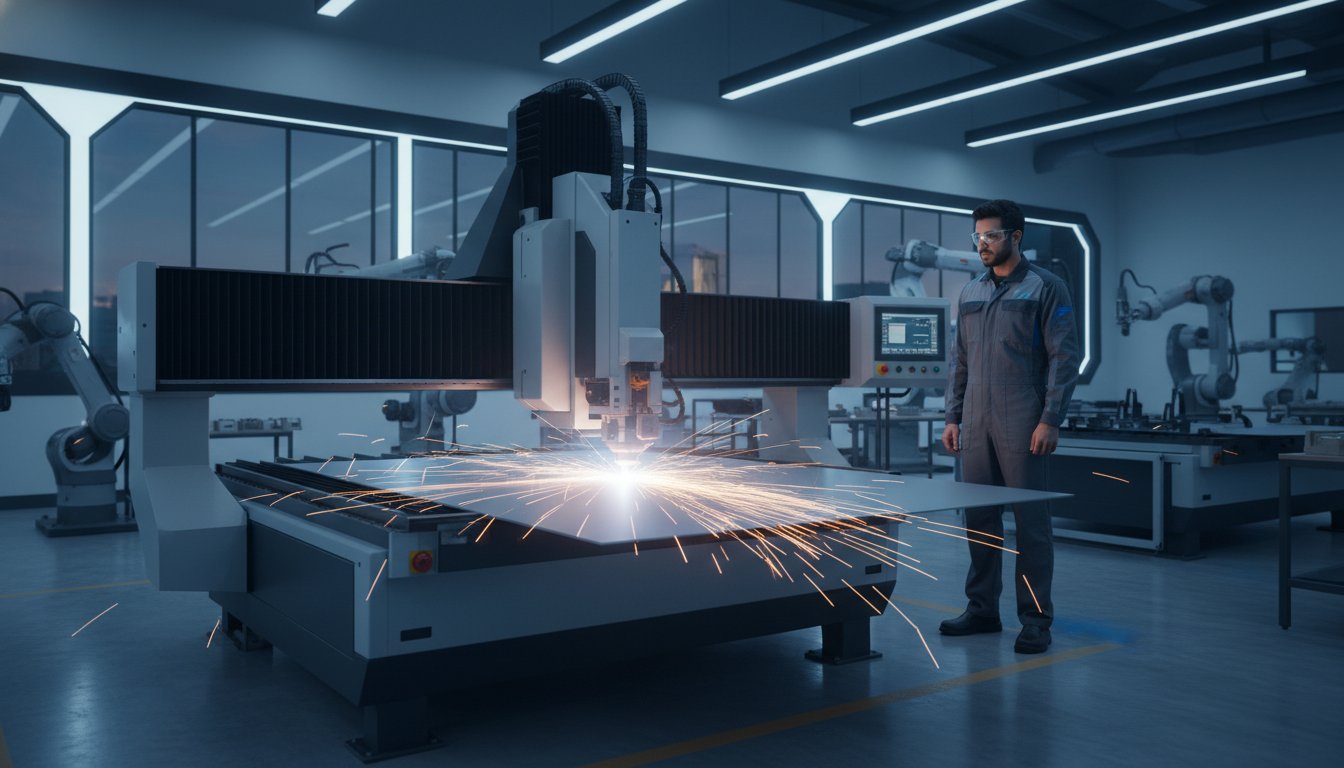
In demanding environments, from challenging terrains to critical urban emergencies across the UAE, the structural integrity of a specialized vehicle is not just a feature-it's a mission-critical requirement. When every millimeter counts and component failure is not an option, relying on outdated fabrication methods introduces unacceptable risks. This is where the advanced precision of industrial laser cutting becomes the cornerstone of modern vehicle fabrication, separating standard builds from truly superior, mission-ready machines.
This guide explores how this foundational technology delivers the strength, accuracy, and quality required for the UAE’s most essential vehicles. Discover how in-house laser cutting ensures that every component for an ambulance, armored car, or custom 4x4 is flawlessly replicated to the highest tolerance. At Auto Industries Factory LLC, we will show you how this capability eliminates supplier delays and provides the absolute certainty that your fleet is built for maximum durability and safety, no matter the challenge.
What is Laser Cutting and Why is it Essential for Modern Fabrication?
Laser cutting is an advanced thermal separation process that utilizes a highly focused, high-energy beam of light to cut materials with extreme accuracy. The core principle of this technology, which you can learn more about by exploring What is Laser Cutting, involves the laser optics directing the beam onto a workpiece, where the intense energy melts, burns, or vaporizes the material in a precise, localized area. A jet of assist gas then clears the molten material, leaving a clean, high-quality edge. This method has become a cornerstone of modern industrial manufacturing, delivering results that are impossible to achieve with older techniques.
To see this powerful technology in action, watch this short demonstration:
Unlike traditional mechanical shearing that can deform material or plasma cutting that often leaves a rough edge, laser cutting offers a superior combination of speed, precision, and versatility. For industries in Oman and across the region-from custom vehicle fabrication to heavy equipment manufacturing-this technology is not just an option; it is essential for producing durable, high-tolerance components that meet demanding engineering standards. It enables the creation of complex geometries and intricate designs with flawless repeatability.
The Science Behind the Beam: How Lasers Cut Metal
The effectiveness of the laser cutting process is a result of several integrated technologies working in perfect harmony. Key elements include:
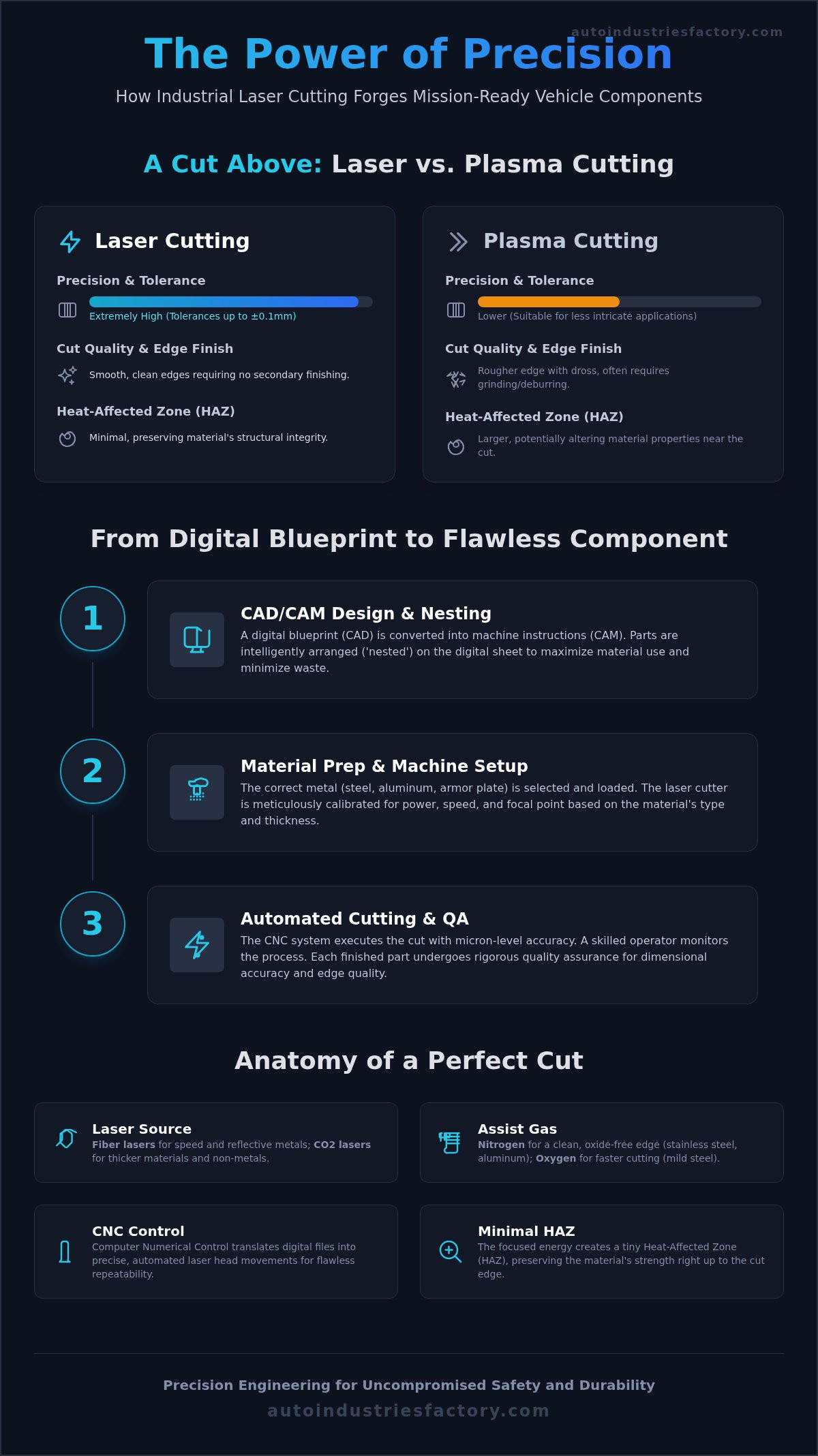
- Laser Source: The two primary types are CO2 lasers, ideal for thicker materials and non-metals, and Fiber lasers, which excel at cutting reflective metals like aluminum and copper with exceptional speed and efficiency.
- Assist Gas: A high-pressure gas is used to clear the cut. Oxygen is often used for mild steel to create an exothermic reaction for faster cutting, while Nitrogen is used for stainless steel and aluminum to produce a clean, oxide-free edge that is ready for welding.
- CNC Control: The entire process is driven by a Computer Numerical Control (CNC) system, which translates a digital design file into precise movements of the laser head, ensuring every part is cut to exact specifications.
- Minimal Heat-Affected Zone (HAZ): The laser's focused energy minimizes the area affected by heat, preserving the material's structural integrity and strength right up to the cut edge.
Laser Cutting vs. Plasma Cutting: A Comparison for Heavy Industry
While both are thermal cutting processes, their applications differ significantly. For industrial decision-makers, understanding the trade-offs is crucial.
Precision and Tolerance: Laser cutting offers superior accuracy, with tolerances as tight as ±0.1mm, making it essential for intricate parts. Plasma is better suited for applications where such fine tolerances are not required.
Cut Quality: Laser-cut parts have smooth, clean edges that typically require no secondary finishing. Plasma cuts often have a rougher edge with dross, necessitating additional grinding or deburring, which adds time and labor costs.
Material Thickness: For extremely thick metal plates (often over 25mm), plasma cutting is generally more cost-effective and faster. However, modern high-power fiber lasers are continually expanding their capabilities in this area.
The Process in Action: From Digital Design to Finished Vehicle Component
At Auto Industries Factory LLC, turning a digital concept into a flawless, heavy-duty vehicle component is a science. Our end-to-end workflow is engineered for precision, consistency, and speed, demonstrating an unwavering commitment to quality control at every stage. This integrated process is what eliminates errors and dramatically reduces production lead times. It is fundamental to modern specialized vehicle manufacturing, enabling us to produce everything from custom bull bars to reinforced chassis components with unmatched accuracy.
Step 1: CAD/CAM Design and Nesting
Every project begins in the digital realm. We start with either the client's blueprint or an in-house design created using Computer-Aided Design (CAD) software. This digital file is then processed by Computer-Aided Manufacturing (CAM) software, which translates the precise geometry into a set of instructions for the cutting machine. A critical part of this stage is ‘nesting,’ where the CAM software intelligently arranges all required parts on the metal sheet to maximize material usage and minimize waste. This step ensures the design intent is perfectly captured before a single piece of metal is cut.
Step 2: Material Preparation and Machine Setup
With the digital blueprint finalized, our technicians move to the physical setup. The first task is selecting the correct grade and thickness of metal, whether it's heavy-duty steel, lightweight aluminum, or specialized armor plate for tactical vehicles. The sheet is then carefully loaded onto the laser cutting bed and secured. Meticulous calibration is essential; the machine’s power, speed, and focal point are precisely configured for the specific material to guarantee a clean, smooth cut. Initial system checks ensure perfect alignment, laying the groundwork for a flawless execution.
Step 3: Automated Cutting and Quality Assurance
This is where precision engineering comes to life. The CNC (Computer Numerical Control) machine executes the cutting path automatically, following the CAM instructions with micron-level accuracy. While the advanced laser cutting process is automated for speed and repeatability, a skilled operator continuously monitors the operation to ensure everything proceeds flawlessly. Immediately after cutting, each part undergoes a rigorous inspection for dimensional accuracy and edge quality. Once approved, the component is ready for the next stage of fabrication, such as press brake bending or welding.
Applications in Specialized Vehicle Manufacturing
The theoretical benefits of advanced metal fabrication become tangible in the world of specialized vehicle conversions. Here, precision is not a luxury-it is a mission-critical requirement that directly impacts performance, safety, and reliability. At Auto Industries Factory, we leverage the power of laser cutting to transform standard vehicles into purpose-built assets, engineered to excel in the most demanding roles across Oman and the wider region.
Ambulance Conversions: Precision for Life-Saving Equipment
In an ambulance, every component must function flawlessly. Laser-cut parts provide the uncompromising accuracy needed to create a safe and efficient mobile medical environment. This technology allows us to fabricate custom interior cabinetry and structural supports that fit perfectly, ensuring no rattles or weaknesses. The precision is essential for creating mounting brackets that securely hold sensitive medical devices, protecting them from vibration and impact, and for manufacturing reinforcement plates that strengthen the vehicle's chassis for the added weight and stress of its life-saving duties.
Military & Police Vehicles: Cutting Armor and Tactical Components
For defense and security applications, failure is not an option. We use advanced fabrication to cut hardened steel armor plates with clean, weld-ready edges, ensuring maximum structural integrity without compromising the material's ballistic properties. This precision is vital for creating custom weapon mounts, secure storage solutions for tactical gear, and specialized dashboards designed to integrate complex communication systems. Every modification is engineered to meet strict defense standards, guaranteeing reliability in high-stakes situations.
Safari & 4x4 Builds: Durability for Off-Road Dominance
Oman’s diverse and rugged terrain, from the dunes of Wahiba Sands to the rocky wadis of the Hajar Mountains, demands vehicles built for extreme durability. Our use of laser cutting technology is fundamental to manufacturing heavy-duty components that can withstand these conditions. We fabricate everything from custom bull bars and bumpers to precision-fit roof racks, canopies, and chassis reinforcements. This process ensures every part offers a flawless fit and is engineered for maximum strength, giving you the confidence to dominate any off-road challenge.
From emergency response to off-road exploration, precision engineering is the foundation of a vehicle you can trust. Discover how our expert fabrication solutions can elevate your fleet at autoindustriesfactory.com.
The Auto Industries Factory Advantage: In-House Capability and Expertise
In the world of precision metal fabrication, the difference between a reliable component and a point of failure often comes down to control. At Auto Industries Factory, we have made a strategic investment in bringing advanced manufacturing processes, including high-power laser cutting, entirely in-house. This core capability is not just an operational detail; it is the foundation of our promise to deliver robust, mission-ready solutions for clients across Oman and the wider region. By managing every stage of production under one roof, we translate our technological investment directly into superior quality, speed, and design freedom for your projects.
Uncompromising Quality Control
When fabrication is outsourced, quality becomes a variable. We eliminate this risk. Our team oversees every critical step, from initial design review and material selection to the final cut and inspection. This integrated approach ensures that every component we produce meets the exact tolerances required for demanding applications, whether for defense, emergency services, or specialized commercial fleets. This is how we guarantee performance where it matters most. Explore our commitment to quality fabrication to see how we uphold these standards.
Faster Turnaround and Prototyping
Speed and agility are critical in today's market. Our in-house fabrication capability dramatically reduces project lead times by removing dependencies on third-party suppliers. This allows us to move seamlessly from design to production, offering significant advantages:
- Rapid Prototyping: We can quickly produce prototypes for testing and client approval, accelerating the development cycle.
- Design Flexibility: On-site control allows for immediate adjustments and design iterations without costly delays.
- Efficient Fleet Orders: We can scale production swiftly to meet the demands of large-scale custom and fleet vehicle orders.
Material and Design Complexity
Our advanced laser cutting systems empower our engineers to push the boundaries of design. We efficiently process a wide range of metals and thicknesses, from heavy-duty steel for bull bars to lightweight aluminum for custom bodywork. This technology enables the creation of intricate geometries and complex patterns that are impossible to achieve with traditional methods. The result is stronger, lighter, and more perfectly integrated components that enhance vehicle performance and durability. Bring us your most demanding fabrication challenges; our technology is ready.
Partner with a fabricator that controls every variable. Contact Auto Industries Factory to discuss your project requirements.
Harnessing Precision: Your Partner in Advanced Vehicle Fabrication
From digital blueprint to mission-ready component, the takeaway is clear: precision is the non-negotiable standard in specialized vehicle manufacturing. This level of quality is achieved through advanced laser cutting, a technology that guarantees flawless accuracy, superior speed, and the versatility to shape even the most robust materials. It's the foundation upon which safe, reliable, and durable vehicle components are built, ensuring performance when it matters most.
At Auto Industries Factory, we have mastered this technology. Our in-house CNC capabilities and extensive experience with armored steel and heavy-duty alloys make us the trusted fabrication partner for ambulance, military, and police vehicle projects across Oman. We don't just cut metal; we engineer confidence. Ready to transform your concept into a heavy-duty reality? Let our expertise guide your next project to success.
Get a Free Estimate for Your Custom Fabrication Project
Frequently Asked Questions About Laser Cutting
What is the maximum thickness of steel and aluminum you can laser cut?
Our advanced fiber laser cutting systems are engineered for heavy-duty applications. We can precisely cut mild steel up to 20mm thick and aluminum up to 15mm thick. This capability allows us to fabricate robust components for vehicle armor, custom chassis modifications, and heavy-duty accessories like bull bars and roof racks. For materials exceeding these thicknesses, our engineering team can recommend alternative fabrication solutions to meet your project's specific structural requirements.
How does laser cutting improve the structural integrity of vehicle modifications?
Laser cutting offers superior precision with a minimal heat-affected zone (HAZ). Unlike plasma cutting, this process does not excessively heat the surrounding metal, which prevents material warping and preserves its original tensile strength. This is critical when fabricating load-bearing components like suspension mounts or chassis brackets. The result is a stronger, more reliable part that integrates flawlessly with the vehicle's structure, ensuring maximum safety and durability in demanding conditions.
Can you work from a simple drawing, or do I need a professional CAD file?
For maximum precision and the fastest turnaround, we strongly recommend providing a professional CAD file in .DXF or .DWG format. However, we understand this is not always possible. Our expert in-house design team is fully equipped to convert your detailed drawings, sketches, or templates into production-ready CAD files. While this service may involve a nominal design fee, it ensures every component is manufactured to our exacting standards of quality and accuracy.
What is the difference in quality between a laser-cut edge and a plasma-cut edge?
The difference is significant. A laser-cut edge is exceptionally clean, smooth, and precise, with sharp corners and virtually no dross (metal slag). It often requires no secondary finishing. In contrast, a plasma-cut edge is rougher, has a more pronounced bevel, and leaves behind dross that must be ground off. The precision of a laser ensures tighter tolerances and a superior, ready-to-weld finish, which is essential for high-quality, professional vehicle fabrication.
How does in-house laser cutting affect the overall cost and timeline of a vehicle conversion project?
Having in-house laser cutting capabilities provides complete control over the production schedule and quality, drastically reducing project timelines. We eliminate delays and costs associated with outsourcing to third-party suppliers, which can save weeks on a complex build. This direct oversight means faster prototyping and immediate adjustments, ensuring a more efficient workflow. Integrating fabrication this way significantly streamlines the entire conversion process, delivering a superior result faster.
Are your laser cutting services available for standalone component orders?
Yes, absolutely. While our laser cutting services are integral to our full vehicle conversions, we also offer them for standalone component orders. Whether you require a single custom-designed bracket, a batch of parts for your own project, or prototype development, our team is ready to assist. We provide the same level of precision engineering and premium quality for individual component orders as we do for our large-scale vehicle builds, serving a wide range of industrial and private clients.


