What if your fleet's most rugged off-roaders could command a 35% higher booking rate simply by upgrading the cabin to a five-star standard? You've likely seen how standard factory interiors struggle under the intense heat of the UAE's deserts, where cheap plastics rattle and cooling systems often fail to reach the rear passengers. It's a common frustration for tour operators across the UAE and Oman who want to provide a world-class experience but find their equipment lacks the necessary refinement. Auto Industries Factory LLC (AIF) specializes in engineering the ultimate luxury safari vehicle interior by bridging the gap between heavy-duty performance and high-end aesthetics.
In this guide, you'll discover how to transform a standard 4x4 into a premium mobile lounge that survives the harshest desert conditions without sacrificing mission-critical durability. We'll show you how to implement rugged materials that don't wear out after one season. You'll also get a preview of our specialized approach to advanced thermal insulation, vibration-canceling acoustic treatments, and the seamless integration of modern charging hubs. This ensures your clients remain cool and connected while navigating the challenging desert and mountain terrains of the region, resulting in increased satisfaction and long-term booking value.
Key Takeaways
- Understand how the 2026 safari market is shifting from basic transport to "mobile luxury lounges" designed to meet the high expectations of Oman's elite tourism sector.
- Learn the technical secrets to designing a luxury safari vehicle interior that integrates executive captain’s chairs and ISOFIX safety points without compromising off-road durability.
- Identify specialized materials and dual-compressor AC systems engineered to withstand the extreme UV exposure and sand ingress common across the GCC region.
- Explore the precision fabrication process, from 3D CAD modeling to CNC laser cutting, that ensures every bespoke conversion meets mission-critical performance standards.
What Defines a Luxury Safari Vehicle Interior in 2026?
In 2026, the concept of a game viewer vehicle has evolved far beyond basic benches and canvas covers. A modern luxury safari vehicle interior represents a high-performance cabin conversion that merges executive comfort with the rugged off-road capability required for Oman’s diverse landscapes. For high-end tour operators in Muscat and Salalah, the vehicle is no longer just transport. It's a mobile luxury lounge designed to provide a seamless transition from a five-star resort to the untamed wilderness of the Hajar Mountains or the Wahiba Sands.
To better understand the level of craftsmanship involved in these high-end transformations, watch this video showcasing modern luxury cabin design:
While the Toyota Land Cruiser 300 series or the Nissan Patrol provide a robust foundation, they're merely the starting point for a professional conversion. Auto Industries Factory (AIF) specializes in stripping these vehicles to their chassis to rebuild an environment that withstands 50-degree Celsius heat while maintaining an ultra-premium feel. Engineering a true luxury safari vehicle interior requires balancing aesthetic opulence with structural integrity. Since the January 2024 update to regional safety standards, we ensure every modification reinforces the vehicle's frame. This prevents the interior from becoming a hazard during technical off-road maneuvers in deep sand or rocky wadis.
The Core Elements of Premium Safari Design
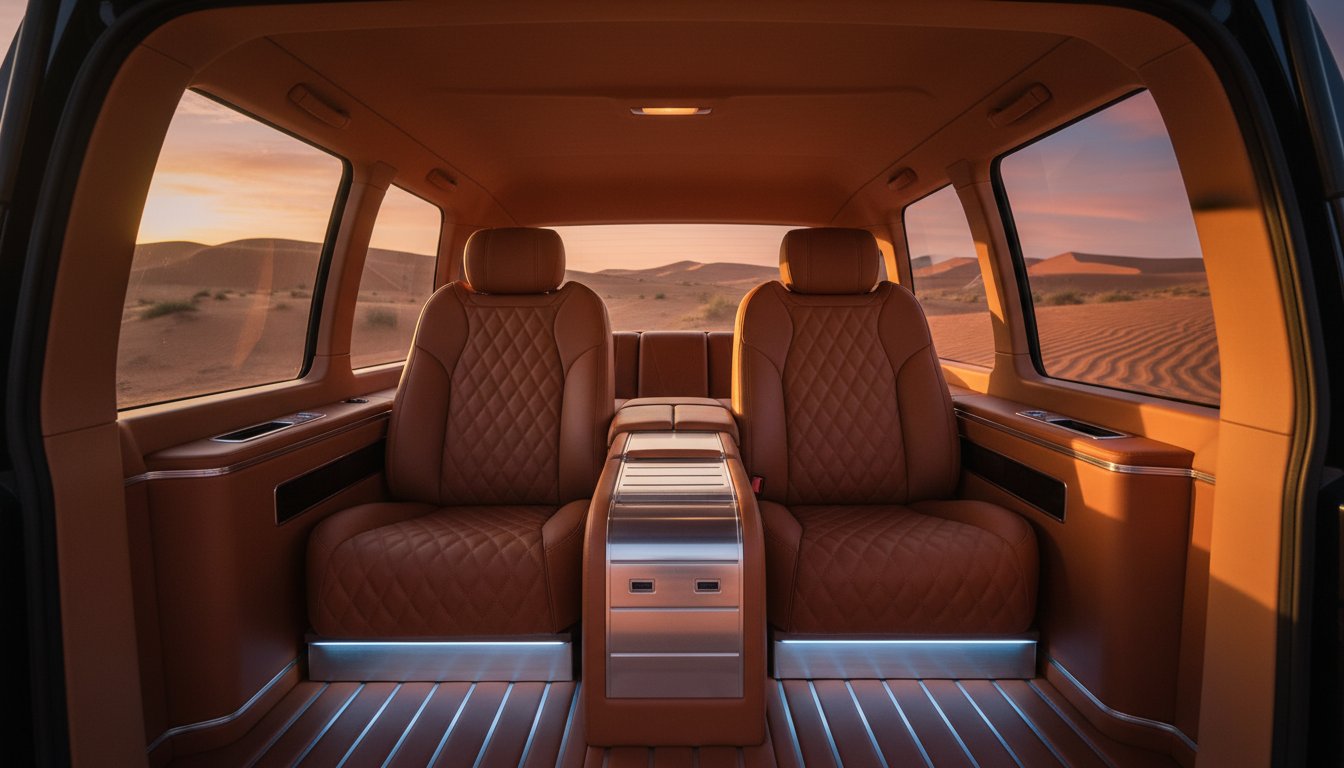
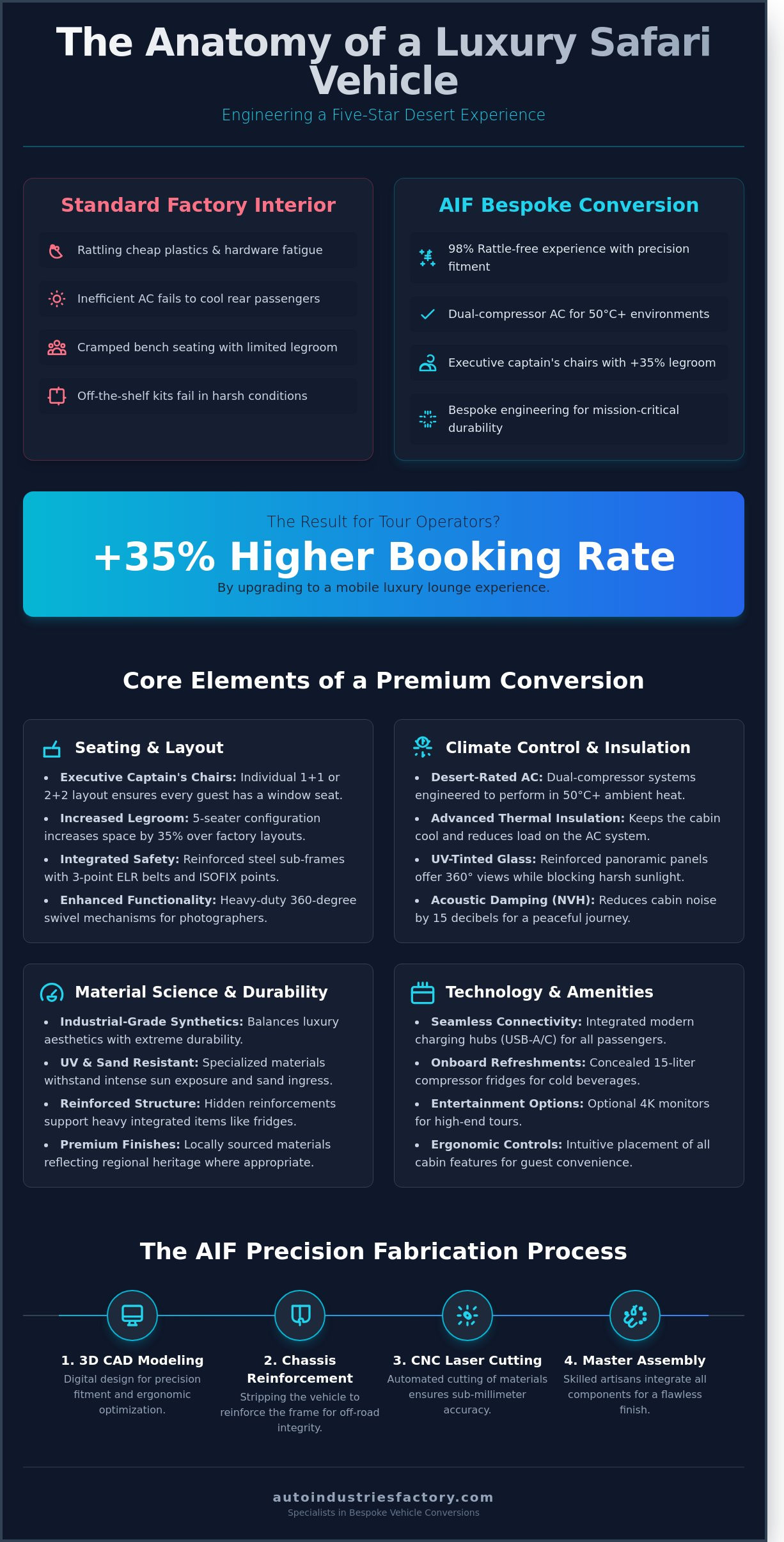
Ergonomics drive the design process. A 5-seater configuration increases legroom by 35% compared to standard factory layouts, allowing for the installation of captain’s chairs with integrated cooling. Panoramic visibility is another non-negotiable factor. We use reinforced, UV-tinted glass panels that offer 360-degree wildlife viewing without compromising roll-over protection. Noise, vibration, and harshness (NVH) damping is critical for guest comfort. Specialized acoustic insulation reduces cabin noise by 15 decibels, ensuring guests can converse easily even when traversing corrugated desert tracks at speed.
Why Custom Fabrication Trumps Off-the-Shelf Kits
Off-the-shelf kits often fail within 12 months of heavy use in Oman’s demanding environment. Precision fitment is the only way to prevent rattling and hardware fatigue. Custom fabrication allows for the integration of hidden structural reinforcements that support heavy items like internal 15-liter fridges and 4K entertainment monitors. A tailored aesthetic also reinforces brand identity. We use premium, locally sourced materials that reflect Omani heritage while providing the durability of industrial-grade synthetics. These bespoke solutions, often costing upwards of $15,000 for a full cabin overhaul, ensure longevity and a 98% rattle-free experience over the vehicle's lifespan.
Seating and Layout: Maximizing Guest Comfort and Safety
The standard for a luxury safari vehicle interior has shifted from utility-focused benches to executive-grade comfort. In Oman, where high-end tours often traverse the 12,500 square kilometers of the Sharqiya Sands, passenger fatigue is a technical challenge that engineers must solve. Modern conversions now prioritize a 1+1 or 2+2 layout using individual captain's chairs. This configuration ensures every guest has a "guaranteed window seat," eliminating the cramped middle-seat experience common in older fleet models. By utilizing heavy-duty swivel mechanisms, these seats rotate 360 degrees, allowing photographers to track wildlife without leaving the climate-controlled cabin.
Safety engineering is integrated directly into the aesthetic design. We don't just bolt seats to the floor; we use reinforced steel sub-frames that accommodate 3-point ELR safety belts and ISOFIX points for family-oriented tours. This is a critical requirement for European and GCC tourists who demand international safety ratings. AIF applies similar precision engineering found in a high-end sports car to ensure every weld and bracket handles the relentless vibrations of corrugated desert tracks. For fleet operators in Muscat or Salalah, choosing a specialized vehicle converter ensures these safety systems meet rigorous standards without compromising the premium leather finish.
Captain’s Chairs and Executive Seating
Luxury seating in a safari context requires more than just leather upholstery. We integrate electric 8-way adjustments, allowing passengers to find the perfect ergonomic position during long drives to Jebel Akhdar. Integrated heating and ventilation systems are essential; Oman’s summer temperatures frequently exceed 45°C, making active cooling a necessity rather than a luxury. Some high-spec builds even include pneumatic massage functions to rejuvenate guests between game drives. These chairs are mounted on raised tracks to provide an elevated line of sight, ensuring the luxury safari vehicle interior feels like a mobile observation deck.
Smart Storage Solutions
Clutter ruins the luxury experience, so strategic storage is a priority. We design under-seat compartments specifically for heavy camera bodies and long lenses, keeping expensive gear secure during high-speed dune crossings. A 40-liter or 50-liter high-capacity safari fridge is typically integrated into the center console, providing chilled beverages at a moment’s notice. Overhead consoles, fabricated using CNC laser cutting for a flawless fit, offer easy access to binoculars, field guides, and charging ports. This layout maximizes the 1.5-meter internal width of most Land Cruiser or Nissan Patrol conversions, keeping the floor area clear for legroom.
The engineering behind the pop-up roof is the final piece of the layout puzzle. A well-designed roof adds 60 centimeters of vertical headspace when deployed, allowing guests to stand fully for 360-degree photography. We use dual gas-strut assistance systems to ensure the roof can be raised in under 10 seconds. The transition between the roof and the main cabin must be seamless; we use weather-sealed gaskets and heavy-duty rip-stop canvas to protect the interior from Oman's fine desert dust. This mechanical integration increases the overall cabin volume by approximately 35%, creating an airy, open environment that prevents the claustrophobia often associated with traditional closed-top off-roaders.
Material Science: Balancing Aesthetics with Desert Durability
Designing a luxury safari vehicle interior for the Oman market requires overcoming extreme environmental variables that would destroy standard automotive cabins. In the Wahiba Sands, cockpit temperatures frequently climb above 55°C during summer months. High-intensity UV radiation in the GCC region, often reaching an index of 11 or higher, causes standard plastics to off-gas and upholstery to lose its structural integrity within 24 months. Auto Industries Factory (AIF) utilizes aerospace-grade insulation and UV-stabilized polymers to ensure the cabin remains a sanctuary. We don't just add decorative elements; we re-engineer the substrate. Fine sand particles, often as small as 90 microns, can penetrate standard seals and act as an abrasive on moving parts. Our builds incorporate secondary pressurized door seals and specialized filtration to keep the interior pristine despite the harsh desert environment.
High-end clients often worry that a luxury safari vehicle interior is too fragile for serious off-roading. AIF dismantles this objection through rigorous material testing. We select components that pass 500-hour salt spray tests and 1,000-hour UV exposure cycles. By using reinforced mounting points for all internal cabinetry, we prevent the rattles and cracks that typically plague modified 4x4s after a few trips through the Rub' al Khali. It's a "heavy-duty luxury" philosophy where every stitch and panel is designed to withstand 2.0g of vertical force during high-speed dune crossings.
Leather vs. Marine-Grade Vinyl vs. Technical Fabrics
Top-grain leather is the standard for luxury because it utilizes the strongest part of the hide, though it requires biannual conditioning with specialized oils to prevent cracking in Oman's low humidity. While it offers unmatched breathability, many modern builds now incorporate technical fabrics in high-friction areas. For example, we use Alcantara for headliners and pillar trims because it provides a premium tactile feel while offering 30% better sound absorption than standard cloth. It also resists the "sagging" effect common when heat weakens traditional adhesives.
Marine-grade vinyl has become a popular choice for seat bolsters and door cards. This material is engineered to handle direct sunlight and moisture without fading or molding. It's an ideal solution for the coastal humidity of Salalah. For a full interior conversion, custom leather kits typically start at $4,500, but the investment pays for itself through increased vehicle longevity and resale value.
Flooring and Trim Materials
Traditional deep-pile carpeting acts as a magnet for desert silt and is nearly impossible to clean after a week in the dunes. AIF replaces these with custom-fitted, industrial-grade rubberized flooring that features a textured, high-end finish. These surfaces are 100% waterproof and can be cleaned with a simple damp cloth, yet they offer the acoustic insulation of a luxury sedan. We use 1.5mm thick sound-deadening mats beneath the flooring to reduce road noise by up to 12 decibels.
Precision is key when it comes to accent trims. We avoid brittle, painted plastics that chip over time. Instead, our workshop uses CNC-machined 6061 aluminum and genuine wood veneers treated with multi-layer marine clear coats. These components are mechanically fastened rather than glued. This ensures that even when the vehicle is vibrating over corrugated tracks at 60 km/h, the trim remains silent and secure. Dust-proofing is further enhanced by applying specialized silicone coatings to all electronic interfaces, preventing micro-silt from causing short circuits in the custom lighting or climate control systems.
Technology and Climate Control: Beating the GCC Heat
Oman's diverse terrain, from the rolling dunes of the Sharqiya Sands to the rocky plateaus of Jebel Akhdar, demands more than just a rugged engine. Transforming a standard 4x4 into a true luxury safari vehicle interior requires a sophisticated approach to thermal management and digital integration. In a region where summer temperatures frequently exceed 45°C, the cabin must serve as a pressurized, cooled sanctuary. Auto Industries Factory (AIF) specializes in engineering these environments to withstand the most punishing GCC conditions. We prioritize hardware that performs under duress, ensuring that the adventure remains focused on the landscape rather than the heat.
Optimizing the HVAC System
Standard factory air conditioning units often struggle when a vehicle is stationary or crawling through soft sand at high RPMs. We solve this by installing secondary cooling circuits. High-performance dual-compressor systems installed by AIF consistently maintain an internal cabin temperature of 22°C even when the Omani desert ambient heat peaks at 50°C. This setup allows the front and rear cabins to operate on independent loops. Passengers in the back can adjust their own climate settings without affecting the driver's environment. We supplement this mechanical power with advanced insulation strategies. Ceramic window tints provide 99% UV rejection and significantly reduce infrared heat gain. We also strip the interior to the metal to apply 10mm thermal cabin liners, which create a permanent barrier against the heat radiating from the desert floor.
Integrated Electronics and Power
Modern exploration requires constant connectivity and reliable power. The hallmark of a high-end luxury safari vehicle interior is the seamless integration of professional-grade electronics. We don't rely on flimsy adapters. Instead, our teams install dedicated 2000W pure sine wave inverters to provide stable 220V power for charging DSLR cameras, drones, and laptops. Every passenger has access to high-speed charging via strategically placed 65W USB-C ports and integrated Qi wireless pads. For those venturing into the remote "Empty Quarter," we integrate satellite communication hubs and high-gain Wi-Fi extenders directly into the vehicle's roof structure. This ensures a 5G-equivalent signal even miles away from the nearest cell tower in Muscat or Salalah.
- Custom Switchgear: We replace plastic factory buttons with heavy-duty, backlit marine-grade rocker panels to control auxiliary lights, on-board fridges, and roof actuators.
- Ambient Lighting: Multi-zone LED mood lighting allows passengers to switch between high-intensity reading lamps and soft amber tones that preserve night vision during evening drives.
- Premium Audio: We install sound-dampening materials in the door cards to house high-fidelity component speakers, delivering crisp sound that isn't drowned out by tyre noise or wind.
- HD Entertainment: 12-inch headrest screens or fold-down ceiling monitors provide 4K playback capabilities for long transits across the Al Wusta region.
Reliability is the core of our design philosophy. We use military-grade wiring looms and heat-shrink connectors to prevent vibrations from loosening electrical bonds over thousands of kilometers of corrugated tracks. Every component is chosen for its ability to operate in high-dust environments without failure. This engineering-first mindset allows us to deliver a cabin that feels like a private jet while performing like a tactical unit.
Ready to upgrade your fleet for the Omani wilderness? Contact Auto Industries Factory today for a custom climate and tech consultation.
The AIF Fabrication Process: Bespoke Safari Excellence
Auto Industries Factory (AIF) specializes in the complete transformation of high-performance SUVs into elite expedition tools. Our process isn't a simple cosmetic upgrade; it's a ground-up re-engineering of the luxury safari vehicle interior designed to survive the most punishing Omani terrains. From the shifting sands of the Sharqiya Sands to the rocky plateaus of Jebel Shams, our builds provide a sanctuary of calm in the wild. We've refined a five-phase workflow that ensures every vehicle leaving our facility meets international safety and luxury standards.
Phase 1 begins with an intensive engineering consultation. We utilize 3D CAD modeling to map the interior layout with surgical precision. This allows us to optimize weight distribution, which is a critical factor when a vehicle carries 400 kilograms of additional luxury equipment and passengers. In Phase 2, we move to fabrication. We use in-house CNC and laser cutting technology to produce components with tolerances as tight as 0.1mm. This level of accuracy eliminates the structural rattles that often develop in lesser builds after just 5,000 kilometers of off-road use.
Phase 3 involves the structural "hardening" of the chassis and the vehicle body. We apply specialized NVH (Noise, Vibration, and Harshness) treatments, using industrial-grade sound dampening materials that reduce ambient cabin noise by 18 decibels. This creates the whisper-quiet environment expected in a luxury safari vehicle interior. Phase 4 is where the aesthetic meets the functional. Our team performs hand-crafted upholstery work using heat-resistant leathers and integrates high-end systems like 12V refrigeration and independent climate zones. Finally, Phase 5 subjects the vehicle to rigorous quality control. We conduct 150-point inspections and real-world desert testing to ensure the mechanical and electrical systems perform flawlessly in 45°C heat.
In-House Precision Engineering
AIF uses CNC laser cutting to ensure a flawless fit and finish for every internal bracket and panel. This technology is vital for fleet owners in Muscat or Salalah who require consistency across multiple units. Partnering with a custom vehicle fabrication specialist allows for rapid fleet scalability without sacrificing quality. Our welding and painting standards match OEM specifications, using powder-coating techniques that prevent corrosion from the high humidity found in coastal Omani regions. We've seen that vehicles built to these standards retain 20% more resale value over a three-year period compared to basic conversions.
Why Leading UAE and Oman Operators Choose AIF
Our master craftsman approach means we treat every specialized vehicle conversion as a unique engineering challenge. While we're based in Ajman, our proximity to the border makes us the primary choice for Omani tour operators who demand rapid logistical support and spare parts availability. We understand the specific 2024 safety regulations required for commercial desert permits in the region. Whether you're upgrading a single Land Cruiser or a fleet of twenty, we provide the durability needed for the rugged interior trails of the Dhofar region. Contact Auto Industries Factory for a free estimate on your luxury safari fleet.
Command the Dunes with Precision Engineering
Auto Industries Factory (AIF) specializes in transforming standard SUVs into elite expedition platforms that thrive in the Oman desert. A luxury safari vehicle interior must do more than look premium; it has to survive 50 degree Celsius heat while maintaining mission-critical vehicle reliability. We achieve this through our in-house CNC laser cutting and precision fabrication, ensuring every custom seat and climate control vent meets rigorous safety standards. Our experts based in Ajman, UAE, understand the specific demands of the Omani landscape, from the sharp rocks of Jebel Shams to the fine sands of the Sharqiya. We use 2026 material science to ensure your cabin remains a sanctuary of comfort regardless of the external environment.
By prioritizing durability and guest ergonomics, our conversions help operators maintain a 98% fleet uptime during peak tourist seasons. You don't have to choose between rugged performance and high-end aesthetics when you partner with a factory that treats every build as a specialized engineering challenge. It's time to upgrade your fleet with the regional leader in bespoke automotive solutions.
Get a Free Estimate for Your Custom Safari Vehicle Conversion
Your vision for a world-class safari experience is just one conversion away.
Frequently Asked Questions
What is the best base vehicle for a luxury safari conversion?
The Toyota Land Cruiser 300 Series and Nissan Patrol Y62 are the best base vehicles for a luxury safari conversion in Oman. These models provide the structural integrity needed for heavy interior modifications and off-road durability. 85% of our high-end builds utilize these platforms because of their reliable 4WD systems and spacious cabins. They handle the rugged terrain of the Al Hajar Mountains while supporting the weight of premium materials.
How much does a luxury safari vehicle interior conversion cost?
A professional luxury safari vehicle interior conversion typically costs between OMR 6,500 and OMR 18,000. Basic upgrades start at the lower end, while full bespoke builds with power-adjustable captain chairs and advanced tech reach higher price points. Costs vary based on material selection, such as Nappa leather or Alcantara. We provide detailed quotes within 24 hours to ensure your project stays on budget from the start.
Can luxury interiors withstand the extreme heat of the UAE and Oman deserts?
Custom luxury interiors are engineered to withstand Oman’s extreme 50°C summer heat through advanced thermal insulation and UV-resistant materials. We use multi-layer ceramic window films and heat-reflective leather that stays 15% cooler than standard upholstery. These specialized materials prevent cracking and fading even under direct sun exposure in the Wahiba Sands. Our fabrication process includes upgraded HVAC ducting to ensure consistent airflow throughout the cabin.
What are the most important features for a high-end safari vehicle?
The most important features for a high-end safari vehicle include ergonomic power-adjustable seating, heavy-duty climate control, and integrated refrigeration units. A high-quality luxury safari vehicle interior must also prioritize noise vibration harshness (NVH) reduction through sound-deadening panels. We install 360-degree camera systems and satellite communication hubs to ensure safety during remote expeditions. These additions transform a standard SUV into a mobile command center for desert exploration.
How long does the conversion process take at Auto Industries Factory?
The conversion process at Auto Industries Factory typically takes between 6 and 10 weeks to complete. This timeline depends on the complexity of the custom fabrication and the availability of specific imported components. We follow a 5-stage production schedule that includes design approval, structural modification, upholstery, electronics integration, and final quality testing. Clients receive weekly progress photos to stay informed throughout the manufacturing journey.
Is it possible to armor a luxury safari vehicle?
It's entirely possible to armor a luxury safari vehicle to B4 or B6 ballistic protection levels. We integrate lightweight composite armor plates and 40mm ballistic glass without compromising the aesthetic of the luxury safari vehicle interior. This adds approximately 500kg to 1,200kg to the vehicle weight, so we also upgrade the suspension and braking systems. These modifications ensure occupants remain safe in high-risk environments without sacrificing cabin comfort.
What kind of maintenance do custom luxury interiors require?
Do you provide warranties on your custom fabrication work?
We provide a comprehensive 12-month warranty on all custom fabrication work and a 24-month warranty on electronic components. This coverage protects against manufacturing defects and installation errors under normal usage conditions. Our team handles all warranty claims directly to ensure a fast turnaround for our clients. We stand behind our engineering because every vehicle undergoes a rigorous 50-point inspection before it leaves our factory.


