When a standard vehicle chassis won't withstand the demanding conditions of Oman, where do you turn? For fleet managers and operators of specialized vehicles, the line between a simple repair and mission-critical custom fabrication can seem unclear, raising valid concerns about durability, safety, and choosing the right materials for the job. This uncertainty can compromise both performance and protection. This is where the precision of professional metal body works becomes essential. It is not merely about welding; it is an engineering discipline that transforms a standard vehicle into a purpose-built asset, designed to perform flawlessly under pressure.
This definitive guide is engineered to eliminate that guesswork. We will break down the entire custom fabrication process, from initial design and material selection-exploring the benefits of heavy-duty steel versus lightweight aluminum-to advanced techniques and final finishing. You will gain the confidence to make informed decisions for your fleet, understand what to demand from an expert fabrication partner, and ensure your final modified vehicle is exceptionally safe, durable, and perfectly fit for its mission.
What is Metal Body Work in Custom Vehicle Fabrication?
When discussing professional metal body work, we are moving far beyond simple dent removal. We are referring to the advanced engineering discipline of custom vehicle fabrication-a modern evolution of a craft with a rich history of coachbuilding. This specialized field involves fundamentally altering, reinforcing, or creating new vehicle structures from raw metal. The primary goal is to transform a standard chassis into a mission-specific asset, purposefully engineered for superior performance, durability, and unwavering reliability.
Collision Repair vs. Custom Fabrication
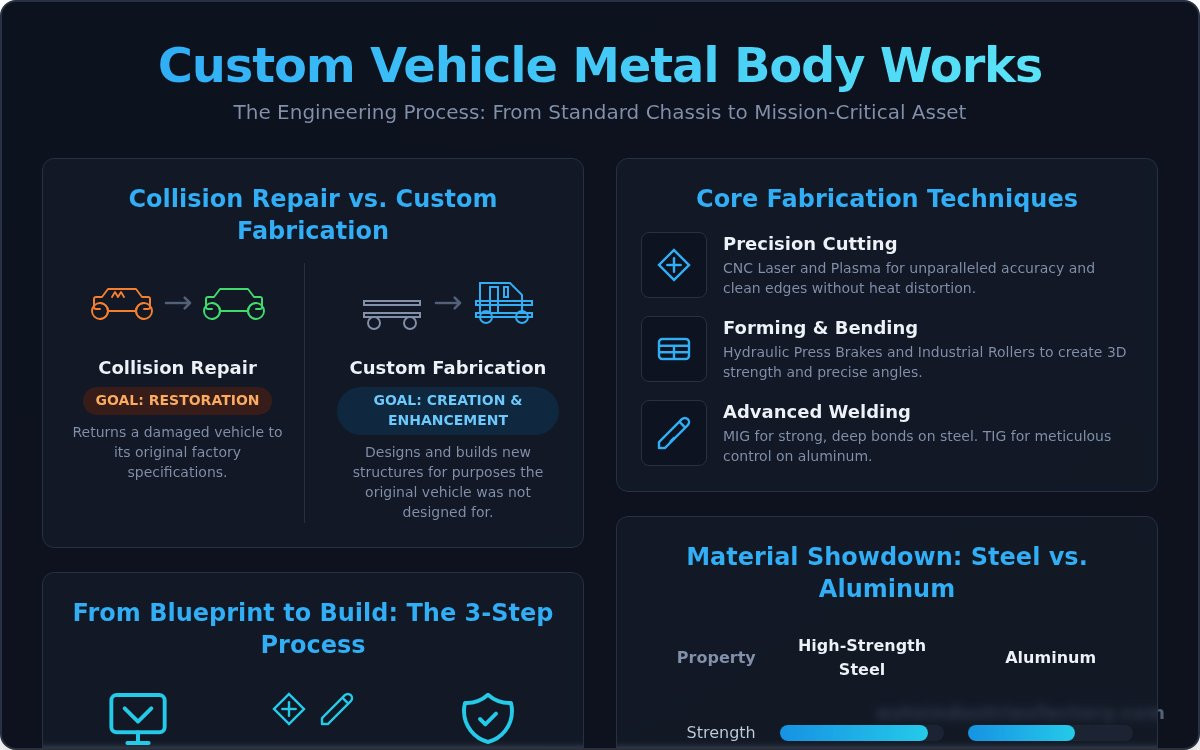
It is crucial to distinguish our work from standard collision repair. A collision shop’s objective is restoration-returning a damaged vehicle to its original factory specifications. Custom fabrication, however, is an act of creation and enhancement. It involves designing and building entirely new components or modifying existing structures to serve a purpose the original vehicle was not designed for. Our focus is exclusively on this advanced fabrication for enhanced, mission-critical functionality.
The Role of Metal Works in Specialized Vehicles
Custom metal body works are the backbone of any specialized vehicle. This process is essential for building vehicles that can withstand the demanding conditions found across Oman, from rugged mountain tracks to vast desert landscapes. Key applications include:
- Structural Reinforcement: Strengthening a 4x4 frame to handle heavy armor or specialized equipment for defense and security applications.
- Body Conversion: Transforming a standard van chassis into a fully equipped, life-saving ambulance with a raised roof and integrated equipment mounts.
- Functional Modification: Adding heavy-duty mounting points, custom storage solutions, or protective bull bars for industrial, safari, or off-road fleets.
From Engineering Design to Physical Form
Every cut, bend, and weld is preceded by meticulous planning. Our process begins with precise Computer-Aided Design (CAD) and rigorous engineering analysis. This foundational stage ensures that every modification not only meets the client's operational requirements but also adheres to strict safety and performance standards. By investing in expert design, we guarantee structural integrity, prevent costly errors, and deliver a flawless, heavy-duty final product built to last.
Core Techniques in Professional Metal Fabrication
Transforming raw metal sheets into rugged, mission-ready vehicle components is a science built on precision and power. Professional metal body works are not simply about cutting and joining; they are an integrated sequence of advanced industrial processes. From the initial design to the final assembly, every step relies on sophisticated technology and expert craftsmanship to guarantee strength, durability, and a flawless fit. This mastery of core techniques is what separates standard modifications from truly engineered, heavy-duty vehicle solutions designed for the demanding conditions in Oman and across the GCC.
Precision Cutting: Laser, Plasma, and CNC
Every durable component begins with a perfect cut. We utilize CNC (Computer Numerical Control) laser cutting for its unparalleled accuracy, producing surgically clean edges on steel and aluminum without heat distortion. For thicker, heavy-duty materials used in chassis reinforcement or armored plating, our CNC plasma cutters provide immense power and speed. Integrating CNC technology ensures every part is an exact replica of the digital design, guaranteeing perfect repeatability for fleet orders and complex assemblies.
Forming and Bending: Press Brakes and Rollers
This is where flat metal gains its three-dimensional strength and function. Our hydraulic press brakes are programmed to create crisp, precise angles and bends, essential for fabricating items like custom bumpers, storage boxes, and brackets. To achieve the smooth, aerodynamic curves required for canopies, fenders, and custom body panels, we employ industrial rollers. This controlled forming process turns basic sheet metal into structurally sound components that integrate seamlessly with the vehicle's original design.
Advanced Welding and Joining Methods
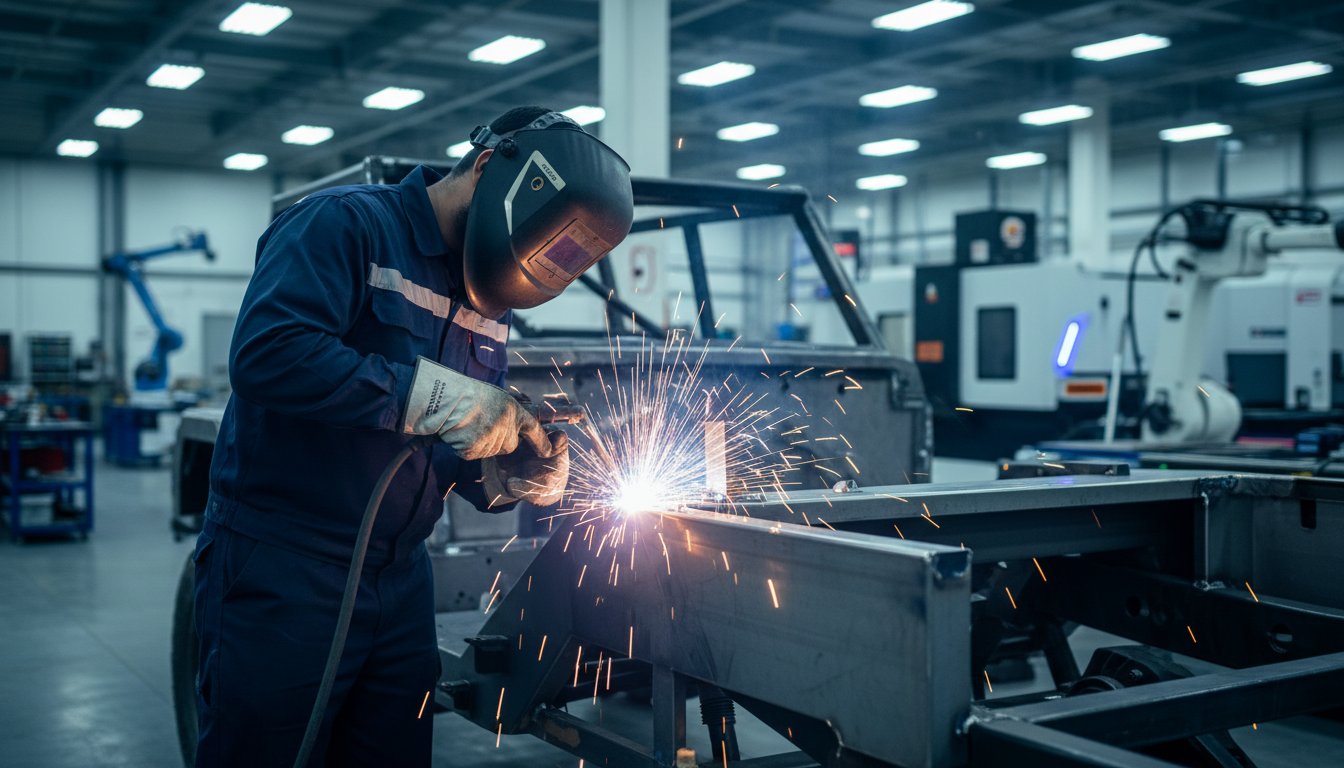
The structural integrity of any custom fabrication hinges on the quality of its welds. MIG (Metal Inert Gas) welding serves as our versatile workhorse, ideal for rapidly creating strong, deep bonds on steel structures. For intricate work on aluminum or stainless steel, such as fuel tanks or specialized racks, TIG (Tungsten Inert Gas) welding provides meticulous control and a clean, premium finish. Understanding these fundamental joining processes, as detailed in many Welding and Metal Fabrication essentials, is non-negotiable. That is why we exclusively employ certified welders, ensuring every seam and joint in our metal body works meets rigorous standards for safety and long-term durability.
Choosing the Right Metal: Materials for Durability and Performance
In professional metal body works, the choice of material is a critical engineering decision that directly impacts your vehicle's performance, lifespan, and total cost of ownership. It's about engineering the perfect balance between strength, weight, corrosion resistance, and budget. Especially in Oman, where intense heat and coastal humidity create a demanding environment, selecting the right metal ensures your custom fabrication is built to last. Understanding these materials helps you appreciate the quality and value behind the final product.
Key factors in material selection include:
- Strength & Durability: The material's ability to withstand impacts and structural stress.
- Weight: Lighter materials can improve fuel efficiency and increase payload capacity.
- Corrosion Resistance: Essential for longevity, particularly in coastal or humid areas.
- Cost: The raw material and fabrication costs associated with each option.
Mild & High-Strength Steel (HSS)
Steel is the workhorse of the fabrication industry. Mild steel is incredibly strong, easy to work with, and cost-effective, making it the ideal choice for heavy-duty applications like vehicle frames, roll cages, and rugged bumpers. For mission-critical structural components, High-Strength Steel (HSS) provides a superior strength-to-weight ratio. Given Oman's climate, a robust protective finish, such as professional powder coating, is non-negotiable to prevent corrosion and ensure maximum durability.
Aluminum Alloys
The primary advantage of aluminum is its significant weight savings. This reduction in weight directly translates to better fuel economy and a higher legal payload, which is crucial for commercial vehicles. Aluminum is naturally resistant to corrosion, a major benefit in coastal environments. While it is more expensive and requires specialized welding expertise, its properties make it the premier choice for custom canopies, storage boxes, and ambulance bodies where minimizing weight is a top priority.
Stainless Steel
When absolute corrosion resistance and hygiene are paramount, stainless steel is the ultimate solution. Its clean, non-porous surface and extreme durability make it essential for interior fittings in ambulances, mobile clinics, and food trucks. Although it represents a higher initial investment, its exceptional longevity and minimal maintenance requirements make it the most effective choice for specialized, high-value metal body works projects where performance cannot be compromised.
Finishing and Protection: Ensuring Long-Term Durability
The true measure of quality in custom vehicle fabrication lies not just in the strength of the welds, but in the resilience of its finish. Once the shaping and assembly are complete, the crucial process of protecting the raw metal begins. A premium finish is a non-negotiable investment, safeguarding the structure from the elements, enhancing its appearance, and drastically reducing long-term maintenance. For vehicles operating in Oman's harsh conditions-from intense solar radiation and coastal humidity to abrasive sand-this protective barrier is the key to longevity.
Surface Preparation: The Foundation of a Lasting Finish
Before any coating is applied, the metal surface must be immaculately clean. We employ industrial processes like sandblasting and grinding to strip away all impurities, including mill scale, oils, and surface rust. This creates a textured, uniform profile that allows primers and coatings to achieve a powerful mechanical bond. Skipping this essential step is a guarantee of future failure, leading to peeling, bubbling, and premature corrosion that compromises the entire structure.
Industrial Primers and Seam Sealing
The first layer of defence is a high-performance primer. Unlike standard primers, industrial-grade epoxy or etch primers create a chemical bond with the steel, forming an impermeable, corrosion-resistant barrier. Following this, every weld, joint, and seam is meticulously sealed. This critical, often unseen, detail prevents moisture intrusion-the primary cause of rust in fabricated components. It ensures that even the most vulnerable areas are completely protected from the inside out.
Protective Coatings: Powder Coating vs. Industrial Paint
The final protective layer determines both the durability and the aesthetic of your custom metal body works. The choice between leading industrial solutions depends on the application:
- Powder Coating: An electrostatically applied dry powder that is cured under heat. This process creates an incredibly tough, thick, and chip-resistant finish. It is the superior choice for heavy-duty components like bull bars, rock sliders, and roof racks that face constant impact and abrasion.
- Two-Part Industrial Paint: Advanced polyurethane or epoxy paints offer exceptional UV resistance and chemical durability. With a wider range of colours and finishes, this method is ideal for larger body panels and achieving a flawless, automotive-grade appearance that matches the vehicle's existing paintwork.
Ultimately, selecting the right finishing process is as important as the fabrication itself. At Auto Industries Factory, our expertise ensures every component is built and protected to withstand the toughest operational demands.
How to Choose a Specialist for Custom Metal Body Works
Selecting the right fabricator for your fleet's custom vehicle modifications is a critical investment in operational readiness, safety, and long-term value. For fleet managers and procurement officers in Oman, the goal is to identify a strategic partner, not just a vendor. The best specialists distinguish themselves through proven capability, deep experience, and an unwavering commitment to quality that ensures your assets perform flawlessly in demanding environments.
Evaluate In-House Capabilities
A true specialist operates from a fully integrated facility. Prioritize a single-source provider that manages design, CNC laser cutting, press brake forming, welding, and painting under one roof. This vertical integration ensures superior quality control, eliminates communication delays with third parties, and provides a single point of accountability. Inquire about their specific machinery; advanced equipment is a direct indicator of their commitment to precision and efficiency in every project.
Review Their Portfolio and Expertise
General auto body shops lack the engineering depth required for complex, heavy-duty projects. Request a portfolio with relevant case studies that match your needs, such as ambulance conversions, military vehicle up-fitting, or rugged 4x4 fabrications. Proven experience with specific vehicle platforms common in the region demonstrates a deeper understanding of chassis limitations and performance requirements for demanding metal body works. This specialized knowledge is non-negotiable for mission-critical applications.
Inquire About Quality Control and Materials
Transparency is the hallmark of a reliable partner. Ask direct questions about their quality assurance protocols. How do they certify weld integrity and ensure structural soundness? Discuss their material sourcing and verification processes for premium-grade steel and aluminum. A reputable fabricator will be open about their standards and processes, giving you complete confidence in the durability and safety of the final product. When your project demands this level of precision, it is crucial to engage with experts. Discuss your project with our engineering team today.
Transform Your Fleet with Precision Metal Fabrication
From selecting the right grade of steel to applying the final protective coating, every step in custom vehicle fabrication is critical for success. The outcome of your project hinges on two key factors: a clear understanding of core fabrication techniques and partnering with a specialist who possesses proven, mission-critical experience. Mastering the art of custom metal body works is about transforming a vision into a durable, high-performance reality that withstands the toughest conditions.
At Auto Industries Factory, we control every stage of this process with our fully in-house capabilities, from initial design to final painting. As trusted specialists for government and commercial fleets across the UAE and the wider region, our expertise is forged in demanding ambulance, military, and safari vehicle conversions. We bring an unparalleled level of precision and reliability to every build.
Ready to equip your vehicles with unparalleled durability and function? Get a Free Estimate for Your Custom Fabrication Project and let's build a vehicle that's engineered for purpose and built to last.
Frequently Asked Questions About Metal Body Works
What is the difference between a bolt-on body kit and custom metal body work?
Bolt-on kits are mass-produced, often from fiberglass or plastic, for a general fit. In contrast, custom metal body work is a bespoke fabrication process. Our technicians shape high-strength steel or aluminum directly to your vehicle’s chassis, ensuring a seamless, integrated design. This method delivers superior durability and a flawless finish, engineered specifically for your vehicle and its operational demands, whether for commercial fleets or specialized off-road use in Oman.
How does custom metal fabrication affect a vehicle's weight and handling?
The impact on vehicle dynamics is meticulously managed. While steel adds significant strength, we can utilize high-grade, lightweight aluminum to mitigate weight gain. Our engineering process includes precise weight distribution calculations to maintain or even enhance stability. For heavy-duty applications common in Oman, like reinforced cargo beds, the gain in structural integrity provides a crucial performance advantage that can be balanced with recommended suspension upgrades to optimize handling.
Can you perform metal body works on an armored vehicle?
Yes, modifying armored vehicles is a core competency at our facility. Our fabrication team is highly experienced in working with ballistic steel and composite armor. We can integrate custom equipment mounts, reinforced bumpers, or modify access points without compromising the vehicle's protective integrity. Every modification is engineered to meet rigorous security standards, ensuring mission-critical reliability for defense and security fleets operating throughout Oman and the wider region.
What is the typical lead time for a custom vehicle fabrication project?
Project timelines depend on complexity. A straightforward fabrication like a custom bull bar may take 1-2 weeks, while a comprehensive full-body conversion can require 4-8 weeks after the design is finalized. Following a detailed consultation, we provide a precise project timeline and a cost estimate in US dollars ($). Our efficient workflow ensures timely completion without compromising the precision engineering and build quality we are known for.
How do you ensure the structural integrity of your modifications is safe?
Structural integrity is our highest priority. We utilize advanced CAD software for design and stress analysis before fabrication begins. Our certified welders and technicians use precision equipment, including CNC cutters and press brakes, to ensure every component integrates perfectly with the vehicle's original chassis. All work is subject to rigorous quality control and is designed to comply with Royal Oman Police (ROP) vehicle standards, guaranteeing a safe and durable final product.
What kind of warranty do you offer on custom metal body works?
We provide a comprehensive 12-month warranty on all our custom metal fabrication. This covers any defects in materials and workmanship, including the structural integrity of our welds and fabrications. The warranty ensures that any issues arising from our work will be rectified by our team. Our commitment is to deliver heavy-duty, reliable solutions engineered to withstand the demanding operational and environmental conditions found across Oman.


