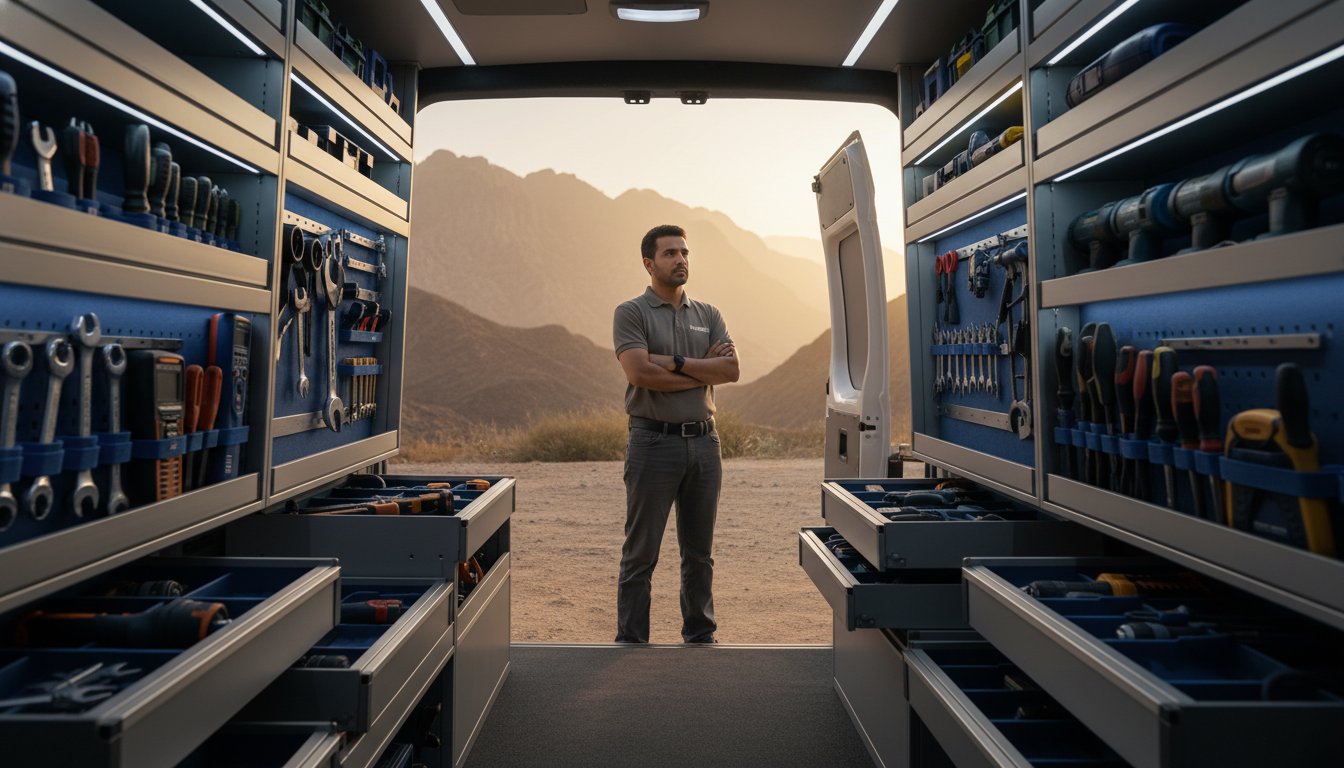
A mobile workshop is not a storage unit; it's a high-precision engineering platform where every millimeter of space must be dictated by vehicle dynamics. When you're optimizing a mobile workshop layout, you aren't just organizing tools. You're balancing center-of-gravity calculations with ergonomic efficiency to ensure your vehicle remains stable on the road and productive on the job site. Most professional operators in Oman understand the frustration of tool clutter and the danger of shifting cargo when navigating rugged desert terrain.
We'll show you how to master space-saving techniques, weight distribution, and workflow engineering to transform any vehicle into a high-performance service unit. This article breaks down the technical requirements for durable infrastructure that survives extreme vibration and harsh environments. You'll learn to implement a logical, scannable layout that reduces search time and improves technician safety. We also preview current 2026 industry standards, including best practices for cargo securement and the critical engineering trade-offs between modular shelving and professional custom fabrication.
Key Takeaways
- Balance payload limits with ergonomic access to ensure your vehicle remains stable and productive under heavy use.
- Apply the 80/20 rule for optimizing a mobile workshop layout by positioning high-frequency tools within arm's reach of primary doors.
- Compare the structural integrity of custom-welded metal frames versus modular shelving for specialized units like safari vehicle conversions.
- Identify critical safety standards for crash-tested mounting points and ventilation to protect technicians and equipment in transit.
The Engineering Core: Principles of Mobile Workshop Layout Design
Every millimeter in a specialized vehicle must serve a mission-critical purpose. Unlike a stationary shop, optimizing a mobile workshop layout requires a ruthless elimination of wasted space, drawing inspiration from Lean manufacturing principles. When you're optimizing a mobile workshop layout, you're practicing the precise science of balancing cubic capacity, payload limits, and ergonomic access. You aren't just fitting shelves; you're engineering a workspace that maintains its integrity at 100 km/h on an Omani graded road.
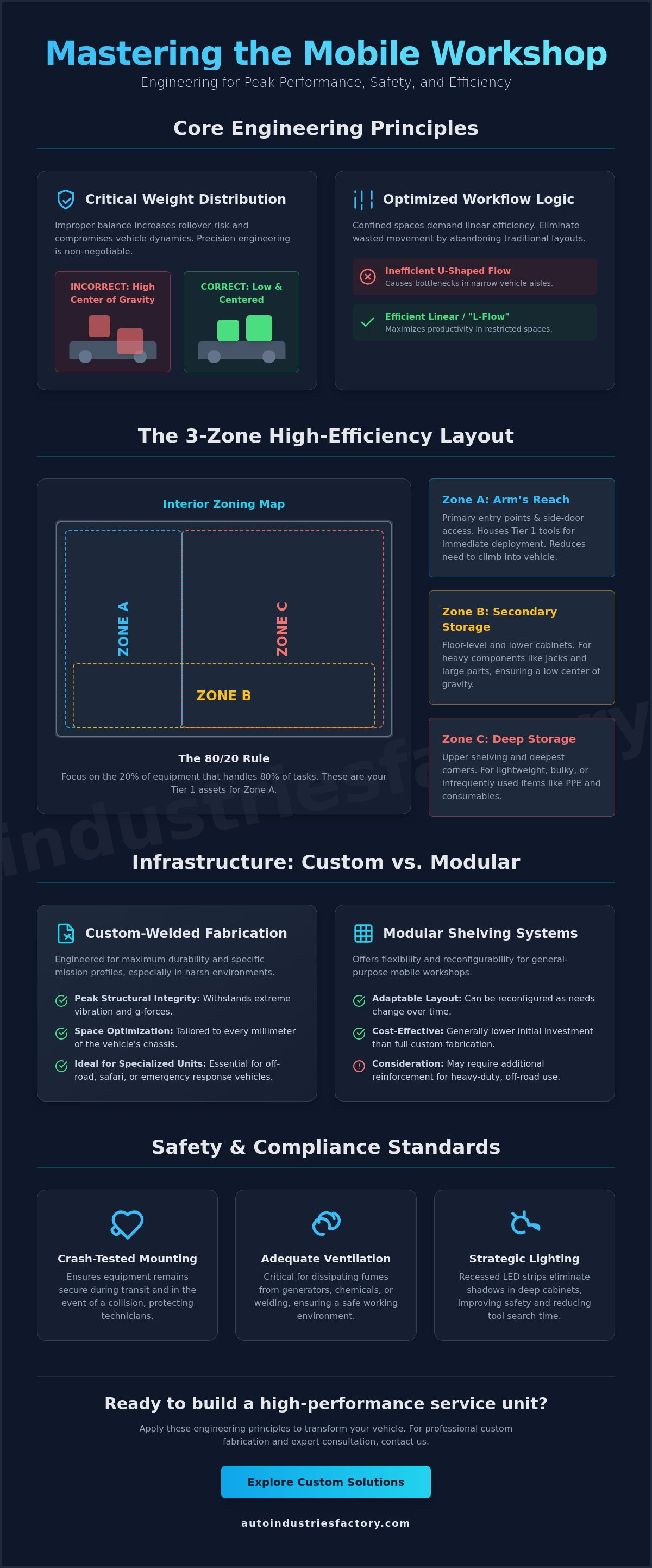
Traditional U-shaped workflows fail in the narrow aisles of a GMC or Toyota conversion. Instead, mobile logic dictates a linear or "L-flow" where movement is restricted but efficiency is maximized. We design "Dynamic Layouts" specifically to withstand the constant vibration and g-forces inherent in off-road safari conditions or high-speed police response. This approach ensures that every tool remains secured and every surface remains functional despite the terrain.
To better understand the fundamentals of a versatile workstation, watch this helpful video:
Weight Distribution and Vehicle Dynamics
Poorly distributed weight is a liability. A high center of gravity increases rollover risks during emergency maneuvers or while navigating steep dunes. Precision engineering requires placing the heaviest equipment, such as generators, compressors, or heavy metalwork tools, directly over the axles or as low as possible within the chassis. Payload Management is the non-negotiable limit of any conversion project that dictates the maximum weight of tools and materials the vehicle can safely carry. Failure to respect these limits compromises braking distance and suspension longevity.
The Golden Triangle of Mobile Accessibility
Efficiency depends on the "Golden Triangle" of mobile units: the entry point, the primary workbench, and the power source. By centering these three nodes, you minimize unnecessary steps and reaching motions. High-frequency tasks shouldn't require a technician to climb deep into the cargo area. Use side-access doors for power controls and frequently used hand tools to keep the workflow externalized. Optimizing a mobile workshop layout this way ensures that the most common repairs happen at the vehicle's edge, saving time and reducing physical strain.
Implementing a High-Efficiency Workflow in Confined Spaces
Efficiency in a 4x4 or commercial van isn't about having every tool. It's about having the right tool in the right place. Optimizing a mobile workshop layout begins with a rigorous mission profile audit to identify the top 20% of equipment that handles 80% of your daily tasks. These are your Tier 1 assets. Once identified, map your interior using three distinct spatial zones to eliminate wasted movement.
- Zone A (Arm’s Reach): Located at the primary entry points. This area houses your Tier 1 tools for immediate deployment.
- Zone B (Secondary Storage): Lower cabinets and floor-level units. Reserve this for heavy components like hydraulic jacks or large spare parts that require a low center of gravity.
- Zone C (Overhead and Deep Storage): Upper shelving or the deepest corners of the vehicle. Use this for lightweight, seasonal, or bulky items like PPE and consumables.
Zone A: The Quick-Access Strategy
A technician should rarely need to climb into the vehicle for routine repairs. By utilizing side-door access, you create a rapid-deployment station. We recommend integrating heavy-duty slide-out trays and drop-down benches. These modifications expand your workspace externally, providing a stable surface for metalwork or assembly without sacrificing internal floor space. Our custom vehicle modification services focus on these high-performance ergonomic solutions to maximize field uptime in demanding Omani environments.
Integrating Power and Lighting Systems
Visibility is a safety requirement. Strategic placement of recessed LED strips eliminates shadows in deep shelving units. This ensures tools are found instantly, even during night operations. Centralize your inverter and battery controls near the rear door. This allows for quick status checks on power levels during field operations without navigating through the workspace. High-output lighting and accessible power hubs turn a cramped interior into a professional-grade engineering platform.
Custom Fabrication vs. Modular Shelving: Choosing Infrastructure
Off-the-shelf plastic shelving systems or light-gauge steel kits often fail the durability test in professional environments. While modular kits are convenient for urban delivery vans, optimizing a mobile workshop layout for the Omani desert requires a more robust foundation. Custom-welded steel or aluminum frames offer the structural integrity needed to withstand thousands of kilometers of corrugated tracks and extreme heat without warping or shearing at the mounting points.
Precision is the difference between a tool kit and a mobile engineering station. We utilize laser cutting and CNC machining to create bespoke tool housing that fits the unique contours of your vehicle's interior. This level of precision ensures vibration-proof storage for sensitive diagnostic equipment. For safari vehicle conversions, this durability isn't optional; it's a safety requirement for remote survival. These internal structures often integrate with external reinforcements like custom bull bars and bumpers to provide a comprehensive protection solution for the entire unit.
Heavy-Duty Metal Canopies and Internal Frames
A custom metal canopy does more than just shield your gear from the sun. It acts as a structural skeleton that allows for heavy tool mounting on vertical planes, which isn't possible with standard vehicle walls. Our fabrication process focuses on rattle-free assembly. Eliminating the constant noise of shifting metal is vital for technician focus and prevents the premature wear of expensive power tools. A rigid internal frame distributes the mechanical load across the chassis, preventing body flex during off-road maneuvers.
Securing Equipment for Rugged Terrain
High-speed transit across uneven terrain creates massive kinetic energy that can turn a loose wrench into a projectile. Optimizing a mobile workshop layout involves integrating mechanical locking mechanisms for all heavy machinery. We recommend recessed tracking systems and custom-fabricated tie-down points built directly into the floor. These allow you to reorganize your payload as mission requirements change while keeping every compressor and generator immovably fixed during transit. If you're ready to upgrade your fleet, explore our professional metal cutting and bending services to start your custom build.
Safety Standards and Compliance for Specialized Mobile Units
Safety is the final, most critical layer of engineering. When you're optimizing a mobile workshop layout, you're building a workspace that must protect the operator as much as the equipment. Crash-tested mounting points for every internal structure aren't optional. They ensure that heavy machinery remains anchored to the chassis during sudden impacts or high-g maneuvers. This level of rigorous compliance is standard in police vehicle modifications, where the stakes of equipment failure are highest.
Ventilation is another technical hurdle. Vehicles carrying fuel canisters, welding gas, or hazardous chemicals require active airflow systems to prevent the buildup of volatile vapors. In the extreme heat of the Oman summer, these risks are magnified. Partnering with a certified vehicle conversion specialist guarantees that your layout complies with national safety standards and environmental regulations. Proper engineering ensures that your team remains safe while handling the mission-critical materials your service demands.
Fire Suppression and Electrical Safety
Every professional conversion should feature strategically placed fire extinguishers and the use of fire-retardant materials in all custom interior panels. Electrical safety is equally paramount. High-output inverters and power tools place significant strain on a vehicle's electrical system. We manage these loads through dedicated fuse blocks and heavy-duty wiring to prevent alternator burnout or harness fires. This proactive engineering protects your investment and ensures technician safety during intense field operations. Don't compromise on the systems that power your productivity.
Partnering for Long-Term Fleet ROI
Professional fabrication offers a superior return on investment compared to temporary shelving solutions. Custom-welded structures reduce maintenance costs over the vehicle's lifecycle by eliminating rattles and structural fatigue. For organizations managing multiple units, optimizing a mobile workshop layout across the entire fleet allows for uniform training and faster equipment audits. A well-engineered mobile workshop doesn't just work better; it lasts longer and costs less to operate in the long run. Standardizing your layout ensures that every technician, regardless of the vehicle they're assigned, can perform at peak efficiency.
Engineer Your Fleet for Maximum Field Performance
A professional mobile unit is more than just a vehicle with shelves. It's a mission-critical tool where precision weight distribution and logical workflow zones dictate your daily operational success. By optimizing a mobile workshop layout with custom-welded steel and crash-tested mounting points, you ensure your expensive equipment survives the most punishing Omani terrain. We've established that technical zoning and high-output power systems are what turn a standard van into a high-performance engineering platform.
Don't settle for off-the-shelf solutions that fail under pressure. We bring specialized expertise from high-stakes military and ambulance conversions to every project. Our facility utilizes in-house laser cutting and CNC machining for a precision fitment that eliminates rattles and structural fatigue. These ruggedized solutions are specifically designed to meet national geographic conditions while maintaining strict safety compliance.
Ready to transform your fleet? Request a custom mobile workshop conversion quote from Auto Industries Factory LLC today. It's time to build a durable, compliant workspace that powers your business forward and protects your team in the field.
Frequently Asked Questions
What is the most important factor in a mobile workshop layout?
The most important factor is the balance between weight distribution and ergonomic accessibility. While tool organization helps productivity, an unbalanced vehicle is a safety hazard that compromises handling. Proper placement of heavy machinery over the axles ensures stability on Omani roads. Optimizing a mobile workshop layout requires prioritizing vehicle dynamics before interior aesthetics to prevent rollovers and suspension fatigue.
How do I calculate the weight limit for my workshop conversion?
You calculate your weight limit by subtracting the vehicle's curb weight from its Gross Vehicle Weight Rating (GVWR). The remaining figure is your total payload capacity for the conversion materials, equipment, and technicians. Professional engineers never exceed this limit to avoid braking failure and structural damage. Always account for the weight of full fuel tanks and fluid reservoirs in your final calculations.
Should I use steel or aluminum for my mobile workshop shelving?
The choice depends on your specific mission profile and payload constraints. Aluminum is ideal for lightweight conversions where maximizing fuel efficiency or range is the primary goal. Steel provides superior durability and structural integrity for heavy-duty military or industrial applications. Custom-welded steel frames are often necessary for mission-critical units that face extreme off-road vibrations and high-impact environments.
How do I prevent tools from rattling and moving during transit?
You prevent movement by integrating mechanical locking mechanisms and precision-cut tool inserts. Standard drawers often fail during off-road transit, so you should utilize heavy-duty latches and recessed floor tracking. Optimizing a mobile workshop layout with custom-fabricated metal housings ensures every tool has a dedicated, secure home. This approach eliminates noise that leads to technician fatigue and protects sensitive equipment from impact damage.
Are there specific regulations for mobile workshops in the GCC?
Mobile workshops in the GCC must comply with GSO standards regarding vehicle safety and cargo securement. In Oman, the Royal Oman Police (ROP) has specific requirements for vehicle modifications, including lighting, dimensions, and weight limits. It's essential to work with a specialist who understands these regional compliance codes. This ensures your vehicle is road-legal and passes annual safety inspections without requiring costly rework.


