For law enforcement agencies across Oman, the stakes are absolute: officer safety is paramount, and vehicle downtime can directly impact public security. The challenge lies in navigating the complex world of police vehicle modifications to ensure every vehicle is not just operational, but a durable, mission-ready asset. A single faulty installation or unreliable component can compromise an entire operation, making professional expertise a non-negotiable requirement.
This is where precision engineering meets tactical necessity. Transforming a standard vehicle into a high-performance patrol unit requires a mastery of everything from heavy-duty exterior armor and advanced lighting to seamlessly integrated communication hubs and secure internal storage. It’s about creating a solution built for relentless, heavy-duty use.
In this ultimate guide, we break down the essential upfitting process from start to finish. Discover the critical modifications that enhance operational efficiency, guarantee officer safety, and deliver a reliable, long-lasting fleet. Learn the professional standards for creating a patrol vehicle your team can depend on, shift after shift.
Why Standard Vehicles Fail in Law Enforcement Roles
A patrol vehicle is far more than a standard car with a siren and flashing lights. It functions as a mobile office, a mission-critical communications hub, and a vital safety tool for officers. A comprehensive police car overview reveals the complexity of these machines, highlighting the immense gap between civilian vehicle standards and the rigorous demands of law enforcement duty in Oman. Standard passenger cars are simply not engineered for this environment. Professional police vehicle modifications are therefore non-negotiable for operational success and officer safety.
Extreme Durability and Performance Demands
Law enforcement vehicles endure a punishing cycle of long idle times followed by sudden, high-speed pursuits. This places extreme stress on the engine, transmission, and electrical systems. A standard car's components would quickly fail. Upgrades are essential, including heavy-duty suspension for aggressive manoeuvres, high-performance braking systems for reliable stopping power, and advanced cooling systems to prevent overheating during prolonged operations. The constant electrical draw from onboard technology far exceeds the capacity of a civilian alternator and battery.
Officer Safety and Ergonomics
The interior of a police vehicle must be a secure and efficient workspace. This requires specialized modifications like reinforced partitions to safely separate officers from detainees in the rear. Secure, quick-access weapon mounts are critical for tactical readiness. Furthermore, custom-fabricated consoles place radios, sirens, and lighting controls within easy reach, reducing distraction and improving response times. Heavy-duty, easily cleanable rear seating is also a necessity for hygiene and durability.
Specialized Equipment Integration
Integrating a suite of specialized equipment is a core component of police vehicle modifications. These systems must be installed with precision to ensure flawless operation when it matters most. Key equipment includes:
- Multi-band communication radios
- Mobile data terminals (MDTs) and ruggedized laptops
- GPS, modems, and cellular boosters
- Integrated siren, PA, and emergency lighting systems
Amateur wiring or improper installation poses a significant risk, potentially leading to electrical fires or catastrophic system failure during an emergency. Professional integration ensures all components are powered safely and function reliably as a cohesive unit.
Core Categories of Police Vehicle Modifications
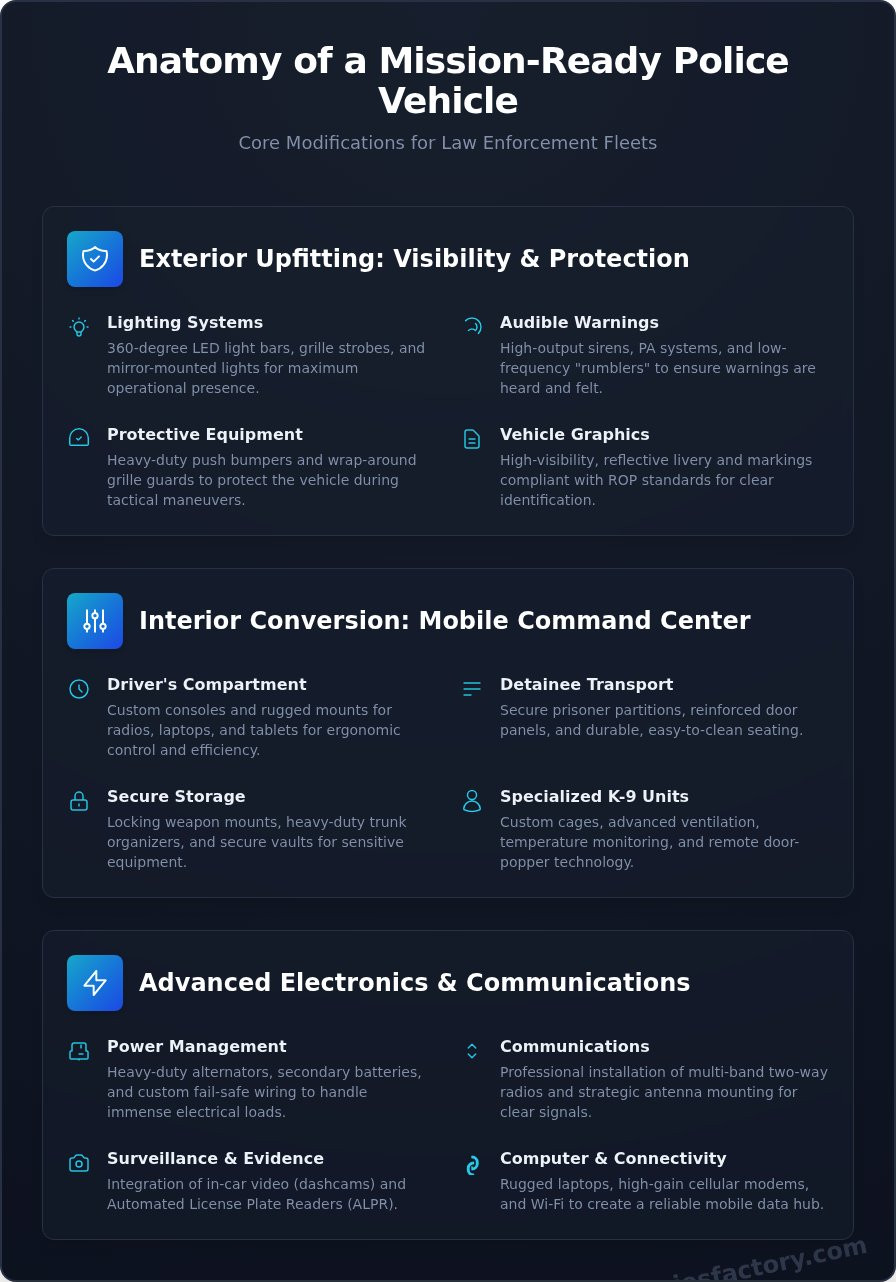
Transforming a civilian vehicle into a pursuit-rated, mission-ready law enforcement asset is a systematic process. Professional upfitting involves a comprehensive overhaul that touches nearly every part of the vehicle, categorized into three primary domains: the exterior shell, the interior cabin, and the complex network of onboard electronics. These specialized police vehicle modifications ensure each unit is durable, functional, and built to protect what matters.
Exterior Upfitting: Visibility, Protection, and Performance
The vehicle's exterior is modified for maximum operational presence and durability. These enhancements are critical for officer safety, public awareness, and vehicle longevity in demanding conditions. Key exterior modifications include:
- Lighting Systems: Advanced, multi-color LED light bars provide 360-degree visibility. This is supplemented by grille lights, mirror-mounted strobes, and rear-facing warning lights to command attention from every angle.
- Audible Warnings: High-output sirens with multiple tones, powerful public address (PA) systems, and low-frequency "rumbler" speakers ensure warnings are both heard and felt by other drivers.
- Protective Equipment: Heavy-duty, precision-fabricated push bumpers (bull bars) and wrap-around grille guards protect the vehicle's front end during tactical maneuvers and from potential impacts.
- Vehicle Graphics: Application of official, high-visibility reflective livery and markings that comply with Royal Oman Police (ROP) standards, ensuring the vehicle is clearly identifiable day or night.
Interior Conversion: The Officer's Mobile Command Center
The interior is re-engineered for safety, efficiency, and control. Every component is selected and installed to create an ergonomic and secure workspace for officers while safely managing detainees.
- Driver's Compartment: Custom-fit center consoles organize radios and controls, while rugged mounts secure laptops and tablets. A centralized switch panel provides seamless control over lights and sirens.
- Detainee Transport: Secure prisoner partitions with integrated window guards create a barrier between officers and detainees. Rear compartments feature reinforced door panels and durable, easy-to-clean seating.
- Secure Storage: Locking weapon mounts for rifles and shotguns, heavy-duty trunk organizers for gear, and secure vaults for sensitive equipment are installed for optimal security and accessibility.
- K-9 Units: For specialized units, we integrate custom cages with advanced ventilation, temperature monitoring systems, and remote door-popper technology for rapid deployment.
Advanced Electronics and Communications Systems
The electrical system is the nerve center of a modern police vehicle. A robust power and data infrastructure is fundamental to all other police vehicle modifications, ensuring every system operates flawlessly when it matters most.
- Power Management: Upgrades include heavy-duty alternators, isolated secondary battery systems, and custom wiring harnesses with fail-safes to manage the immense electrical load of onboard equipment.
- Communications: Professional installation of multi-band two-way radios and strategic antenna mounting ensures clear, uninterrupted communication with dispatch and other units.
- Surveillance & Evidence: Integration of advanced in-car video systems (dashcams) and Automated License Plate Readers (ALPR) provides critical evidence-gathering capabilities.
- Computer & Connectivity: Equipping vehicles with rugged laptops, high-gain cellular modems, and Wi-Fi creates a reliable mobile data terminal for accessing critical information in the field.
The Professional Upfitting Process: From Stock to Patrol-Ready
Transforming a standard vehicle into a mission-ready law enforcement asset is more than just installing lights and sirens; it's a comprehensive engineering discipline. A professional upfitter replaces ad-hoc installations with an integrated, systematic approach designed for maximum reliability, safety, and operational effectiveness. This meticulous process ensures that every component works together flawlessly, providing officers with a tool they can depend on. At AIF, we treat every build as a complete system, engineered from the ground up to meet the demanding conditions of police work in Oman and beyond.
Step 1: Consultation and Needs Analysis
The foundation of any successful fleet conversion is a deep understanding of the agency's unique requirements. Our process begins with a detailed consultation to define the vehicle's specific mission. We collaborate with your team to outline operational priorities, whether for urban traffic enforcement, tactical response, or rugged desert patrol. This critical first step ensures the final build is precisely tailored to your needs, budget, and deployment schedule.
Step 2: Engineering, Design, and Layout
Once the mission is defined, our engineering team creates a detailed blueprint for the conversion. Using advanced CAD software, we map the precise placement of all equipment, from communications consoles to prisoner partitions, ensuring optimal ergonomics and officer efficiency. Meticulous planning of the electrical system is paramount; we calculate power loads and design a robust wiring harness to prevent failures and ensure all systems operate reliably under stress. This design phase eliminates guesswork and prevents costly errors during the build.
Step 3: Fabrication and Systems Integration
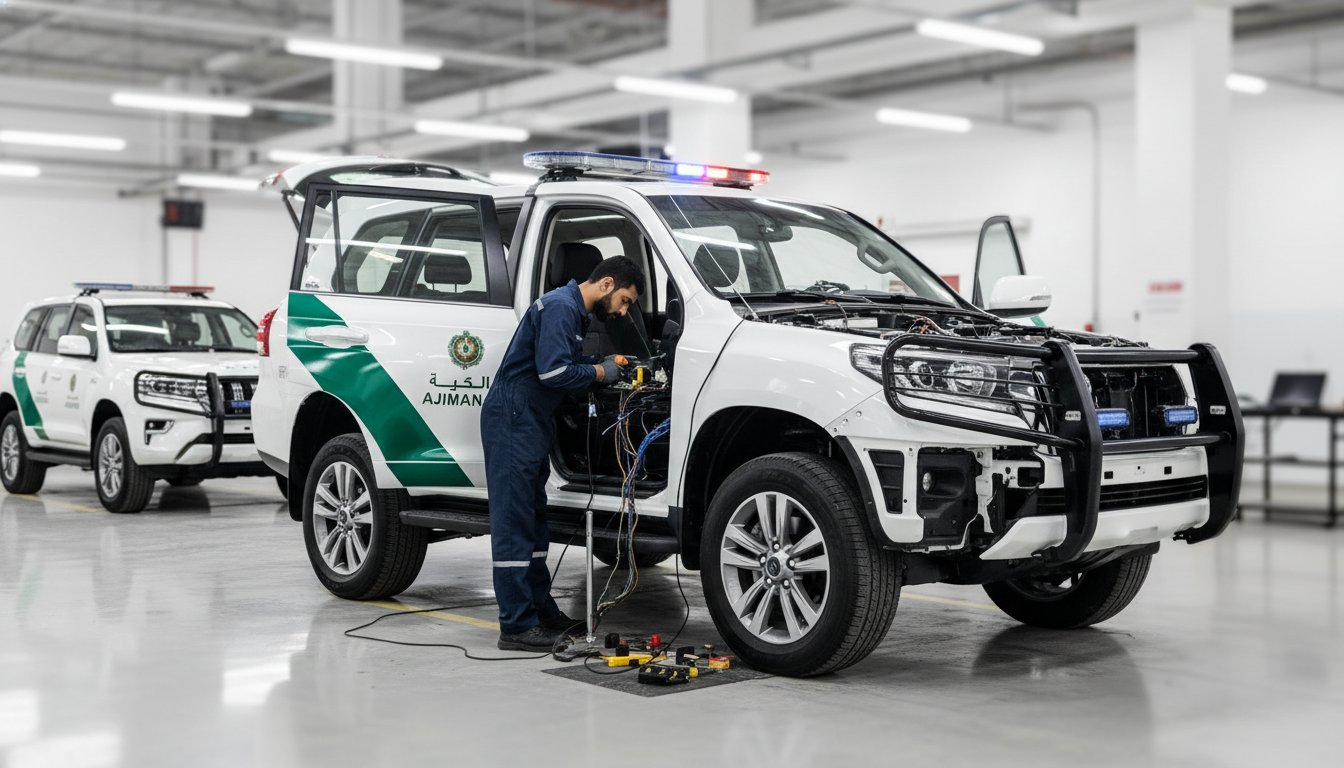
This is where the physical transformation occurs. Our expert technicians begin by carefully decommissioning the stock interior to prepare the vehicle for its new role. We leverage our in-house fabrication capabilities to create heavy-duty, custom brackets, consoles, and mounts for a perfect fit. All wiring, electronics, and specialized equipment are professionally integrated, turning the design blueprint into a fully functional reality. These carefully executed police vehicle modifications ensure durability and a seamless user experience for the officers in the field.
Step 4: Quality Assurance, Testing, and Delivery
Before any vehicle is cleared for duty, it undergoes a rigorous quality assurance protocol. Every system is subjected to comprehensive testing to verify its functionality and durability. We check for:
- Electrical Integrity: Ensuring all lighting, sirens, and electronics function correctly without power drains.
- Mechanical Soundness: Road testing to confirm that all installations are secure, silent, and rattle-free.
- Specification Compliance: A final, detailed inspection to guarantee every aspect of the build meets the agreed-upon plan.
This commitment to quality is non-negotiable. See how our proven process ensures fleet reliability and protects what matters most.
Choosing the Right Base Vehicle for Police Conversion
The foundation of any successful law enforcement fleet is the selection of a robust, mission-appropriate base vehicle. This crucial first step dictates the ultimate performance, long-term reliability, and operational safety of the final converted unit. The most advanced equipment cannot compensate for a platform that is ill-suited for the rigorous demands of police duty. Therefore, a strategic assessment of the vehicle's intended role is paramount before any police vehicle modifications are considered.
Patrol Sedans vs. SUVs vs. Special Purpose Trucks
While high-performance sedans remain a viable option for highway patrol and urban pursuit roles due to their agility and speed, the modern trend heavily favors Sport Utility Vehicles (SUVs). In regions like Oman, the versatility of an SUV is unmatched, offering higher ground clearance for varied terrain, significantly more cargo space for tactical gear and communication equipment, and superior all-weather capability. For highly specialized tasks, purpose-built trucks and vans are essential for units such as forensics, mobile command centers, SWAT teams, or secure prisoner transport.
Key Drivetrain and Chassis Considerations
Before upfitting, several factory specifications are non-negotiable for ensuring a vehicle can withstand the stresses of police work. Partnering with experienced vehicle conversion specialists ensures these critical elements are prioritized from the start.
- Engine and Transmission: Opting for a manufacturer's 'police-spec' or 'pursuit-rated' package is critical. These feature heavy-duty cooling systems, reinforced drivetrain components, and performance-tuned transmissions designed for sustained high-stress operation.
- Payload Capacity: The combined weight of ballistic armor, communications arrays, storage vaults, and personnel equipment can easily exceed a standard vehicle's limits. A heavy-duty chassis and suspension are essential to maintain safe handling and prevent premature component failure.
- Electrical System: A high-output alternator is one of the most vital factory options. Standard alternators cannot handle the constant electrical load from emergency lighting, sirens, radios, and onboard computers, leading to critical system failures in the field.
Popular Models for Law Enforcement Fleets
Globally, models like the Ford Police Interceptor Utility and Dodge Charger Pursuit are dominant choices. However, in the GCC and Oman, operational requirements demand platforms proven for durability in harsh climates and rugged landscapes. Here, the Toyota Land Cruiser and Nissan Patrol are undisputed powerhouses, valued for their legendary reliability and off-road prowess. These vehicles provide an exceptional foundation for a wide range of police vehicle modifications, from standard patrol conversions to advanced tactical response units.
Selecting Your Vehicle Modification Partner: What to Look For
The final step in upfitting your fleet is choosing the right technical partner. This decision extends far beyond a simple transaction; it's the formation of a long-term relationship built on trust, precision, and reliability. The quality of your partner's work directly impacts officer safety, vehicle uptime, and operational readiness. A superior partner acts as a consultant, ensuring every component is integrated flawlessly for peak performance in demanding Omani conditions.
When vetting a conversion company for your police vehicle modifications, use the following criteria to separate simple installers from true engineering partners.
In-House Fabrication vs. Simple Installation
A key differentiator is the ability to custom-fabricate components in-house. A partner with advanced metalwork, welding, and design capabilities can create durable, purpose-built solutions that perfectly fit the vehicle and mission requirements. This ensures superior quality control and durability compared to companies that merely bolt on off-the-shelf parts, which may not withstand the rigors of police duty.
Proven Experience and Past Performance
Theory is no substitute for experience. Demand a portfolio of completed projects and ask for references from other law enforcement or government agencies, particularly within the region. A provider with a documented history of successful large-scale fleet deployments demonstrates the capacity, expertise, and project management skills necessary to handle complex conversions on schedule and to exact specifications.
Commitment to Quality and After-Sales Support
Your fleet vehicles are critical assets that must remain operational. A reliable partner stands firmly behind their work long after the keys are handed over. Inquire about their warranty policies, ensuring they cover both parts and labour. Furthermore, insist on receiving comprehensive documentation, including detailed electrical schematics, to simplify future maintenance and troubleshooting for your own technicians.
To ensure a successful outcome for your fleet, your chosen partner should demonstrate excellence across these key areas:
- Engineering First Approach: They design solutions, not just install products.
- End-to-End Capabilities: From initial design and fabrication to final integration and testing.
- Robust Supply Chain: Access to premium, heavy-duty components and materials.
- Transparent Communication: Clear documentation and accessible post-delivery support.
Ultimately, a partner with comprehensive, in-house capabilities is best equipped to deliver the advanced and reliable police vehicle modifications your agency requires to protect and serve effectively.
Your Partner in Advanced Law Enforcement Vehicle Upfitting
Transforming a stock vehicle into a patrol-ready asset is a mission-critical task. As we've explored, the process demands a strategic approach to selecting the right base vehicle and a deep understanding of officer safety and operational demands. This complexity underscores why professional police vehicle modifications are a non-negotiable requirement for any modern law enforcement agency aiming for peak performance and reliability.
Choosing the right upfitting partner is the most crucial decision. At Auto Industries Factory, we are specialists in Police and Military Vehicle Conversions. Our complete in-house design, fabrication, and integration capabilities ensure every component is built for heavy-duty performance. As a partner trusted by agencies in the UAE and across the region, we deliver solutions engineered to protect what matters.
Take the next step in upgrading your fleet's capabilities. Request a consultation for your fleet modification project.
Let's build a fleet that is prepared for any challenge.
Frequently Asked Questions
How long does a full police vehicle modification take?
The timeline for a complete police vehicle modification depends on the project's complexity and scope. A standard patrol car upfit, including lighting, sirens, and communication systems, typically takes 2 to 3 weeks. More advanced conversions, such as for tactical response units or mobile command centers, can extend to 4-6 weeks or more. We provide a precise project timeline after a detailed consultation to ensure minimal fleet downtime and a clear schedule for your department's planning.
What is the difference between upfitting and armoring a police vehicle?
Upfitting focuses on equipping a vehicle for operational duty. This includes installing mission-critical equipment like emergency lighting, sirens, communication radios, in-vehicle computers, and prisoner partitions. Armoring, in contrast, is a specialized process focused on officer protection. It involves reinforcing the vehicle's structure with ballistic-grade materials like steel plates and bullet-resistant glass to withstand threats. While upfitting enhances functionality, armoring enhances survivability in high-risk situations.
What are the most common mistakes to avoid when modifying a police fleet?
A critical mistake is improper electrical load management, which leads to battery failure and equipment malfunction. Another common error is using consumer-grade components that cannot withstand the heavy-duty demands of police work, resulting in frequent repairs. Finally, overlooking ergonomic design for consoles and equipment placement can hinder officer efficiency and safety. Partnering with an experienced upfitter who understands these challenges is essential for creating a reliable and effective law enforcement fleet.
Can existing vehicles in our fleet be retrofitted with new technology?
Yes, retrofitting is a core part of our services. We specialize in upgrading existing fleet vehicles with the latest law enforcement technology. This includes integrating modern LED lighting systems, installing advanced in-car video and communication equipment, or adding new computer mounts and consoles. Retrofitting is a highly cost-effective solution to enhance your fleet's capabilities, extend its service life, and ensure your officers have access to the most advanced tools available.
How do you ensure all the electronics don't drain the vehicle's battery?
Proper power management is fundamental to our police vehicle modifications. We conduct a thorough electrical load calculation for all installed equipment to ensure the system is balanced. We then install heavy-duty solutions such as power distribution modules, secondary battery systems, and high-output alternators. Additionally, we integrate intelligent timers and low-voltage disconnects that automatically shut down non-critical equipment to preserve battery power when the engine is off, ensuring vehicle readiness at all times.
Do your modifications comply with regional standards in the UAE/GCC?
Absolutely. All our police vehicle conversions are engineered to meet or exceed the stringent standards set by authorities across the region, including the specific requirements of the Royal Oman Police (ROP) and broader GCC regulations. We ensure full compliance with local laws governing emergency lighting configurations, siren tones, vehicle markings, and equipment installation. Our expertise in the Omani and wider GCC market guarantees that your fleet is fully compliant, road-legal, and mission-ready.


