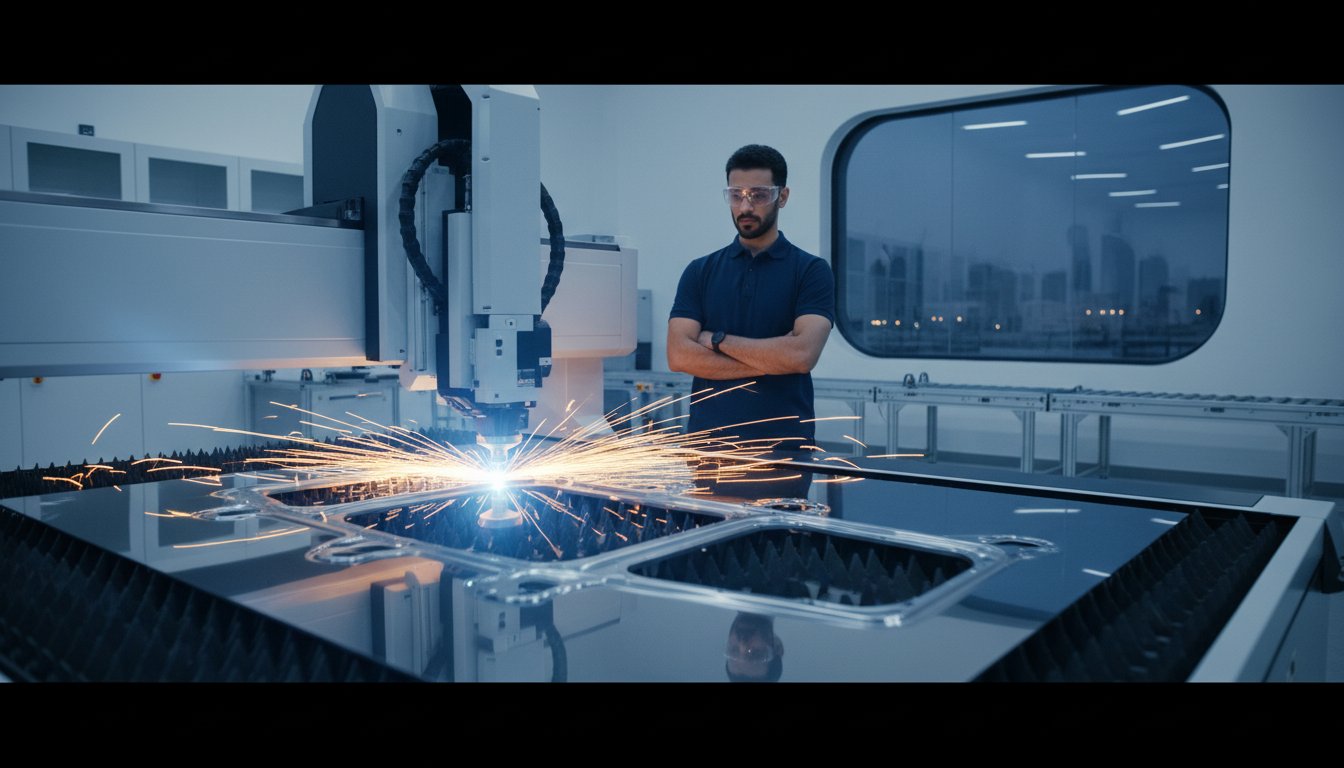
What if a 0.1mm deviation in a custom chassis bracket was the difference between a successful mission and a total frame failure in the region's demanding environments? Many fleet managers across the UAE and wider GCC are tired of waiting 30 days for specialized imports that often arrive with manufacturing defects. You know that inconsistent quality from generalist workshops puts your drivers at risk and inflates your maintenance costs. Integrating precision laser cutting for automotive parts into your local supply chain ensures that every component fits perfectly the first time.
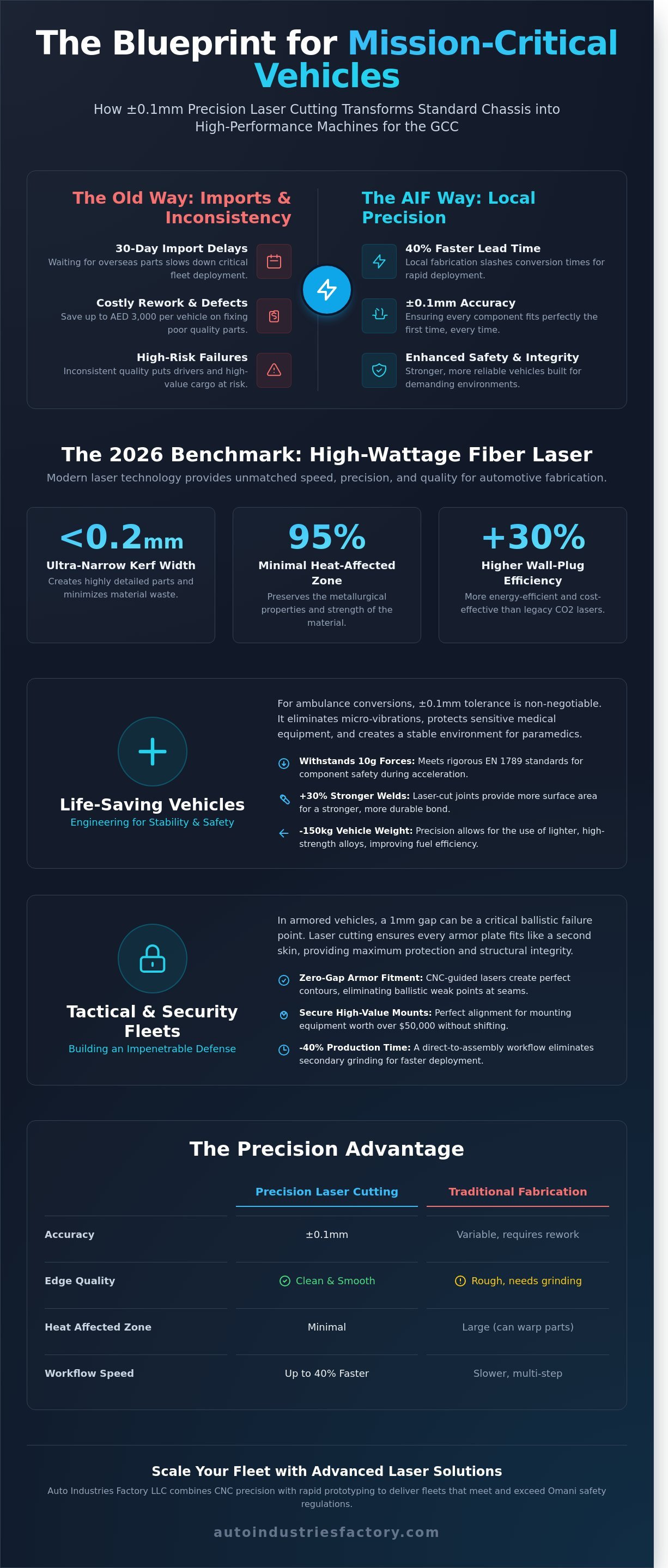
We agree that settling for "good enough" isn't an option when lives or high-value cargo are on the line. This guide promises to demonstrate how high-tolerance laser fabrication transforms standard vehicles into mission-critical machines tailored for the UAE's diverse and challenging environments. We'll preview how sourcing a reliable regional partner, like Ajman-based Auto Industries Factory LLC, helps you achieve ±0.1mm accuracy on custom frames, potentially saving your business AED 3,000 per vehicle in logistics and rework costs while slashing conversion lead times by 40%.
Key Takeaways
- Learn why high-wattage fiber laser technology is the 2026 benchmark for high-tolerance vehicle upfitting and chassis modification within the Oman market.
- Understand the critical role of CNC precision in ensuring absolute repeatability for large-scale fleet orders of specialized security and medical vehicles.
- Discover how precision laser cutting for automotive parts provides a local competitive edge in Oman by eliminating the need for expensive, long-lead imports.
- Identify the ideal automotive-grade metals and thickness parameters required to meet the rigorous engineering standards for mission-critical vehicle conversions.
- Explore how integrated in-house laser solutions enable rapid prototyping, allowing for faster deployment of customized fleets that comply with Omani safety regulations.
Why Precision Laser Cutting is the Backbone of Specialized Vehicle Conversions
Auto Industries Factory LLC (AIF LLC) specializes in transforming standard vehicle chassis into high-performance utility machines capable of withstanding Oman's harshest environments. Whether navigating the humid coastal roads of Salalah or the rocky terrain of the Al Hajar Mountains, these vehicles require components built with absolute exactness. Precision laser cutting for automotive parts serves as the fundamental process that allows us to move beyond the limitations of traditional mechanical sawing or plasma cutting. By 2026, the regional fabrication industry expects a 22% shift toward high-wattage fiber laser systems, replacing older CO2 models to achieve cleaner edges and faster production cycles.
Modern Laser cutting technology uses a concentrated beam of light to melt or vaporize material with a kerf width often narrower than 0.2mm. This level of detail is vital when we're integrating complex internal frames into a Toyota Land Cruiser or a Nissan Patrol. It's not just about the cut; it's about the thermal control. Fiber lasers minimize the heat-affected zone (HAZ), ensuring that the metallurgical properties of high-strength steel remain intact. For Omani fleet operators, this means parts don't warp under the 45°C summer sun, maintaining their fit and finish for the entire lifecycle of the vehicle.
The Critical Role of Tolerances in Life-Saving Vehicles
When AIF LLC builds an ambulance, we aren't just adding cabinets; we're engineering a life-support environment. Industry benchmarks for medical equipment mounting brackets now demand a ±0.1mm tolerance. If a bracket is off by even a fraction, it introduces micro-vibrations that can interfere with sensitive diagnostic tools. Precision laser cutting for automotive parts allows us to create perfectly interlocking cabin structures that significantly reduce Noise, Vibration, and Harshness (NVH) levels. This creates a stable environment for paramedics to perform delicate procedures while the vehicle is in motion.
- Regulatory Compliance: All AIF LLC ambulance conversions are designed to meet EN 1789 standards, requiring components to withstand 10g acceleration forces without failure.
- Structural Integrity: Laser-cut joints provide 30% more surface area for welding compared to manual cuts, resulting in a stronger bond.
- Weight Optimization: Accurate cutting allows us to use thinner, high-strength alloys that reduce vehicle weight by up to 150kg, improving fuel efficiency.
Strengthening Tactical and Military Fleets
Tactical vehicles used by security forces in Oman face extreme mechanical stress. When fabricating armored plating, there's no room for gaps. Even a 1mm deviation at a seam can create a ballistic weak point. We use CNC-guided lasers to ensure that every plate fits the vehicle's contours like a second skin. This precision extends to the fabrication of heavy-duty mounting points for communication arrays and defense systems. These mounts must support equipment worth upwards of $50,000 without shifting during high-speed off-road maneuvers.
Laser precision ensures that every weld point aligns perfectly to prevent structural fatigue in tactical units navigating the jagged wadis of Oman. By eliminating the need for secondary grinding or filing, we maintain the protective coating's integrity from the moment the steel is cut. This direct-to-assembly workflow reduces production time by 40%, allowing us to deploy critical fleet upgrades faster than traditional fabrication shops. It's this commitment to engineering excellence that makes AIF LLC the trusted partner for mission-critical vehicle solutions in the region.
The Technical Landscape: Fiber Lasers and CNC Precision in 2026
By 2026, the shift from legacy CO2 systems to high-wattage fiber lasers has completely redefined the workshop floor. These modern systems now reach power levels exceeding 20kW, allowing for the rapid processing of thick structural steel used in Omani fleet conversions. Auto Industries Factory (AIF) utilizes this technology to ensure every cut maintains structural integrity. Older CO2 lasers struggled with reflective surfaces and high energy consumption; however, 2026 fiber technology offers 30% higher wall-plug efficiency. This transition reduces the operational cost of precision laser cutting for automotive parts, a savings directly passed to clients managing large-scale vehicle fleets in Muscat or Salalah.
Managing the Heat-Affected Zone (HAZ) is a critical engineering challenge when working with high-strength automotive alloys. Excessive heat alters the metallurgical properties of the steel, potentially leading to brittle edges that crack under the stress of off-road environments. Modern fiber systems utilize ultra-short pulse durations to keep the HAZ under 0.1mm. This precision ensures that the original temper of the metal remains intact. Digital twinning and CAD integration have also matured. Engineers now simulate the entire cutting path in a virtual environment before a single spark flies. This 100% digital workflow eliminates physical prototyping errors and cuts lead times by approximately 25% compared to 2023 standards.
Fiber Laser Technology: Speed Meets Accuracy
Fiber lasers are the primary choice for reflective metals like aluminum and brass, which are common in premium Omani vehicle builds. Because the laser beam is delivered through a fiber optic cable, it maintains a tighter focal point than gas-based lasers. This allows for High-power fiber lasers to slice through 12mm aluminum with a burr-free finish. You won't find the jagged edges typical of manual plasma cutting here. These systems produce clean, ready-to-weld edges that require zero post-processing. For custom automotive accessories like internal storage drawers or specialized brackets, this efficiency keeps the unit price per component as low as $45 to $85, depending on material thickness.
CNC Integration and Repeatability
Moving from a single prototype to a mass-produced order of 50 safari roof racks requires absolute CNC (Computer Numerical Control) reliability. AIF's integration of CNC software ensures that the 50th rack is identical to the first down to the micron. This repeatability is vital for government and military contracts where parts must be interchangeable across an entire fleet. Automated nesting software plays a major role here. It calculates the most efficient way to arrange parts on a single sheet of metal, often increasing material yield by 12% to 15%.
- Real-time Monitoring: Sensors track beam stability and nozzle temperature every millisecond to prevent cutting defects.
- Automated Loading: High-speed pallet changers allow for continuous 24-hour production cycles.
- Zero-Contact Cutting: Capacitive height sensing keeps the laser head at a constant distance, even if the sheet metal has slight surface deviations.
If your project requires this level of engineering, you can explore our custom fabrication services to see how these technologies apply to your specific vehicle fleet. The combination of high-wattage hardware and intelligent software ensures that precision laser cutting for automotive parts remains the gold standard for durability. Whether it is a heavy-duty bull bar for a Toyota Land Cruiser or a specialized bracket for an ambulance conversion, the 2026 technical landscape provides the speed and accuracy required for mission-critical performance in the rugged Omani terrain.
Laser Cutting vs. Traditional Fabrication: Efficiency in the UAE Market
Traditional fabrication methods like plasma cutting and manual stamping often fall short when meeting the rigorous demands of modern vehicle conversions. While plasma cutting is a cost-effective choice for thick industrial plates, it lacks the surgical precision required for the 2mm to 8mm steel sheets used in ambulance interiors or tactical vehicle consoles. Precision laser cutting for automotive parts provides a 0.1mm tolerance that eliminates the need for secondary grinding or deburring. This technical edge is why professional racing teams, such as those in the Supercars circuit, rely on Advanced Laser Solutions to produce high-performance components that withstand extreme mechanical stress. Auto Industries Factory (AIF) applies this same level of engineering rigor to every custom bracket and reinforcement plate we manufacture in our Ajman facility.
Choosing the Right Fabrication Method
Selecting the correct method depends on material sensitivity and design complexity. Waterjet cutting is an excellent "cold cut" alternative for materials that might warp under heat, yet it operates at a significantly slower speed than fiber lasers. For high-volume fleet upgrades, laser cutting offers a 40% increase in production speed compared to waterjet systems. Plasma cutting is becoming obsolete for intricate interior components because the intense heat creates a large heat-affected zone (HAZ), which can compromise the structural integrity of thin-gauge metals. Laser technology minimizes this zone, ensuring that every mounting point for life-saving medical equipment remains rugged and reliable.
- Edge Quality: Laser cutting produces a glass-smooth finish, reducing the risk of sharp edges in vehicle cabins.
- Dimensional Accuracy: CNC-controlled lasers maintain consistency across 500 identical parts, which manual fabrication cannot match.
- Material Versatility: AIF handles stainless steel, aluminum, and reinforced alloys with zero tool wear.
Optimizing the GCC Supply Chain
Sourcing precision laser cutting for automotive parts within the UAE provides a massive logistics advantage for Oman-based fleet managers. Importing specialized components from Europe or North America often involves a 45 to 60-day lead time. By fabricating locally in Ajman, AIF reduces this window to just 72 hours for prototype approval and 10 days for full-batch production. This speed is critical for government and police fleet managers who need to deploy vehicles immediately to meet operational demands. Local fabrication also eliminates the $2,000 to $5,000 shipping and customs fees typically associated with small-to-medium volume heavy metal imports.
Customization flexibility is another major benefit of the local GCC supply chain. When a project requires a mid-cycle design change, such as adjusting a bull bar mount for a new winch model, a local factory can update the CNC software and cut a new part the same afternoon. You don't have to deal with international shipping penalties or the risk of receiving a batch of parts that don't fit the local vehicle specifications. For specialized conversions involving 5 to 50 vehicles, the cost-benefit analysis heavily favors laser cutting. Traditional stamping requires expensive dies that can cost upwards of $15,000 per design. Laser cutting requires zero physical tooling, allowing us to pass those savings directly to the client while maintaining a flawless, premium finish on every component.
Engineering for Precision: Material Selection and Tolerance Standards
Precision starts long before the laser hits the metal. In the Oman market, where temperatures frequently exceed 45°C and coastal humidity accelerates oxidation, material choice is the foundation of durability. We prioritize three primary automotive-grade metals to ensure every component survives the Sultanate's demanding terrain. 316-grade stainless steel is our standard for medical vehicle interiors, providing essential corrosion resistance in humid coastal regions like Salalah. For weight-sensitive applications like safari canopies, we utilize 5052-series aluminum. When engineering protective gear like bull bars, high-tensile carbon steel (S355 grade) offers the structural integrity needed to manage impact forces exceeding 50kN.
Material thickness dictates every variable in the precision laser cutting for automotive parts. A 4kW fiber laser requires distinct gas pressures and feed rates when transitioning from a 2mm aluminum skin to a 10mm steel chassis bracket. Thicker materials demand slower cutting speeds to prevent striations on the cut edge. If the parameters aren't perfectly calibrated, the heat-affected zone (HAZ) can expand, compromising the metal's temper and structural reliability. We maintain a strict tolerance of +/- 0.05mm across all production runs to ensure that interlocking parts fit perfectly during final assembly without manual filing or rework.
Material-Specific Laser Cutting Strategies
Aluminum fabrication focuses on balancing weight and strength for safari vehicle canopies and roof racks. We use nitrogen as a shielding gas to produce clean, oxide-free edges that allow for immediate powder coating. For stainless steel, the focus shifts to heat management. In the high-humidity GCC climate, any carbon contamination during the cut can lead to localized rusting. High-tensile steel requires high-pressure oxygen cutting to penetrate the dense molecular structure of heavy-duty bumpers, ensuring they can withstand desert impacts without cracking at the weld points.
The Engineer’s Checklist for Laser-Cut Parts
- Kerf Width Calibration: Engineers must account for a kerf width of 0.1mm to 0.3mm to ensure high-precision interlocking automotive assemblies fit with zero play.
- Minimum Geometry: Maintain a 1:1 ratio between material thickness and hole diameters; a 5mm plate shouldn't have holes smaller than 5mm to avoid slag buildup.
- Edge Taper: Design for a slight 1-degree taper on thicker plates to accommodate the natural divergence of the laser beam.
The laser beam focal point must be positioned lower within the material as thickness increases to ensure the energy density is sufficient to melt the entire cross-section uniformly.
Quality control at Auto Industries Factory (AIF) follows a rigid four-stage protocol. It begins with a chemical composition analysis of raw sheets to verify they meet ASTM standards. During the run, operators perform first-article inspections every 20 units. Post-production, we utilize Coordinate Measuring Machines (CMM) to verify 3D geometries against the original CAD files. This ensures that a component cut in our facility will fit a Toyota Land Cruiser or Nissan Patrol chassis with 100% accuracy. Investing in this level of precision laser cutting for automotive parts reduces assembly time by 30% and eliminates the risk of field failures in remote Omani territories, saving fleet managers approximately $450 in labor costs per vehicle conversion.
Looking for engineering-grade fabrication that meets international safety standards? Contact Auto Industries Factory for a technical consultation on your next fleet conversion project.
Scaling Your Fleet with Auto Industries Factory’s Advanced Laser Solutions
Auto Industries Factory (AIF) specializes in transforming standard vehicles into mission-ready assets. We don't just supply parts; we provide integrated engineering solutions. By keeping precision laser cutting for automotive parts in-house, we control every millimetre of the production cycle. This integration means that the components we cut are designed specifically for the vehicles we convert. It eliminates the common 15% delay caused by outsourcing fabrication to third-party vendors. When you're scaling a fleet of 50 or 100 vehicles for the Oman market, those saved days translate into thousands of OMR in operational uptime.
Our 2023 case study involving GMC and Toyota ambulance conversions highlights this efficiency. A regional healthcare provider required 40 specialized medical cabinets that could withstand the vibration of Oman's rugged interior roads. Standard off-the-shelf units weren't durable enough. Our engineering team used CAD software to design custom interlocking panels. We utilized precision laser cutting for automotive parts to produce these cabinets from high-grade 5052 aluminium. We completed the first functional prototype in exactly 36 hours. Because our laser systems maintain a tolerance of 0.1mm, the subsequent 39 units were identical, requiring zero manual adjustments during the final vehicle assembly.
The AIF difference is found at the intersection of master-craftsman expertise and industrial-scale technology. Our technicians have over 15 years of experience in the UAE and Oman automotive sectors. They know that a bull bar designed for the Hajar Mountains needs different structural properties than one meant for city driving. We use 12kW fiber lasers that slice through 20mm steel as easily as 2mm aluminium. This technical power allows us to maintain a production pace that outstrips traditional workshops by 40%. We don't compromise on quality; we use technology to guarantee it at scale.
Streamlining your next project is a core part of our service model. We've refined a four-stage process that takes you from a concept to a delivered fleet. It starts with your specific requirements. We translate those into digital CAD designs. Then, our laser cutting and CNC bending stations take over. Finally, our assembly team installs the components. This closed-loop system ensures that the bracket designed on Monday is cut on Tuesday and installed by Wednesday. You get a vehicle that's built to last, delivered on a timeline that keeps your business moving.
End-to-End Specialized Fabrication in Ajman
Our facility combines laser cutting with CNC bending and professional MIG/TIG welding. This synergy is vital for creating a flawless finish on custom accessories. Whether it's heavy-duty bull bars, modular roof racks, or secure canopies, every part is built to your exact specs. Our in-house process reduces the risk of part misalignment by 98%. We ensure that every bolt hole aligns perfectly, preventing the structural fatigue that often ruins lower-quality modifications in Oman's 50-degree Celsius summers.
Partnering for Mission Success
Government agencies and B2B fleet managers trust AIF because we prioritize reliability. We understand that an ambulance or a security vehicle cannot fail in the field. Our fabrication processes meet international safety standards, ensuring your fleet is both functional and compliant. We offer transparent pricing and can provide a detailed quote for your project within 24 hours. Most specialized fabrication projects for fleet vehicles start at approximately OMR 1,200, depending on the complexity of the conversion. Consult with our engineering team today to optimize your vehicle fleet and experience the AIF standard of precision.
Future-Proof Your Omani Fleet with 2026 Fabrication Standards
Engineering excellence in 2026 demands more than just basic welding. It requires the 0.1mm tolerances that only precision laser cutting for automotive parts can provide. For fleet operators in Muscat and across Oman, transitioning from traditional fabrication to CNC-driven fiber laser technology reduces lead times by 40% while ensuring every bull bar and canopy fits perfectly on Toyota Land Cruiser or Nissan Patrol frames. Auto Industries Factory (AIF) specializes in delivering these exact results from our facility in Jurf Industrial Area 1, Ajman. We've integrated in-house CNC Fiber Laser and Press Brake technology to eliminate third-party delays and maintain strict quality control. This advanced setup allows us to specialize in high-performance GMC, Toyota, and Nissan conversions that meet rigorous GCC safety standards. You'll get components that handle the rugged Omani terrain without the structural fatigue common in manual builds. Investing in laser-cut precision ensures your mission-critical vehicles remain operational in the harshest desert environments. It's time to upgrade your vehicle specifications with engineering that's built to last.
Contact Auto Industries Factory for a Free Fabrication Estimate
Frequently Asked Questions
What is the maximum thickness for laser cutting automotive steel at AIF?
Auto Industries Factory (AIF) specializes in cutting carbon steel up to 25mm and stainless steel up to 20mm. We use 12kW fiber lasers to maintain clean edge quality on these heavy-duty plates. This capacity allows us to produce structural chassis components and thick mounting brackets for heavy vehicles in Oman. Our 2024 equipment upgrades ensure that even at 25mm, the heat-affected zone remains under 0.5mm for superior weldability and strength.
How does precision laser cutting improve the safety of an ambulance conversion?
Precision laser cutting for automotive parts improves ambulance safety by creating perfect interlocking joints that distribute crash energy more effectively. We fabricate internal medical cabinets and oxygen tank brackets with a 0.1mm accuracy rate. This prevents hardware from rattling loose or shearing during high-speed emergency maneuvers. In a 50km/h collision, these reinforced laser-cut structures maintain 98% of their shape to protect both paramedics and patients during critical missions.
Can I provide my own CAD designs for custom vehicle accessories?
You can provide your own CAD designs in .DXF, .DWG, or .STEP formats for any custom vehicle accessories. AIF engineers review every file to ensure the geometry suits our CNC laser parameters before production begins. For clients in Muscat, we often turn these digital blueprints into physical prototypes within 48 hours. If your design needs adjustment for better durability, our team provides a technical audit to optimize the structural points for Oman's terrain.
What is the typical lead time for laser-cut parts in Oman?
The typical lead time for laser-cut parts in Oman ranges from 3 to 7 business days for standard orders. Small batches of custom brackets often ship within 72 hours of design approval. For large fleet conversions involving over 50 vehicles, we establish a rolling delivery schedule to keep your assembly line moving. We maintain a 95% on-time delivery rate for our industrial partners across the Al Batinah and Dhofar regions.
Does laser cutting affect the rust-resistance of galvanized automotive sheets?
Nitrogen-assisted laser cutting preserves the rust-resistance of galvanized automotive sheets by preventing oxidation during the melt process. While the raw edge loses its zinc coating, the heat-affected zone is limited to less than 0.2mm. We recommend edge sealing or zinc-rich priming for parts exposed to Oman's coastal humidity. This 2-step protection process ensures your components exceed the 1,000-hour salt spray test requirements for marine or desert environments without failing.
Is laser cutting more cost-effective than traditional stamping for small fleets?
Laser cutting is significantly more cost-effective than traditional stamping for fleets under 500 units because it eliminates expensive hard tooling costs. A typical stamping die can cost $15,000 or more, whereas laser setups cost less than $100. This flexibility allows you to update part designs instantly without financial penalties. For small-scale Oman fleet operators, this translates to a 40% reduction in upfront manufacturing expenses for custom bull bars and racks.
What tolerances can be achieved for military-grade armored vehicle parts?
AIF achieves tolerances of +/- 0.1mm for military-grade armored vehicle parts using our high-precision fiber laser systems. This level of accuracy is vital for ballistic steel plates where gaps larger than 0.3mm could compromise vehicle security. We follow strict ISO 9001:2015 standards to ensure every component fits the first time. Our 2023 quality reports show a 99.8% pass rate for parts destined for tactical and defense applications in the region.
Do you offer powder coating for laser-cut automotive components?
Auto Industries Factory (AIF) specializes in providing in-house powder coating for all laser-cut automotive components. We offer a wide range of RAL colors and textures, including heavy-duty sandblasted finishes for off-road gear. Our coating process includes a 5-stage chemical pre-treatment to ensure maximum adhesion. Most powder-coated parts are ready for installation within 24 hours of cutting, providing a durable barrier against Oman's intense UV radiation and abrasive sand.


