
Imagine a tactical unit losing its primary communication link or an ambulance experiencing a power surge during a critical patient transfer. These aren't just technical glitches; they're mission-ending failures caused by factory components pushed beyond their limits. You likely already know that standard alternators and lead-acid batteries simply aren't designed to handle the massive draws of modern medical or tactical gear. Implementing professional vehicle electrical system upgrades for equipment is the only way to ensure your fleet remains operational under extreme stress.
We'll show you how to engineer a fail-safe electrical architecture that eliminates electronic interference and prevents premature battery death. You'll learn how to balance high-output generation with advanced storage solutions like lithium-ion systems. This guide breaks down the technical requirements for seamless gear integration and explains how the 2026 National Electrical Code updates impact your build. From dual-battery isolation to arc flash protection, we're covering the precise engineering needed for a rugged, reliable power ecosystem.
Key Takeaways
- Identify the "Power Gap" between factory output and high-draw demands to prevent catastrophic system failure.
- Learn how vehicle electrical system upgrades for equipment utilize high-output alternators and dual-battery architectures for maximum reliability.
- Master the use of military-grade TXL wiring and marine-grade breakers to eliminate thermal risks and protect sensitive electronics.
- Understand the necessity of redundant power ecosystems in ambulance and tactical vehicle builds to guarantee uptime during critical missions.
- Gain insights into separating cranking power from equipment power to extend battery life and ensure the vehicle always starts.
The Power Gap: Why Standard Vehicle Electrical Systems Fail Specialized Equipment
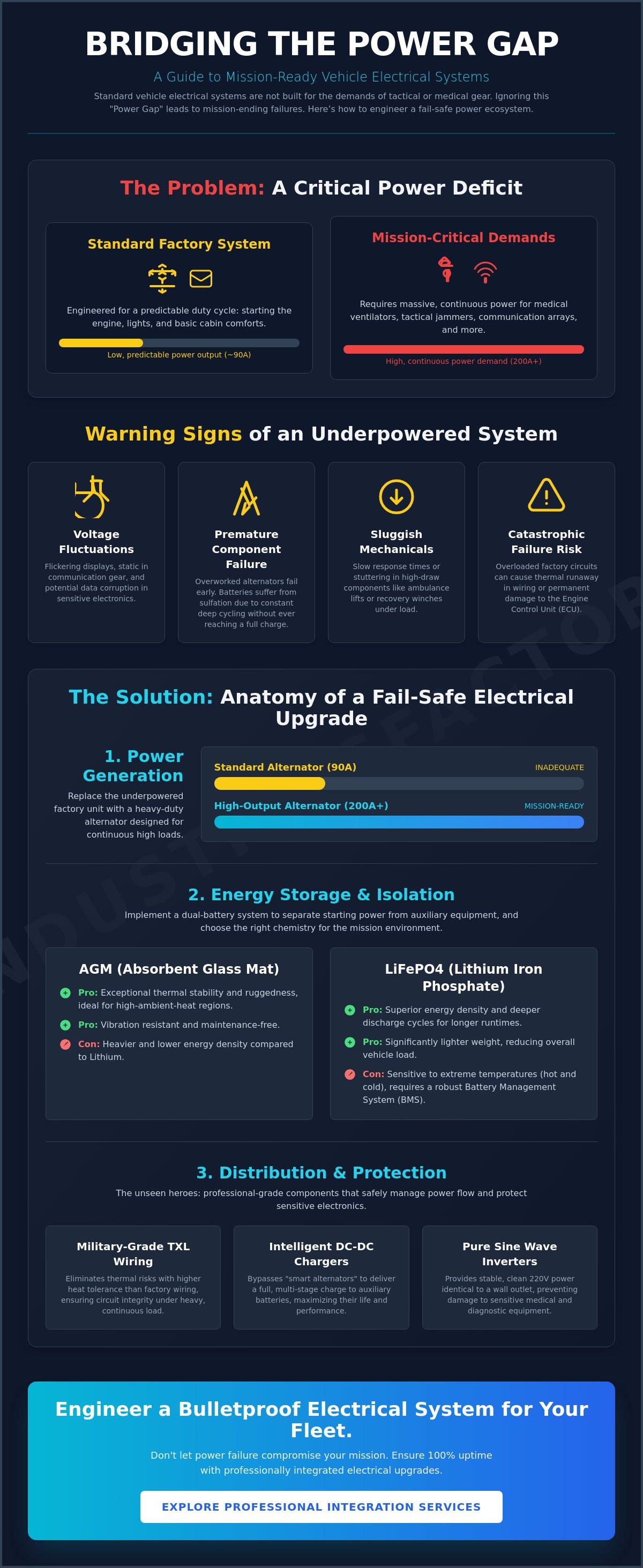
Standard vehicles are engineered for a specific, predictable duty cycle: starting the engine, running lights, and maintaining basic cabin comfort. When you introduce mission-critical gear like advanced medical ventilators or high-draw tactical jammers, you encounter the "Power Gap." This is the deficit between the Original Equipment Manufacturer (OEM) alternator output and the actual amperage required to sustain specialized equipment without depleting the starter battery. Professional operators don't deal with "peak loads" or short bursts of power like car audio enthusiasts; they require "continuous loads." This means your automotive electronic systems must sustain high current for hours, not seconds.
A vehicle electrical upgrade is the systematic enhancement of charging, storage, and distribution components. Ignoring this gap leads to severe risks. Overloading factory circuits can cause thermal runaway in wiring looms or permanent damage to the Engine Control Unit (ECU). When a factory system is pushed beyond its thermal limits, the heat generated can compromise the integrity of the entire harness. This leads to catastrophic failure in the field. To better understand how these systems are reinforced, watch this helpful video:
Common Symptoms of an Underpowered System
Identifying a failing system before it leaves you stranded is critical for operational readiness. Frequent voltage fluctuations are a primary indicator. These often manifest as flickering displays or static in communication gear, which can corrupt data in sensitive digital equipment. It's a sign that the alternator is struggling to keep up with the demand.
You might also notice premature alternator failure or battery sulfation. This happens because the system stays in a constant state of deep cycling, never reaching a full charge. For vehicles utilizing mechanical components, such as lifts in ambulance conversions or winches on safari trucks, slow response times or stuttering under load are clear signs of inadequacy. Implementing professional vehicle electrical system upgrades for equipment ensures these mission-critical components receive the steady, high-amperage current they demand for 100% uptime.
Core Components of a Professional Electrical System Upgrade
Engineering a reliable power ecosystem requires more than just adding a bigger battery. Professional vehicle electrical system upgrades for equipment focus on a synchronized chain of generation, storage, and distribution. While standard 90A alternators suffice for civilian use, mission-critical applications demand 200A+ heavy-duty units to maintain continuous loads without overheating. These high-output components provide the raw current necessary to power everything from medical refrigerators to signal jammers simultaneously.
Modern vehicles utilize "smart alternators" that prioritize fuel efficiency over auxiliary charging. This makes traditional solenoids obsolete. Instead, we use intelligent DC-DC chargers to ensure secondary battery banks receive a full, multi-stage charge profile regardless of the engine's current state. For 220V diagnostic or medical gear, Pure Sine Wave inverters are essential. Unlike cheaper modified sine wave units, pure sine wave power mimics the stability of a wall outlet, preventing damage to sensitive microprocessors. If you're looking for precision engineering in these builds, explore our specialized vehicle modification services for expert integration.
Selecting the Right Battery Chemistry
Choosing between AGM and Lithium (LiFePO4) depends on your operational environment. Lithium provides superior energy density and deeper discharge cycles, but it's sensitive to extreme temperatures. In high-ambient-heat regions, AGM batteries are often preferred for their thermal stability and ruggedness. High-stakes missions require storage that won't fail when the thermometer climbs.
High-Output Alternator Integration
Installing a high-output unit isn't a simple "bolt-on" procedure. It requires an external regulator to manage complex charge profiles across multiple battery banks. You must also account for mechanical stress. This includes upgrading belt tensioners and ensuring proper pulley sizes to prevent slippage at high RPMs. We strictly adhere to SAE standards for heavy-duty wiring to ensure every connection can handle the increased current without excessive voltage drop or heat buildup.
Professional Engineering: Wiring Standards and Power Management
A high-output alternator provides the raw current, but the wiring infrastructure determines if that power actually reaches its destination. For professional vehicle electrical system upgrades for equipment, standard automotive wire isn't enough. We utilize military-grade wiring looms featuring cross-linked polyethylene (TXL) insulation. TXL is engineered to withstand extreme temperatures and abrasion, ensuring the harness doesn't melt or short-circuit under continuous high-amperage loads. Precision in the loom design is what separates a reliable mission-critical vehicle from a potential fire hazard.
Circuit protection is equally vital. We've moved beyond standard glass fuses that are prone to vibration failure. Instead, professional builds utilize MIDI fuses and marine-grade manual reset breakers. These components offer superior arc protection and can be reset quickly in the field. Centralizing these controls through a Power Management Module (PMS) allows for the intelligent distribution of power to lighting, sirens, and specialized medical gear. This centralized approach simplifies troubleshooting and prevents a single equipment failure from taking down the entire system. Ensuring long-term reliability requires professional vehicle equipment integration to maintain the integrity of these complex circuits.
Grounding and EMI Suppression
Electromagnetic interference (EMI) can cripple sensitive radio gear or corrupt patient data on medical monitors. To eliminate this, we implement the "Star Grounding" technique. By bringing every component ground wire back to a single, central point, we prevent ground loops that cause static and digital noise. This ensures crystal-clear communication and accurate diagnostic readings in the most demanding environments.
Heat Management for Electrical Components
Inverters and DC-DC chargers generate significant heat during operation. Strategic placement is mandatory to ensure adequate airflow and prevent thermal throttling. High-heat environments degrade electrical conductivity over time, which increases resistance and further stresses the system. If you need a robust power architecture for your fleet, explore our specialized modification solutions for a fail-safe build.
Mission-Specific Applications: From Ambulances to Safari Trucks
Every mission dictates its own electrical requirements. A standard off-the-shelf solution can't account for the unique duty cycles of emergency response or remote exploration. Professional vehicle electrical system upgrades for equipment ensure that your power architecture matches your specific operational reality. Whether you're navigating urban environments in a tactical unit or crossing deserts in a safari conversion, your electrical ecosystem must be as rugged as the chassis it's built on.
- Ambulance Conversions: These vehicles require absolute redundancy. We engineer systems that isolate life-support equipment from the primary vehicle battery, ensuring ventilators and climate control stay active even if the engine is off. For a detailed breakdown of medical electrical standards, consult our Ambulance Conversion Guide.
- Tactical and Police Units: Modern enforcement requires massive power for high-draw signal boosters, surveillance gear, and high-intensity light bars. We focus on EMI-shielded circuits to prevent interference with sensitive radio communications.
- Off-Road and Safari: Reliability in remote areas means powering refrigeration and high-draw winches without depleting your starting power. These builds often integrate solar charging to maintain battery health during long stationary periods.
Custom Fabrication for Electrical Housing
Precision wiring deserves precision protection. We design and build custom metal enclosures to shield battery banks and sensitive control panels from vibration, dust, and moisture. These housings aren't just about safety; they're about ergonomics. By integrating electrical controls into custom dashboard layouts, we ensure operators can manage complex systems without distraction.
Compliance and Quality Control
Adhering to international standards for emergency and specialized vehicle wiring isn't optional; it's a core requirement for safety. Every connection and loom we install undergoes rigorous testing to ensure it meets these high-stakes benchmarks. Utilizing in-house custom vehicle fabrication allows us to control every variable, from the mounting brackets to the final heat-shielding. This comprehensive approach ensures superior system longevity and prevents the failures that common aftermarket shops often overlook.
Secure Your Mission With Professional Power Engineering
Mastering the "Power Gap" requires more than just high-capacity batteries; it demands a synchronized ecosystem of generation and distribution. You've seen how military-grade TXL wiring and intelligent power management modules prevent the thermal failures common in standard setups. These systems ensure that life-support gear and tactical surveillance equipment remain active when every second counts. Professional vehicle electrical system upgrades for equipment are engineered for 100% uptime in the field's harshest conditions.
We specialize in mission-critical ambulance and military conversions, adhering strictly to GSO and international vehicle modification standards. Our facility utilizes in-house laser cutting and CNC machining to create custom enclosures that protect your sensitive components from mechanical and thermal stress. This level of precision is why leading agencies trust us for their most demanding modification challenges. We don't just add parts; we engineer solutions that guarantee reliability.
Ready to secure your fleet's operational readiness? Consult with our engineers for a custom vehicle electrical solution today. We're here to build the robust power architecture your mission demands.
Frequently Asked Questions
Does upgrading my electrical system void the vehicle's factory warranty?
Upgrading your electrical system doesn't void the entire vehicle warranty, though it may affect coverage for the specific factory components you modify. Most regional regulations require manufacturers to prove that an aftermarket modification directly caused a failure before denying a warranty claim. By utilizing professional installation that isolates new circuits from the factory Engine Control Unit, you minimize the risk of technical conflicts or denied coverage.
What is the 'Big 3' upgrade, and is it enough for professional equipment?
The 'Big 3' upgrade involves reinforcing the three primary cables in your engine bay: the alternator-to-battery wire, the battery-to-chassis ground, and the engine-to-chassis ground. While this is a foundational step for vehicle electrical system upgrades for equipment, it's rarely enough for mission-critical applications. Professional builds require high-output alternators and dedicated storage banks to sustain the continuous high-amperage draws of medical or tactical gear.
How do I calculate the total power consumption of my specialized equipment?
You calculate total power consumption by summing the maximum amperage ratings of all devices intended for simultaneous operation. If a device only lists power in Watts, divide that number by your system voltage (typically 12V or 24V) to find the Amps. Always include a 20% safety margin in your final calculation to account for resistance in the wiring and peak surges during equipment startup.
Why is a DC-DC charger better than a traditional battery isolator?
A DC-DC charger is superior because it provides a controlled, multi-stage charge profile that ensures your auxiliary battery reaches 100% capacity. Traditional isolators are simple relays that often fail to trigger when modern "smart alternators" reduce their voltage output to save fuel. DC-DC chargers compensate for this voltage drop, protecting your equipment batteries from the premature sulfation caused by chronic undercharging.
Can I use a standard car battery for my secondary equipment power?
You shouldn't use a standard starting battery to power specialized equipment. Starting batteries are designed for short, high-current bursts to crank the engine and will degrade rapidly if they're deep-cycled by auxiliary gear. Reliable vehicle electrical system upgrades for equipment utilize AGM or Lithium (LiFePO4) deep-cycle batteries. These chemistries are specifically engineered to provide sustained current over long durations and can handle hundreds of discharge cycles without failure.


