
A standard chassis is just a shell. Without precision engineering, it's a liability in a crisis. You know that an emergency vehicle conversion is far more than adding sirens and decals. It's a high-stakes integration of complex medical systems, electrical grids, and structural reinforcements that must perform under extreme stress. When lives are on the line, concerns about structural integrity or incompatible electrical systems aren't just inconveniences; they're mission-critical failures.
This guide breaks down the technical standards and in-house fabrication processes required to build a truly mission-ready fleet. You'll discover how to navigate the latest CAAS Version 4.0 requirements and EN 1789 standards to ensure your units are compliant and durable. We will explore the specialized metalwork, such as custom bull bars and CNC-machined components, that minimizes downtime and maximizes protection. From advanced life support configurations to rugged police modifications, we provide the engineering roadmap for high-performance vehicles that meet international safety benchmarks and operational demands.
Key Takeaways
- Precision fabrication using laser cutting and CNC machining is essential for maintaining structural integrity and achieving millimeter-perfect component integration.
- Successful emergency vehicle conversion demands high-output electrical systems and specialized climate control to ensure 24/7 reliability for sensitive medical gear.
- Adhering to international standards like EN 1789 guarantees that your fleet meets the rigorous safety, crash-test, and ergonomic requirements necessary for life-saving missions.
- Ballistic armoring and frame reinforcement are critical for transforming standard platforms into tactical units capable of withstanding high-velocity threats and heavy equipment loads.
- A comprehensive in-house engineering approach minimizes lead times and ensures every mission-critical system is seamlessly integrated from design through to final painting.
The Core Pillars of Professional Emergency Vehicle Conversion
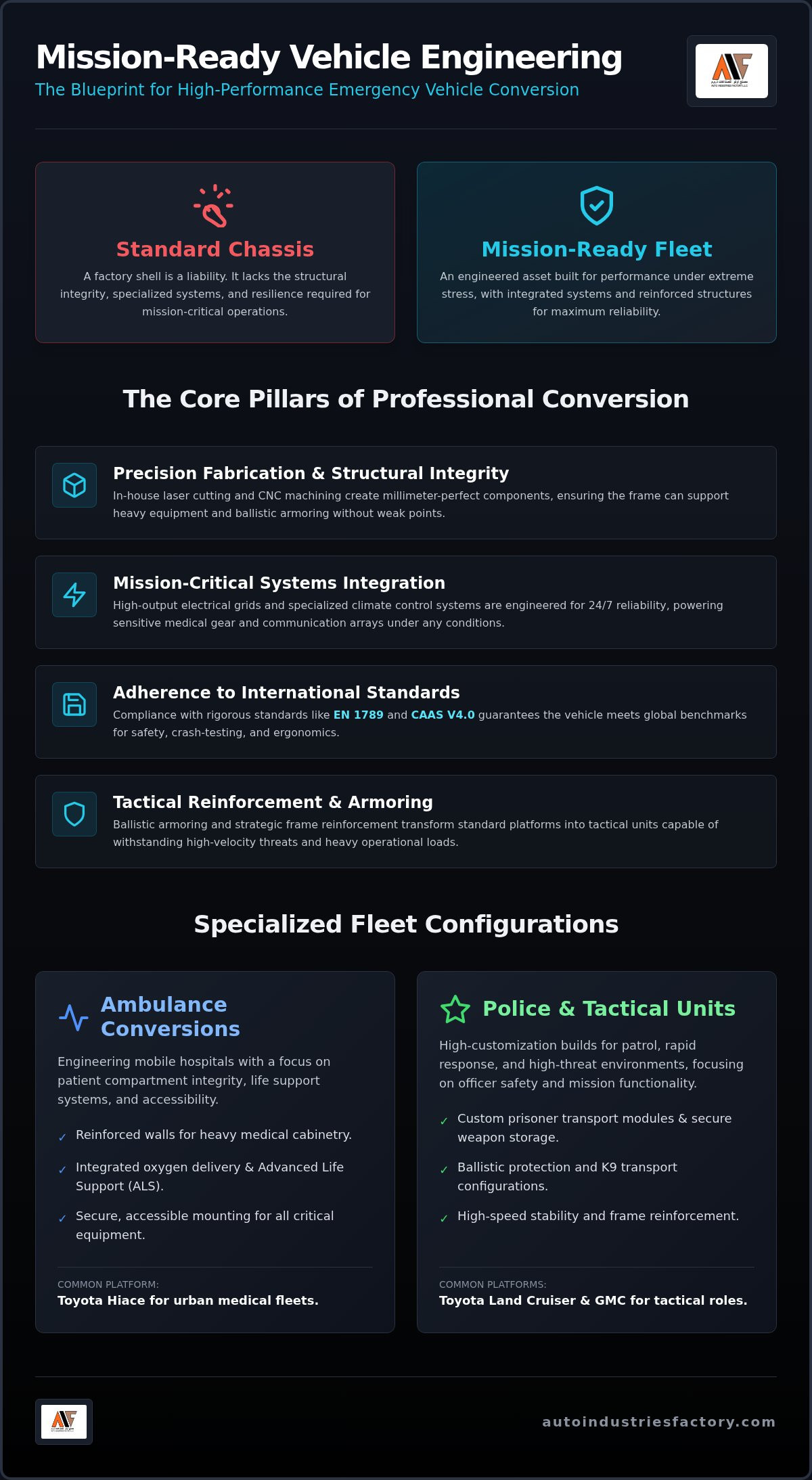
Professional emergency vehicle conversion is a comprehensive engineering discipline. It's about turning a standard factory chassis into a high-performance unit capable of saving lives under extreme stress. This process goes far beyond installing sirens; it involves a total structural transformation. Understanding emergency vehicle classifications is the first step in designing a unit that meets the specific operational needs of medical, police, or military teams. We treat every build as a mission-critical solution where precision is the only acceptable standard.
To better understand how these vehicles are adapted for high-stakes environments, watch this helpful video:
Selecting the right platform is the most critical step in an emergency vehicle conversion project. We specialize in rugged chassis like the Toyota Land Cruiser and GMC for tactical roles, while the Toyota Hiace remains a favorite for urban medical fleets. These platforms offer the payload capacity needed to carry heavy medical equipment and ballistic plating without compromising safety. Every conversion begins with a mission-specific design phase. This pre-fabrication stage ensures that the vehicle's center of gravity and electrical output are optimized for its future role.
The three primary sectors; medical, law enforcement, and tactical military; each present unique engineering challenges. A military unit requires ballistic armoring that would be overkill for a standard patient transport van. Conversely, a police cruiser needs high-speed stability that a heavy box-type ambulance might sacrifice for space. Precision in the pre-fabrication phase is what separates a professional build from a basic upfit. We use digital modeling to ensure that every bolt hole and wiring loom is accounted for before the physical work begins.
Ambulance Conversions: Mobile Life Support
Ambulance units are essentially mobile hospitals. The engineering focus here is on the patient compartment's structural integrity. We reinforce walls to support heavy medical cabinetry and specialized equipment. Integrating oxygen delivery and advanced life support (ALS) systems requires precision plumbing and electrical work. Every component must be accessible yet securely mounted. You can find more detail on these specifications in our Ambulance Conversion Guide.
Police and Tactical Vehicle Modifications
Law enforcement units demand high levels of customization for patrol and rapid response. These modifications include the installation of prisoner transport modules and secure weapon storage. Tactical units might require ballistic protection or specialized K9 transport configurations. The goal is to create a workspace that is both safe for the officers and functional for the mission. For a comprehensive look at upfitting standards, explore our guide on Police Vehicle Modifications.
Engineering Resilience: In-House Fabrication and Structural Integrity
The foundation of a reliable emergency vehicle conversion lies in its structural resilience. When a vehicle is deployed for frontline response, it carries significantly more weight than a standard passenger unit. We use in-house laser cutting and CNC machining to achieve the millimeter precision required for these complex builds. This industrial approach ensures that every bracket, reinforcement plate, and mounting point fits perfectly. By controlling the fabrication process from start to finish, we eliminate the weak points often found in generic, off-the-shelf upfits. Precision is mandatory when a vehicle's frame must support heavy life-support systems or ballistic armoring.
Managing weight distribution is a critical engineering challenge. Adding heavy medical cabinetry or steel bumpers shifts the vehicle's center of gravity, which can negatively impact braking and high-speed handling. Our engineering team calculates these loads during the design phase to ensure the chassis remains balanced. This focus on stability is a core requirement of the CAAS Ground Vehicle Standard (GVS), which dictates how modern ambulances should be manufactured for maximum safety. A well-engineered conversion doesn't just add equipment; it reinforces the entire platform to handle the increased operational stress.
Precision Metalwork in Conversion
Repeatable quality is essential for fleet managers who need consistency across multiple units. We utilize CNC bending and laser cutting to produce identical components for every build. High-grade steel is used for structural reinforcements, while lightweight aluminum is preferred for internal cabinetry to save on payload capacity. Structural welding in specialized vehicle fabrication serves as the permanent bond that ensures the chassis can withstand extreme kinetic forces and heavy payloads during high-speed response. These techniques allow us to create durable internal structures that won't rattle or fail over years of service.
Exterior Protection and Utility
Front-line vehicles require robust exterior protection to navigate debris or clear paths in emergencies. We fabricate custom bull bars and heavy-duty rear bumpers designed specifically for impact protection. These aren't just cosmetic additions; they're engineered to protect the radiator and engine components from damage. You can learn more about our process in our guide to Custom Bull Bars and Bumpers. Additionally, we integrate heavy-duty roof racks to support lighting arrays and rescue gear. If you are planning a fleet upgrade, you can view our full range of fabrication services to see how we build for durability.
Mission-Critical Systems: Power, Medical, and Communication
A robust chassis and precision fabrication mean little if the onboard systems fail during a crisis. In a professional emergency vehicle conversion, the electrical architecture must support a constant load of life-saving equipment, communication tools, and high-intensity lighting. We integrate high-output alternators and dual-battery systems to ensure 24/7 reliability. This setup prevents the primary engine battery from draining while the vehicle is stationary, allowing medical or tactical teams to operate without interruption. For fleets operating in rugged environments, we harden these systems against the vibrations and dust typical of off-road response.
The technical complexity of a modern emergency vehicle conversion also extends to climate control and communication. Managing extreme temperatures is vital for preserving sensitive medical supplies and ensuring the comfort of the crew in harsh climates. We install specialized HVAC systems that maintain stable internal environments regardless of external conditions. Simultaneously, we integrate complex communication arrays, including multi-band radios, GPS tracking, and fleet management telematics. These systems allow dispatch centers to monitor vehicle health and location in real-time, which is a critical standard for any professional transport operation, such as A One Taxi Services Ltd. Furthermore, emergency lighting and sirens are wired to meet strict amber and blue light regulations for legal compliance.
Our team at Auto Industries Factory specializes in these complex integrations, ensuring every system is mission-ready. We provide a total solution where the electrical, mechanical, and communication components work in perfect harmony.
Advanced Electrical Architecture
Sensitive medical and tactical electronics require clean power to function correctly. We utilize pure sine wave inverters to prevent interference or damage to delicate hardware. To maintain equipment readiness while the vehicle is parked at the station, we install shore power connections. This allows the onboard systems to run on external power, keeping batteries charged and medical gear calibrated. Every mission-critical component is protected by separate circuits, ensuring that a single failure doesn't compromise the entire unit's capability.
Specialized Medical and Tactical Interiors
The interior of an emergency unit must be as durable as its exterior. We use anti-bacterial surfaces and easy-clean flooring in our ambulance builds to maintain high hygiene standards. Ergonomic seating is a priority for both medical staff and tactical teams, providing support during long shifts and high-speed maneuvers. Our custom cabinetry is designed with a focus on rapid access. Every drawer and compartment is engineered to stay secure under high-stress conditions while remaining easy to open when every second counts.
Regulatory Compliance and Safety Standards for Emergency Fleets
Compliance isn't just about paperwork. It's about ensuring every unit survives the worst-case scenario. In a professional emergency vehicle conversion, we adhere to rigorous international safety standards. For ambulance fleets, this means understanding EN 1789 standards. These regulations cover everything from crash-test resilience to ergonomic layouts for medical staff. A vehicle that doesn't meet these criteria is a liability in the field. We perform extensive quality control and stress testing on all custom fabrications before deployment. This ensures that every weld and mounting point can handle the kinetic forces of high-speed response and heavy payloads. Safety is the primary metric of our engineering success.
Ballistic Protection and Armoring
Tactical and military units require specialized protection that goes beyond standard bodywork. Integrating armored plates is a delicate engineering task. We must provide maximum protection without compromising vehicle mobility or overstressing the suspension components. Our builds range from handgun protection to high-velocity rifle rounds, depending on the mission profile. We also integrate transparent armor, or ballistic glass, to ensure 360-degree safety for the crew. For a deeper look at how these systems are integrated into larger platforms, read our Armored Personnel Carrier Guide. Precision fitting of these materials is essential to prevent ballistic gaps while maintaining the vehicle's original handling characteristics.
Visibility and Livery Standards
A mission-ready fleet must be instantly recognizable. Visibility is a safety feature in itself. We apply high-visibility livery, including reflective Battenburg markings and agency-specific logos, to ensure units are seen in all lighting conditions. Our emergency vehicle conversion process includes professional vehicle painting that provides long-term durability against harsh climates and UV exposure. We ensure full compliance with national regulations for emergency signaling equipment, including light bar colors and siren frequencies. Every unit leaves our facility with a finish that reflects the authority and professionalism of the agency it serves. If you need a fleet that meets these exacting standards, contact us for a custom fabrication estimate today.
Auto Industries Factory: Custom Engineering for Mission-Ready Fleets
We don't just assemble parts; we engineer solutions. Our emergency vehicle conversion capability is built on a foundation of industrial-grade fabrication. Unlike general upfitters who rely on outsourced components, we maintain total control from initial design to final painting. This in-house approach allows us to deliver national-scale fleet conversions with millimetre precision. We specialize in high-performance platforms like the Toyota Land Cruiser, Hilux, and GMC, ensuring each unit is structurally reinforced to handle the rigors of frontline duty. By managing every stage of the build, we eliminate integration issues and ensure every vehicle meets our rigorous durability standards.
Our facility in Ajman serves as a hub for regional and global emergency services. We use advanced laser cutting and CNC machining to produce durable, repeatable results across high-volume orders. This technical capacity ensures that every vehicle in your fleet performs exactly like the last. Our master craftsmen utilize these technologies to create components that are lighter, stronger, and more precise than traditional manual methods. We provide a comprehensive range of services, including:
- In-house metal bending and welding for structural frames and reinforcements.
- Custom electrical looms for mission-critical power management and systems.
- Specialized paint booths for agency-specific branding and protective coatings.
- Fabrication of heavy-duty bull bars and bumpers for impact protection.
Our Full-Service Conversion Process
We collaborate directly with agencies to design bespoke vehicle layouts that solve specific operational pains. Whether it's an extended roof ambulance or a tactical military unit, our engineering team maps every system before fabrication begins. Our Ajman-based facility is equipped to handle complex modifications for national fleets, ensuring consistent quality and reduced lead times. This "total solution" approach means you receive a vehicle that is ready for immediate deployment. For a complete capability overview, explore Our Services.
Built for the Harshest Environments
Our heritage in safari vehicle conversions and off-road engineering informs every emergency vehicle conversion we produce. We understand how heat, dust, and vibration affect vehicle longevity. This expertise allows us to fabricate custom accessories like metal canopies, roof racks, and bull bars that are truly built for duty. These components protect vital engine parts and provide secure storage for rescue gear in the most demanding terrains. We build for reliability where others build for appearance. If you are ready to upgrade your fleet with engineered reliability, contact us for a technical consultation and quote today.
Build Your Mission-Ready Fleet with Precision Engineering
Building a fleet that performs under pressure requires more than just upfitting; it demands an engineering-first mindset. Every decision in a professional emergency vehicle conversion must prioritize structural integrity and seamless system integration. By utilizing in-house CNC machining and laser cutting, we eliminate the variables that lead to mechanical failure. Our rugged 4x4 and safari-ready engineering ensures that your units can navigate the harshest environments without compromising the safety of the crew or the precision of life-saving equipment.
Specialized vehicle fabrication experts understand that reliability is the only metric that matters when lives are on the line. Choosing a partner with total manufacturing control ensures your fleet meets international safety standards and operational requirements. If you're ready to transform your standard chassis into high-performance tactical or medical units, our team is prepared to deliver the technical expertise your mission requires.
Request a Technical Quote for Your Emergency Fleet
We look forward to helping you build a fleet that's truly mission-ready.
Frequently Asked Questions
What is the standard timeframe for an emergency vehicle conversion?
The standard timeframe for an emergency vehicle conversion typically ranges from four to eight months. This schedule depends on the complexity of the mission-critical systems and the current availability of the base chassis. We manage the entire fabrication and integration process in-house to minimize lead times and ensure every unit meets our rigorous engineering benchmarks before deployment.
Can you convert existing fleet vehicles or do you only work with new chassis?
We convert both new chassis and existing fleet vehicles that meet the required structural and mechanical standards. Our engineering team conducts a thorough assessment of every vehicle to ensure the frame can support the weight of medical cabinetry or tactical armoring. This approach allows agencies to upgrade their current assets to mission-ready standards while maximizing their budget.
What international safety standards do your ambulance conversions meet?
Our ambulance builds are engineered to meet essential international benchmarks, including EN 1789 standards for crash-test resilience and ergonomic patient compartment design. We also ensure compliance with GSO 1794 requirements, which are mandatory for Middle Eastern markets. These certifications guarantee that your emergency vehicle conversion provides maximum protection for both the crew and the patient during high-speed response.
Do you provide ballistic armoring for police and military vehicles?
Yes, we provide comprehensive ballistic armoring solutions for police and military units. Our capabilities range from handgun protection to high-velocity rifle rounds, depending on the specific threat level required. We use in-house laser cutting and CNC machining to integrate armored plates and ballistic glass without compromising the vehicle's original mobility or handling characteristics.
Is the medical equipment included in the ambulance conversion process?
We offer a total solution that includes the integration of advanced medical systems and hardware as part of the conversion. During the design phase, we work with your team to determine the specific cabinetry and life-support equipment needed. Every system is wired into the vehicle's electrical architecture using high-output alternators to ensure 24/7 reliability in the field.
Can you handle large-scale national fleet orders?
What type of warranty is provided on custom fabricated components?
We provide a comprehensive warranty on all our custom fabricated components, including metal canopies, bull bars, and internal structural reinforcements. This guarantee reflects our confidence in our master craftsmanship and the durability of the high-grade materials we use. Specific warranty terms are provided based on the mission profile and the complexity of the vehicle's custom modifications.
Do you offer decommissioning and livery removal for old emergency vehicles?
We offer professional decommissioning services, including the removal of specialized equipment and emergency livery. Our team can also perform a full vehicle color change to return the chassis to a standard appearance or prepare it for a different role. This service helps agencies manage the full lifecycle of their fleet while maintaining a professional and updated image.


