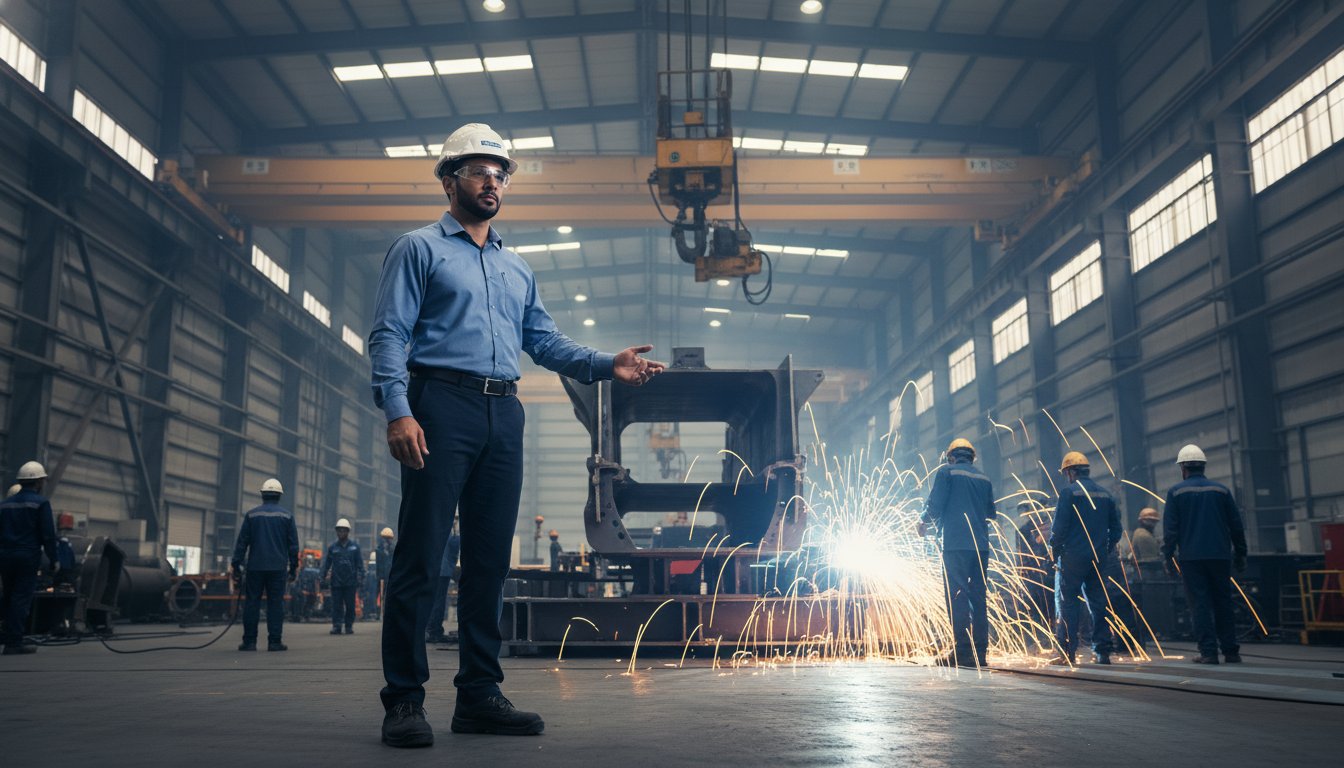
The leap from a simple workshop weld to a mission-critical structural component is immense. When your project’s success hinges on flawless execution and the ability to withstand extreme operational demands, the line between standard metalwork and professional heavy fabrication becomes paramount. For project managers and engineers in Ajman, UAE, finding a partner who truly understands the technical requirements for heavy-duty applications isn't just a preference-it's a necessity for ensuring safety, durability, and performance.
This guide is engineered to bridge that knowledge gap for complex welding & industrial projects. We move beyond the basics to explore the advanced processes, material science, and uncompromising quality standards that define industrial-grade work. You will learn how to identify the criteria for a high-quality fabrication partner, gain the confidence to commission large-scale custom metalwork, and see how precision engineering transforms raw materials into assets built for mission-critical performance.
What Defines an 'Industrial' Welding Project?
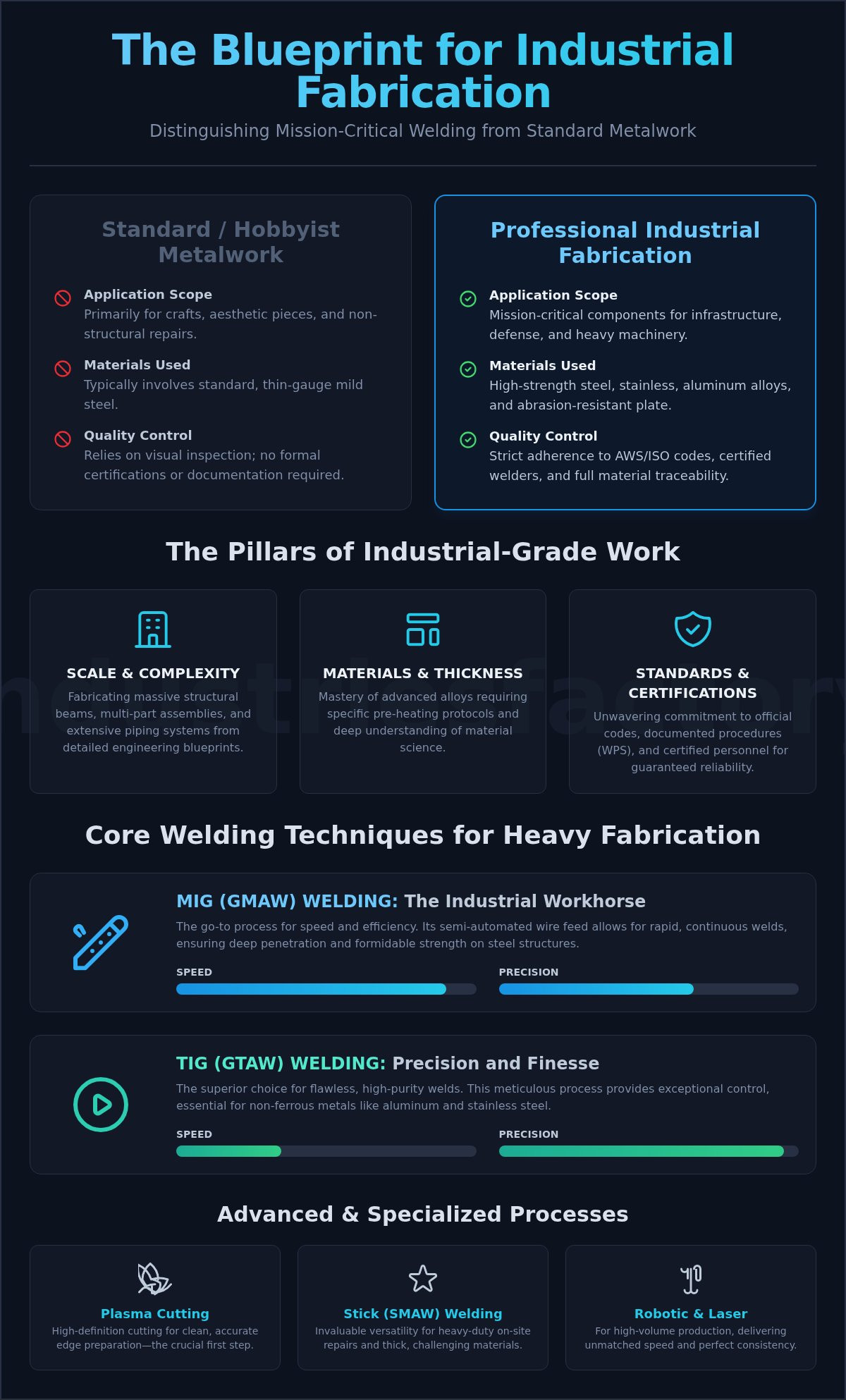
While hobbyist welding can produce beautiful crafts and useful repairs, a professional industrial project operates on an entirely different level. The distinction goes far beyond the equipment used; it lies in the immense responsibility for structural integrity, operational safety, and flawless performance under extreme pressure. Industrial fabrication is where engineering meets execution, creating the heavy-duty components that form the backbone of critical infrastructure. In this field, there is no margin for error.
To visualize the precision involved even in a smaller-scale industrial-style project, consider the following demonstration:
Scale and Complexity
Industrial projects are defined by their sheer scale and intricacy. This involves fabricating massive structural beams, complex multi-part assemblies for heavy machinery, or extensive piping systems vital to Oman's energy sector. Such tasks demand absolute adherence to detailed engineering blueprints and specifications. Success relies on specialized jigs and fixtures to ensure repeatable precision across hundreds of components, often accumulating thousands of man-hours to complete a single project.
Materials and Thickness
While a DIY project may use standard mild steel, professional welding & industrial projects command the use of advanced, high-performance materials. We routinely work with high-strength structural steel, abrasion-resistant plate, stainless steel, and specialized aluminum alloys. Welding thick sections of these metals requires advanced preparation, specific pre-heating protocols, and a deep understanding of how different materials react to heat. Mastering the Core Welding Techniques for these diverse alloys is essential to prevent structural weakness.
Standards and Certifications
Perhaps the most critical differentiator is the unwavering commitment to official standards and quality control. Every weld in an industrial setting must meet stringent codes set by bodies like the American Welding Society (AWS) or ISO. Projects demand certified welders, documented Welding Procedure Specifications (WPS), and complete traceability for all materials. This certified, documented approach is non-negotiable for high-stakes applications in defense, marine, and industrial construction, guaranteeing every component is built for mission-critical reliability.
Core Welding Techniques for Heavy Fabrication
The success of large-scale welding & industrial projects hinges on selecting the right technique for the material, application, and required outcome. At Auto Industries Factory LLC, our master fabricators are experts in deploying the precise method needed, balancing the critical factors of speed, structural strength, and aesthetic precision. Executing these advanced techniques requires not only immense skill but also state-of-the-art equipment capable of delivering consistent, certifiable results for heavy-duty applications.
MIG (GMAW) Welding: The Industrial Workhorse
Gas Metal Arc Welding (GMAW), or MIG, is the go-to process for speed and efficiency, particularly on steel structures. Its semi-automated wire feed system allows for rapid, continuous welds, making it ideal for fabricating vehicle frames, reinforcing chassis, and creating heavy-duty structural supports. By precisely matching wire types and shielding gases (like Argon/CO2 blends) to the base metal, we achieve deep penetration and formidable strength, ensuring that speed never compromises the integrity required for industrial applications.
TIG (GTAW) Welding: Precision and Finesse
When a project demands flawless, high-purity welds, Gas Tungsten Arc Welding (GTAW), or TIG, is the superior choice. This meticulous process provides exceptional control, making it essential for fabricating with non-ferrous metals like aluminum and stainless steel. We utilize TIG welding for critical components such as custom fluid tanks, intricate piping, and highly visible joints where a clean, precise bead is paramount. While slower than MIG, its unparalleled quality is non-negotiable for premium and mission-critical fabrications.
Advanced and Specialized Processes
Our capabilities extend beyond conventional methods to include a suite of specialized processes that optimize results for complex projects. These advanced techniques are part of a disciplined production system that prioritizes quality and safety from start to finish.
- Plasma Cutting: Before any welding begins, precise preparation is key. We use high-definition plasma cutting to create clean, accurate edges, a crucial first step in a safe and Integrated Fabrication Workflow that guarantees maximum weld integrity.
- Stick (SMAW) Welding: For heavy-duty on-site repairs or welding on thick, challenging materials, the versatility of Shielded Metal Arc Welding remains invaluable.
- Robotic & Laser Welding: For high-volume production runs, we leverage robotic and laser welding systems to deliver unmatched speed, perfect consistency, and minimal heat distortion, ensuring every component meets exact specifications.
Case Study: Vehicle Conversion as a Premier Industrial Project
Nothing showcases the complexity of modern welding & industrial projects quite like a specialized vehicle conversion. This process is where engineering design, precision fabrication, and expert welding converge to transform a standard vehicle into a purpose-built machine. A standard truck, van, or SUV is methodically stripped to its core frame, then rebuilt with enhanced strength, custom components, and specialized functionality, demonstrating a mastery of multiple advanced welding techniques on a single, dynamic project.
Structural Reinforcement and Chassis Modification
The foundation of any heavy-duty conversion is the chassis. To handle increased loads and operational stress, we integrate new cross-members and supports using heavy-gauge steel. High-strength MIG (Metal Inert Gas) welding is employed for its deep penetration and robust bonds, essential for reinforcing the vehicle's core structure. For instance, when preparing a truck chassis for an ambulance box, every new weld is engineered to enhance, not compromise, the vehicle's original structural integrity and safety standards.
Fabricating Custom Components and Armor
Beyond the frame, every component must be purpose-built for durability. Our technicians fabricate custom bull bars, heavy-duty bumpers, and rugged roof racks from raw materials. For security vehicles, this involves the meticulous process of cutting, bending, and welding armor plating to create a protective shell. In contrast, TIG (Tungsten Inert Gas) welding is our method of choice for aluminum accessories, delivering flawless, clean welds that are as strong as they are aesthetically pleasing. Explore our portfolio of converted vehicles to see the results.
Bodywork and Integration
The final stage is integrating custom bodywork seamlessly with the original vehicle. This includes welding new body panels, fitting extended roofs, and installing custom access doors. Our welders employ advanced techniques to control heat and minimize distortion, ensuring perfect panel gaps and a factory-finish appearance. The final product is a testament to precision industrial work, where every seam and joint contributes to a vehicle that is stronger, more capable, and perfectly suited for its mission.
Beyond the Weld: The Integrated Fabrication Workflow
Expert welding is the backbone of any robust industrial structure, but it is one critical step in a much larger, precision-driven process. At Auto Industries Factory, we understand that exceptional results in welding & industrial projects depend on a seamless, end-to-end workflow managed under one roof. This integrated approach eliminates communication gaps between different vendors, reduces the risk of costly errors, and significantly shortens project timelines. From initial digital concept to final protective coating, our comprehensive fabrication process ensures every component is built to perform.
By controlling every stage, we deliver a superior final product that meets the demanding standards of Oman's industrial sector. Our methodology is built on three pillars of excellence: precision preparation, expert execution, and flawless finishing.
Stage 1: Design and Precision Preparation
A perfect weld begins long before the arc is struck. Our process starts in the digital realm with advanced CAD/CAM software to design components with absolute accuracy. These digital blueprints are then fed directly to our state-of-the-art CNC laser cutting and press brake machinery, which cut and form steel, aluminum, and other alloys with micron-level precision. This meticulous preparation is non-negotiable; it guarantees that every piece fits together perfectly, creating optimal conditions for strong, clean welds.
Stage 2: Assembly, Welding, and Quality Control
With precisely formed components, our team moves to assembly. We utilize custom-built jigs and fixtures to hold parts in exact alignment, preventing any shift or distortion during the welding phase. Our certified welding technicians then execute the plan, applying their expertise in techniques like MIG, TIG, and ARC welding. Critically, quality control is not an afterthought. We conduct in-process inspections and employ non-destructive testing (NDT) methods to verify weld integrity, penetration, and dimensional accuracy throughout the project.
Stage 3: Finishing and Final Assembly
The final stage transforms a raw fabrication into a finished, durable asset. Welds are expertly ground and sanded to create a smooth, professional finish that is both functional and aesthetic. We then apply heavy-duty protective coatings, such as industrial-grade paint or rugged powder coating, to shield the structure from corrosion and wear. The process concludes with the final assembly of any mechanical or electrical components, delivering a turnkey solution ready for deployment. Learn more about our complete in-house fabrication services and see how our integrated workflow can benefit your next project.
How to Choose the Right Partner for Your Industrial Project
Selecting a fabrication partner for your industrial project in Oman is a critical decision that directly impacts your timeline, budget, and operational safety. Not all welding shops are equipped to handle the scale, precision, and rigorous standards required for industrial-grade work. The right partner is an asset; the wrong one is a liability. Making an informed choice is essential for project success.
To ensure you select a capable and reliable fabricator, use the following criteria to vet potential partners:
Assess In-House Capabilities and Equipment
A workshop's equipment roster is a direct reflection of its capabilities. A serious industrial partner will have advanced machinery like CNC laser cutters and heavy-duty press brakes, alongside multiple welding technologies (MIG, TIG, Arc). We recommend requesting a facility tour. The size, organisation, and condition of their workshop reveal much about their professionalism and capacity. A partner with comprehensive in-house services acts as a one-stop shop, reducing logistical complexity and ensuring total accountability for the final product.
Evaluate Experience and Past Projects
A proven track record is the strongest indicator of future performance. Ask for a portfolio of completed welding & industrial projects that are similar in scale and complexity to your own. Look for specific experience in Oman's key sectors, such as logistics, defense, or transport. Client testimonials and detailed case studies provide invaluable insight into their process, problem-solving skills, and ability to deliver on their promises. Experience isn't just about years in business-it's about relevant, successful project execution.
Inquire About Quality and Project Management
Superior fabrication is built on a foundation of rigorous process control. Ask potential partners to detail their quality control process, from material sourcing to final inspection. Key questions to ask include:
- Do you employ certified welders and technicians?
- Will our project have a dedicated project manager?
- What is your communication protocol for project updates and milestones?
- How do you ensure compliance with industry and safety standards?
A professional partner will have clear answers and documented procedures that guarantee your project is delivered on time, within budget, and to the highest quality standard. At Auto Industries Factory, we pride ourselves on a transparent process that has made us a trusted partner for demanding industrial projects across the region.
Your Partner for Mission-Critical Fabrication
Heavy fabrication is a complex discipline where success hinges on more than just a strong weld. It requires a holistic approach, from initial design and material selection to precision execution and finishing. The key to transforming ambitious concepts into durable realities lies in partnering with a team that manages the entire integrated workflow, ensuring uncompromising quality at every stage.
For demanding welding & industrial projects, you need a partner with proven capabilities. Auto Industries Factory offers complete end-to-end in-house solutions, backed by a proven track record across the UAE and the wider GCC region. Our certifications for high-stakes military and medical projects are a testament to our relentless commitment to precision, durability, and mission-critical reliability.
Don't leave your project's success to chance. Discuss Your Industrial Project With Our Experts today and let's build something powerful together.
Frequently Asked Questions
What is the difference between fabrication and welding?
Metal fabrication is the complete process of creating a product from raw materials. This includes design, cutting, bending, forming, and assembly. Welding is a specific, critical technique used within the fabrication process to permanently join metal pieces together using heat and pressure. Think of fabrication as building the entire structure, while welding is the specialized skill that ensures its joints are strong, durable, and precisely fused for maximum integrity and performance.
How are costs estimated for large industrial welding projects?
For large-scale welding & industrial projects in Oman, costs are often quoted in US Dollars ($) for clarity in international material procurement. Our estimates are comprehensive, based on several key factors: the type and quantity of materials (e.g., stainless steel vs. carbon steel), the complexity of the design and required welds, projected man-hours, and any specialized certifications required. We also factor in finishing processes like powder coating or galvanizing to provide a complete, transparent quote.
What are the most common materials you work with for industrial projects?
Our facility is equipped to handle a range of premium, heavy-duty materials suited for demanding industrial applications. We most commonly work with various grades of carbon steel for structural strength, stainless steel (including 304 and 316 grades for corrosion resistance in Oman's coastal environments), and high-strength aluminum alloys for applications requiring lighter weight without compromising durability. We select the optimal material based on your project's specific performance and environmental requirements.
Why is CNC laser cutting so important before the welding stage?
CNC laser cutting is a non-negotiable step for achieving flawless results. It provides unparalleled precision, creating components with exact dimensions and clean edges that manual methods cannot replicate. This accuracy is critical because it ensures a perfect fit-up between parts before welding. A precise fit minimizes gaps, reduces the amount of filler material needed, and results in stronger, cleaner, and more structurally sound welds. It is the foundation of high-quality fabrication.
What industries depend on high-quality industrial welding and fabrication?
Numerous core sectors in Oman rely on our expert industrial welding and fabrication services. These include the demanding Oil & Gas industry for pipeline and platform components, the construction sector for structural steel frameworks, and the marine industry for ship repair and outfitting. We also provide mission-critical solutions for the defense, logistics, and transportation sectors, delivering rugged and reliable components built to withstand the harshest operational conditions and ensure maximum uptime.
Can you handle both one-off custom projects and large production runs?
Absolutely. Our facility is structured to be both agile and scalable, giving us the capability to manage a diverse range of project volumes. We excel at producing one-off bespoke prototypes and highly customized fabrications that require intensive design and engineering input. Simultaneously, we are fully equipped with the advanced machinery and streamlined processes necessary to execute large, high-volume production runs with consistent precision, quality, and efficiency, ensuring we meet your project's unique demands.


