Have you ever found yourself navigating the complex world of vehicle modification, confused by technical terms like 'CNC machining' or 'press brake bending'? Understanding the difference between welding, machining, and fabrication can be challenging, especially when you need a durable, mission-specific solution. This is where the power of professional metal fabrication comes in-the foundational process for creating everything from heavy-duty bull bars to complete, reinforced vehicle bodies designed for maximum reliability.
This guide cuts through the noise. We will provide a clear, straightforward definition of metal fabrication, breaking down the core processes of cutting, bending, and assembling. You will learn about the materials best suited for rugged applications and see exactly how these advanced techniques are applied to build the custom, high-performance vehicle components essential for operating in demanding environments like those found across Oman. By the end, you’ll understand the craft and be equipped to make informed decisions for your next project.
Defining Metal Fabrication: From Raw Material to Mission-Ready Component
At its core, metal fabrication is the comprehensive process of building machines and structures from raw metal materials. It is a critical, value-added discipline that transforms stock metal-such as sheets, plates, bars, and tubes-into a durable, finished product engineered for a specific and often demanding application. This process is far more than simple metalworking; it is the methodical conversion of a design concept into a tangible, high-performance component.
While terms like welding and machining are often used in the context of fabrication, they represent individual techniques within the broader field. The full scope of Defining Metal Fabrication encompasses every step from initial blueprint to final assembly, ensuring each part is built to exact specifications for maximum reliability. It is distinct from casting, which involves pouring molten metal, or machining, which focuses solely on removing material.
To better understand the hands-on expertise this work demands, the following video offers valuable insights from a seasoned professional:
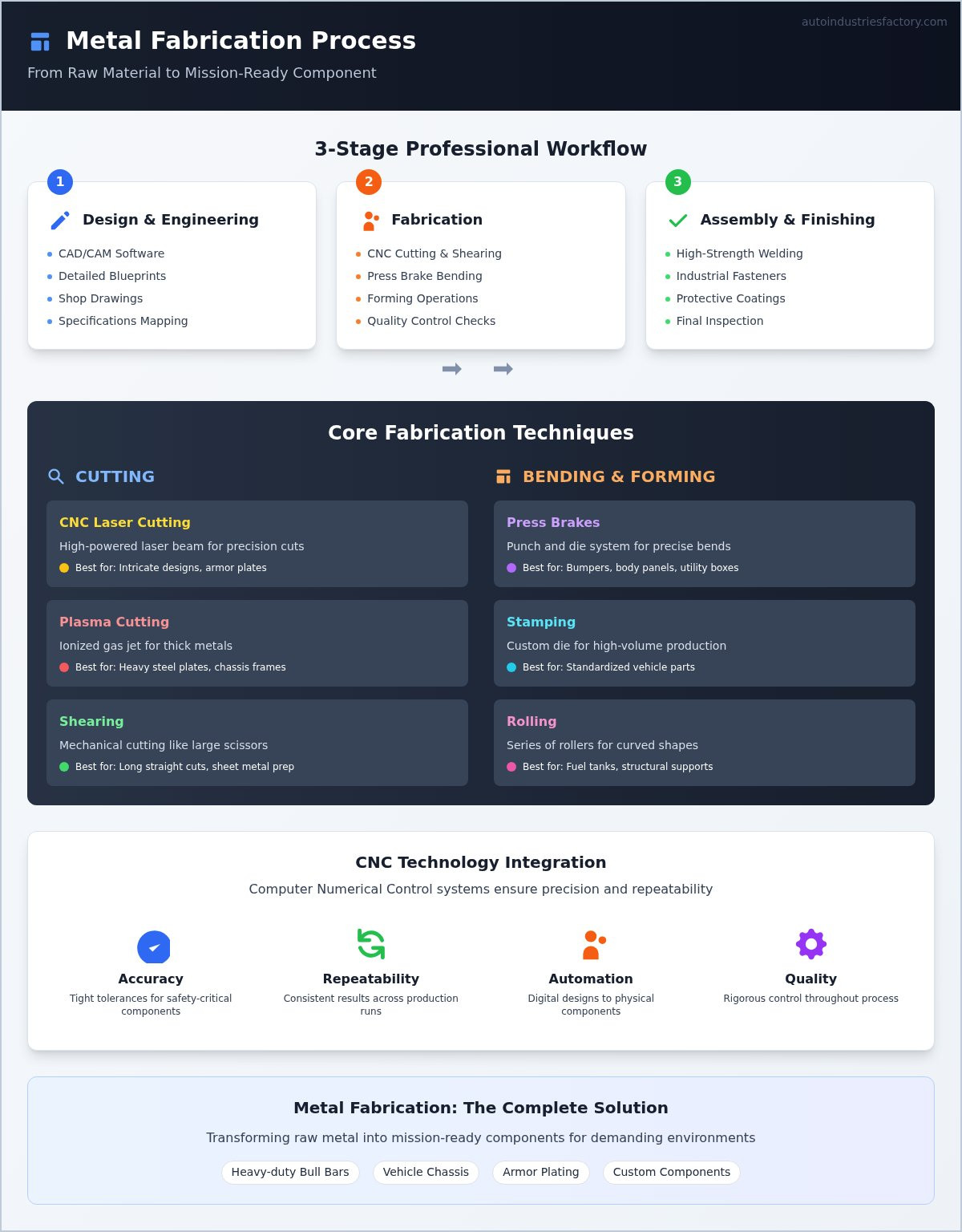
Every professional METALFABRICATION project, from a heavy-duty bull bar to a complex vehicle chassis, follows a structured, three-stage workflow. This methodical approach guarantees precision, durability, and performance, ensuring the final product is not just built, but engineered for the mission ahead.
Stage 1: Design & Engineering
This is the critical foundation of any successful project. Using advanced CAD (Computer-Aided Design) and CAM (Computer-Aided Manufacturing) software, engineers create detailed blueprints and shop drawings. This digital planning phase ensures every cut, bend, and weld is meticulously mapped out to meet stringent project specifications, structural requirements, and performance standards before any material is touched.
Stage 2: Fabrication (The Core Processes)
Here, the digital designs are brought to life. This is the hands-on phase where raw metal is transformed through a series of precise actions like CNC laser cutting, shearing, press brake bending, and forming. Throughout this stage, rigorous quality control checks are performed to verify dimensional accuracy and material integrity, ensuring each individual piece is flawless and ready for assembly.
Stage 3: Assembly & Finishing
The final stage involves joining the precisely fabricated parts into a complete structure. This is typically achieved through high-strength welding or the use of industrial-grade fasteners. To ensure long-term durability and resistance to harsh environments, a protective finish like powder coating or specialized painting is applied. A final, thorough inspection confirms the component is mission-ready and meets all quality standards.
Core Metal Fabrication Techniques and Processes Explained
From a raw sheet of steel to a mission-ready component, the transformation relies on a sequence of highly specialized processes. Modern METALFABRICATION, especially for heavy-duty vehicles operating in demanding environments like Oman, combines raw power with digital precision. The entire workflow is built on three fundamental stages: cutting the raw material, forming it into a desired shape, and assembling the finished parts into a durable structure.
Technology is the cornerstone of this precision. Computer Numerical Control (CNC) systems are integrated into nearly every stage, translating digital designs into flawless physical components. This automation guarantees exceptional accuracy and repeatability, whether producing a single custom bull bar or an entire fleet of armored personnel carriers.
Cutting: The First Step in Shaping Metal
Every fabrication project begins with cutting raw metal stock to the precise dimensions required by the design. The chosen method depends on the material's thickness, the required precision, and production volume.
- CNC Laser Cutting: This advanced process uses a high-powered laser beam to deliver exceptionally clean and precise cuts. It is the go-to method for intricate designs or when fabricating high-strength steel, such as cutting armor plates for military vehicles where tight tolerances are critical for safety.
- Plasma Cutting: Ideal for thicker conductive metals, plasma cutting uses an ionized gas jet to melt through the material. It offers a balance of speed and power, making it perfect for efficiently cutting heavy steel plates used in robust vehicle chassis and frames.
- Shearing: A mechanical process that functions like a large pair of scissors, shearing is used to make long, straight cuts on sheet or plate metal. It is a fast and economical method for preparing large metal sheets for subsequent bending or forming operations.
Bending & Forming: Giving Metal Its Shape
Once cut, the flat metal must be given its three-dimensional form. Understanding the principles behind these Core Metal Fabrication Techniques is essential for achieving both strength and accuracy. CNC-controlled machines ensure that every bend and curve is executed to exact specifications.
- Press Brakes: A press brake is a machine tool that bends sheet metal along a straight axis. By using a punch and die, CNC-controlled press brakes can create complex angles and shapes, essential for forming rugged components like custom bumpers, body panels, and utility boxes.
- Stamping: In high-volume production, stamping uses a custom die to press a sheet of metal into a specific, repeatable shape. This is common for manufacturing standardized vehicle parts where consistency is key.
- Rolling: To create gradual curves or cylindrical shapes, metal is passed through a series of rollers. This technique is vital for fabricating components like fuel tanks or curved structural supports for custom vehicle canopies.
Assembling: Joining Components Together
The final assembly stage is where individual components are joined into a cohesive, functional structure. The method used dictates the final strength and permanence of the product.
- Welding: Welding fuses metal parts by melting them together, creating an incredibly strong, permanent bond that is often stronger than the base material itself. Techniques like MIG (Metal Inert Gas) and TIG (Tungsten Inert Gas) are fundamental in vehicle manufacturing for constructing everything from the primary vehicle frame to life-saving roll cages.
- Rivets and Fasteners: For joints that may need to be disassembled for maintenance or are joining dissimilar materials, mechanical fasteners like bolts, screws, and rivets are used. They provide a secure, non-permanent connection essential for attaching body panels or mounting accessories.
Key Metals in Vehicle Fabrication: Choosing for Strength and Performance
The success of any custom vehicle build hinges on selecting the right raw materials. In advanced METALFABRICATION, the choice is never arbitrary; it is a strategic decision dictated by the vehicle's intended mission, from life-saving ambulance duties to tactical military operations. Understanding the properties of each metal is fundamental, a topic covered well in this comprehensive guide to metal fabrication. For demanding applications in Oman's challenging climate, factors like strength, weight, and resistance to heat and corrosion are paramount.
Each metal offers a distinct set of advantages, and our expert engineers select the optimal material to guarantee performance, durability, and safety.
Carbon Steel & High-Strength Steels
Regarded as the backbone of heavy-duty vehicle construction, carbon steel and its high-strength variants provide unmatched rigidity and impact resistance. This makes it the premier choice for foundational components like chassis, frames, and reinforcement structures. We utilize it for rugged, heavy-duty bull bars and protective underbody plates that must withstand extreme conditions. For military and security vehicles, specialized ballistic steel is employed for critical armoring, offering life-saving protection against threats.
Aluminum Alloys
When weight reduction is a priority, aluminum alloys are the superior choice. Valued for an exceptional strength-to-weight ratio, aluminum helps improve fuel efficiency and vehicle agility without compromising durability. It is commonly used for fabricating custom canopies, roof racks, and non-structural panels. Its inherent corrosion resistance makes it ideal for vehicles operating in Oman's coastal areas, ensuring long-term performance and a flawless finish even in harsh, humid environments.
Stainless Steel
Stainless steel is specified where hygiene and corrosion resistance are non-negotiable. Its non-porous, easy-to-sterilize surface makes it an essential material for ambulance interiors, patient compartments, and medical equipment mounts. Beyond its clinical applications, the durability and aesthetic appeal of stainless steel also make it a popular material for crafting premium custom exhausts, side steps, and decorative trim components that resist rust and maintain a polished look for years.
At a Glance: Metal Properties & Applications
- Carbon Steel: Maximum strength and impact resistance. Ideal for frames, chassis, and armor.
- Aluminum Alloy: Lightweight and corrosion-resistant. Best for accessories like canopies and reducing overall vehicle mass.
- Stainless Steel: Supreme corrosion resistance and hygiene. Essential for medical interiors and premium trim.
Applications: How Metal Fabrication Builds Specialized Vehicles
While the techniques of cutting, bending, and welding may seem abstract, their real-world impact is profound, especially in the creation of mission-critical vehicles. This is where raw metal is transformed into life-saving and tactical equipment. The precision of professional METALFABRICATION is the critical element that ensures these specialized vehicles are rugged, durable, and absolutely reliable when performance matters most. From emergency response to off-road exploration, fabrication provides the backbone for vehicles built for purpose.
Ambulance and Emergency Vehicle Conversion
A standard van becomes a life-saving ambulance through meticulous metal fabrication. This complex conversion process involves reinforcing the vehicle's core structure to handle demanding conditions and added weight. Key fabrication tasks include:
- Fabricating reinforced body panels and extended roofs to create a safe, functional patient compartment.
- Creating custom-fit aluminum interior cabinets and secure mounts for sensitive medical equipment.
- Welding the entire structural frame to meet stringent safety standards, such as EN 1789, ensuring patient and crew safety.
Police & Military Vehicle Modification
In the defense and security sectors, metal fabrication is synonymous with protection. Modifying vehicles for tactical use demands flawless engineering and advanced materials to protect what matters. This includes laser cutting and welding high-strength ballistic steel for vehicle armoring, providing critical defense against threats. Further modifications involve building heavy-duty ram bars for tactical maneuvers and assembling custom weapon mounts and secure, anti-rattle storage solutions for essential gear.
Custom 4x4 and Safari Vehicle Accessories
Beyond emergency services, fabrication enhances the capability of off-road and adventure vehicles, a crucial industry in Oman's demanding terrain. Bending and welding heavy-gauge steel tubes creates rugged bull bars, rock sliders, and roof racks capable of withstanding extreme conditions. Similarly, fabricating lightweight yet durable aluminum canopies and drawer systems for pickup trucks adds essential utility for work or exploration. This is where expert custom vehicle fabrication comes into play, transforming a standard 4x4 into a purpose-built machine ready for any challenge.
How to Choose a Metal Fabrication Partner for Your Project
Understanding the processes of metal fabrication is only half the battle. The success of your project hinges on selecting a partner with the right expertise, technology, and commitment to quality. A skilled fabricator doesn't just cut and weld metal; they transform your design concepts into durable, high-performance assets. When evaluating potential partners in Oman and the wider region, focus on these critical criteria.
In-House Capabilities and Technology
Look for a partner who offers comprehensive, end-to-end services. A true one-stop shop that manages design, precision cutting, expert welding, and flawless finishing under one roof eliminates logistical headaches and ensures consistent quality control. Advanced machinery, such as CNC laser cutters and press brakes, is essential for achieving the tight tolerances and repeatability required for modern applications. A partner like Auto Industries Factory manages the full process, guaranteeing a streamlined workflow and a superior final product.
Experience and Portfolio
General experience is good, but specialized expertise is better. Your project deserves a team that understands the unique demands of your industry, whether it's defense, emergency vehicle conversion, or custom automotive accessories. Review a fabricator’s portfolio for past projects that are relevant to your own. Expertise in mission-critical applications is a key indicator of quality and reliability. Don't hesitate to ask for case studies or examples of similar work to verify their capabilities.
Quality Control and Certifications
A robust quality assurance process is non-negotiable. Inquire about how a potential partner maintains quality at every stage-from material sourcing and initial cuts to final inspection and finishing. Reputable fabricators are transparent about their quality checks. Furthermore, internationally recognized certifications, such as ISO 9001, demonstrate a formal commitment to maintaining the highest operational standards in METALFABRICATION, giving you confidence in the durability and safety of the final product.
Ultimately, your choice of fabricator will directly impact your project's timeline, budget, and performance. By prioritizing in-house capabilities, proven experience, and a certified commitment to quality, you ensure your vision is executed with precision and built to last. For projects that demand rugged reliability and expert engineering, partnering with a proven specialist is the only path forward. Discover how a dedicated fabrication team can bring your project to life at autoindustriesfactory.com.
Transforming Metal into Mission-Ready Solutions
As we've explored, metal fabrication is a sophisticated process that transforms raw materials into durable, high-performance components. For specialized vehicles, selecting the right materials and techniques is not just a choice-it's a critical factor for safety and operational success. Ultimately, the quality of the final product depends entirely on the skill and capability of your fabrication partner.
At Auto Industries Factory, we are specialists in mission-critical vehicle conversions, with proven expertise across the UAE and the wider GCC region, including Oman. Our comprehensive in-house METALFABRICATION capabilities ensure precision from initial design to final delivery. If you demand rugged, reliable, and flawless results for your fleet, our team is ready to deliver.
Ready to start your project? Get a Free Estimate for Your Custom Fabrication Project today and partner with a team dedicated to engineering excellence.
Frequently Asked Questions About Metal Fabrication
What is the difference between metal fabrication and welding?
Metal fabrication is the complete process of creating a metal product from raw materials, which includes cutting, bending, shaping, and assembly. Welding, on the other hand, is a specific technique used within the fabrication process. It is the method of joining separate metal pieces together using heat and pressure. Think of fabrication as building the entire structure, while welding is one of the critical tools used to complete the assembly.
What is custom metal fabrication?
Custom metal fabrication is the process of designing and creating bespoke metal parts or structures according to a client's unique specifications. Unlike mass-produced items, each custom project is a one-of-a-kind solution. This can range from manufacturing a heavy-duty, custom-fit bull bar for a specific vehicle model to engineering unique components for specialized machinery. It’s about transforming a precise design concept into a durable, functional metal product.
How much does a typical metal fabrication project cost?
The cost of a metal fabrication project in Oman is highly variable and depends on material type, design complexity, labor hours, and finishing requirements. For instance, a simple custom steel bracket might cost under $100 USD, whereas a complex, powder-coated aluminum canopy for a pickup could range from $1,500 to $5,000 USD or more. Material choice and the precision required are the largest factors influencing the final price. A detailed project consultation is necessary for an accurate quote.
What skills are required to be a metal fabricator?
A professional metal fabricator requires a blend of technical and practical skills. Core competencies include the ability to read and interpret complex engineering blueprints, proficiency in various welding methods (like TIG and MIG), and the safe operation of machinery such as press brakes, shears, and grinders. Strong mathematical skills for precise measurements are essential, as is a meticulous attention to detail to ensure every component meets strict quality and safety standards for a flawless finish.
Is metal fabrication only for industrial parts?
No, while it is fundamental for industrial applications like machine parts and structural steel, its use is incredibly diverse. Metal fabrication is crucial in the automotive sector for creating custom accessories like protective bumpers and roof racks. It is also widely used in architecture for creating custom railings and facades, in commercial products like furniture and signage, and even in producing intricate artistic sculptures. The process is versatile enough for both heavy-duty and aesthetic applications.
What is CNC in metal fabrication?
CNC stands for Computer Numerical Control. In fabrication, it refers to the use of computer-controlled machines to perform tasks like cutting, punching, or bending metal. A designer creates a digital file, which the CNC machine reads to execute the process with extreme precision and repeatability. Using CNC technology, such as laser or plasma cutting, allows for the creation of highly complex shapes and ensures every part is identical, increasing efficiency and quality dramatically.


