

An ALS ambulance is more than a transport vehicle; it is a mobile intensive care suite where the margin for engineering error is zero. In high-acuity emergencies, the success of a paramedic often rests on the reliability of the vehicle's underlying infrastructure. You know that a cramped workspace or an electrical system that fails under high-heat conditions is more than a design flaw; it is a direct barrier to life-saving care. When lives are on the line, the structural integrity of the clinical environment becomes the most critical tool in the medical team's kit.
This professional guide explores the technical requirements for a superior ALS ambulance setup and design. We provide a comprehensive analysis of the structural, electrical, and ergonomic standards required to build a mission-ready unit. You will learn how Auto Industries Factory LLC applies precision engineering to achieve compliance with international safety standards while optimizing the clinical workspace for maximum efficiency. We preview the essential fabrication techniques for heavy-duty conversions, from reinforced chassis work to advanced power management systems that support high-draw medical equipment in the toughest environments.
Key Takeaways
- Define the technical specifications for EN 1789 Type C ambulances to ensure your fleet meets international standards for high-acuity patient transport.
- Evaluate the structural benefits of specialized vehicle platforms, including GMC and Toyota extended roof modifications, for optimized clinical space.
- Implement robust electrical solutions like high-output alternators and dual-battery systems to power intensive monitoring equipment without failure.
- Apply ergonomic principles to your ALS ambulance setup and design to ensure all life-saving tools remain within a seated, belted reach.
- Leverage precision engineering and CNC machining to build durable units that withstand the rigors of mission-critical applications in high-heat environments.
What is ALS Ambulance Design? Standards and Classifications
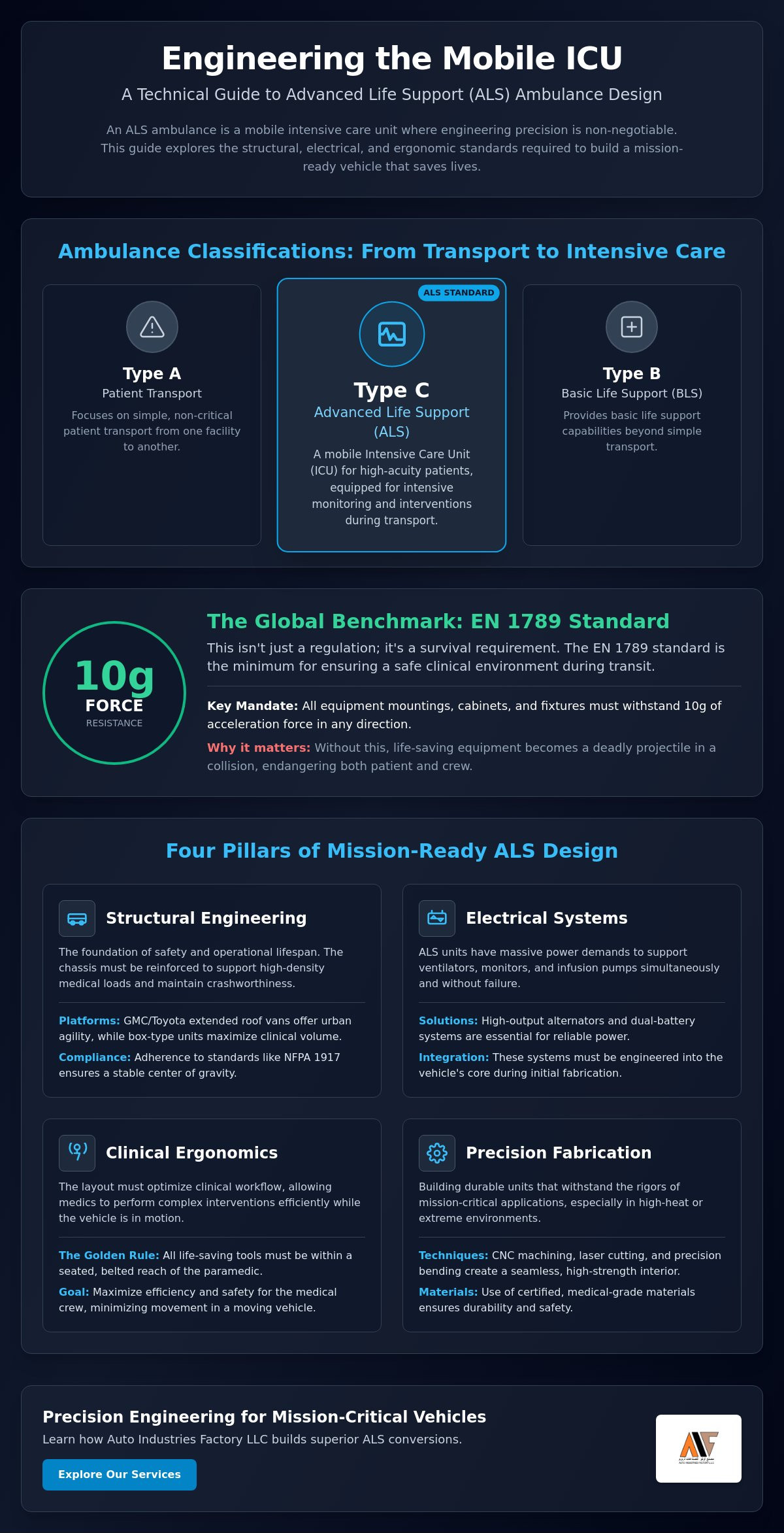
ALS ambulance design isn't just about adding equipment to a van. It's about engineering a platform capable of sustaining life during critical transport. An Advanced Life Support (ALS) unit, often classified as a Type C ambulance, serves as a mobile intensive care environment. Unlike standard transport vehicles, these units are purpose-built for high-acuity patient care and intensive monitoring. Every millimeter of the interior is calculated to support complex medical workflows while the vehicle is in motion.
The global benchmark for these conversions is the EN 1789 standard. This regulation dictates everything from acceleration forces to equipment mounting points. Understanding various Ambulance classifications and types is essential for fleet managers who require mission-ready vehicles. At Auto Industries Factory, we treat these standards as the absolute minimum, focusing on structural reinforcement that exceeds basic requirements. We ensure that the vehicle foundation can handle the weight and vibration of advanced medical suites.
To better understand the complexity of these modern medical environments, watch this helpful video showing a high-spec conversion:
Classifying the ALS Vehicle (Type C)
International standards categorize emergency vehicles into three primary tiers. Type A units focus on simple patient transport, while Type B provides basic life support (BLS). Type C, however, represents the pinnacle of ALS ambulance setup and design. These units must accommodate advanced resuscitation equipment and provide enough floor space for two medical staff to perform interventions simultaneously. Achieving this often requires specialized vehicle platforms, such as GMC or Toyota chassis with extended roof modifications, to provide the necessary vertical clearance and clinical volume for intensive care tasks.
The Importance of Regulatory Compliance
Compliance isn't just a legal checkbox. It's a survival requirement. The EN 1789 standard ensures that every cabinet, oxygen cylinder, and monitor bracket can withstand 10g of force in any direction. If a conversion uses substandard materials, those components become projectiles during a collision. Our specialized vehicle modifications utilize certified medical-grade materials and precision fabrication to ensure that the clinical workspace remains intact under extreme stress. We use laser cutting and CNC bending to create a seamless, high-strength environment that protects both patients and crew.
Building an ALS unit also means calculating a much higher electrical load. You aren't just powering lights and a radio. You're supporting ventilators, multi-parameter monitors, and infusion pumps. This demand requires dual-battery systems and high-output alternators integrated during the initial fabrication phase. Optimizing the ALS ambulance setup and design involves more than equipment placement; it requires a deep understanding of how structural engineering and clinical workflow intersect. By utilizing advanced fabrication techniques, we ensure that every Type C unit is a reliable tool for life-saving interventions.
Structural Engineering and Interior Layout
The structural foundation of a Type C vehicle determines its operational lifespan and safety profile. Choosing between a box-type ambulance and an extended roof van is a strategic decision based on the mission profile. Box-type units maximize clinical volume; however, extended roof GMC or Toyota platforms offer superior agility in congested urban centers. Regardless of the platform, the chassis must undergo significant reinforcement to support the high-density load of oxygen manifolds and advanced medical equipment. Adhering to the NFPA 1917 ambulance standard ensures that these structural modifications maintain the vehicle's crashworthiness and center of gravity.
Precision engineering is the differentiator in high-performance ALS ambulance setup and design. Auto Industries Factory LLC utilizes CNC machining and laser cutting to produce interior components that fit with aerospace-level accuracy. This method eliminates the vibration and rattling common in lower-tier conversions, which can distract paramedics and damage sensitive monitors. Proper weight distribution is also critical. We strategically place heavy battery banks and oxygen systems in reinforced sub-floor compartments to preserve braking efficiency and cornering stability. Every structural member is designed to contribute to the vehicle's overall rigidity without adding unnecessary mass.
Seamless Interior Fabrication for Infection Control
Paramedics require a workspace that is easy to decontaminate after every high-acuity call. We eliminate joints and seams by using high-quality composite or metal panels that provide a continuous surface. These non-porous, antimicrobial materials prevent bacteria and viruses from taking hold in the cabin. By designing 'coved' corners where the floor meets the cabinets, we ensure that biohazards cannot accumulate in hard-to-reach crevices. This seamless approach is a hallmark of a professional medical conversion designed for long-term durability and safety.
Advanced Storage and Mounting Solutions
Medical equipment in an ALS unit must stay secure during high-speed transit. Our custom-fabricated cabinetry is engineered specifically for high-vibration environments. We use our in-house metal cutting and bending capabilities to create bespoke brackets for ventilators, monitors, and defibrillators. Every mount is certified to withstand the G-forces specified in modern safety standards. If you are planning a fleet upgrade, viewing our specialized vehicle conversion solutions can provide clarity on these technical requirements. We ensure that every piece of life-saving gear is accessible yet perfectly restrained.
Electrical Systems and Life Support Integration
An ALS suite is power-hungry. You're running ventilators, monitors, defibrillators, and suction units simultaneously. A standard vehicle electrical system will fail under this load. Effective ALS ambulance setup and design starts with a rigorous calculation of the total amperage required during peak operation. We don't just add accessories; we re-engineer the entire power grid of the vehicle to ensure total reliability in the field. Every circuit is designed to handle the high-draw requirements of modern life-support technology without compromising the vehicle's primary functions.
To sustain these mission-critical devices, we integrate high-output alternators and dedicated dual-battery systems. This configuration ensures the medical suite remains powered even if the engine is off. For sensitive medical electronics, pure sine wave inverters are mandatory. Unlike modified sine wave units, these provide clean, stable power that won't damage delicate circuitry in high-end ECG monitors or infusion pumps. We protect your equipment as much as we protect the patient.
Life support integration also includes the oxygen delivery system. We design centralized manifolds with copper or stainless steel piping to ensure consistent flow to wall-mounted outlets. Exterior access points are positioned for rapid cylinder exchange. This allows the crew to swap tanks without disturbing the patient or contaminating the clinical environment. It's a pragmatic approach to gas management that prioritizes speed and safety.
Power Redundancy and Management
Reliability is built through redundancy. We implement smart charging systems that prioritize the medical batteries and include shore power connections for station-based charging. Digital control panels allow real-time monitoring of battery health and system status. If a primary system fails, emergency override switches bypass non-essential circuits to keep life-support devices running. This level of engineering is what separates a standard conversion from a mission-ready ALS unit.
Climate Control and HVAC for Extreme Environments
In high-heat regions like the UAE, standard air conditioning isn't enough. We design heavy-duty AC systems with independent climate zones for the driver and patient compartments. This ensures the clinical area stays at a precise temperature regardless of external conditions. Our ALS ambulance setup and design also offers HEPA filtration and positive/negative pressure ventilation options. These features are essential for managing infectious disease transport and ensuring the long-term safety of the medical team.
Ergonomics and Clinical Workflow in ALS Units
In a high-speed emergency transport, a paramedic's safety and effectiveness depend on staying belted. Efficient ALS ambulance setup and design ensures that the vast majority of critical equipment, including airway tools and IV supplies, remains within a seated, belted reach. We refer to this as the "Golden Circle" of clinical workflow. Achieving this requires meticulous placement of cabinetry and medical outlets relative to the primary attendant seat. When every second counts, a paramedic shouldn't have to stand up or reach across the cabin to access life-saving gear.
Airway management is the most critical task in an ALS environment. We design the area at the head of the stretcher with integrated suction, oxygen, and intubation supplies. This layout minimizes movement and reduces the time needed for interventions. For IV access, we position sharps containers and catheter supplies on the curbside wall, angled specifically for ease of use while the vehicle is in motion. This level of detail prevents the "clinical chaos" often found in poorly designed conversions.
Lighting and communication are the final pillars of an ergonomic workspace. We install task-specific LED lighting that provides high Color Rendering Index (CRI) values. This allows paramedics to accurately assess skin tone and identify veins with clinical precision. We also integrate intercom systems and telemetry data links. These systems allow the crew to transmit real-time ECG data to the receiving hospital while staying focused on the patient. If you are ready to upgrade your fleet with these advanced features, contact us to discuss our ambulance conversion and vehicle modification services today.
Paramedic Safety and Seating
Paramedic safety is a core engineering requirement. We install M1/M2 certified seating equipped with integrated 3-point harnesses. These are not static chairs; we utilize swivel and sliding seat mechanisms that allow the medic to move closer to the patient’s head or side without unbuckling. This design significantly improves clinical efficiency during transport while providing maximum protection during a sudden stop or impact. By optimizing seat placement, we ensure the medic has a 360-degree view of the patient and monitoring equipment.
Patient Loading and Stretcher Systems
Loading a high-acuity patient requires precision and mechanical assistance. We integrate hydraulic or mechanical stretcher loading systems to reduce the risk of back injuries for the crew. Because ALS units often handle bariatric patients, we reinforce the structural floor of the ambulance to support heavy-duty stretcher weights. We ensure there is adequate clearance for rapid loading and unloading, even in tight urban spaces, providing a stable and secure platform for the most intensive care tasks. For integrated care beyond the vehicle, you can discover RIHA Industries and their advanced patient transfer systems.
The Auto Industries Factory LLC Approach to ALS Conversions
Auto Industries Factory LLC enters 2026 with a dedicated focus on the technical precision required for mission-critical vehicles. We don't view a conversion as a simple assembly task; it is a structural engineering discipline where fabrication precision dictates clinical performance. Every ALS ambulance setup and design project we undertake starts with a blank-slate analysis of your fleet's specific operational requirements. By maintaining total control over the manufacturing process in-house, we eliminate the variables that lead to vehicle failure in the field. National fleets trust our modifications because they're built to endure the most demanding mission cycles in the region.
Our facility is a center of technical excellence where we leverage advanced CNC machining and laser cutting for every component. This ensures that every structural bracket and interior panel fits with absolute accuracy, reducing long-term maintenance costs and increasing vehicle uptime. Beyond the structural build, we provide comprehensive painting and vehicle color change services to ensure your professional branding is as resilient as the chassis itself. A mission-ready unit must project authority while performing at the highest level of mechanical and clinical reliability.
Complete In-House Fabrication Capabilities
Controlling the entire fabrication pipeline allows us to maintain a rigorous quality control loop. From structural welding to the creation of bespoke metal accessories like bull bars and roof racks, every step happens under our roof. This vertical integration ensures that every element of the conversion adheres to international safety standards without compromise. You can learn more about our specialized vehicle conversions to see how we apply these master-craftsman principles across diverse vehicle platforms. We don't outsource the critical components of your build because we believe in total engineering accountability.
Customised Solutions for Every Mission
Every emergency service has unique operational demands that a "one size fits all" approach cannot solve. We specialize in adapting high-performance platforms, including GMC and Toyota extended roof models, for specialized ALS service. Our engineers provide bespoke design consultations to ensure the final layout aligns perfectly with your specific clinical and mechanical protocols. Whether you're managing a single specialized unit or a large national fleet, we provide solutions that prioritize ruggedness and reliability. Contact us to discuss your next ambulance conversion and see how our expertise transforms a vehicle into a life-saving tool.
Secure Your Mission-Ready ALS Fleet
Building a Type C ambulance requires more than just installing medical equipment; it demands a foundation of elite structural engineering. You've seen how precision fabrication and optimized ergonomics transform a standard vehicle into a life-saving clinical environment. By prioritizing the Golden Circle of reachability and high-output electrical systems, you ensure your paramedics can perform critical interventions without compromise. Every detail in the ALS ambulance setup and design process must focus on durability and mission success.
Auto Industries Factory stands as a specialist in vehicle fabrication and conversion. We utilize in-house CNC machining and laser cutting to deliver unmatched precision across every build. Whether you're deploying GMC or Toyota platforms, our rugged modifications meet the highest international standards for safety and performance. Don't settle for standard conversions when mission-critical reliability is on the line. Request a quote for your custom ALS ambulance fleet and experience the difference of master-crafted engineering. We look forward to building the next generation of your emergency response capabilities.
Frequently Asked Questions
What is the difference between ALS and BLS ambulance setup?
ALS units function as mobile intensive care environments, whereas BLS units are designed for non-invasive patient care and transport. An ALS setup requires significantly more floor space to allow two medical professionals to perform resuscitation simultaneously. It also demands a higher electrical capacity to support advanced monitors, ventilators, and infusion pumps that are not typically found in a standard BLS unit.
Which vehicle platforms are best for ALS ambulance conversions?
The GMC Savana and Toyota Hiace with extended roof modifications are the preferred platforms for professional conversions. These vehicles provide the mechanical durability and payload capacity necessary to support heavy medical suites and structural reinforcements. Their interior volume allows for the ergonomic layouts required to meet international Type C ambulance standards.
Does an ALS ambulance require specific electrical certifications?
Professional conversions must adhere to strict load management standards, such as those outlined in EN 1789 or NFPA 1917. While specific certification labels vary by region, the system must utilize certified medical-grade components like pure sine wave inverters. These ensure that sensitive life-support electronics operate without interference or power surges during critical transport.
How long does a professional ALS ambulance conversion take?
A high-spec Type C conversion typically requires between four to eight weeks to complete. This timeline accounts for structural chassis reinforcement, precision CNC interior fitting, and extensive testing of the oxygen and electrical systems. Complex ALS ambulance setup and design projects involving bespoke cabinetry or specialized climate control may require additional time for engineering and quality assurance.
What are the mandatory medical equipment requirements for a Type C ambulance?
Type C ambulances must carry advanced resuscitation equipment, including multi-parameter monitors, transport ventilators, and automated external defibrillators. The design must also include centralized oxygen manifolds, high-capacity suction units, and secure storage for emergency medications. The layout is engineered to ensure all these tools are accessible to the paramedic from a seated, belted position.
Can an existing van be converted into a compliant ALS unit?
Existing vans can be converted provided the chassis meets the minimum payload and vertical height requirements for Advanced Life Support classification. We conduct a thorough structural assessment to ensure the vehicle can handle the additional weight of the medical interior. If the platform is viable, we apply the same precision laser-cutting and fabrication techniques used in our new vehicle conversions.
How do you ensure infection control in ambulance design?
Infection control is achieved by using seamless, non-porous interior panels and antimicrobial surfaces that resist pathogen growth. We eliminate traditional joints and seams where bacteria can accumulate, using coved floor edges for easier cleaning. These engineering choices allow the medical team to perform total decontamination of the clinical workspace in a matter of minutes.
What standards govern ambulance conversions in the UAE?
Conversions in the UAE are primarily governed by EN 1789 standards alongside specific regulations from local health authorities like the DHA or DoH. These standards ensure that every ALS ambulance setup and design is optimized for extreme high-heat environments. Compliance involves rigorous testing of the HVAC systems and structural integrity to guarantee patient safety in regional operational conditions.


