

Why does a mission-critical vehicle price vary so wildly across the Emirates? When you're responsible for a medical fleet, the ambulance conversion cost in the UAE isn't just a line item; it's a calculation of durability, response time, and engineering precision. You likely feel the pressure of balancing a strict budget against the fear of non-compliance with evolving 2026 standards. It's a high-stakes environment where a cheap fabrication shortcut can lead to catastrophic failure during an emergency response. You deserve a transparent look at what goes into a high-performance build.
You need clarity in an industry that often hides behind vague quotes and technical jargon. This guide provides a direct breakdown of the factors driving fleet expenses, from the new Federal Authority for Ambulance and Civil Defence regulations to the specific engineering requirements of EN 1789 Type A, B, and C classifications. We'll explore how choices in base vehicles, such as Toyota or GMC platforms, impact your long-term ROI and operational reliability. By the end of this analysis, you'll have the technical roadmap needed to secure a compliant, robust, and cost-effective fleet for the years ahead.
Key Takeaways
- Identify how the 2026 Federal Authority for Ambulance and Civil Defence mandates specific technical standards for every medical fleet in the country.
- Analyze how your choice between a Toyota Hiace or a GMC extended roof platform directly influences the total ambulance conversion cost uae.
- Differentiate between Type A, B, and C classifications to ensure your equipment choices match the specific life-support requirements of your mission.
- Learn why in-house fabrication processes like laser cutting and CNC machining are vital for the structural integrity of specialized box-type conversions.
- Gain a clear framework for selecting an engineering partner that prioritizes mission-critical durability over low-quality shortcuts.
Understanding the UAE Ambulance Conversion Landscape
The UAE's emergency medical services have moved far beyond basic patient transport. Modern fleets now operate as mobile intensive care units, requiring a level of engineering that standard commercial vehicles can't provide. A certified unit is a high-performance medical environment built to withstand the region's extreme climate while protecting both patients and paramedics. The ambulance conversion cost uae reflects the specialized engineering required to meet these rigorous safety benchmarks. Professional fabrication is the difference between a simple van with a stretcher and a life-saving asset that meets national licensing standards.
Planning a fleet requires a deep technical understanding of how different Ambulance Types and Functions align with local operational needs. To see how these technical requirements translate into a physical build, watch this detailed look at a high-roof conversion:
The Role of Specialized Vehicle Conversions
Precision is the core of every mission-critical build. Standard vehicle frames require structural reinforcement to support the weight of medical oxygen manifolds, heavy-duty electrical systems, and cabinetry. Using advanced specialized vehicle conversions ensures that the interior layout is optimized for rapid movement. We utilize laser cutting and CNC machining to create custom mounting points that won't fail under stress. Materials are selected for high impact resistance and medical-grade hygiene, ensuring the compartment remains sterile and durable over thousands of emergency calls.
National Standards and Compliance
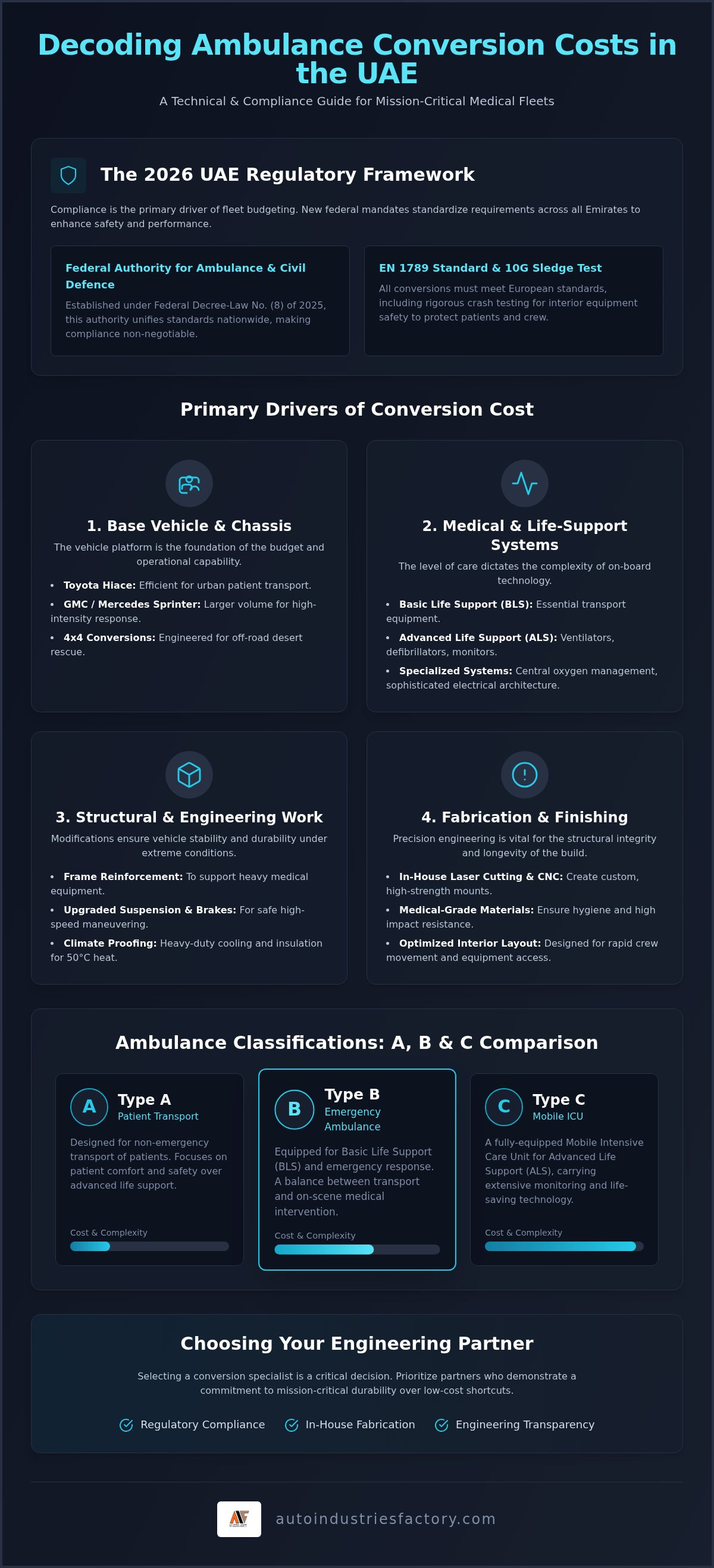
Regulatory compliance is the primary driver of fleet budgeting in 2026. The establishment of the Federal Authority for Ambulance and Civil Defence under Federal Decree-Law No. (8) of 2025 has standardized requirements across the country. Every conversion must adhere to EN 1789 standards, which include the 10G-rated "Sledge Test" for interior equipment safety. Meeting MOH and DHA certification isn't just about passing an inspection; it's about ensuring the vehicle is legally allowed to operate on UAE roads. While these standards impact the initial ambulance conversion cost uae, they protect the provider from the legal and operational risks of using non-compliant equipment.
Primary Drivers of Ambulance Conversion Cost in the UAE
Every dirham spent on a medical fleet must translate into operational uptime. The ambulance conversion cost uae isn't a flat fee because no two missions are identical. Environmental challenges in the Emirates, specifically the combination of extreme ambient heat and fine desert sand, necessitate specialized engineering that goes beyond standard factory specs. While basic conversions might focus on aesthetics, a professional build prioritizes heavy-duty cooling systems and high-grade thermal insulation to protect sensitive medical electronics and ensure patient comfort in 50°C temperatures.
Base Vehicle and Structural Modification
The choice of chassis serves as the foundation for the entire budget. Compact platforms like the Toyota Hiace are efficient for urban patient transport, but high-intensity emergency response often requires the increased volume of a GMC extended roof or a Mercedes Sprinter. We frequently engineer 4x4 conversions for off-road response in remote desert regions. This modification requires reinforced suspension and upgraded braking systems to handle the significant weight of medical cabinetry and life-support equipment. These structural changes are essential to maintain vehicle stability during high-speed emergency maneuvers.
Medical Technology and Life-Support Systems
The gap between Basic Life Support (BLS) and Advanced Life Support (ALS) represents a major shift in technical complexity. Integrating ventilators, defibrillators, and multi-parameter monitors requires a sophisticated electrical architecture. According to Ambulance Manufacturing Standards, electrical systems must be reliable and modular to allow for rapid equipment access. A central oxygen management system with copper piping is a standard requirement for certified units. Precision fabrication ensures these systems are secured against vibration, preventing leaks and electrical shorts during transit.
Interior surfaces must be non-porous and seamless to meet infection control standards. We utilize CNC machining to create custom cabinetry that maximizes space without adding unnecessary weight. This level of detail in fabrication ensures the vehicle remains easy to clean and durable enough for 24/7 deployment. If you're planning a fleet expansion, reviewing our specialized vehicle conversion solutions can help you align your technical requirements with your operational budget.
Ambulance Types: Type A, B, and C Cost Comparison
The classification of your vehicle dictates the complexity of its engineering. In the UAE, ambulances are categorized based on the EN 1789 standard, which separates units into Type A, B, and C. Each tier requires a different level of structural reinforcement and electrical integration. Understanding these distinctions is vital when calculating the total ambulance conversion cost uae for a diverse fleet. A unit designed for simple hospital transfers has significantly different fabrication requirements than a mobile intensive care unit meant for high-speed trauma response.
Type A and B: Standard Emergency Response
Type A units are patient transport ambulances designed for non-emergency use. These vehicles are common for private clinic fleets and corporate industrial sites. They focus on basic patient comfort and safety, featuring a certified stretcher system and basic oxygen supply. Type B units serve as the primary emergency ambulance for basic life support (BLS). These require more sophisticated cabinetry and integrated electrical outlets for portable medical devices. While these models are more accessible, they still require professional fabrication to ensure all interior components meet the 10G-rated safety standards required for UAE medical licensing.
Type C and Box-Type: The High-Performance Tier
Type C ambulances operate as Mobile Intensive Care Units (MICU). These vehicles are engineered for advanced life support (ALS) and must accommodate a wide array of life-saving technology. The box type ambulance represents the premium choice in this tier. Unlike standard van conversions, a box-type unit features a custom-fabricated modular body mounted onto a chassis like the GMC or Toyota Land Cruiser. This design offers several advantages:
- Maximum Interior Volume: Square walls allow for more efficient storage of ventilators, monitors, and infusion pumps.
- Superior Durability: The reinforced structure is built to withstand the mechanical stress of constant deployment in harsh environments.
- Mission-Specific Layouts: Precision engineering allows for custom configurations tailored to specialized rescue missions.
The investment in a Type C or box-type unit is higher due to the intensive metalwork and electrical engineering involved. We utilize advanced laser cutting and CNC machining to ensure every mounting point is structurally sound. For fleets requiring long-term reliability and maximum workspace for paramedics, the box-type conversion provides the best return on investment. You can explore our full range of ambulance conversion solutions to see how these tiers align with your specific mission requirements.
The Engineering Advantage: How Fabrication Impacts Budget
In-house fabrication is the most effective way to manage the ambulance conversion cost uae without compromising on mission-critical quality. When a provider handles every stage, from initial design to final painting, they eliminate the markups and communication gaps associated with third-party outsourcing. This centralized approach allows for tighter quality control over components like oxygen manifolds and electrical harnesses. It's about engineering a solution that works from day one and stays in service for years. Every weld and mounting point is a calculated investment in vehicle uptime.
A master engineer doesn't just assemble parts; they solve complex modification challenges using advanced technology. By utilizing in-house metal cutting and bending, we maintain total control over the structural integrity of the build. This level of oversight ensures that specialized features, such as extended roofs for GMC and Toyota platforms, are integrated seamlessly into the base chassis. Managing these processes under one roof is the only way to guarantee that the ambulance conversion cost uae remains transparent and predictable for fleet managers.
Precision Manufacturing with Laser and CNC
We utilize advanced CNC machining to ensure that medical cabinetry fits the vehicle's interior contours with absolute accuracy. This precision prevents rattling and structural fatigue during high-speed emergency responses, where vibration can damage sensitive medical equipment. Laser cutting technology allows us to maintain consistent structural integrity across an entire fleet, ensuring every unit meets the same rigorous safety standards. Precision engineering reduces material waste and minimizes manual rework, directly lowering the overall production cost. These technologies allow us to build complex, box-type ambulance structures with extreme precision.
Durability in the UAE Environment
The UAE's high humidity and saline air can quickly degrade poorly fabricated vehicles. Superior welding and high-quality anti-corrosive painting are essential to prevent rust and structural failure. We also engineer custom accessories like front metal bull bars, brush guards, and reinforced bumpers to protect the vehicle in rugged terrain. These aren't just aesthetic additions. They're essential protective components that reduce long-term maintenance expenses by shielding the chassis from impact. Learn more about our expert fabrication services to see how we build for longevity.
If you're looking for a reliable engineering partner for high-volume fleet orders, we provide the technical capability to deliver robust, compliant units. To ensure your medical fleet is built to the highest regional standards, request a technical estimate from our engineering team today.
Selecting a UAE Vehicle Conversion Specialist
Choosing an engineering partner for a medical fleet isn't a simple procurement task. It's a strategic decision that impacts the long-term reliability of your emergency response. A specialist must demonstrate more than just an assembly line; they need deep technical capability and extensive in-house resources. Many providers in the region rely on third-party fabricators, which often leads to hidden markups and inconsistent quality. By selecting a partner with a centralized manufacturing process, you maintain better control over the ambulance conversion cost uae and ensure that every unit meets the same rigorous structural standards.
A solution-oriented partner doesn't just follow a blueprint. They anticipate the challenges of the UAE environment, from thermal management to high-vibration stability. Evaluating a specialist's portfolio across diverse sectors, such as police, military, and safari vehicle modifications, provides proof of their ability to engineer for extreme conditions. This cross-industry expertise is what separates a standard conversion from a mission-critical asset. You need a craftsman who understands that structural integrity is non-negotiable when lives are on the line.
Why Auto Industries Factory LLC?
We build vehicles that don't fail. Our reputation as master engineers is built on delivering rugged, reliable conversions for the most demanding industries in the Emirates. Every stage of the process happens under one roof. From initial CAD design and precision laser cutting to CNC machining and final painting, our in-house control ensures absolute precision. This eliminates the inefficiencies of outsourcing and allows us to offer comprehensive fleet solutions tailored to your specific operational brief. Learn more About Auto Industries Factory LLC and our commitment to engineering excellence.
Requesting a Technical Quote
Moving from a fleet requirement to a finished build requires a clear engineering proposal. To provide an accurate ambulance conversion cost uae, our team needs a detailed breakdown of your mission profile. Be prepared to provide the following information during your consultation:
- Base Vehicle Specifications: Identify if you're utilizing a Toyota Hiace, GMC, or a Land Cruiser platform.
- Medical Classification: Specify if the unit requires Type A (Transport), Type B (Emergency), or Type C (ICU/Box-Type) certification.
- Fleet Volume: We specialize in high-volume orders and provide technical estimates based on the scale of your deployment.
- Specialized Accessories: List requirements for custom bull bars, reinforced bumpers, or specific electrical communication systems.
Our consultation process is designed to align your budget with the highest safety standards. We take your operational brief and transform it into a robust engineering reality. If you're ready to secure a reliable partner for your next fleet project, contact us for a specialized vehicle quote today.
Engineering Your Fleet for 2026 and Beyond
Budgeting for a medical fleet in the Emirates requires a shift from viewing vehicles as simple transports to seeing them as high-performance engineering solutions. You've seen how the ambulance conversion cost uae is influenced by the precision of in-house fabrication and the strict 2026 regulatory environment. Choosing between a versatile Toyota Hiace or a heavy-duty GMC extended roof platform is only the first step. The real value lies in structural integrity, where laser cutting and CNC machining ensure your equipment stays secure during high-speed emergency responses.
As specialists in mission-critical vehicle modifications, we provide the technical expertise needed to navigate these complex requirements. Our in-house design and fabrication capabilities guarantee that your fleet meets national standards while remaining robust enough for the UAE's harsh climate. We offer UAE-wide delivery and technical support to ensure your operations stay mission-ready. Request a Specialized Engineering Proposal from Auto Industries Factory LLC today. Your commitment to saving lives deserves an engineering standard that never compromises on protection.
Frequently Asked Questions
What is the average lead time for an ambulance conversion in the UAE?
Lead times for a specialized build depend on the complexity of the technical requirements and the volume of the order. While standard patient transport units can be completed faster, a custom box type ambulance requires intensive metalwork and electrical integration. We focus on precision engineering to ensure every vehicle meets 2026 standards before delivery. Contact our team with your specific fleet size to receive a projected timeline for your project.
Can any van be converted into a certified ambulance?
Not every commercial vehicle is suitable for certification as a medical unit in the UAE. To meet Federal Authority for Ambulance and Civil Defence standards, the chassis must support the weight of medical systems and structural reinforcements. We specialize in transforming high-performance platforms like the Toyota Hiace, GMC, and Land Cruiser. These vehicles provide the necessary durability and space for mission-critical applications where a standard passenger van would fail.
How does the EN 1789 standard affect the cost of conversion?
The EN 1789 standard significantly impacts the ambulance conversion cost uae by mandating rigorous safety and structural benchmarks. Compliance requires 10G-rated mounting systems for all interior equipment and specialized materials that resist fire and impact. While these requirements increase the initial engineering investment, they're mandatory for medical licensing. Meeting these standards ensures that your fleet is legally compliant and provides maximum protection for both patients and paramedics during transit.
Does the conversion cost include the medical equipment?
Conversion estimates typically cover the structural fabrication, electrical systems, and interior cabinetry. Medical equipment like ventilators, monitors, and stretchers are often specified based on the required care level, such as BLS or ALS. We provide comprehensive solutions that can include the integration of these devices into the vehicle's architecture. It's best to define your medical equipment grade during the initial consultation to ensure the electrical systems are engineered for the correct load.
What is the difference between BLS and ALS ambulance builds?
The primary difference lies in the technical complexity of the life-support systems. Basic Life Support (BLS) units are engineered for standard emergency care and non-critical transport. Advanced Life Support (ALS) builds, or Type C units, require sophisticated electrical grids and modular storage for intensive care technology. These high-performance units feature advanced oxygen management and patient monitoring systems, making them essential for mobile intensive care and trauma response missions across the country.
Are 4x4 ambulance conversions more expensive than standard RWD models?
Engineering a 4x4 ambulance involves more intensive structural modifications than a standard rear-wheel-drive build. These units require reinforced suspension, specialized drivetrains, and often custom bull bars for off-road durability. While the initial investment is higher, a 4x4 conversion is necessary for fleets operating in rugged terrain or remote desert areas. These modifications ensure the vehicle can reach patients in environments where standard urban ambulances cannot navigate safely.
Can Auto Industries Factory handle large-scale fleet conversions?
Auto Industries Factory LLC is fully equipped to manage high-volume fleet orders for medical, police, and military applications. Our facility utilizes in-house laser cutting and CNC machining to maintain consistent quality across dozens of units simultaneously. We offer complete solutions from initial design to final painting, ensuring every vehicle in your fleet meets the same technical specifications. Our engineering team specializes in scaling production without compromising the ruggedness of individual builds.
Does the conversion affect the base vehicle manufacturer warranty?
Professional conversions are designed to work within the structural limits of the base vehicle. However, any modification to the original chassis or electrical system can impact specific parts of the manufacturer's warranty. We use precision engineering and non-invasive mounting techniques wherever possible to protect the vehicle's integrity. It's recommended to consult with your vehicle supplier and our technical team to understand how custom fabrication interacts with your specific warranty terms for the ambulance conversion cost uae.


