

More protection can make an SUV less capable if added weight reduces payload or ground clearance. A tactical SUV conversion must balance protection, comfort, clearance, and carrying capacity around the vehicle’s mission. The right conversion starts with the role, not a list of equipment.
A capable vehicle should remain comfortable and composed on the road. This article explains how a tactical SUV conversion affects cabin comfort, protection, payload, handling, and off-road performance. You’ll also learn what to consider when choosing a platform and how careful planning can align modifications with the vehicle’s intended work.
Key Takeaways
- Match protective features to the vehicle’s mission while preserving cabin comfort and discreet appearance.
- Assess payload and ground clearance together, since added equipment can affect both carrying capacity and off-road capability.
- Choose an SUV platform based on the required role, available space and the demands of its intended operating environment.
- Plan the conversion around equipment layout, electrical needs and how added weight may influence handling and fuel use.
- Explore specialist vehicle modifications when a standard SUV needs to support police, military or other demanding operational work.
Balancing discreet protection with luxury and comfort
A tactical SUV conversion should match protective features to the mission without making the cabin harder to use. Discreet protection can involve integrating selected components behind existing trim rather than adding conspicuous exterior equipment. The right approach depends on the threat, occupants’ needs, and operating conditions. Protection is a system-level decision, not simply another layer fitted to the body.
Protection options can include partial or full armor, mechanical screens or nets, and electronic-warfare equipment. Each brings different installation and space requirements. Armor changes vehicle weight and its distribution, while poorly positioned screens may affect visibility or access. Electronic equipment needs a suitable layout and power supply. A professional plan considers these elements together rather than treating each as a separate upgrade.
Cabin comfort also depends on practical details: door operation, seat access, visibility, climate control, and control placement. Equipment near the dashboard, for example, can obstruct sightlines or make essential controls difficult to reach. A layout review should preserve clear movement through the cabin and keep frequently used functions accessible. Discreet finishes can retain a restrained appearance, but must not obstruct inspection or routine access to components.
Safety, legal, and insurance risks depend on the effects of modifications and how the work is documented. Added weight or obstructed visibility can affect safe operation, while changes that do not meet applicable UAE vehicle requirements may raise compliance concerns. Inaccurate or undisclosed modification details can also complicate insurance coverage or a later claim.
A professional inspection covers mounting points, doors, windows, wiring, and equipment placement, followed by an assessment of the vehicle in operation. Maintenance should follow the requirements of the installed components and include checks for loose fixings, damaged seals, electrical faults, and changes in handling.
For vehicles assigned to casualty evacuation, comfort must support the task rather than imitate a luxury passenger cabin. A converted medical evacuation vehicle may have a flat aluminum floor and a cabin without glass. Litter securing systems need to prevent movement under off-road loads, and autonomous cabin heating can maintain warmth independently of the engine. These features show why an evacuation SUV differs from one designed for discreet transport.
Define the priority before specifying equipment: occupant protection, communications, passenger comfort, or evacuation support. Then assess how each component affects access, visibility, cabin space, and vehicle balance. This mission-led approach keeps protection purposeful and comfort functional, ensuring specialized climate control systems maintain a comfortable cabin temperature while the layout keeps the evacuation function clear and usable.
Conversion work includes defining the task, calculating costs and materials, documenting the work, optional painting, and handing over the vehicle with the necessary documents. Connecting each step to the mission helps align the finished specification and finish with the vehicle’s intended use. Clear handover documentation also records the work completed and documents supplied by Auto Industries Factory LLC.
Ground clearance and payload capacity
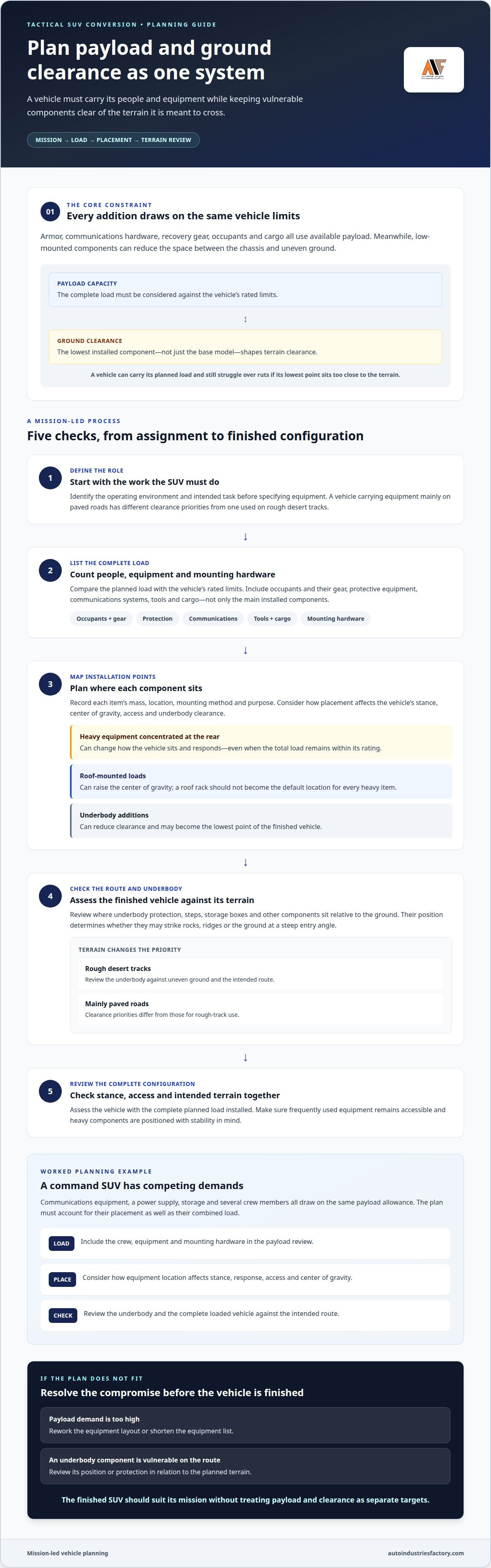
Ground clearance and payload are linked design limits, not separate targets. A tactical SUV conversion adds equipment that takes up space and adds weight. Armor, communications hardware, recovery gear, occupants, and cargo all use the vehicle’s available capacity. At the same time, low-mounted components can reduce the space between the chassis and uneven ground. A vehicle carrying everything planned may still struggle over ruts if its lowest point sits too close to the terrain.
Payload planning starts with the vehicle’s rated limits and the equipment list. The conversion team accounts for occupants and their gear, then adds each installed system and its mounting hardware. Consider a command SUV carrying communications equipment, a power supply, storage, and several crew members. These needs compete for the same payload allowance. Weight distribution matters too: concentrating heavy equipment at the rear can change how the vehicle sits and responds, even when the total load remains within its rating.
Ground clearance depends on the finished vehicle, not just the base model’s advertised specification. Underbody protection, steps, storage boxes, and other components can become the lowest point. Their position determines whether they may strike rocks, ridges, or the ground at a steep entry angle. A professional review maps the underbody against the intended route. A vehicle used on rough desert tracks, for example, needs different clearance priorities from one carrying equipment mainly on paved roads.
Load placement helps preserve both clearance and stability. Heavy components should be positioned with the vehicle’s center of gravity in mind, while frequently used equipment needs to remain accessible. Roof-mounted loads can raise the center of gravity; underbody additions can reduce clearance. The conversion plan considers each component’s mass, location, mounting method, and purpose. A roof rack, for instance, can carry bulky gear, but should not become the default place for every heavy item.
- List the load: Include people, protective equipment, communications systems, tools, and cargo.
- Map installation points: Record where each component sits, including its effect on underbody clearance.
- Review the finished configuration: Assess vehicle stance, access, and intended terrain with the complete load installed.
These checks help identify compromises early. If equipment uses too much payload, the design may need a different layout or a shorter equipment list. If an underbody component is vulnerable on the planned route, its position or protection may need adjustment. The goal is a usable vehicle, not the maximum equipment count. A balanced tactical SUV conversion carries mission-critical equipment while preserving practical clearance and payload capacity for its assigned work.
Which SUV models do professionals recommend for tactical conversions?
No single SUV suits every tactical role. A command vehicle, protected transport unit, and desert patrol vehicle make different demands on cabin space, payload, access, and terrain performance. Start with the assignment, then compare platforms against the equipment and operating conditions. For a fleet operating in the UAE, distinguish paved-road duty from regular travel across sand or rough tracks. A model’s reputation alone cannot show whether its finished configuration will meet the task.
The 2025 Cadillac Escalade ESV is identified as an armored SUV conversion example. It can serve as a reference point for considering a large SUV platform, but the model name alone doesn’t establish suitability for a particular fleet. The conversion plan still needs to account for the intended protection, occupants, equipment, and usable payload. A tactical SUV conversion should be assessed as a completed vehicle, not simply by comparing the original model’s features.
Start by matching the vehicle layout to the mission. A command role may need room for workstations and communications equipment, while a patrol configuration may prioritize passenger access and space for carried gear. An evacuation role requires a different interior, especially when a patient transport area is needed. A platform suited to one role may not be right for another.
Compare candidate vehicles using the same practical criteria. A professional assessment can examine:
- Interior arrangement: Whether occupants and installed systems can fit without blocking doors, controls, or essential sightlines.
- Payload margin: Whether the planned crew, protective components, and equipment fit within the vehicle’s capacity.
- Terrain demands: Whether underbody clearance and the final equipment layout suit the intended route.
- Integration needs: Whether the vehicle can accommodate required electrical systems and securely mounted equipment.
Model selection also depends on how the fleet will use and maintain its vehicles. A unit assigned to remote routes may need an equipment layout that preserves access for inspection and servicing. A vehicle used mainly in a secure urban environment may place greater value on passenger comfort and a restrained exterior. These are role-based distinctions, not claims that one SUV is universally superior.
Before choosing a platform, define the crew, equipment, route, and protection objectives. Then compare suitable models against those requirements and assess the proposed conversion’s effect on capacity and usability. The 2025 Cadillac Escalade ESV illustrates one possible armored SUV direction; the right choice for a UAE fleet depends on the complete mission profile and finished vehicle configuration.
How is a tactical SUV conversion planned and completed by a professional?
A professional conversion starts by defining the vehicle’s assigned task. A command SUV, patrol vehicle, and evacuation unit require different layouts and equipment. The fleet specifies who will use the vehicle, where it will operate, and what it must carry. This mission profile guides platform selection, cabin planning, and fabrication. Without it, equipment choices can conflict with access, payload, or everyday operation.
The conversion team then assesses the base vehicle and develops a workable configuration. A communications-focused build, for example, may require workstations, electrical upgrades, and dedicated equipment storage. The team checks how these components fit together and whether occupants can reach controls and exits. It also considers equipment location, mounting requirements, and added weight. These decisions shape the materials and labor needed for the project.
- Define the task: Record the vehicle’s role, operating environment, occupants, and essential equipment.
- Plan the configuration: Map cabin layout, protection requirements, electrical needs, storage, and access.
- Calculate materials and costs: Estimate the fabrication materials and work needed for the agreed configuration.
- Complete and document the work: Fabricate and install the planned components, then record the conversion work.
- Prepare handover: Review the completed vehicle and provide the necessary documents.
Plan costs early, before fabrication begins. The project price depends on the vehicle, selected materials, equipment, and conversion work, and is provided after a quote request. A defined equipment list helps keep the scope clear. If requirements change, such as adding communications hardware after layout approval, the plan and material needs may change too.
Electrical planning needs particular attention when a civilian SUV will support medical, communications, or protective equipment. Added systems may require electrical upgrades to support their intended use. The installation plan should account for wiring routes, equipment locations, and access for servicing. A communications setup, for instance, needs planned space and connections, not an improvised fit after the interior work is complete.
Fabrication and installation follow the agreed configuration. Metal components may need cutting, bending, joining, and finishing to suit their mounting locations. Painting can be included when required. Documentation records the completed work, and the handover provides the fleet with the necessary vehicle documents. A disciplined sequence helps avoid clashes between equipment, trim, wiring, and occupant access.
The final review compares the finished SUV with its intended role. The team checks that installed equipment is secure, planned systems are integrated, and the cabin remains usable for its crew. A clearly documented handover closes the conversion process and gives fleet operators a defined reference for the completed configuration.
How do added equipment and armor affect fuel economy, handling, and reliability?
Armor and mission equipment increase an SUV’s operating load. Extra mass generally requires more energy to move, so fuel consumption can rise, particularly with frequent acceleration or stop-start driving. The effect depends on the vehicle, the amount and location of added weight, and its operating pattern. A communications SUV carrying a power system and workstations, for example, has a different load profile from a lightly equipped patrol vehicle.
Placement matters as much as total mass. Equipment mounted high can raise the center of gravity, while uneven loading can affect balance from side to side or front to rear. A tactical conversion should account for how equipment placement affects the vehicle’s center of gravity, handling, and cross-country ability. A roof-mounted load may influence cornering and body movement, while rear-mounted equipment can alter the vehicle’s stance. Plan locations around the SUV’s intended routes and tasks.
Added weight also changes how the vehicle responds during acceleration, braking, and turns. The finished configuration needs an assessment of the suspension, tires, and braking system against its intended load. A vehicle carrying armor, occupants, and mission equipment every day faces different demands from one carrying those items occasionally. Keeping the equipment list focused helps avoid unnecessary weight and preserves capacity for essential gear.
Reliability depends on how well added systems integrate with the base vehicle. Protective panels and mounted equipment need secure attachment points. Electrical systems for communications and other equipment require planned wiring and proper integration. Poorly routed wiring can complicate inspection, while loose mounts can cause noise, damage, or operational hazards. Review the completed vehicle as a system, including its components and access points.
- Review the complete load: Include armor, installed equipment, occupants, and carried gear.
- Check placement: Assess how each heavy item affects balance, visibility, and clearance.
- Assess vehicle systems: Consider suspension, tires, brakes, and electrical integration as part of the finished configuration.
- Plan ongoing inspections: Examine mounts, wiring, and components for wear or damage during scheduled maintenance.
Fuel use and handling cannot be judged from the SUV model alone. Weight, distribution, route, and driving pattern all influence the result. A professional assessment considers the finished vehicle under its intended load rather than relying only on the original vehicle’s behavior. This helps identify whether equipment placement or the configuration needs adjustment before fleet deployment.
For an SUV requiring specialized vehicle modifications, discuss your conversion requirements.
That distinction matters when defining an evacuation vehicle’s role. CASEVAC and MEDEVAC differ in the level of medical equipment installed in the vehicle. Consider the planned medical fit alongside armor and other mission equipment when setting the overall configuration.
Civilian vehicles converted for tactical use may need electrical upgrades to support medical, communications, or protective equipment. Including these requirements in the plan helps align the electrical installation with the intended equipment. Electrical integration can then be reviewed alongside the vehicle’s load and mission role.
Auto Industries Factory
Auto Industries Factory LLC plans specialized vehicle conversions around operational requirements. Its Police & Military Vehicle Modifications serve fleets needing purpose-built vehicles, while Safari Vehicle Conversions are designed for demanding off-road use. Metal Canopies and Roof Racks provide additional vehicle-fabrication options for carrying equipment.
Turn to Auto Industries Factory LLC when a standard vehicle needs adaptation for a defined fleet role and its layout, equipment, and fabrication must work together. Share the vehicle platform, intended use, and required equipment to shape a conversion suited to the task.
To discuss your vehicle requirements, contact Auto Industries Factory LLC.
Set the direction for your next fleet vehicle
Use the vehicle’s mission brief to guide the next fleet decision. Before commissioning a tactical SUV conversion, define its users, required equipment, operating environment, and essential access needs. Consider how the vehicle will be inspected, serviced, and adapted as priorities change. These details establish a clear project scope and give the fabrication team a practical starting point.
Auto Industries Factory LLC supports specialized vehicle projects through Ambulance Conversions, Police & Military Vehicle Modifications, and Safari Vehicle Conversions. Each serves a distinct operational purpose. A useful first discussion focuses on the vehicle platform, its intended role, and the requirements the finished vehicle must meet. This keeps the project grounded in fleet needs.
Bring those priorities together before moving into a conversion project. A well-defined brief helps turn operational requirements into a purposeful vehicle configuration. Contact Auto Industries Factory LLC to discuss your vehicle requirements and take the next step with confidence.
Frequently Asked Questions
What is a tactical SUV conversion?
A tactical SUV conversion transforms a standard vehicle into a mission-specific unit for roles such as military transport or police operations. Depending on the vehicle’s purpose, the work can involve structural reinforcement, armoring, or integration of electrical and communication systems. A fleet, for example, may need a platform configured to carry communications equipment or support a defined transport role. The finished configuration should reflect its intended operational use.
What features and equipment are included in a tactical SUV conversion?
Features depend on the vehicle’s assigned role and may include structural reinforcement, armor, electrical systems, communications equipment, or a modified interior. A command vehicle, for example, may need communications systems, while a transport configuration may prioritize secure equipment storage. Some builds may also use vehicle accessories such as metal canopies or roof racks. These are possible conversion elements, not a standard package included in every build.


