

A Basic Life Support vehicle is more than a transport van with a siren; it's a precision-engineered medical environment where every millimeter of steel and every amp of power determines a patient's outcome. You've likely seen how ambiguity in international standards can lead to weight imbalances or critical electrical failures during a rescue. It's frustrating when "standard" conversions don't meet the rugged demands of the field. This guide eliminates the guesswork by detailing the exact BLS ambulance conversion specifications required for 2026.
We'll master the technical requirements for structural integrity, medical gas capacities, and high-performance electrical systems. You'll learn how to optimize interior layouts for crew efficiency while maintaining the strict payload margins necessary for platforms like the Toyota Hiace or GMC chassis. We're moving beyond basic assembly to provide a blueprint for a durable, compliant, and life-saving fleet. From reinforced suspensions to oxygen delivery systems, we'll ensure your vehicles are ready for the high stakes of 2026 emergency response.
Key Takeaways
- Identify the mandatory 2026 BLS ambulance conversion specifications and the critical engineering distinctions between Type A transport and Type B emergency units.
- Explore the shift toward high-impact ABS and reinforced FRP interior panels to ensure long-term structural durability and superior infection control.
- Learn to isolate medical equipment loads using dual-battery architecture and pure sine wave inverters to prevent catastrophic electrical failures.
- Review the essential hardware requirements for compliance, including automatic loading stretchers and integrated respiratory support systems.
- Understand the performance advantages of in-house fabrication for mission-critical platforms like the Toyota Hiace and GMC box-type ambulances.
Defining BLS Ambulance Standards and Classifications
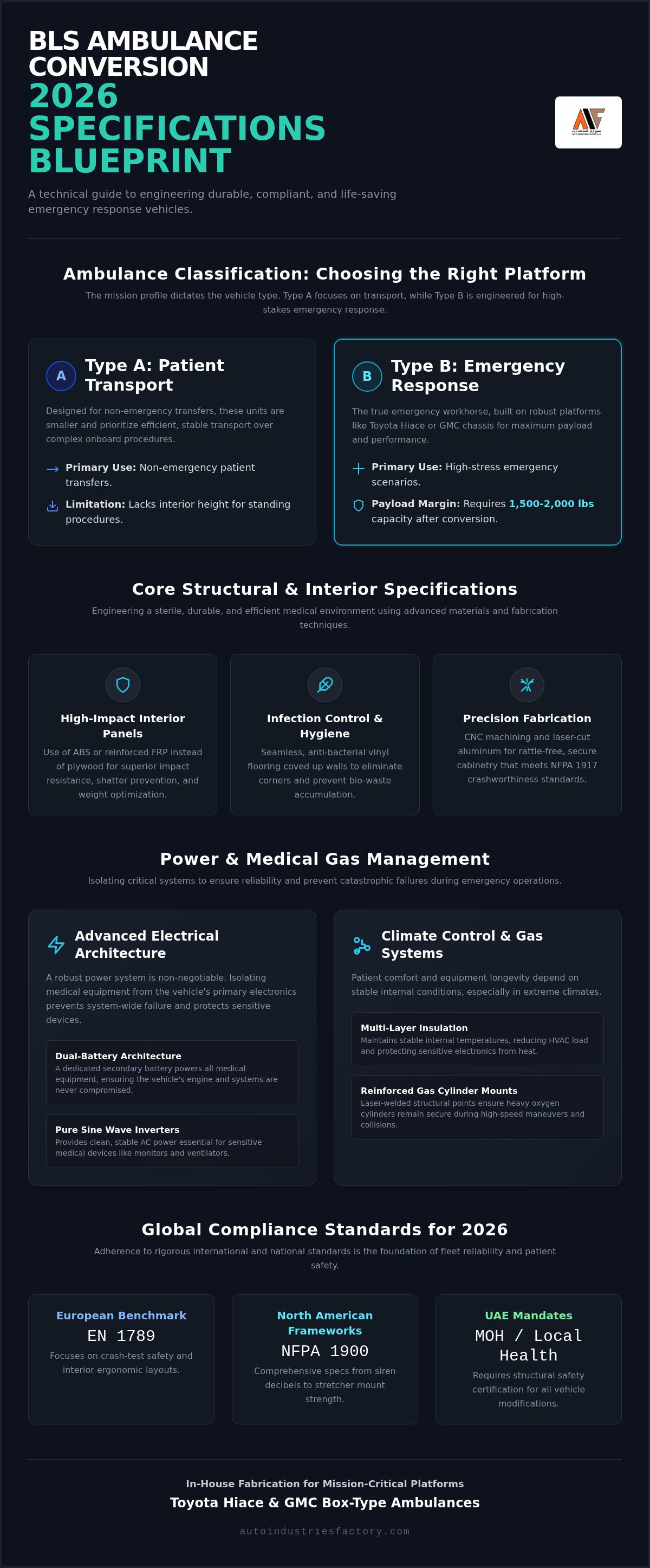
A Basic Life Support (BLS) ambulance is a precision-engineered environment designed for non-invasive emergency care. These units don't carry the heavy pharmacological or invasive surgical equipment found in Advanced Life Support (ALS) vehicles. Instead, they prioritize the "Golden Hour" by focusing on rapid patient stabilization and high-speed, safe transport. Professional BLS ambulance conversion specifications for 2026 emphasize structural durability and ergonomic efficiency to ensure the medical crew can work effectively in high-stress scenarios. The goal is simple: provide a reliable platform for oxygen administration, wound management, and fracture immobilization.
The global landscape for emergency vehicles relies on rigorous Ambulance Standards and Classifications. In 2026, the European EN 1789:2020+A1:2023 standard remains the primary benchmark for crash-test safety and interior layout. Conversely, the North American market has largely shifted from the old KKK-A-1822 specs to the comprehensive NFPA 1900 and CAAS GVS V4.0 frameworks. These regulations dictate everything from the decibel level of sirens to the tensile strength of stretcher mounts. Compliance isn't optional; it's the foundation of fleet reliability and patient safety.
Type A vs. Type B: Choosing the Right Platform
Choosing between Type A and Type B units depends on your specific mission profile. Type A vehicles, often classified as patient transport units, are smaller and designed for non-emergency transfers. They typically lack the interior height for standing medical procedures. Type B units are the true emergency workhorses. They require a significant payload capacity, often needing a margin of 1,500 to 2,000 pounds after the conversion is complete. High-performance platforms like the Toyota Hiace or GMC models are preferred for Type B builds. They offer the engine torque and chassis strength needed to carry heavy medical gas systems and crew without sacrificing road performance.
Regulatory Compliance in the UAE National Market
Operating within the UAE requires strict adherence to national health and transport mandates. The Ministry of Health and local health authorities set specific benchmarks for vehicle licensing and registration. Every modification, from a custom bull bar to an extended roof, must undergo structural safety certification. At Auto Industries Factory LLC, our in-house fabrication process ensures that every BLS ambulance conversion specifications requirement is met under one roof. We handle the design, laser cutting, and CNC machining to guarantee that the final vehicle isn't just a van with a stretcher, but a fully compliant medical solution ready for the UAE's demanding climate and terrain.
Structural Fabrication and Interior Specifications
Engineering a medical vehicle requires more than just bolting down equipment. Modern BLS ambulance conversion specifications for 2026 demand the use of high-impact ABS (Acrylonitrile Butadiene Styrene) or reinforced FRP (Fiber-Reinforced Plastic) for interior panels. These materials offer superior impact resistance compared to traditional plywood, significantly reducing the risk of shattering during a collision. They also provide a lightweight profile that preserves the vehicle's payload capacity for critical medical gear.
Hygiene remains a primary engineering constraint. Floors must be finished with anti-bacterial, seamless vinyl that curves up the walls to prevent bio-waste accumulation in corners. For the partition wall, we utilize safety glass windows and integrated communication ports. This allows the driver to maintain contact with the medical crew without compromising the sterile environment or safety of the patient compartment. Structural integrity is often measured against the NFPA 1917 Standard, which provides the framework for crashworthiness and equipment retention. Our in-house fabrication team uses CNC machining and laser cutting to produce rattle-free cabinetry that remains secure even during high-speed emergency maneuvers.
Advanced Interior Paneling and Insulation
In extreme desert climates, thermal and acoustic insulation is vital for both patient comfort and equipment longevity. We utilize multi-layer insulation to maintain a stable internal temperature, which reduces the load on the vehicle's HVAC system. Structural reinforcement points are laser-welded into the chassis to support heavy items like the main stretcher and oxygen cylinders. For weight optimization, we often recommend laser-cut aluminum cabinetry over heavier composites. You can view our specialized fabrication services to see how we balance durability with vehicle payload.
Seating and Ergonomics for Medical Crews
Crew safety is a priority in any 2026 build. Paramedic seats must feature 3-point safety belts and swivel functionality for easy patient access without unbuckling. The squad bench is engineered to integrate storage for spine boards and immobilization kits while providing a secondary seating or patient area. By maintaining a clear "workflow triangle" between the attendant seat, the patient's head, and the primary medical controls, we reduce crew fatigue and improve response times during transport. This ergonomic layout ensures that every tool is within reach when seconds count.
Electrical Systems and Medical Gas Management
Electrical reliability is the backbone of any mission-critical vehicle. In 2026, BLS ambulance conversion specifications prioritize a dual-battery architecture to eliminate the risk of a dead engine in the field. This system isolates the vehicle's primary start battery from the secondary medical equipment load using an intelligent isolator or split-charging relay. If the medical crew runs high-intensity lighting or climate control while the engine is off, the primary battery remains protected. To safeguard sensitive electronics like heart monitors or digital suction units, we install pure sine wave inverters. Unlike cheaper modified sine wave versions, pure sine wave technology provides "clean" power that prevents voltage spikes and interference; this ensures equipment longevity and accuracy during patient care. Centralized control panels manage these systems through a ruggedized interface, allowing the attendant to toggle sirens, scene lights, and HVAC with a single touch.
Intelligent Load Management and Charging
Modern fleets rely on automatic charging systems via external shore-line connections. These "auto-eject" plugs ensure that when the vehicle is parked at the station, both battery banks are topped up and the interior climate is maintained without idling the engine. Inside the compartment, we install specialized LED lighting arrays. High-intensity trauma lights provide the specific illumination required for emergency procedures, while soft ambient lighting helps reduce patient anxiety during transport. For 2026, a standard BLS electrical suite must support a continuous operational load of at least 150 amps to manage integrated systems and future hardware upgrades.
Medical Oxygen Pipeline and Outlets
Medical gas management is an engineering feat of safety and redundancy. Our BLS ambulance conversion specifications include a piped oxygen system with a minimum capacity of 3,000 liters, maintained at a pressure of at least 300 psi. We utilize rigid copper tubing or high-pressure flexible hoses, depending on the chassis vibration profile, to deliver gas to wall-mounted outlets. These outlets are customized to BS, DIN, or American quick-connect standards based on regional requirements. To prevent mid-mission depletion, digital pressure alarms provide real-time monitoring at the attendant's control panel. We also engineer secure manifold storage for 10L or 20L cylinders, using laser-cut brackets to ensure they remain stationary even during rapid deceleration or off-road navigation.
Essential Medical Equipment for BLS Conversions
Selecting the right hardware for a medical vehicle is a matter of balancing life-saving capability with vehicle payload and interior volume. Under 2026 BLS ambulance conversion specifications, every piece of equipment must have a dedicated, crash-tested mounting point to ensure crew safety. The primary patient handling system revolves around the main automatic loading stretcher. This hardware requires a precision-engineered floor track system that meets 10G crash test standards. While a fixed base is standard, many agencies opt for a sliding base to allow the medical attendant better access to the patient's side in narrow van configurations like the Toyota Hiace or Land Cruiser. Space optimization isn't just a design choice; it's a safety requirement that prevents loose gear from becoming hazardous in transit.
Respiratory and diagnostic tools form the secondary layer of the BLS suite. This includes wall-mounted flowmeters connected to the oxygen manifold and heavy-duty portable suction units. Diagnostic tools like pulse oximeters, sphygmomanometers, and basic AED units are strategically placed for rapid deployment. For immobilization, the vehicle must be equipped with cervical collars, head immobilizers, and vacuum splints. We fabricate custom compartments to house these items, ensuring they remain secure yet accessible when seconds count. You can contact our engineering team to discuss custom equipment integration for your specific fleet requirements.
Patient Handling and Transfer Systems
Beyond the primary stretcher, a compliant BLS unit must handle patients in restricted access areas. This necessitates the inclusion of foldable scoop stretchers and stair chairs. These tools are engineered from lightweight aluminum to minimize the impact on the vehicle's total weight. Every transfer system must be secured with mechanisms that prevent movement during high-speed maneuvers. We use laser-cut brackets and heavy-duty straps to ensure that even in the event of a sudden stop, the equipment remains locked in its designated housing. This level of precision engineering is what separates a professional conversion from a standard utility modification.
The BLS First Aid and Trauma Suite
The trauma suite is the heart of the medical compartment's workflow. It includes a mandatory primary emergency medical bag stocked with dressings, bandages, and basic airway management tools. To maintain a sterile environment, wall-mounted sharps containers and biohazard waste management systems are integrated directly into the cabinetry. We balance the use of portable and fixed diagnostic equipment to maximize floor space. By utilizing CNC-machined recesses for monitors and AEDs, we provide a flush-mount finish that protects the electronics from dust and physical impact while keeping the work area clear for the medical crew.
Customizing Your Fleet with Auto Industries Factory
Auto Industries Factory LLC stands as a national leader in vehicle fabrication, delivering mission-critical solutions that exceed standard BLS ambulance conversion specifications. We don't just assemble parts; we engineer integrated medical environments. Our in-house advantage means every stage of production, from initial 3D design and laser cutting to final painting, happens under our direct supervision. This localized control ensures that your fleet meets the highest durability benchmarks for 2026, providing a robust platform for emergency response in the UAE's demanding terrain. We eliminate the ambiguity of third-party outsourcing by centralizing all technical processes.
Versatility is a core requirement for modern emergency fleets. We specialize in high-performance platforms including the Toyota Hiace, GMC box-type units, and Land Cruiser Hardtop configurations. Whether your operations require Left-Hand Drive (LHD) or Right-Hand Drive (RHD) setups, our facility is equipped to handle global export requirements with precision. By managing metal cutting, bending, and specialized vehicle modifications internally, we maintain strict quality oversight that others cannot match. National fleets trust our rugged engineering because we build for the high stakes of the field, ensuring every vehicle is mission-ready from the moment it leaves our factory.
Our 7-Step Conversion Process
Precision is the cornerstone of our manufacturing philosophy. We utilize advanced laser cutting and CNC machining to achieve zero-tolerance builds, ensuring every cabinet and bracket fits perfectly without the risk of rattles or structural failure. Our seven-step process includes rigorous quality control benchmarks where we test electrical load capacity, oxygen pipeline integrity, and overall structural crashworthiness. You can explore our full fabrication capabilities to see how our in-house technology delivers superior results compared to standard assembly-line conversions. We provide a transparent engineering path from the initial chassis arrival to the final certified build.
Partnering for National Fleet Excellence
We act as a consultative partner rather than a mere vendor. Our engineering team works closely with fleet managers to tailor interior layouts to specific regional EMS protocols, ensuring that the final build enhances crew efficiency and patient care. Beyond the delivery of the vehicle, we provide comprehensive after-sales support and maintenance to keep your mission-critical assets operational in the long term. Reliable engineering is a strategic investment in patient safety and fleet longevity. Contact our expert engineering team today for a detailed BLS conversion quote and a technical consultation tailored to your fleet's specific needs.
Engineering Your Fleet for the 2026 Mission
Mastering BLS ambulance conversion specifications is no longer just about meeting a checklist; it's about building a ruggedized environment that protects both the patient and the crew. We've explored how high-impact materials and isolated electrical architectures ensure mission-readiness in the most demanding conditions. By utilizing in-house CNC and laser cutting, we eliminate the structural failures common in generic builds. Our national UAE service coverage ensures that your mission-critical vehicles remain operational and compliant with 2026 standards, regardless of the extreme climates they face.
Reliability in the field starts on the factory floor. When you prioritize precision engineering, you invest in a fleet that performs without compromise when seconds count. Our solution-oriented approach transforms standard platforms into durable emergency workhorses. Don't leave your compliance or safety to chance with unverified modifications. It's time to equip your team with the tools they deserve for high-stakes missions.
Request a Technical Specification Quote for Your Fleet today and partner with an engineering team dedicated to your operational success. We're ready to build the future of your emergency response.
Frequently Asked Questions
What is the difference between BLS and ALS ambulance conversion specifications?
BLS units are designed for non-invasive emergency care and rapid stabilization. ALS units require additional space and power for invasive life-support equipment like ventilators and cardiac monitors. While BLS ambulance conversion specifications focus on patient transport and basic oxygen delivery, ALS builds demand higher electrical loads and specialized cabinetry for advanced pharmacology. Both types must meet 2026 crash-test standards, but ALS units carry a significantly higher equipment payload.
Which base vehicles are best suited for a BLS ambulance conversion?
High-performance platforms like the Toyota Hiace and GMC chassis are the industry standards for 2026. For harsh terrains, the Land Cruiser Hardtop provides the ruggedness needed for off-road missions. These vehicles are chosen for their high payload capacity, which must accommodate at least 1,500 to 2,000 pounds of medical gear and crew after the conversion. Their engine torque ensures reliable performance during high-speed emergency response.
What are the mandatory oxygen system requirements for a BLS unit?
Piped oxygen systems must maintain a capacity of at least 3,000 liters with a minimum pressure of 300 psi. Portable cylinders require at least 300 liters of capacity and 500 psi. In 2026, all installations must include digital pressure monitoring and secure manifold storage. We use laser-cut brackets to ensure cylinders remain stationary during rapid maneuvers, preventing hazardous movement in the medical compartment.
How long does a professional BLS ambulance conversion typically take?
A standard conversion for a vehicle like the Toyota Hiace typically takes 4 to 6 weeks. More complex projects, such as box-type ambulances or extended roof GMC conversions, can take 8 to 12 weeks. This timeline ensures precision in every step, from CNC fabrication to final painting. We prioritize quality control benchmarks, including electrical load testing and oxygen pipeline integrity, to ensure every vehicle is mission-ready.
Are custom ambulance conversions compliant with UAE national safety standards?
Every custom build must adhere to Ministry of Health and national health authority mandates for emergency vehicle registration. Our in-house fabrication process ensures that all structural modifications and medical systems meet these safety benchmarks. By managing the entire design and manufacturing process internally, we provide the documentation and structural integrity required for national licensing. This ensures your fleet is fully compliant with 2026 UAE safety standards.
Can a BLS ambulance be upgraded to an ALS unit later?
It's feasible if the initial BLS ambulance conversion specifications included a high-capacity electrical architecture. ALS units require significantly more power for ventilators and monitors, so a pure sine wave inverter and dual-battery system are essential foundations. If these weren't integrated during the first phase, a later upgrade would require stripping the interior to install new wiring and reinforced mounting points for advanced medical gear.
What electrical protection is required for medical equipment in an ambulance?
Sensitive diagnostic tools require pure sine wave inverters to prevent interference and voltage spikes. We also implement a dual-battery architecture that isolates the medical equipment load from the vehicle's primary start battery. This ensures the medical gear doesn't drain the engine's power source. Integrated control panels manage this distribution, providing a stable 150-amp continuous load capacity for all onboard medical and communication systems.


