

What makes a 4x4 build work well is not the number of modifications, but how closely they match the vehicle’s mission. Anyone considering custom 4x4 fabrication UAE needs to choose work that suits the vehicle, its operating conditions, and the tasks it must perform. A vague scope can lead to components or modifications that do not support the intended use.
Start with a clear brief: identify the vehicle, explain its role, and describe the conditions it will face. This guide shows how to set a practical conversion scope, assess fabrication and integration requirements, and distinguish a coordinated conversion from a request for individual metalwork.
Auto Industries Factory LLC brings vehicle conversions together with in-house metal fabrication, including CNC laser cutting, bending, welding, machining, and painting. Its services include safari and 4x4 conversions, metal canopies, and roof racks. Use the guidance below to prepare the vehicle and project details needed for a focused estimate request.
Key Takeaways
- Define the vehicle’s mission and platform before selecting modifications, so the scope reflects the work the vehicle must perform.
- Understand how in-house CNC laser cutting, bending, welding, machining, and painting can coordinate metalwork with conversion requirements.
- Compare safari conversions, off-road and overland builds, and custom 4x4 fabrication UAE by purpose, base vehicle, and scope.
- Prepare a project brief with the vehicle details, current configuration, operating conditions, priorities, and requested work.
- See how AIF’s 4x4 conversion, safari conversion, and metal fabrication services support precision, reliability, engineered safety, and on-time delivery.
Custom 4x4 Fabrication UAE: Define the Mission Before the Build
Custom 4x4 fabrication UAE means planning vehicle modifications and metalwork around the vehicle platform, its operating conditions, and the tasks it must perform. This helps distinguish a full conversion from a request for an individual accessory. A roof rack or canopy addresses a specific need; a conversion considers how the vehicle as a whole will serve its intended role.
The right scope depends on how the vehicle will be used. A private owner may prioritise regular off-road trips alongside everyday driving. A safari operator may need a vehicle configured for repeated passenger operations in demanding terrain. A fleet team may prioritise consistency across vehicles and suitability for defined tasks. These different requirements call for specific briefs, not a one-size-fits-all package. To identify relevant vehicle features, review the characteristics of off-road vehicles and consider which ones matter for your use.
What should a 4x4 conversion achieve?
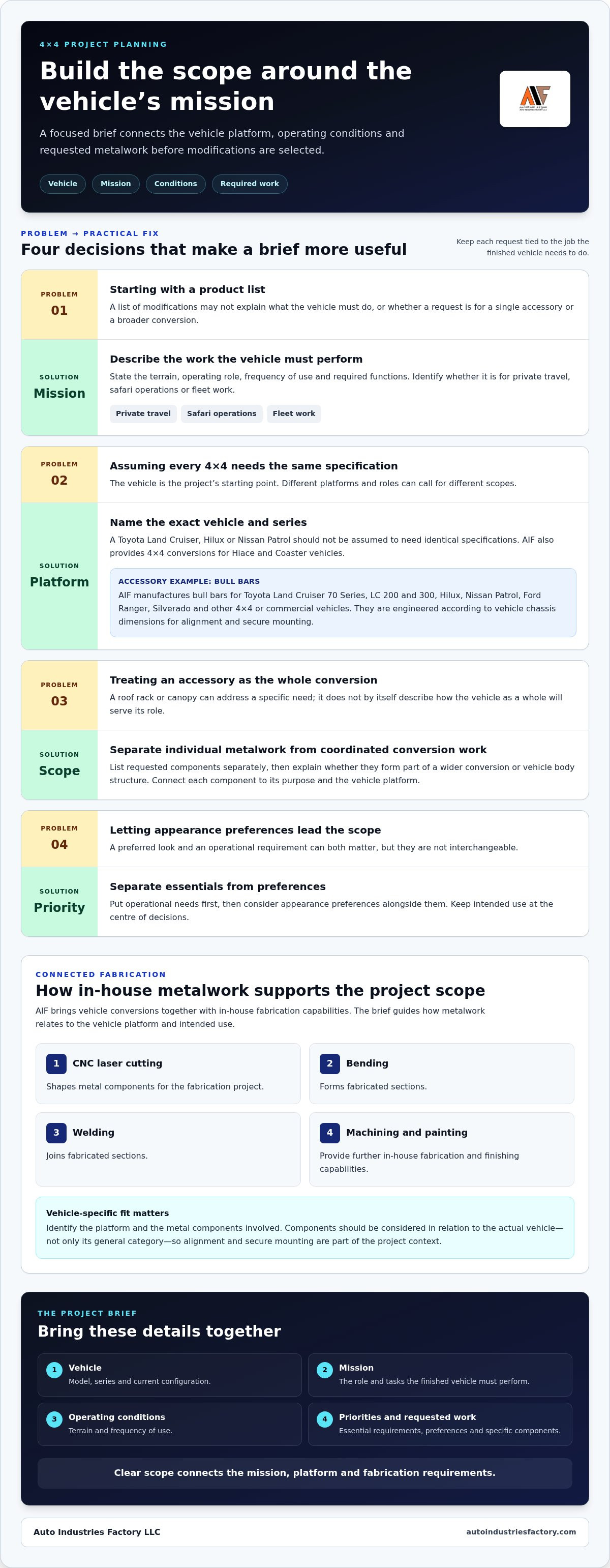
Begin with the job the vehicle must do, not a list of products. Describe the terrain, operating role, frequency of use, and functions required from the finished vehicle. Be specific about whether it is for private travel, safari operations, or fleet work. This context helps connect fabrication decisions to practical requirements rather than appearance alone.
Next, separate essential requirements from preferences. An operational requirement should lead the scope; a preferred look can be considered alongside it. Both may matter, but they are not interchangeable. Keep the intended use at the centre of the project, then weigh appearance preferences against the vehicle’s role. This gives a custom 4x4 fabrication UAE project a clear starting point.
Which vehicle platforms can shape the project scope?
The vehicle platform is a key part of the brief because each vehicle is a different starting point. A Toyota Land Cruiser, Hilux, or Nissan Patrol may each suit a different project scope. Do not assume they should receive identical specifications. The intended role, vehicle, and required metalwork all inform the work. AIF also provides 4x4 conversions for Hiace and Coaster vehicles, illustrating how project needs can vary by platform.
Describe accessory requests separately from broader conversion work. AIF manufactures bull bars for Toyota Land Cruiser 70 Series, LC 200 and 300, Hilux, Nissan Patrol, Ford Ranger, Silverado, and other 4x4 or commercial vehicles. Its bull bars are engineered according to vehicle chassis dimensions to ensure perfect alignment and secure mounting. State the exact vehicle model and series so the accessory request is tied to the right platform.
Before discussing fabrication, record the vehicle model and explain what it needs to do. Connecting the mission, platform, and requested work gives the project a practical foundation.
How In-House 4x4 Fabrication Connects Metalwork to Vehicle Performance
A 4x4 conversion can involve more than fitting an accessory. Metal components and vehicle modifications need to be considered together when they form part of the same project. Auto Industries Factory LLC coordinates this work with in-house CNC laser cutting, bending, welding, machining, and painting. These capabilities connect the fabrication scope to the vehicle platform and intended use.
Coordinating component production and vehicle conversion in one workflow helps keep the fabrication scope connected to the vehicle and project requirements. This is particularly relevant when metalwork forms part of a wider conversion or vehicle body structure. AIF provides customized solutions from design through final inspection, with precision and reliability central to the process.
What fabrication processes contribute to a 4x4 project?
Each process has a different role. CNC laser cutting shapes metal components, bending forms them, welding joins fabricated sections, and machining supports further component work. Painting is also handled in-house. Together, these capabilities support metalwork for vehicle conversions and body structures, with the project brief guiding the work.
- CNC laser cutting: Shapes metal components for the fabrication project.
- Bending and welding: Form and join fabricated sections.
- Machining and painting: Provide further in-house fabrication and finishing capabilities.
Why does vehicle-specific fit matter?
Components need to be considered in relation to the actual vehicle platform, not just its general category. Alignment and secure mounting matter when metalwork becomes part of a vehicle’s working configuration. The appropriate scope depends on the project and platform, so do not assume a component intended for one model will suit another without adaptation.
Bull bars are a clear example: AIF engineers them according to vehicle chassis dimensions to ensure perfect alignment and secure mounting. This connects fabrication to the vehicle’s structure and shows why the platform and metalwork requirements belong in the same brief.
When describing a project, identify the metal components involved, explain their purpose, and name the vehicle platform. AIF’s vehicle conversion and fabrication services bring these capabilities together for work tailored to operational requirements. Precision in fabrication supports reliable integration, while the agreed scope remains the guide for the build.
Compare 4x4 Fabrication Options by Vehicle, Use, and Project Scope
Two projects can use the same vehicle and still need different scopes. A private 4x4 for recreational travel has a different role from a vehicle used for safari operations. Compare options by intended use, base vehicle, required fabrication, and how much of the vehicle needs modification. This makes it easier to distinguish a complete operational build from a request for one accessory.
When is a conversion scope different from an accessory order?
A conversion modifies a vehicle for a defined operational role. Its scope connects the platform with the work required to support that role. An accessory order is narrower and focuses on an individual item, such as a bull bar, bumper, metal canopy, or roof rack. AIF’s bull bars are engineered according to vehicle chassis dimensions to ensure perfect alignment and secure mounting. An accessory can support a broader vehicle setup, but ordering one alone is not the same as commissioning a complete conversion.
| Project purpose | Relevant AIF service category | Scope to describe |
|---|---|---|
| Safari operations | Safari Vehicle Conversions | Vehicle platform, operating role, and conversion work required for the safari use case. |
| Off-road or overland use | 4x4 Conversion (UAE) | Intended use, base vehicle, and whether the request is a broader conversion or specific metalwork. |
| A single fabricated component | Custom Bull Bars and Bumpers, or Metal Canopies and Roof Racks | Identify the requested accessory and vehicle. AIF bull bars are engineered according to vehicle chassis dimensions to ensure perfect alignment and secure mounting. |
How should buyers compare potential build approaches?
Use the table to clarify scope, not to assume every vehicle in a category receives the same specification. A safari conversion is defined by its operating role. An off-road or overland project needs its own use case under the broader 4x4 Conversion (UAE) category. A single accessory request is different again. The vehicle and its requirements determine the appropriate scope.
For a useful comparison, record these details for each approach:
- Intended use: State the role the vehicle must perform.
- Base vehicle: Name the platform so the work relates to the actual vehicle.
- Fabrication scope: Distinguish an individual accessory from work within a wider conversion.
- Coordination: Note whether the project involves vehicle conversion and metalwork together.
Give safari requirements their own brief. AIF’s safari vehicle conversion and custom metal fabrication capabilities bring fabrication together with conversion work, with the scope tailored to the vehicle and its use. For a standalone accessory, focus the request on that component. For a broader build, describe the full operational role so the project can be considered as a coordinated scope.
This distinction makes comparisons more useful. A roof rack request should not be compared with a full conversion as though they were equivalent projects. Compare conversion options against the same mission and vehicle platform.
Prepare a Clear Brief for Your UAE 4x4 Fabrication Project
A clear brief connects the vehicle, its operating role, and the requested work before fabrication begins. For custom 4x4 fabrication UAE, that shared understanding supports precision, reliability, engineered safety, and planning for on-time delivery.
What information should the project brief include?
Build the brief in sequence. Keep each point specific, and distinguish operational requirements from preferences.
- Define the mission. Describe the vehicle’s intended role, who will use it, and what it must do. Note relevant terrain and operating conditions, such as regular desert use or safari operations.
- Identify the vehicle. Record its make and model, along with details that identify the platform. The project scope should relate to the actual vehicle, not just a broad category such as “4x4.”
- Describe its current configuration. List existing modifications or accessories relevant to the requested work. Explain how the new work needs to relate to the vehicle as it is currently configured.
- Specify the required work. Name the conversion or fabrication work and explain the purpose of each item. Separate an individual accessory from a wider conversion, and mark which requirements are essential and which are preferences.
- Share priorities and constraints. Explain how the vehicle will be used and what matters most in its operation. Include project constraints that affect the requested scope.
For example, a useful brief might identify a vehicle intended for regular safari operations, describe its current configuration, and list the requested conversion work with the reason for each item. That gives the project a clearer basis than a general request for a rugged build because it links the work to a defined purpose.
How can the project stay aligned through fabrication?
Before fabrication starts, align the project scope with the vehicle platform and requirements for each requested item. If the purpose changes or new work is added, update the brief so the overall project remains connected to the intended use.
Auto Industries Factory LLC coordinates vehicle conversion with in-house fabrication, including CNC laser cutting, bending, welding, machining, and painting. Connecting these capabilities to the agreed brief helps keep metalwork and conversion requirements aligned, with precision and reliability central to the work. Explore AIF’s vehicle conversion and fabrication services in relation to your project scope.
Once your mission, vehicle details, current configuration, and required work are documented, you can begin the estimate process. GET FREE ESTIMATE
Choose AIF for Precision-Engineered 4x4 Conversion and Fabrication
A successful 4x4 project connects the vehicle’s operating role with the work carried out on it. Auto Industries Factory LLC provides 4x4 Conversion (UAE), Safari Vehicle Conversions, and Metal Fabrication, bringing vehicle modification and metalwork together under one roof. This coordinated approach keeps project requirements in view from the agreed scope through fabrication and final inspection.
For custom 4x4 fabrication UAE, coordination matters because a conversion and its metal components may be related parts of the same build. In-house CNC laser cutting, bending, welding, machining, and painting support this work. The scope is aligned with the vehicle platform and operational needs, with precision, reliability, engineered safety, and on-time delivery as priorities.
What makes AIF’s approach relevant to custom 4x4 work?
AIF tailors work to vehicle platforms and operational requirements, including use in rugged terrain, desert conditions, and extreme environments. Bringing conversion and fabrication capabilities together supports coordination across the project, rather than treating each metal component as an isolated task. AIF’s fabrication approach connects the work to the requirements of the vehicle and its intended use.
This approach applies to a broader 4x4 conversion, a safari vehicle conversion, or fabrication within a defined vehicle scope. Begin with the specific vehicle and how it will be used. AIF’s in-house processes support coordinated metalwork, while the agreed project requirements guide the work.
What is the next step for a 4x4 project?
Prepare a concise brief with the vehicle make and model, intended use, current configuration, and requested conversion or fabrication work. Explain the purpose of each item, along with relevant operating conditions, priorities, and project constraints. These details establish a clear basis for discussing scope and vehicle-specific requirements before fabrication begins.
Share your vehicle details and project requirements with Auto Industries Factory LLC to begin the estimate process. GET FREE ESTIMATE
Turn Your 4x4 Requirements Into a Practical Next Step
A well-planned build begins with clear decisions: what the vehicle needs to do, which requirements matter most, and what work belongs in the project scope. That clarity helps shape custom 4x4 fabrication UAE around the vehicle and its intended role.
As you move from planning to project discussions, consider how conversion and metalwork will work together. AIF coordinates vehicle conversion with in-house CNC laser cutting, bending, welding, machining, and painting. These capabilities support a coordinated process grounded in precision, reliability, engineered safety, and on-time delivery. The project requirements guide the work and keep decisions connected to the vehicle’s operation.
Bring the vehicle details, intended use, and requested scope together in one brief. Discuss your 4x4 project with AIF to take the next step.
Frequently Asked Questions
Can AIF convert a Toyota Hiace to 4x4?
Yes. AIF provides 4x4 conversion service for Toyota Hiace and Coaster vehicles. Identify the vehicle and explain its intended use, such as a defined work role or safari operation. That context helps frame the conversion around the vehicle’s requirements.
Which vehicles can AIF make custom bull bars for?
AIF manufactures bull bars for Toyota Land Cruiser 70 Series, LC 200 and 300, Hilux, Nissan Patrol, Ford Ranger, Silverado, and other 4x4 or commercial vehicles. State the vehicle model and series accurately, since specifications for one platform should not be assumed to apply to another. AIF bull bars are engineered according to vehicle chassis dimensions to ensure perfect alignment and secure mounting.
Does AIF provide complete 4x4 conversions or only metal accessories?
AIF provides 4x4 Conversion (UAE) and Safari Vehicle Conversions, as well as metal fabrication and accessories such as bull bars, canopies, and roof racks. Its bull bars are engineered according to vehicle chassis dimensions to ensure perfect alignment and secure mounting. A conversion addresses a vehicle’s intended role; an accessory request focuses on a particular component. For custom 4x4 fabrication UAE, specify whether you need a broader conversion, an individual fabricated item, or both.
Can AIF fabricate a custom metal canopy or roof rack?
Yes. AIF fabricates metal canopies and roof racks. Describe the vehicle and the component’s intended use, then specify whether you need a canopy, a roof rack, or both. A custom-fabricated component is engineered for the specific vehicle model. Include the function you need so the request is clear.
Does AIF offer electric winch kits for 4x4 vehicles?
Yes. AIF offers electric winch kits with a 12-volt (or sometimes 24-volt) DC motor that draws power from the vehicle battery. Include the vehicle details and intended application in your request so the kit is considered in its specific context.
What information should I provide when requesting a 4x4 fabrication estimate?
Provide the vehicle make and model, its intended operating role, and a clear description of the conversion or fabrication work requested. Include relevant operating conditions and priorities. For a fleet request, clarify whether the scope covers one vehicle or several, and identify any differences between them. These details give the estimate process a practical project-specific starting point.


