

The toughest-looking safari truck isn’t automatically the right choice for a rental fleet. The safari truck rental conversion specs that matter are those matched to repeated use: route conditions, passenger and luggage needs, and the demands placed on the vehicle day after day. Listings often leave out these details, making it difficult to compare builds or understand what a conversion covers.
A fleet-ready build is an engineered system, not a collection of accessories. Assess the base vehicle, suspension, protective body modifications, passenger layout, interior, and roof-rack requirements against your operating pattern. The goal is a practical purchasing brief, not assumptions based on appearance.
This guide explains how to compare specifications across platforms such as the Toyota Land Cruiser and Hilux, and what to include when briefing a conversion. Auto Industries Factory LLC converts safari and off-road vehicles, with in-house fabrication capabilities for tailored builds. A clear brief gives the project a precise starting point and keeps decisions aligned with the vehicle’s intended role.
Key Takeaways
- Separate the needs of choosing a hire vehicle from the decisions involved in commissioning a fleet conversion.
- Use safari truck rental conversion specs to compare platforms, suspension, protection, interiors, and accessories against the vehicle’s intended role.
- Map route conditions, passenger requirements, luggage, and operating frequency before settling on a configuration.
- Build a specification checklist that records the base vehicle, conversion scope, and acceptance requirements.
- See how in-house fabrication processes support tailored safari and off-road vehicle conversions.
Safari Truck Rental Conversion Specs: What Buyers Need to Define
Rental-ready performance starts with a clear build brief, not a hire listing. Safari truck rental conversion specs are the agreed requirements for the base vehicle, its functional setup, and the fabrication needed for a defined role. They turn a broad goal such as “suitable for desert tours” into decisions that can be compared, built, and reviewed.
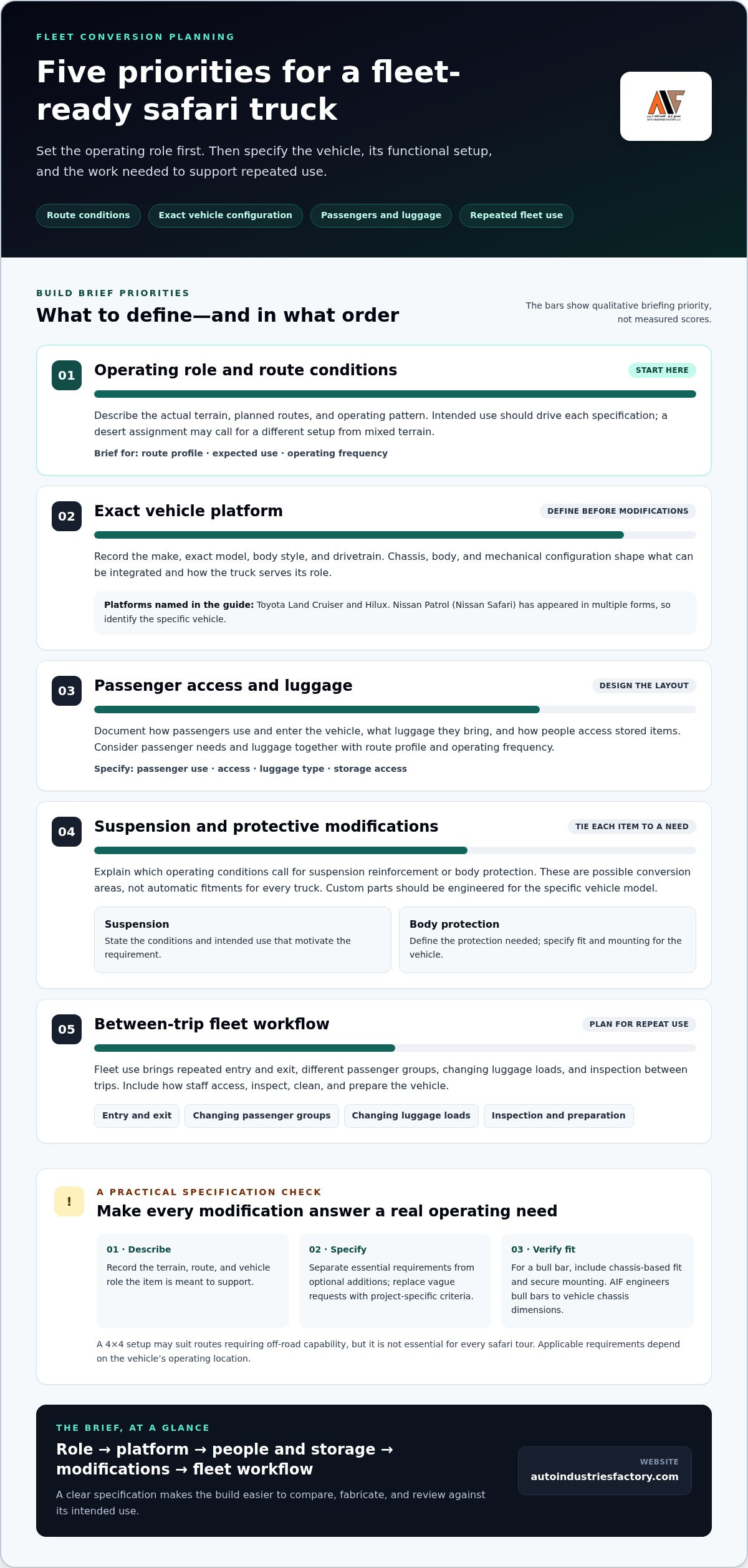
Intended use should determine every conversion specification, from the vehicle platform to the passenger area and protective modifications. A vehicle assigned to desert routes may need a different configuration from one used on mixed terrain, even when both builds start with the same platform. Auto Industries Factory LLC provides safari and off-road conversions shaped around the vehicle’s operating role. Its vehicle conversion services include safari vehicle conversions.
Which decisions belong in a safari truck specification?
Organize the build brief into categories so each requirement has a clear place and can be reviewed against the vehicle’s role:
- Vehicle: identify the make, exact model, body style, and drivetrain configuration.
- Performance and protection: describe the route conditions and the suspension requirements or protective body modifications needed for those conditions.
- Passenger and storage areas: document passenger use, interior needs, luggage type, and how people access stored items.
Then label each item essential or optional. Replace vague requests with project-specific criteria, such as the passenger and luggage needs or the parts of the vehicle that require protection. Don’t assume there is one standard dimension or setup for every fleet. Clear requirements make it easier to distinguish necessary work from additions that do not serve the assigned role.
How rental-fleet use changes the conversion brief
Fleet use brings repeated entry and exit, different passenger groups, changing luggage loads, and inspection between trips. Those patterns make practical layouts and durable material and fabrication choices central to the brief. Define how staff need to access, inspect, and prepare the vehicle, rather than focusing only on the passenger experience during a single outing.
Vehicle platforms also differ in body styles and mechanical configurations. For example, the Nissan Patrol (Nissan Safari) has appeared in multiple forms, so identify the specific vehicle rather than relying on a model name alone. For broader context on conversion planning, consult the safari vehicle conversion guide.
Core Safari Truck Conversion Specifications: Platform, Suspension, and Protection
Set the vehicle platform before choosing modifications. The chassis, body style, and drivetrain shape what can be integrated and how the finished truck will serve its fleet role. Auto Industries Factory LLC converts Toyota Land Cruiser and Hilux platforms, aligning conversion decisions with intended routes, passenger use, and operating requirements rather than treating one configuration as suitable for every tour.
Each modification in the brief should answer a specific operating need, not simply add equipment to the vehicle. A 4×4 setup may suit routes that require off-road capability, but it shouldn’t be treated as essential for every safari tour. Describe the actual terrain and expected use, then consider whether the platform and proposed modifications fit that assignment.
Choosing the vehicle platform for the operating role
Specifying suspension and protective body modifications
Suspension reinforcement is a possible conversion area, not an automatic fitment for every truck. Describe the operating conditions and intended use that motivate it. Protective body modifications should also answer a defined requirement, and any custom-fabricated parts should be engineered for the specific vehicle model. That makes the proposed work easier to evaluate against both the vehicle and its role.
For a bull bar, fit and mounting are central to the specification. AIF’s bull bars are engineered according to vehicle chassis dimensions to ensure perfect alignment and secure mounting. The U.S. OSHA Motor Vehicle Safety Regulations outline requirements for vehicles in off-highway jobsites, including braking and lighting considerations. This is a U.S. reference, not a statement of local requirements. Use it as context, while defining the applicable requirements for the vehicle’s operating location separately.
Make the conversion brief specific enough to guide fabrication and review. For each proposed item, record:
- Operating need: the route condition or fleet task the modification addresses.
- Vehicle reference: the exact platform and model the work is engineered for.
- Scope: the body area or suspension requirement involved, plus relevant integration considerations.
- Review criteria: how the completed work will be assessed against the agreed brief.
This approach keeps safari truck rental conversion specs tied to real use and gives the build team a clear basis for decisions. AIF’s safari vehicle conversion work brings together vehicle modifications and fabrication capabilities to support role-specific builds.
Compare Safari Truck Configurations Against Routes and Passenger Needs
A useful comparison starts with the assignment, not a universal “best” build. A Toyota Land Cruiser or Hilux can serve different tour roles, so route conditions, passenger use, luggage, and operating frequency should shape the conversion brief. Use the table to compare priorities before detailing the project-specific specification.
| Operating profile | Route considerations | Passenger and luggage needs | Conversion areas to define |
|---|---|---|---|
| Mainly maintained routes | Describe the regular route surface and any occasional off-road sections. | Set out who uses the vehicle and what luggage travels on typical trips. | Specify whether suspension reinforcement or protective body modifications address an identified operating need. |
| More demanding off-road use | Document the terrain and conditions the fleet expects the vehicle to encounter. | Explain how passenger use and luggage requirements affect the vehicle’s assigned role. | Assess suspension and protection requirements against the route profile and the specific vehicle. |
| Frequent fleet operation | Describe how often the vehicle is expected to operate and across which route types. | Consider repeated passenger use, luggage handling, and the interior’s intended function. | Define practical priorities for the interior, roof racks, suspension, and body protection. |
These are comparison prompts, not prescribed packages. Auto Industries Factory LLC’s conversion work can include reinforced suspensions, protective body modifications, custom interiors, and roof racks. The table identifies areas to consider; exact configurations, dimensions, and requirements belong in the individual project brief. Compare proposals using the same operating profile so differences in scope are easy to identify.
Match conversion choices to the route profile
A vehicle used mainly on maintained routes may have different protection and suspension requirements from one assigned to more demanding off-road conditions. Record the regular route profile, including where the vehicle leaves maintained surfaces and how often that happens. Use those details to decide whether suspension reinforcement or protective body modifications suit the intended role. A route label alone is not enough to determine the specification; describe the conditions the vehicle is expected to encounter.
Balance passenger space, interior, and luggage requirements
Define passenger use and luggage needs in practical terms: who will travel, what they’ll carry, and how the vehicle must accommodate those items. Custom interiors can be planned around the fleet’s passenger role, while roof racks may be relevant when luggage or equipment needs to be carried externally. Specify the configuration for the particular build instead of assuming a standard layout or load rating.
The same platform may therefore lead to different conversion choices. A truck assigned to maintained routes with a particular passenger and luggage profile could have different priorities from one used frequently off-road, even if both are based on a Land Cruiser or Hilux. Compare each proposal against route conditions, passenger use, luggage, and operating frequency. Then record which modifications are essential and which are optional. This keeps safari truck rental conversion specs grounded in the fleet’s actual use, without ranking one configuration as universally superior.
Build a Safari Truck Conversion Specification Checklist
A strong conversion brief lets the fleet buyer and build team work from the same requirements. It records the vehicle’s role, the changes requested, and how the completed work will be reviewed. Use this checklist to turn operating needs into clear safari truck rental conversion specs without assuming standard dimensions or a one-size-fits-all package.
What to document before requesting a conversion
Start with the operating role, then capture the vehicle and its intended use. For every requested modification, distinguish a required outcome from an optional enhancement. If a detail depends on project design, mark it as a point to resolve in the agreed scope instead of presenting an unsupported measurement as a fixed specification.
- Define the operating role. Describe the tour use, operating pattern, and main requirements the converted vehicle must support.
- Identify the base vehicle. Record the make, exact model, body style, and relevant vehicle configuration so the brief is tied to the intended platform.
- Describe the routes. Note the route profile, including maintained routes and any off-road conditions relevant to the vehicle’s assignment.
- Set out passenger needs. Explain how passengers will use the vehicle and what the passenger area must accommodate, without assuming a standard seating layout.
- Record luggage requirements. Describe the luggage or equipment carried and whether storage inside the vehicle or roof racks form part of the brief.
- List suspension and protection needs. Identify requested suspension reinforcement or protective body modifications, linking each to an operating requirement.
- Specify the interior and accessories. Include custom interior requirements and relevant accessories, separating essential items from optional additions.
- Classify each requirement. Mark items as essential, optional, or dependent on project design so priorities remain visible during scope discussions.
- Document acceptance expectations. Record the agreed fabrication scope and the final inspection expectations used to review the completed work.
How to review scope and acceptance requirements
Before approving the brief, check that every requested modification maps to a stated operating need. Confirm that the agreed scope describes what will be fabricated and what the final inspection will cover. Keep applicable compliance or registration checks specific to the jurisdiction where the vehicle will operate, and verify those requirements through the relevant channels.
This process also helps separate a firm requirement from a preference. A roof rack, for example, may be essential for one operating role and optional for another. Record the intended use without adding an unverified load rating or dimension. Clear distinctions keep decisions traceable from the initial brief through final review.
With the requirements organized, explore AIF’s conversion services for safari and off-road builds, supported by in-house fabrication capabilities including CNC laser cutting, bending, welding, machining, and painting.
AIF Safari Vehicle Conversions: From Requirements to Precision Fabrication
A safari fleet conversion is strongest when the brief, vehicle, and fabrication scope are aligned from the outset. Auto Industries Factory LLC converts safari and off-road vehicles, including Toyota Land Cruiser and Hilux platforms. Builds can be tailored to the vehicle’s operating role, with project decisions guided by practical use, reliability, and engineered-for-safety priorities.
AIF’s in-house fabrication capabilities include CNC laser cutting, bending, welding, machining, and painting. Together, these disciplines support precision fabrication for vehicle conversion work. They provide a practical foundation for translating agreed requirements into fabricated components while keeping the scope specific to the vehicle and its intended use. Solutions can be customized from design through final inspection.
How in-house fabrication supports a tailored conversion
Each fabrication method has a role in project-specific work. Cutting and bending prepare metal components; welding and machining support their fabrication and fit; painting completes the stated finishing capability. The right combination depends on the conversion scope. Custom-fabricated parts are engineered for the specific vehicle model, keeping the build brief grounded in the actual platform rather than a generic template.
AIF’s in-house capabilities connect the requested work with the methods used to produce it. For fleet buyers, a practical way to use that capability is to define the requirement, record the intended function, and make the fabrication scope clear for review through final inspection. This supports precision, reliability, and a build engineered for safety.
Prepare a clear brief for your safari fleet build
Before discussing scope, gather the details that guide build decisions. Keep the brief concise but specific, and distinguish required outcomes from optional enhancements. Include:
- Vehicle: make, exact model, and relevant configuration.
- Operating role: the tour use and expected operating pattern.
- Routes: the route demands the vehicle is intended to handle.
- People and cargo: passenger needs, luggage, and storage requirements.
- Requested modifications: suspension, protective body work, interior, roof racks, or other relevant conversion items.
- Project expectations: agreed fabrication scope, inspection expectations, and delivery requirements.
Use the discussion to connect each modification to a clear fleet need and align the scope with priorities for reliability and safety. If on-time delivery is important to operations, state the required schedule as a project expectation without assuming a timeline. Clear safari truck rental conversion specs focus decisions and give the build team a defined basis for the work.
For a tailored safari or off-road build, request a safari vehicle conversion estimate.
Turn Your Fleet Requirements into a Build Brief
Put the intended vehicle role and fleet priorities into a brief the conversion team can act on. Clear requirements give each build decision a purpose and keep the project focused on how the truck will be used. Strong safari truck rental conversion specs start with that clarity, then develop through a scope shaped around your operating needs.
Auto Industries Factory LLC provides Safari Vehicle Conversions and 4×4 Conversion services, supported by in-house CNC laser cutting, bending, welding, machining, and painting. Bring your vehicle details and operating requirements together to make the estimate request specific and useful.
Request a safari vehicle conversion estimate and take the next step toward a fleet build shaped around your requirements. A clear brief is a strong foundation for moving forward with confidence.
Frequently Asked Questions
What specifications matter most when converting a truck for safari rental use?
The most important specifications are those that determine whether the truck suits its assigned role: vehicle configuration, route demands, passenger use, luggage, suspension, body protection, interior, and accessories. For a fleet, also record how often the truck will operate and what staff need to inspect between trips. This makes safari truck rental conversion specs useful for comparing proposed builds, rather than simply describing visible equipment.
Is a 4×4 conversion necessary for every safari truck?
No. A 4×4 conversion isn’t necessary for every safari operation. The requirement depends on the routes and tasks assigned to the vehicle. A truck used mainly on maintained routes may have different needs from one expected to travel off-road. Describe the route profile and operating conditions in the brief, then assess drivetrain and modification choices against those demands. Avoid adding 4×4 capability solely because it’s commonly associated with safari vehicles.
Can a Toyota Land Cruiser or Hilux be converted for safari use?
Yes. Auto Industries Factory LLC converts Toyota Land Cruiser and Hilux vehicles for safari and off-road use. Identify the exact model and configuration because conversion decisions need to suit the specific vehicle, not just the nameplate. If a fleet is planning more than one model, document each vehicle separately so the requested modifications and fabrication scope remain clear for each platform.
What should a safari truck conversion brief include?
A useful brief identifies the vehicle, its operating role, route profile, passenger requirements, luggage needs, and requested modifications. Separate essential outcomes from optional features, and note where a detail depends on project design. For example, describe what storage must accommodate rather than guessing a dimension. Include how the completed work will be reviewed so the build scope and final inspection expectations are clear before fabrication begins.
How much does a safari truck conversion cost?
The cost depends on the vehicle and conversion scope, so there isn’t one reliable fleet-wide figure. A build with a limited set of modifications differs from one requiring several vehicle-specific changes. For a useful estimate, provide the exact vehicle details and distinguish required work from optional additions. Auto Industries Factory LLC can prepare an estimate based on the safari conversion requirements described for the project.
How do I compare safari truck conversions for a rental fleet?
Compare builds against the same use case. Check that each proposal addresses comparable routes, passenger needs, luggage, operating frequency, and requested modifications. Then compare the stated fabrication scope and inspection expectations, not just the accessory list. If vehicles will serve different tour roles, evaluate each configuration against its own assignment. This avoids treating a feature-rich build as automatically better than one more closely matched to fleet use.
What does a safari vehicle conversion process involve?
A safari conversion process starts by defining the vehicle’s role and agreeing on the work that supports it. The project scope guides the required fabrication and vehicle modifications, followed by review against the agreed inspection expectations. At Auto Industries Factory LLC, solutions can be customized from design through final inspection. Document the requirements throughout the project so the intended function remains clear and the work stays focused on precision, reliability, and safety.


