

A tactical vehicle should be specified from the mission outward, not chosen from a catalogue inward. For any tactical vehicle conversion UAE project, first define what the vehicle must do, where it will operate, and what its crew and equipment need from the platform.
Turning a mission brief into a practical specification takes coordination. The base vehicle affects the conversion scope, and structural modifications must work alongside any planned onboard systems. This guide explains how to write a useful brief, compare platform suitability, and plan a conversion around safety, reliability, and delivery coordination.
You’ll learn what to define before selecting a platform, how to plan fabrication and systems integration, and which operational and approval requirements to include in the project plan. Auto Industries Factory LLC provides military modifications, troop vehicle conversions, and police vehicle conversions, supported by in-house CNC laser cutting, machining, bending, welding, and painting. These capabilities support customized projects coordinated from design through final inspection, with the build focused on its intended mission.
Key Takeaways
- Write the mission brief around the vehicle’s role, operating environment, crew, and fleet needs before defining the conversion scope.
- Compare platform examples such as the Toyota Land Cruiser, Nissan Patrol, and Ford Ranger against the intended role, rather than choosing by name alone.
- Plan structural work and mission-specific systems together, and capture fabrication requirements in the project brief.
- For a tactical vehicle conversion UAE project, map requirements, fabrication, and final inspection in sequence, including any applicable fleet approvals.
- Coordinated in-house cutting, machining, bending, welding, and painting can support a customized conversion project.
Tactical Vehicle Conversion in the UAE: Define the Mission Before the Build
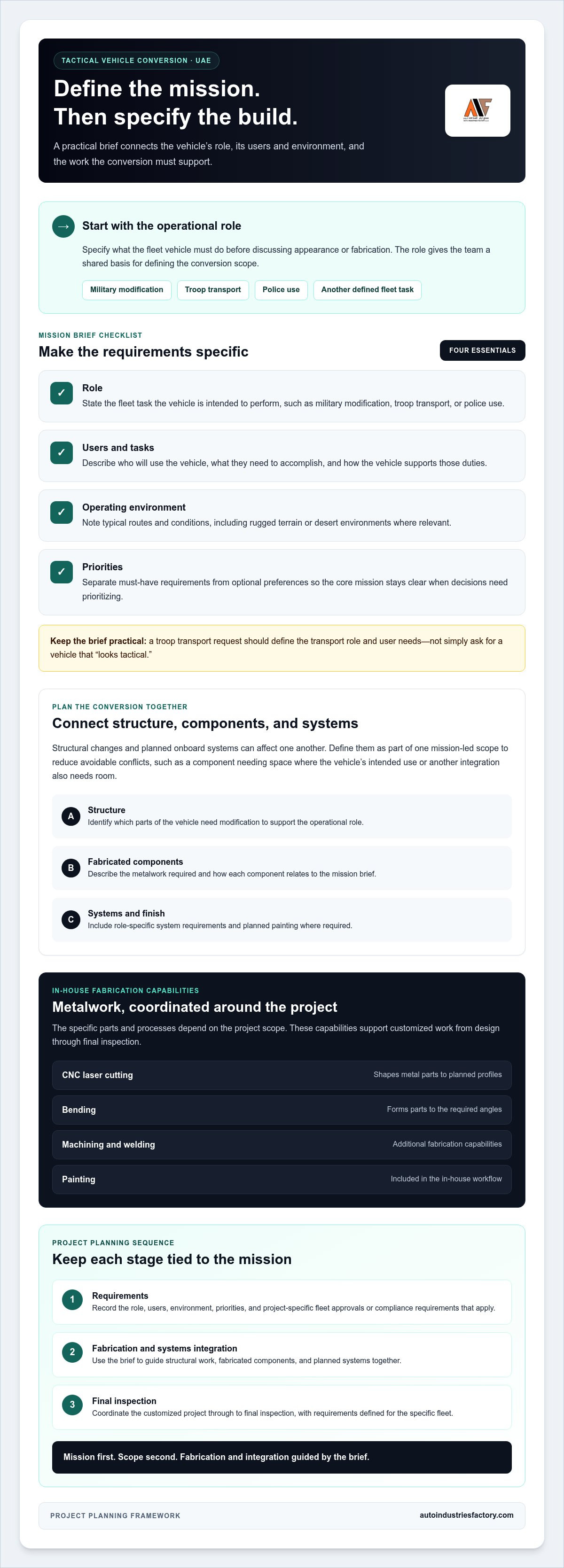
A vehicle can look specialized and still be poorly matched to the work it must perform. A successful tactical vehicle conversion UAE project starts by defining the fleet’s operational role, then translating it into requirements for the people using the vehicle, its working environment, and the tasks it needs to support.
A tactical vehicle conversion adapts a vehicle to meet the practical requirements of a specific operational role. That role might involve military modification, troop transport, or police use. The term “technical” is also used for improvised tactical vehicles, often based on civilian pickups, as described in the reference on Technical (vehicle). A planned fleet conversion should begin with a defined brief, not appearance alone.
Keep the scope focused on the intended role. For example, specify the crew’s tasks, the operating environment, and the vehicle functions the conversion must support. Auto Industries Factory LLC undertakes police and military vehicle modifications and troop vehicle conversions, with customized work coordinated from design through final inspection. Its specialized vehicle conversion services are shaped around each project’s requirements.
What should a tactical vehicle conversion brief specify?
Start with clear answers rather than assumptions. Record the intended role and operating context before discussing fabrication. This gives the project team a shared basis for defining the conversion scope and separating essential requirements from preferences.
- Role: State whether the vehicle is intended for military modification, troop transport, police use, or another defined fleet task.
- Users and tasks: Describe who will use the vehicle, what they need to accomplish, and how the vehicle supports those duties.
- Operating environment: Note typical routes and conditions, including rugged terrain or desert environments where relevant.
- Priorities: Separate must-have requirements from optional preferences to keep the core mission clear when decisions need to be prioritized.
For example, a troop transport brief should define the transport role and user needs, not simply request a vehicle that “looks tactical.” Record specific requirements in the project brief so they can guide the conversion scope.
Why does mission definition matter for UAE fleets?
Fleet vehicles may serve different roles and operate under different conditions across the UAE. A clear brief helps align the chosen platform with the intended work, then connects that choice to structural fabrication and planned systems integration. It also gives fleet decision-makers a consistent basis for comparing requirements instead of treating one configuration as suitable for every role.
Include project-specific fleet approval and compliance requirements in the planning discussion, and identify which apply to the intended vehicle and use. Requirements can vary by project, so define them for the specific fleet rather than assuming another fleet’s approvals or configuration will apply. A well-defined mission gives the conversion team a disciplined starting point for precision and reliability.
How Tactical Vehicle Conversion Integrates Structure, Systems, and Mission Needs
A mission brief becomes a workable conversion scope when it connects three elements: the vehicle’s structure, the components being fabricated, and any systems needed for its role. Treating these as separate decisions can create avoidable conflicts. For example, a component may need to fit in a particular location while leaving room for the vehicle’s intended use and other planned integrations.
Mission requirements should define the conversion scope, so every structural change and system requirement serves the vehicle’s intended role. This principle keeps a tactical vehicle conversion UAE project focused on practical needs rather than modifications added for appearance alone.
How does fabrication support a mission-specific vehicle?
Fabrication turns project requirements into physical components. CNC laser cutting shapes metal parts to planned profiles, while bending forms them to the required angles. Machining and welding are additional fabrication capabilities, and painting is also part of Auto Industries Factory LLC’s in-house workflow. The specific parts and processes depend on the project scope.
Keeping these capabilities in-house supports coordination across customized metalwork, from cutting and forming through welding and painting. This provides a connected fabrication workflow while allowing the work to reflect each project’s requirements. AIF emphasizes precision, reliability, and engineered safety, with customized vehicle solutions coordinated from design through final inspection.
- Structure: Identify which parts of the vehicle need modification to support the operational role.
- Fabricated components: Describe the metalwork required and how each component relates to the mission brief.
- Finish: Include painting in the planned fabrication workflow where required.
This structure-first approach keeps fabrication decisions tied to the intended use. It also helps distinguish physical modifications from systems that need separate integration planning.
How should vehicle systems fit the operational role?
Define system requirements around tasks, not assumptions. If a project includes electrical or communication systems, record them as distinct integration needs and explain how they relate to the vehicle’s structure and use. Avoid adding equipment simply because it appears on another vehicle. Requirements should follow the specific fleet role and project brief.
For example, a vehicle assigned to a particular operational task may need a different layout and integration plan from one assigned to troop transport. Not every role needs a complex system package. The important point is to consider structural work and planned systems together, so the scope is clear before fabrication begins.
For a separate overview of armoured personnel carrier design and roles, see this armoured personnel carrier guide. Fleets planning a customized vehicle scope can also explore AIF’s specialized vehicle conversion services, supported by in-house cutting, machining, bending, welding, and painting.
Choosing a Tactical Vehicle Platform in the UAE: Match the Base Vehicle to the Role
The right base vehicle isn’t necessarily the one with the strongest reputation or the most imposing appearance. It’s the one whose format, intended use, and fleet context align with the conversion brief. Toyota Land Cruiser, Nissan Patrol, and Ford Ranger are examples to assess, not universal recommendations. For a tactical vehicle conversion UAE project, compare each candidate against the same operational criteria before choosing a platform.
| Role | Operating environment | Vehicle format to assess | Fleet requirements |
|---|---|---|---|
| Military modification | Routes and conditions defined by the project, including rugged terrain where relevant | Assess a 4×4 or commercial vehicle format against the planned conversion scope | Consider fleet consistency, intended tasks, and project-specific requirements |
| Troop transport | Operating conditions and route profile identified in the brief | Assess whether the proposed format supports the transport role and planned modifications | Set out passenger, equipment, and operational needs without assuming a standard layout |
| Police use | Conditions and duties specified for the law-enforcement fleet | Compare the candidate format with the tasks and conversion scope | Account for fleet use and applicable project requirements |
Which platform characteristics should fleet teams compare?
Start with the role, then assess the vehicle format and the work the conversion requires. Is the project suited to a 4×4 or a commercial vehicle conversion? Will the operating environment shape structural or fabricated components? Fleet standardization may also influence selection when common platforms support consistent planning. Keep comparisons of dimensions, payload, engine, and performance tied to verified manufacturer specifications for the exact vehicle and variant.
AIF’s 4×4 and commercial vehicle conversion services support project-specific vehicle transformations. Connect platform choice to actual fleet needs, rather than assumptions based on a model name. Use the Toyota Land Cruiser, Nissan Patrol, and Ford Ranger as examples for comparison, without treating any as inherently better suited.
How do tactical and troop-transport requirements differ?
Military modifications describe a broad operational category; troop vehicle conversions focus on a transport role. That distinction can change the brief. A transport project needs to define passenger and equipment needs, while another military modification may prioritize different operational tasks. Specify requirements for the particular vehicle and project rather than assuming seating capacity or protection levels.
For law-enforcement fleet considerations, explore this police vehicle modifications guide. Auto Industries Factory LLC undertakes police and military vehicle modifications and troop vehicle conversions. Its specialized vehicle conversion services can support a project plan that links the chosen base vehicle with its intended role and fabrication scope.
Planning a Tactical Vehicle Conversion in the UAE: Requirements, Fabrication, and Inspection
A well-planned tactical vehicle conversion UAE project needs more than a list of modifications. It needs a clear record of the operational purpose, selected vehicle, and work included in the project scope. That record gives the fleet and fabrication team a shared reference from initial planning through final inspection.
What information should be ready before a conversion project?
Bring together the operational role, intended users, base vehicle, and required conversion scope. Add relevant operating conditions and fleet-level requirements, then identify any authority or procurement requirements that may apply. Define those requirements for the specific vehicle and project instead of assuming they are the same across fleets.
Tie specifications to confirmed details for the selected vehicle. If a requirement is undecided, record it as an open project item rather than treating an assumption as a fixed specification.
A practical sequence from brief to inspection
Use this sequence to organize decisions and keep project information clear:
- Document the mission. Describe the role, users, tasks, and relevant operating conditions.
- Identify the vehicle. Record the base vehicle and fleet requirements that shape its intended use.
- Define the scope. Separate requested structural work and fabricated components from other project needs, and distinguish essential requirements from preferences.
- Verify project requirements. Identify applicable fleet, authority, or procurement requirements and confirm how they apply to the specific project before treating them as settled.
- Coordinate the work and inspection. Use the agreed scope as the reference for customized fabrication and the project’s final inspection.
This sequence is a planning aid, not a universal conversion procedure. The work and checks depend on the project requirements and selected vehicle. Clear documentation reduces ambiguity when translating fleet needs into a defined conversion scope.
How does AIF coordinate fabrication and final inspection?
Auto Industries Factory LLC coordinates customized vehicle solutions from design through final inspection. Its in-house capabilities include CNC laser cutting, machining, bending, welding, and painting. Together, these support project-specific fabrication without implying that every build uses the same processes or components.
A clear brief guides precision fabrication, while final inspection brings the customized project back to its agreed requirements. AIF emphasizes precision, reliability, engineered safety, and on-time delivery. Inspection is part of its coordinated project offering, with specific checks tied to the project scope.
For fleet teams preparing a conversion brief, AIF’s vehicle conversion services include police and military vehicle modifications and troop vehicle conversions, supported by in-house fabrication. Use the project requirements as the foundation for defining the work and coordinating it through final inspection.
Tactical Vehicle Conversion UAE: Build a Project Around Precision and Reliability
A mission-ready fleet vehicle is the result of connected decisions. The role defines what the conversion must support; the selected platform shapes the project scope; and coordinated fabrication turns that scope into a customized vehicle. Planning these elements together gives fleet teams and the conversion partner a shared reference for decisions from design through final inspection.
Auto Industries Factory LLC combines military modifications and troop vehicle conversions with in-house metal fabrication. CNC laser cutting, machining, bending, welding, and painting support customized vehicle work within a coordinated service. AIF emphasizes precision, reliability, engineered safety, and on-time delivery. Each project is planned around its requirements rather than a single configuration for every tactical role.
For fleet teams looking to learn about the company’s approach, explore AIF’s company background and capabilities. Its fabrication resources support customized solutions coordinated from design through final inspection.
What makes AIF’s conversion approach relevant to tactical fleets?
The project brief connects fleet needs to the vehicle work. Military modifications and troop vehicle conversions serve distinct roles, so the intended use guides the scope. In-house CNC laser cutting, machining, bending, welding, and painting support metal fabrication as part of customized vehicle projects. Coordinating these capabilities with the project plan helps keep the work aligned with the agreed requirements, without assuming every build follows the same path.
AIF’s vehicle conversion services bring conversion work and fabrication capabilities into one coordinated offering. The approach runs from design through final inspection, with precision, reliability, and engineered safety as stated priorities. The actual work and inspection are specific to each project’s scope and vehicle.
What should a fleet include when requesting a project estimate?
A clear request gives the project team a practical starting point. Include the essentials below, along with any relevant documents already available:
- Mission: State the vehicle’s intended role and the tasks it needs to support.
- Platform: Identify the base vehicle and any fleet standardization requirements that affect the project.
- Operating environment: Describe relevant routes, conditions, and expected use.
- Conversion scope: Outline desired structural work, fabricated components, and other project requirements.
- Technical documentation: Provide vehicle-specific information and identify applicable fleet or project requirements.
These details provide a practical starting point for discussing the project scope. For a tactical vehicle conversion UAE project, share the mission, platform, and required work with AIF to begin planning a customized solution. GET FREE ESTIMATE
Turn Your Mission Brief into a Build Plan
Turn operational priorities into a project brief your fleet team can act on. Set out the vehicle’s intended role, the work it must support, and the requirements that will guide the conversion. A clear starting point keeps decisions focused as the project moves from planning to fabrication.
For a tactical vehicle conversion UAE project, Auto Industries Factory LLC provides Military Modifications and Troop Vehicle Conversions, supported by in-house CNC laser cutting, machining, bending, welding, and painting. Its customized solutions are coordinated from design through final inspection, with precision, reliability, and engineered safety as priorities.
Bring your mission requirements and vehicle details forward for a project discussion. The team can use them to understand the scope and prepare an estimate. Take the first step toward a conversion plan built around your fleet’s needs.
Frequently Asked Questions
What is a tactical vehicle conversion?
A tactical vehicle conversion adapts a vehicle to a defined operational role, with the project scope shaped by the vehicle, its users, and the work it must support. For a tactical vehicle conversion UAE project, clarify the intended use before defining modifications. Auto Industries Factory LLC provides Military Modifications and Troop Vehicle Conversions, supported by in-house fabrication for customized vehicle projects. The specific work follows the project requirements.
Which vehicles can be used for tactical conversions?
The suitable vehicle depends on the mission and conversion scope. Toyota Land Cruiser, Nissan Patrol, and Ford Ranger are examples fleet teams may assess, not a universal ranking or recommendation. Compare each candidate with the intended role, operating conditions, and fleet requirements. For technical comparisons such as dimensions or payload, use specifications for the exact vehicle model and variant rather than assumptions based on its name.
Can a standard vehicle be converted for military or troop use?
Auto Industries Factory LLC provides Military Modifications and Troop Vehicle Conversions, with project scope tailored to the chosen vehicle and its intended use. First identify the base vehicle, role, operating environment, and required work. This helps establish whether the proposed platform fits the project rather than assuming every standard vehicle can serve every mission. Vehicle-specific information helps define the conversion scope.
How do I choose between a tactical vehicle and a troop vehicle conversion?
Choose according to the vehicle’s primary task. A tactical vehicle project may support a specialist operational role, while a troop vehicle conversion centres on transport. That distinction affects what the brief needs to cover, including intended users, equipment needs, and operating conditions. Auto Industries Factory LLC provides both Military Modifications and Troop Vehicle Conversions, with the scope determined by the project rather than a standard package.
What fabrication capabilities are involved in a tactical vehicle conversion?
Auto Industries Factory LLC’s in-house capabilities include CNC laser cutting, machining, bending, welding, and painting. These processes support customized metal fabrication as required by a vehicle project, while the specific components and materials depend on its scope. The capabilities are coordinated as part of customized solutions from design through final inspection. Include relevant technical information for the selected vehicle when defining the project requirements.
How long does a tactical vehicle conversion take?
Project timing depends on the conversion scope, selected vehicle, and fabrication requirements. Auto Industries Factory LLC emphasizes on-time delivery, with timing coordinated around the project. Share the intended role, vehicle details, and required work to discuss the schedule for your project.
What information should I provide for a tactical vehicle conversion estimate?
Share the base vehicle and variant, intended mission, users, operating environment, and modifications being considered. Include relevant fleet requirements and vehicle-specific technical documents if available. It also helps to separate essential requirements from preferences so the scope is clear. Use Auto Industries Factory LLC’s GET FREE ESTIMATE prompt to start a project discussion.


