

A larger ambulance body won’t automatically make a better working vehicle. A successful box type ambulance conversion starts with the operating mission, then turns crew workflow, access, equipment, and vehicle-platform requirements into a practical layout.
Before commissioning a unit, fleet planners need to decide whether a box body suits the operating environment, which requirements belong in the specification, and how the finished layout will work in daily use. These decisions affect the compartment plan and the way the vehicle is configured.
This guide explains how to compare ambulance formats, plan the patient compartment, and prepare a project brief. It covers practical considerations such as the base vehicle, entry points, work zones, storage, and review criteria.
Auto Industries Factory LLC carries out box type ambulance conversions as coordinated vehicle-fabrication projects. Its in-house capabilities include design, laser cutting, CNC machining, welding, and painting. A clear brief helps align those capabilities with your operational priorities and supports precision, reliability, safety, and on-time delivery.
Key Takeaways
- Assess whether a box body suits your routes, operating environment, and need for a distinct patient-care workspace.
- Plan the compartment around crew tasks, movement, entry points, and access to supplies, not equipment volume alone.
- Compare box and van formats by workflow, access, intended use, and vehicle-platform needs before choosing a format.
- Build a project brief that records the mission, users, workflow, vehicle information, and which requirements are confirmed or still open.
- A clear brief helps guide the box type ambulance conversion from layout priorities through customized fabrication.
What Is a Box Type Ambulance Conversion, and Which Missions Suit It?
A box type ambulance conversion creates a separate patient compartment behind the cab. The squared-off space can be planned around crew movement, patient access, and equipment storage. This format is worth considering when the operation calls for a distinct working area rather than an ambulance interior integrated into a van body.
Start with the mission, not the body shape. A patient-transfer fleet, an emergency-response team, and a specialist unit may have different needs for loading, workspace, and onboard equipment. A box body can provide a defined compartment, but its layout should follow the tasks crews perform and the conditions in which the vehicle operates.
The following video shows an ambulance-based campervan conversion, a different end use, but it offers a visual look at adapting an ambulance vehicle.
Which operating needs can a box ambulance support?
A separate patient compartment gives planners a defined area to organize tasks and access. A patient-transfer operation might prioritize a direct loading path and a layout suited to routine transfers. An emergency-response vehicle may require different access and equipment arrangements, while a specialist fleet may need a plan built around its own duties. These are planning examples, not universal prescriptions. The intended service should determine the layout.
Write down the work the vehicle will perform, who will use the compartment, and which items need to be accessible during routine operations. Then distinguish essential requirements from preferences. This mission profile gives the conversion team a practical basis for planning before fabrication begins.
What makes the box format different from a van conversion?
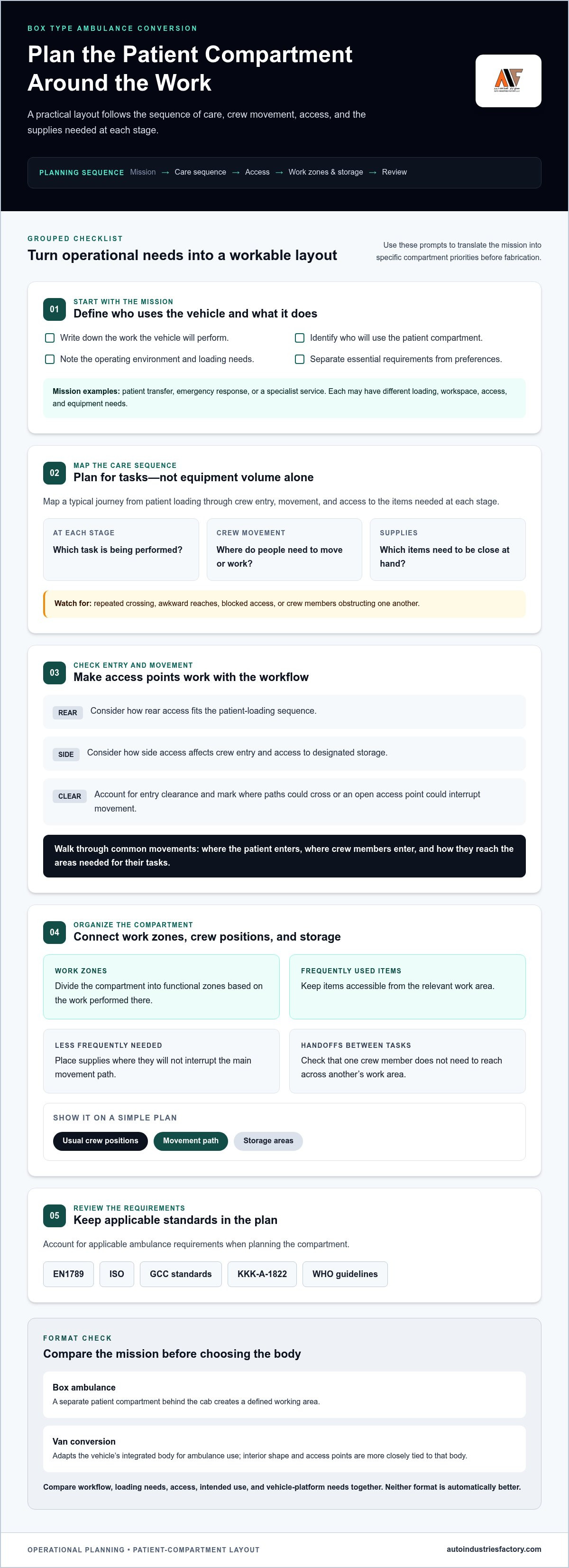
A box ambulance has a dedicated compartment behind the cab; a van conversion adapts the vehicle’s integrated body for ambulance use. This affects how the layout is planned. A separate compartment offers a defined working area, while a van’s interior shape and access points are more closely tied to its body. Neither format is automatically better. Compare the mission, crew workflow, loading needs, and vehicle platform together. A general overview of Ambulance Types and History describes common ambulance formats and their uses.
For a fleet decision, consider how often the vehicle will perform each duty, where crews need to enter and move, and how the unit must fit into existing operations. A box body may suit a team that needs a distinct workspace; an integrated van layout may better match a different mission. Choose according to operational priorities, not assumptions about either format.
Auto Industries Factory LLC converts ambulances, including box type units. Its in-house design and fabrication capabilities include laser cutting, CNC machining, welding, and painting, supporting a coordinated conversion shaped around defined requirements. Its ambulance offerings include BLS, ALS, ICU, Neonatal, and 4×4 off-road ambulances meeting EN1789, ISO, GCC standards, KKK-A-1822, and WHO guidelines.
How Patient-Compartment Layout Shapes a Box Type Ambulance
A practical compartment layout follows what the crew needs to do, in what order, and how people and supplies move through the space. Adding equipment is not enough if routine tasks involve repeated crossing, awkward reaches, or blocked access. For a box type ambulance conversion, connect the clinical specification to the way the team will use the vehicle.
Plan the compartment around the sequence of care, not the inventory of equipment. Map a typical journey from patient loading through crew entry, movement, and access to the items needed at each stage. This helps identify where pathways need to stay clear, which supplies need to be close at hand, and where crew members may need to work without obstructing one another. The plan should also account for applicable ambulance requirements, including EN1789, ISO, GCC standards, KKK-A-1822, and WHO guidelines.
Plan access points around loading and crew movement
Rear access, side access, and entry clearance influence how people approach the compartment and move inside it. Rear access may be central to the loading sequence; side access can affect how crew members enter or reach designated storage. The right arrangement depends on the vehicle’s use, operating environment, and workflow. No single door plan suits every fleet.
Before fixing positions, sketch or walk through common movements: where the patient enters, where crew members enter, and how they reach the areas needed for their tasks. Mark points where paths could cross or an open access point could interrupt another movement. This exercise turns general preferences into specific priorities and brings entry clearance into the plan early.
Organize work zones, storage, and equipment relationships
Divide the compartment into functional zones based on the work performed there. Keep frequently used items accessible from the relevant work area, and place less frequently needed supplies where they won’t interrupt the main movement path. The aim is to make the relationship between tasks, storage, and crew positions clear, not to create rigid boundaries.
Check the handoffs between stages of work. If one crew member must reach across another’s work area, or a frequently used supply is far from the task that requires it, the layout may create unnecessary movement. Show the usual crew positions, movement path, and storage areas on a simple plan. That gives the layout a functional test before fabrication.
Keep the clinical specification and applicable ambulance requirements at the center of these decisions. For AIF ambulance offerings, these include EN1789, ISO, GCC standards, KKK-A-1822, and WHO guidelines. Vehicle-platform constraints then shape how the priorities can be implemented. A clear plan helps coordinate the compartment rather than treating each fitting as a separate decision.
Auto Industries Factory LLC brings design and fabrication capabilities to ambulance conversions, including laser cutting, CNC machining, welding, and painting. Explore its ambulance conversion services when planning a compartment around operational requirements.
Box Type vs. Van Ambulance: Compare the Mission Before the Format
A box body and an integrated van body create different planning conditions, but neither format suits every fleet. Compare how each supports the work across a full operating cycle, from routine patient transfers to higher-demand response duties. Start with the tasks, access needs, and vehicle-platform requirements, then assess each format against them.
Use the comparison as a starting point, not a scorecard. A box configuration may be justified by a specific workflow or workspace requirement; wanting more room, on its own, doesn’t establish that need. Assess how often each duty occurs, what patient-care tasks the fleet performs, and whether the selected platform supports the conversion. Technical suitability depends on the complete vehicle and its planned use.
When should a fleet consider a box configuration?
Consider a box body when the mission calls for a clearly defined patient compartment or a layout organized around distinct work areas. A specialist fleet, for example, may need a workspace planned for its operating sequence. Separate a functional requirement from a general preference for extra space, then assess access, workflow, and the vehicle platform together. The body format alone doesn’t determine operational suitability.
When might an integrated van format fit better?
A van format may fit a fleet whose duties align with an integrated vehicle body and its available working area. Teams operating on varied routes can also weigh vehicle form and access as part of their mission review, rather than assuming either format has a universal advantage. Auto Industries Factory’s ambulance conversion services include both box type and extended-roof ambulance conversions. AIF’s ambulance offerings meet EN1789, ISO, GCC standards, KKK-A-1822, and WHO guidelines.
Let the mission choose the format. Compare the duty cycle, patient-care needs, workflow, access, and platform as one system. This gives fleet planners a practical basis for choosing a box type ambulance conversion or an integrated van format without relying on assumptions about cost, performance, or service life.
Build a Clear Box Ambulance Project Brief Before Fabrication
A useful project brief turns operating needs into decisions that can be discussed and reviewed before fabrication. For a box type ambulance conversion, record what the unit must do, who will use it, and which requirements are fixed. Label estimates and open questions separately so assumptions don’t become unintended specifications. Include applicable ambulance requirements, such as EN1789, ISO, GCC standards, KKK-A-1822, and WHO guidelines, in the requirements review.
Use this sequence to organize the brief:
- Define the mission. Describe the intended service, operating pattern, and duties the vehicle will perform. Distinguish routine work from occasional specialist tasks.
- Identify the users and workflow. Record who will work in the compartment and describe the usual sequence of tasks, handoffs, and patient movement.
- Document the vehicle platform. Include the selected vehicle and available technical information. Mark details that need technical review rather than treating estimates as confirmed facts.
- Set layout and access priorities. Note preferred entry points, clearance needs, movement paths, work areas, and storage relationships. Explain the operational reason for each priority.
- List systems and finishes where relevant. Describe required onboard systems, including electrical provisions if the project needs them, along with finish requirements. Separate essential items from optional preferences.
What information belongs in the initial specification?
Make the brief specific enough to guide planning without guessing at engineering details. For each requirement, record its source and status: confirmed, preferred, or awaiting technical review. Include the intended use, crew workflow, patient-care requirements, vehicle-platform information, access priorities, and applicable systems. This distinction helps the conversion team identify which decisions are ready to carry forward.
Standards also need to be considered in relation to the intended market and use. AIF’s ambulance offerings meet EN1789, ISO, GCC standards, KKK-A-1822, and WHO guidelines. Include the applicable requirements in the project brief and use them as part of the design and acceptance review.
How should the completed conversion be reviewed?
Use the agreed brief and drawings as the review baseline. Compare the finished layout with documented priorities, walk through entry and movement paths, inspect workmanship and finishes, and review installed systems against their specified requirements. Then rehearse representative operational handoffs to assess whether the planned sequence works in practice.
Keep acceptance criteria tied to the approved project documents and applicable ambulance requirements, including EN1789, ISO, GCC standards, KKK-A-1822, and WHO guidelines. Record differences, outstanding items, and agreed resolutions so the review has a clear closeout trail. Auto Industries Factory LLC coordinates vehicle fabrication through in-house design, laser cutting, CNC machining, welding, and painting. Bring a brief that separates confirmed requirements from open technical questions.
How Auto Industries Factory Delivers a Customized Box Ambulance
A customized box ambulance starts with the operating requirements, not a standard layout applied to every fleet. The mission profile, vehicle information, and layout priorities create a working brief. They guide decisions about the compartment and its fabrication, keeping the finished unit connected to its intended use.
Auto Industries Factory LLC converts vehicles for specialized uses, including box type ambulances. Its in-house capabilities include design, laser cutting, CNC machining, welding, and painting. These capabilities support a coordinated project shaped around documented requirements and the vehicle’s intended role. AIF’s ambulances meet EN1789, ISO, GCC standards, KKK-A-1822, and WHO guidelines.
From operational requirements to a fabrication plan
The fabrication plan translates agreed priorities into decisions about the vehicle and its body. A defined access preference and crew workflow, for example, can inform the layout plan. Vehicle information provides the basis for developing the conversion. Ground technical details in reviewed information rather than assumed specifications.
Each in-house capability contributes to the broader fabrication process:
- Design connects the documented mission and layout priorities to a plan for the conversion.
- Laser cutting and CNC machining support the production of components shaped to project requirements.
- Welding contributes to fabricating and assembling the conversion.
- Painting contributes to the completed vehicle finish.
These steps work together as parts of a coordinated project. A clear brief helps align component production and fabrication decisions with the intended use of the ambulance. Auto Industries Factory’s specialized vehicle conversion services include ambulance conversions and other purpose-built vehicle modifications.
Prepare to discuss your box type ambulance conversion
Bring a concise project brief to the discussion. Include the vehicle platform and available technical information, intended service, operating pattern, crew workflow, and highest-priority layout needs. Mark which requirements are settled and which remain preferences or open questions. This keeps the conversation focused on the project’s actual scope and helps organize the next decisions.
A box type ambulance conversion is a coordinated fabrication project, so clarity at the start matters. A documented mission and set of priorities provide a practical foundation, while in-house design and fabrication capabilities support the work from plan through finish.
Ready to discuss a vehicle project? Contact Auto Industries Factory about your box type ambulance conversion and share your mission profile, vehicle information, and priority layout needs.
Turn Your Fleet Requirements Into a Clear Next Step
Turn operational priorities into a focused conversation about the vehicle your team needs. A concise mission profile and clear priorities keep the project discussion grounded in the intended use. Your brief doesn’t need to answer every technical question; it should make essential needs and open decisions visible.
Auto Industries Factory LLC offers box type ambulance conversions, supported by in-house design, laser cutting, CNC machining, welding, and painting. These capabilities support a coordinated fabrication project shaped around defined requirements rather than a one-size-fits-all specification. AIF ambulances meet EN1789, ISO, GCC standards, KKK-A-1822, and WHO guidelines.
Bring your vehicle information and priority requirements to the project discussion. Discuss your box type ambulance conversion requirements with Auto Industries Factory LLC and take the next step toward a unit planned around your operation.
A well-defined project is a strong foundation. With the right priorities on paper, your team can move forward with clarity and confidence.
Frequently Asked Questions
What is a box type ambulance conversion?
A box type ambulance conversion creates a distinct patient-care compartment as part of a converted vehicle. It’s a vehicle-fabrication project, not a medical service: the operator defines the mission and clinical setup, while the conversion shapes the vehicle around those needs. AIF ambulance offerings meet EN1789, ISO, GCC standards, KKK-A-1822, and WHO guidelines. For a clear starting point, describe the fleet’s work and the arrangement crews need, rather than beginning with a list of preferred fittings.
What is the difference between a box ambulance and a van ambulance?
A box ambulance uses a dedicated compartment behind the cab, while a van ambulance adapts the integrated body of the base vehicle. This affects how the interior shape and access points inform the plan. A fleet that needs a separate workspace may assess a box format, while one whose workflow fits an integrated interior may assess a van. Compare each against the same mission and operating pattern.
Can a box type ambulance be customized for different medical missions?
Yes. A box ambulance conversion can be planned around different missions by documenting the required workflow, compartment arrangement, access priorities, and onboard systems. A fleet planning patient transfers, for example, may set different layout priorities from a specialist response unit. The operator’s clinical specification should guide the vehicle configuration. A conversion shapes the vehicle; it doesn’t provide medical care or determine clinical protocols. AIF ambulance offerings meet EN1789, ISO, GCC standards, KKK-A-1822, and WHO guidelines.
How do you choose a chassis for a box type ambulance conversion?
Assess the vehicle’s published technical information alongside the intended duty and proposed conversion. Consider how the completed vehicle will be used and whether the platform suits the planned body and onboard systems. Keep the vehicle variant and source documents clear in the brief, and have technical information reviewed as part of the project. Include applicable ambulance requirements, including EN1789, ISO, GCC standards, KKK-A-1822, and WHO guidelines.
What should an ambulance conversion project brief include?
Include the intended mission, operating pattern, crew roles, typical workflow, and patient-care requirements. Add the vehicle’s make, model, variant, and available technical documents, along with relevant layout, access, finish, and onboard-system priorities. Record applicable requirements, including EN1789, ISO, GCC standards, KKK-A-1822, and WHO guidelines. Mark each item as required, preferred, or awaiting review to distinguish assumptions from agreed requirements.
Does a box type ambulance need to meet EN 1789?
The applicable requirements depend on the intended market and use. Include the requirements relevant to the specific vehicle and intended service in the project brief, then use them as project and acceptance criteria.
How is a box ambulance conversion reviewed before delivery?
Review the completed vehicle against the approved project documents. Compare the layout with the agreed plan, walk through access and routine operational handoffs, and inspect workmanship, finishes, and specified systems. Check the vehicle against applicable requirements, including EN1789, ISO, GCC standards, KKK-A-1822, and WHO guidelines. Record differences and unresolved items, then assess them against the project’s acceptance criteria.


