In the high-stakes world of defense and security, there is zero margin for error. Selecting a partner for mission-critical vehicle modification demands absolute confidence in their engineering prowess, quality control, and adherence to uncompromising military standards. The challenge, however, is navigating the complex landscape of military vehicle fabrication companies UAE to identify a specialist who can deliver vehicles that are not just modified, but truly mission-ready. A poor choice risks more than just budgets and timelines; it compromises operational integrity and the safety of personnel in the field.
This definitive buyer’s guide is engineered to eliminate that uncertainty. We provide the essential criteria for rigorously evaluating potential fabricators, from their technical certifications and material sourcing to their process transparency and post-delivery support. Inside, you will discover the critical questions needed to verify capabilities and gain the assurance that your tactical vehicles will be fabricated to the highest standards of durability and performance. Our goal is to empower you to forge a long-term partnership with a trusted expert, ensuring every vehicle in your fleet is built to succeed in its mission.
Key Takeaways
- Prioritize partners with proven in-house fabrication and advanced technology, as these capabilities are direct indicators of vehicle reliability and mission readiness.
- A top-tier fabricator demonstrates versatility by offering a comprehensive range of modifications across diverse platforms, from commercial vehicles like Toyota and GMC to specialized military vehicle chassis.
- Develop a structured vetting process to properly evaluate military vehicle fabrication companies UAE, focusing on verified qualifications and a portfolio of past projects.
- Understand the end-to-end fabrication process, from initial brief to final delivery, to effectively manage project timelines and ensure partner transparency.
Core Capabilities: What to Demand from a Military Vehicle Fabricator
When selecting from the top military vehicle fabrication companies UAE has to offer, it's crucial to look beyond simple assembly. True fabrication excellence is rooted in a deep, integrated set of core capabilities that directly influence a vehicle's performance, reliability, and survivability in the field. A premier fabricator operates not as an assembler of parts, but as a comprehensive engineering partner, transforming a standard chassis into a mission-specific, heavy-duty asset. This one-stop-shop approach, from initial design to final integration, minimizes project risks and guarantees a higher standard of quality control.
To see these advanced processes in action, the following video provides a look inside a UAE-based armored vehicle manufacturing facility:
In-House Design and Engineering
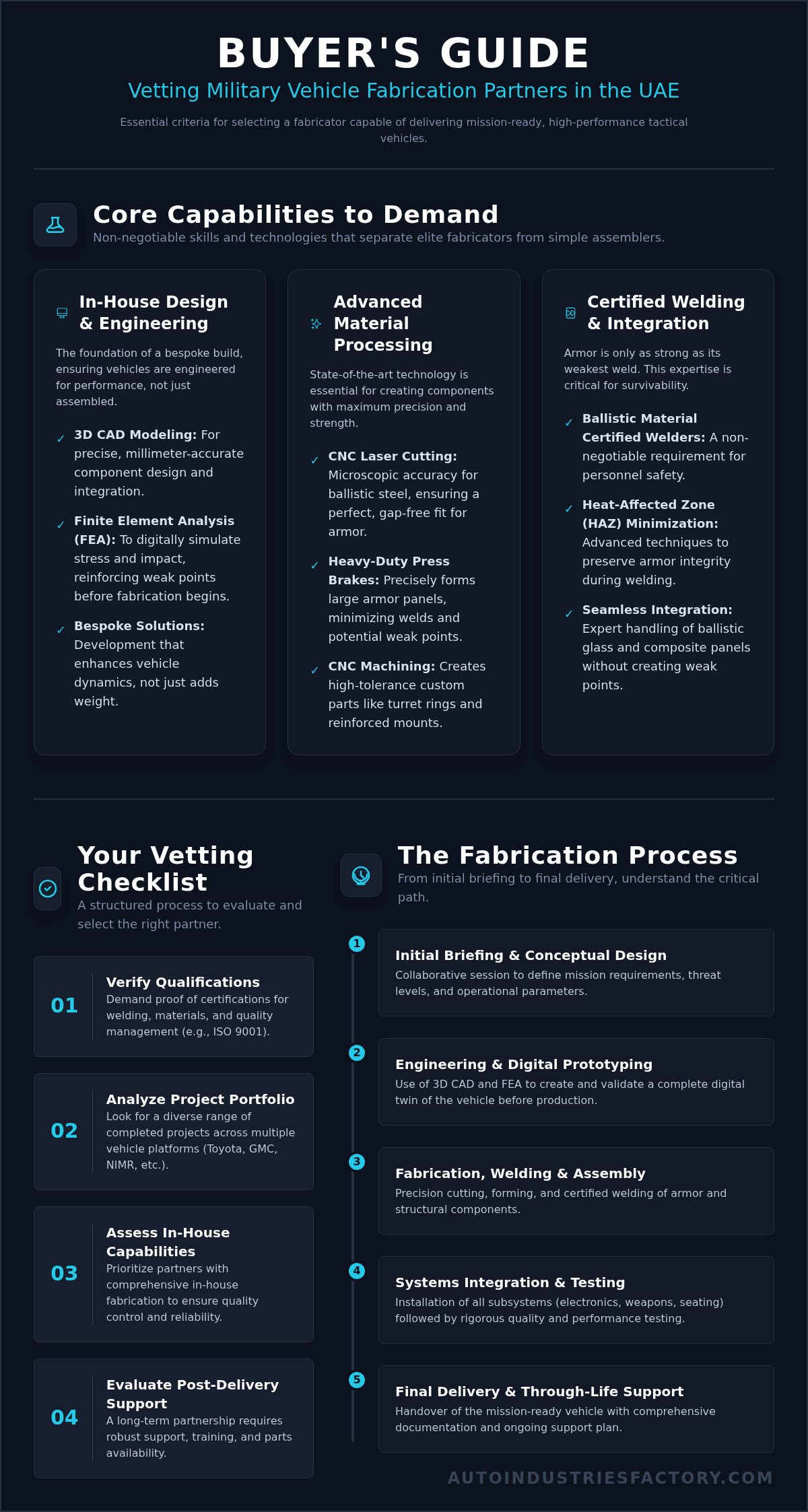
A dedicated in-house engineering team is the foundation of any custom military build. Look for proficiency in 3D CAD modeling for precise component design and Finite Element Analysis (FEA) to digitally simulate stress, impact, and vibration. This allows engineers to identify and reinforce potential weak points before a single piece of steel is cut. This capability is the difference between bolting on a pre-made kit and developing a truly bespoke solution that preserves or enhances the original vehicle's critical dynamics and handling characteristics.
Advanced Material Processing Technology
The quality of the final product is dictated by the technology used to shape it. A state-of-the-art facility will utilize advanced machinery for unparalleled precision:
- CNC Laser Cutting: Guarantees that ballistic steel and armor plates are cut with microscopic accuracy, ensuring a perfect, gap-free fit for maximum protection.
- Heavy-Duty Press Brakes: Allow for the precise bending and forming of large armor panels, creating stronger, more resilient vehicle bodies with fewer welds (and thus, fewer potential points of failure).
- CNC Machining: Essential for creating high-tolerance custom components like reinforced suspension mounts, turret rings, or specialized equipment brackets that standard parts cannot match.
Certified Welding and Armor Integration
Armor is only as strong as its weakest weld. It is non-negotiable that a fabricator employs welders certified specifically for ballistic materials. They must use techniques that minimize the heat-affected zone (HAZ), a phenomenon where excessive heat from welding can compromise the temper and protective properties of armored steel. This expertise extends beyond metal, covering the seamless integration of ballistic glass and composite panels. Understanding how to modify the wide types of military vehicles without creating ballistic weaknesses is the hallmark of an expert fabricator.
Types of Military Vehicle Modifications and Conversions Offered
Leading military vehicle fabrication companies in the UAE distinguish themselves not by specializing in a single vehicle type, but by demonstrating mastery across a wide spectrum of mission-critical platforms. True expertise is showcased through a diverse portfolio, proving the capability to engineer custom solutions for platforms ranging from the ubiquitous Toyota Land Cruiser and GMC chassis to advanced armored vehicles like the NIMR. This versatility extends from fundamental structural modifications and armoring to the complex integration of advanced electronic and weapons systems, ensuring every vehicle is precisely configured for its intended operational role.
Armored Personnel Carriers (APCs) & Troop Transports
The primary objective in converting vehicles into APCs and troop transports is maximizing occupant survivability. This begins with engineering 360-degree ballistic and blast protection to established international standards. Beyond the armor, elite fabricators focus on the interior, designing ergonomic layouts that reduce crew fatigue during long missions. Key features include the installation of advanced blast-mitigating seats, secure and accessible weapon storage systems, and optimized entry and egress points for rapid deployment.
Tactical, Patrol, and Reconnaissance Vehicles
For tactical applications, the engineering challenge lies in balancing formidable protection with the agility required for rapid deployment and reconnaissance. A premier fabricator skillfully integrates the necessary armor levels without compromising vehicle mobility or speed. This approach mirrors the core capabilities outlined in the U.S. Army's vehicle strategy, which emphasizes adaptability and mission-readiness. Common modifications include:
- Integration of turret rings and weapon mounts for various caliber systems.
- Installation of advanced surveillance, thermal imaging, and communication suites.
- Upgrades for extreme terrain, including heavy-duty bumpers, recovery winches, and reinforced suspension systems.
Mobile Command Centers and EOD Vehicles
These platforms represent the pinnacle of systems integration. Transforming a vehicle into a mobile command center or an Explosive Ordnance Disposal (EOD) unit requires deep expertise in electrical and electronic engineering. The best military vehicle fabrication companies UAE specialize in integrating complex C4ISR (Command, Control, Communications, Computers, Intelligence, Surveillance, and Reconnaissance) suites. This involves creating custom, climate-controlled interiors with dedicated workstations, onboard power generation systems, and specialized storage solutions for sensitive robotics and diagnostic equipment.
Your Vetting Checklist: How to Evaluate and Select a Partner
When procuring mission-critical assets, a glossy sales pitch is not enough. The performance and reliability of your armored vehicles depend entirely on the partner you choose. To move beyond marketing claims and make an informed decision, a structured evaluation process is essential. This checklist focuses on verifiable qualifications, robust quality systems, and tangible proof of capability among the military vehicle fabrication companies UAE has to offer.
Past Performance and Regional Experience
A fabricator's history is the best predictor of its future performance. Request detailed case studies of projects similar to yours, focusing on vehicle type, armor level, and specific modifications. Crucially, verify their experience working with government and defense clients within the GCC. A company familiar with the region's specific operational requirements and procurement processes, as outlined in the UAE Defense Market Overview from the International Trade Administration, brings invaluable expertise. Always ask for references you can contact directly to discuss project execution and after-sales support.
Certifications and Quality Management
Certifications are not just paperwork; they are proof of a commitment to repeatable, high-quality outcomes. A reputable fabricator will readily provide evidence of their quality management systems. Key credentials to look for include:
- ISO 9001:2015 Certification: This is the global standard for quality management, ensuring documented processes and a focus on continuous improvement.
- Military Standards Compliance: Inquire about their experience and adherence to internationally recognized standards like STANAG for armor levels and MIL-STD for components and testing.
- Internal QC Processes: Ask them to detail their internal inspection process, from raw material verification to final vehicle sign-off.
Material Sourcing and Traceability
The integrity of an armored vehicle begins with its materials. A premier fabricator maintains full transparency and traceability for all ballistic components. Ask direct questions about where they source their ballistic steel and armored glass. Reputable companies have strong, long-standing relationships with certified global suppliers and will provide material certificates and ballistic test reports for every component used in your build, ensuring there are no compromises on protection.
Facility Inspection and Security Protocols
A physical tour of the fabrication facility is non-negotiable. An organized, clean, and well-equipped workshop reflects a professional operation and a culture of precision. During your visit, assess their physical security measures and inquire about the digital security protocols they use to protect sensitive project details and client confidentiality. This firsthand look provides confidence that the company has the infrastructure and discipline to handle high-stakes defense projects. This rigorous checklist ensures you partner with a fabricator capable of delivering the highest standards of defense vehicle conversion.
The Fabrication Process: From Initial Briefing to Final Delivery
Understanding the end-to-end manufacturing journey is critical when commissioning a tactical vehicle. The most reputable military vehicle fabrication companies UAE operate with a transparent, multi-stage process that ensures precision, accountability, and a final product that performs flawlessly in the field. This structured approach, built on key client approval milestones, transforms a standard vehicle chassis into a mission-ready asset. A clear process is the hallmark of a reliable engineering partner, guaranteeing that expectations are managed and met from day one.
Phase 1: Consultation and Requirement Definition
This foundational stage is a collaborative deep-dive to establish the vehicle's exact purpose. Our engineers work directly with your team to define the mission profile, whether for patrol, tactical response, or command and control. Key decisions are made here, including the selection of the base vehicle chassis (e.g., Toyota Land Cruiser, Nissan Patrol) and the specific ballistic and blast protection levels required (e.g., CEN B6/B7, STANAG). The phase concludes with a detailed project scope, timeline, and budget agreement.
Phase 2: Engineering Design and Prototyping
Once requirements are locked, our engineering team translates the concept into precise technical blueprints using advanced 3D CAD software. These detailed models map every component, from the exact placement of armor plating and ballistic glass to the integration paths for communication and surveillance systems. This digital design undergoes a rigorous client review. Only after receiving formal sign-off does any physical work commence, ensuring complete alignment before production.
Phase 3: Fabrication and Systems Integration
This is where the engineering vision is forged in steel. The base vehicle is systematically disassembled, and its structure is heavily reinforced to manage the significant weight of armor. Key activities include:
- Precision laser-cutting and welding of certified high-strength ballistic steel.
- Installation of multi-layered ballistic glass and run-flat tire systems.
- Seamless integration of all mechanical, electrical, and tactical systems, including C4ISR equipment, advanced power management, and weapon mounts.
Phase 4: Testing, Trials, and Handover
Before a vehicle is cleared for delivery, it undergoes a battery of rigorous tests. This includes extensive mobility and performance trials to validate handling, braking, and powertrain integrity under load. All integrated electronic and communication systems are subjected to full functionality tests. For ultimate assurance, we can facilitate independent third-party ballistic or blast testing to certify the vehicle's protective capabilities. The process concludes with a formal handover, complete with comprehensive operator training and detailed technical documentation.
Your Partner for Mission-Critical Fabrication in the UAE
Selecting the right partner is the most critical step in ensuring your tactical vehicles perform flawlessly in the field. Your evaluation should prioritize fabricators with comprehensive in-house capabilities-from design to delivery-and a verifiable track record of success. Among the top military vehicle fabrication companies UAE has to offer, the distinction lies in proven engineering precision and an unwavering commitment to mission reliability.
At Auto Industries Factory LLC, we provide that distinction. Our ISO 9001 certified facility in Ajman is equipped for fully in-house design, CNC laser cutting, and fabrication, giving us complete control over every project. With proven experience serving regional defense and security clients, we build robust, reliable, and mission-ready vehicle solutions tailored to the most demanding operational requirements.
Ready to equip your fleet for maximum effectiveness? Discuss Your Mission Requirements with Our Fabrication Experts today and take the first step towards a more capable and secure force.
Frequently Asked Questions
What are the most important military standards for vehicle armoring?
The most critical standards are NATO's STANAG 4569, which defines protection levels against kinetic energy, artillery, and IED threats, and the European CEN 1063 standard, which classifies ballistic resistance (e.g., BR6 or BR7). Adherence to these internationally recognized benchmarks ensures that the armor provides a verified and reliable level of protection for personnel. Our engineering process at Auto Industries Factory LLC is rigorously aligned with these standards to guarantee mission-critical survivability and performance for clients in the UAE and across the region.
How long does a typical military vehicle conversion project take in the UAE?
A standard conversion project, such as armoring a 4x4 vehicle to a B6/B7 level, typically takes between 8 to 16 weeks. This timeline can vary based on the project's complexity, the specific armor level required, custom fabrication needs, and the availability of the base vehicle. Leading military vehicle fabrication companies UAE prioritize a streamlined workflow, from initial design and material sourcing to final integration and testing, ensuring timely delivery without compromising on quality or protection standards.
Can existing fleets of vehicles be retrofitted and armored?
Absolutely. Retrofitting existing fleets is a core service and a cost-effective way to enhance security. Our process begins with a thorough structural assessment of each vehicle to ensure the chassis, suspension, and braking systems can safely manage the additional weight of the armor. We then engineer a custom armor solution that integrates seamlessly with the existing platform, upgrading key components as necessary to maintain optimal performance and handling characteristics for your operations in the UAE.
What is the difference between custom fabrication and simple vehicle upfitting?
Simple upfitting involves adding pre-manufactured, bolt-on accessories like light bars, winches, or communication systems. Custom fabrication is a far more advanced process where we design, engineer, and build unique components from raw materials like armored steel or composites. This includes creating bespoke armor capsules, integrated weapon mounts, or specialized storage systems tailored precisely to mission requirements. Fabrication requires deep engineering expertise, precision machinery, and certified welding capabilities.
How do you ensure the vehicle's original performance is not compromised by the added weight of armor?
Maintaining performance is a critical engineering challenge we address comprehensively. We offset the added weight by systematically upgrading key systems. This includes installing heavy-duty suspension components, high-performance braking systems, and reinforced tires. For certain projects, engine performance tuning or cooling system enhancements are also recommended. We use advanced, lightweight composite materials where possible to provide maximum protection with a minimal impact on vehicle dynamics, agility, and durability.
Do you work with client-provided vehicles or source them as part of the project?
We offer complete flexibility to meet our clients' needs. We regularly work on vehicles provided directly by our clients, including government and private security agencies from the UAE. Alternatively, we can manage the entire procurement process for you. Leveraging our extensive network within the UAE's automotive market, we can efficiently source suitable base vehicles, such as the Toyota Land Cruiser or Nissan Patrol, ensuring they meet the exact specifications required for the conversion project.


