

A pursuit-ready Tahoe isn’t created by adding every available accessory. The Chevrolet Tahoe police pursuit vehicle setup should match the fleet’s mission because each conversion choice can affect space, vehicle systems, and day-to-day usability. Before approving a build, define what the vehicle must do, which equipment is essential, and how the crew will use it during a shift.
This guide helps fleet buyers turn operational needs into a practical setup brief. You’ll consider the Tahoe’s intended role, major conversion decisions, and the trade-offs involved in integrating equipment. Before specifying a build, verify the exact model year, trim, drivetrain, payload, and electrical-system details, along with the requirements that apply in the intended operating jurisdiction.
From warning and communications equipment to interior arrangements and fabricated components, the goal is a coordinated vehicle solution, not a loose collection of add-ons. Auto Industries Factory LLC provides police and military vehicle modifications, supported by in-house design, laser cutting, CNC machining, welding, and painting. The sections ahead will help you define fleet requirements and communicate them clearly for a project-specific conversion.
Key Takeaways
- Build the Chevrolet Tahoe police pursuit vehicle setup around its assigned patrol role, not a generic equipment checklist.
- Compare core and expanded configurations by weighing operational value against space, payload, and integration considerations.
- Organize procurement requirements into a brief covering vehicle details, fleet quantities, duty cycle, and equipment priorities.
- Separate published Tahoe specifications from capabilities that depend on the conversion and installed equipment.
- A coordinated conversion process can bring design, laser cutting, CNC machining, welding, and painting together for a project-specific build.
What Makes a Chevrolet Tahoe Suitable for Police Pursuit Duties?
A Chevrolet Tahoe police pursuit vehicle setup is a mission-specific conversion of a suitable base vehicle. The platform alone doesn’t determine whether it fits a fleet. Duty cycle, crew requirements, equipment load, and operating environment all influence the final specification. A Tahoe assigned to routine patrol may need a different cabin and cargo arrangement from one intended for highway response or supervisory use.
Keep the vehicle’s published specifications separate from capabilities created by conversion. Manufacturer documentation describes the vehicle as built for a particular model year, trim, and market. Added equipment changes the configuration and may affect available payload, cabin space, and electrical demand. The Chevrolet Tahoe Wikipedia page provides general model history, including the Z56 police package, but historical references aren’t a substitute for current fleet documentation.
For a visual example of a Tahoe PPV, watch this video:
Start with the patrol mission, not an equipment list
Define the assignment before selecting equipment. Routine patrol, highway response, supervisory duties, and specialist roles place different demands on seating, storage, communications, and vehicle use. Record the typical crew, carried equipment, shift duration, and expected duty cycle. Turn these details into requirements, such as the number of occupants to accommodate and which items must remain accessible during a shift.
Operating conditions matter, too. Fleet use may involve extended time on the road, frequent stops, varied surfaces, or exposure to heat and dust. Document the conditions relevant to your deployment rather than assuming one configuration suits every role. This gives the conversion team a practical basis for planning the layout and prioritizing requirements.
Check the Tahoe platform against fleet requirements
Verify the exact model year, trim, drivetrain, payload, and manufacturer documentation for the vehicle being procured. Don’t assume a consumer trim or a package described for an earlier model matches a current fleet vehicle. Confirm the dimensions and capacity for the actual unit, then account for the crew and proposed equipment when assessing available payload.
Map the cabin and cargo area before finalizing the conversion. Note passenger access, seating needs, storage volume, and the footprint of planned equipment. A layout that fits on paper may restrict access or leave essential items difficult to reach. Review the proposed arrangement as one integrated vehicle solution, not a collection of separate additions.
Finally, verify current model-year specifications and the applicable vehicle modification, road-use, and emergency equipment requirements for the fleet’s operating jurisdiction. Auto Industries Factory LLC undertakes police and military vehicle modifications, supported by in-house fabrication capabilities. A clear mission brief gives the conversion process a sound starting point.
Which Systems Shape a Chevrolet Tahoe Police Pursuit Vehicle Setup?
A Chevrolet Tahoe police pursuit vehicle setup brings several equipment groups into one working environment: warning, communications, occupant workspace, storage, and vehicle protection. The right combination depends on the vehicle’s role, department policy, exact model, and operating jurisdiction. A patrol unit and a supervisor’s vehicle may share a platform but require different priorities. Describe operational needs in the equipment brief rather than assuming one standard package.
System integration means coordinating equipment, installation, and vehicle requirements so each component works within the complete vehicle configuration. That coordination starts before fabrication. Warning devices can affect visibility and controls, storage can compete with passenger space, and electrical additions must be considered against the specific vehicle’s systems. Treating each item as an isolated add-on can create conflicts that a whole-vehicle plan is designed to identify early.
Warning, communication, and control equipment
Set out the intended functions for emergency lighting, siren, radio, and control interfaces without prescribing unverified brands or technical ratings. The design brief should explain how equipment supports visibility and communication, where operators need access to controls, and how the layout supports safe use while driving. Include department policy and applicable jurisdiction requirements in the specification. The conversion should reflect those requirements, not generic assumptions about every fleet.
Consider the operator’s workflow. Which controls need to be reachable from the normal driving position? What information must be visible without distracting from vehicle operation? Clear answers help define an ergonomic arrangement while leaving exact equipment selection to the project specification.
Cabin, storage, and electrical integration
Map the cabin and cargo area before installation. Show occupant space, equipment storage, planned wiring routes, and access needed for inspection or servicing. For example, a storage unit may keep essential equipment organized but also affect passenger access or use space needed for other mission items. Recording these interactions before fabrication helps keep the final arrangement practical for the crew.
Assess electrical demand and vehicle interfaces against the exact model year and configuration. Don’t infer capacity from another Tahoe or an older fleet build. A model-specific review can inform how proposed equipment connects with vehicle systems and where installation routes can be planned. When addressing control module programming or electronic vehicle systems, resources such as N2 Speed provide dedicated calibration and module programming for American vehicle platforms. Include service access in the layout. Organized wiring and accessible components can make maintenance tasks easier to plan, though the result depends on the completed design and installation.
Protection requirements also belong in the system plan. Identify the areas or components the fleet wants protected, then assess how that equipment interacts with the vehicle layout, occupant space, and applicable requirements. Include the intended operating jurisdiction in the compliance review. Don’t assume a setup accepted in one location automatically meets requirements elsewhere.
Auto Industries Factory LLC carries out police and military vehicle modifications, with in-house design, laser cutting, CNC machining, welding, and painting supporting coordinated fabrication. Sharing the mission, vehicle details, and priority systems helps shape a conversion brief around the complete vehicle rather than a loose set of components.
How Should Fleets Compare Tahoe Setup Options?
Compare configurations by mission, not by the number of accessories in a proposal. A core patrol build may prioritize essential warning and communications equipment, usable occupant space, and practical storage. A specialist or supervisory vehicle may need expanded communications, additional storage, or specific protection features. Each addition has trade-offs: it can use space, add weight, increase integration work, or affect access for occupants and maintainers.
Use a comparison table to show what each option delivers and what procurement still needs to verify. The entries below are planning prompts, not fixed specifications. Assess the Chevrolet Tahoe police pursuit vehicle setup against the selected model year and the fleet’s approved requirements.
| Mission need | Setup category | Key trade-off | Verification item |
|---|---|---|---|
| Routine, high-use patrol | Core warning and communications | Essential coverage while preserving cabin usability | Equipment scope, operator access, vehicle interfaces |
| Extended communications needs | Expanded radio and control workspace | More capability can increase cabin and electrical demands | Model-specific electrical assessment and control layout |
| Additional carried equipment | Expanded storage | Storage volume may reduce occupant or cargo flexibility | Payload, access, mounting, and service access |
| Role-specific protection | Protection components | Added components can affect packaging and vehicle load | Approved scope, fit, and jurisdiction requirements |
Match setup scope to duty cycle
Separate high-use patrol requirements from specialist or supervisory assignments. For each role, identify the equipment needed for core duties and distinguish it from features that are convenient but not essential. An item that adds complexity without solving a documented need can complicate packaging, operator workflow, and future maintenance planning. The aim is a fit-for-purpose configuration, not the fullest possible one.
Assess every proposal against payload, cabin usability, equipment integration, and maintainability, alongside acquisition considerations. For organizations balancing broader support vehicles alongside specialized pursuit units, consulting fleet management and vehicle leasing specialists such as fleetsauce.co.uk can help inform general procurement strategies. Exact specifications depend on the chosen Tahoe model year, trim, drivetrain, and approved fleet requirements. Don’t compare builds as if they share a common baseline unless the vehicles and mission assumptions match.
Compare build proposals on useful criteria
Look for a clearly documented scope, a coherent integration plan, and an explanation of how fabrication and installation support the intended use. Consider whether equipment remains accessible for service, whether the layout can accommodate future changes, and whether multiple fleet vehicles can be built consistently. These details make a proposal easier to evaluate than a component list alone. For broader context on coordinated fleet conversions, see this guide to police vehicle modifications.
Before approving a configuration, make sure the proposed build reflects the same mission, vehicle data, and verification criteria across the fleet. Auto Industries Factory LLC supports project-specific police and military vehicle modifications. Its vehicle modification services can support a coordinated conversion discussion.
What Should Buyers Specify Before a Tahoe Conversion?
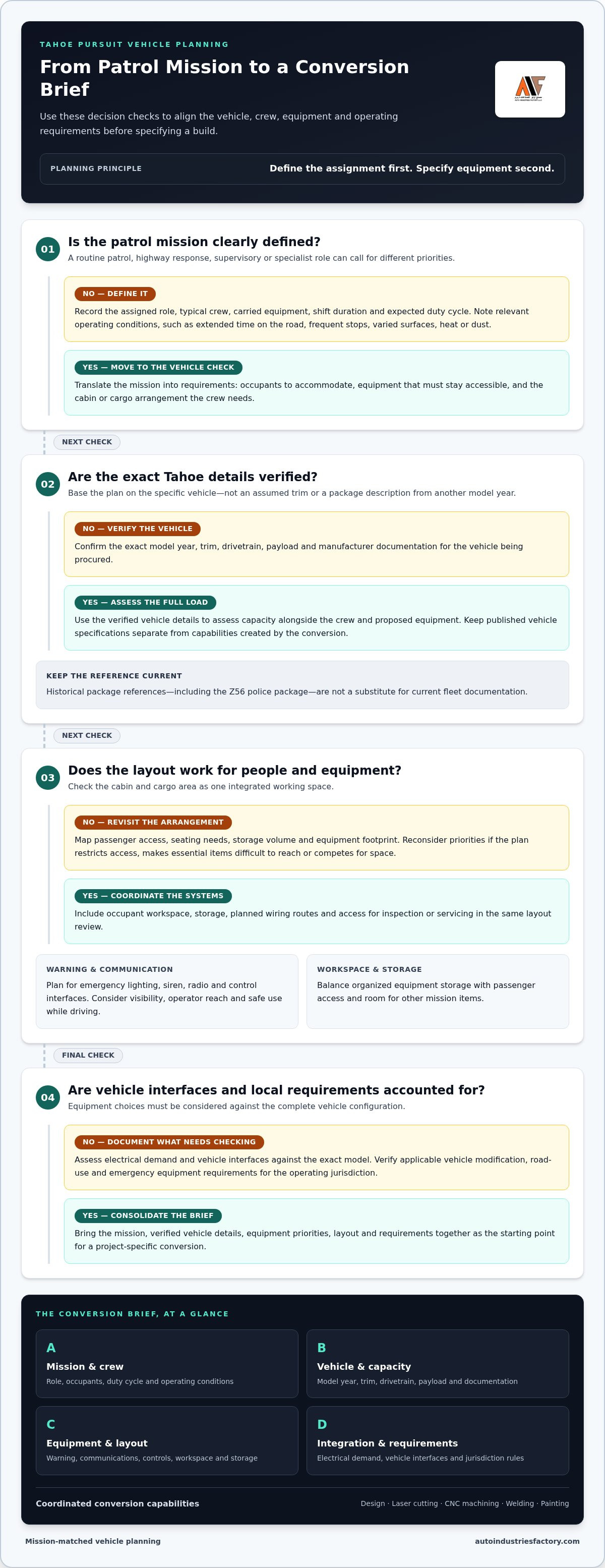
A strong procurement brief turns operational needs into decisions that can be designed, fabricated, and reviewed. For a Chevrolet Tahoe police pursuit vehicle setup, make the scope specific to the actual vehicle and fleet role. Use this sequence to organize the work:
- Define the mission. Identify the vehicle’s role, typical users, duty cycle, operating conditions, and essential tasks.
- Confirm vehicle data. Record the model year, trim, drivetrain, payload information, and relevant manufacturer documentation.
- Scope systems. Set priorities for warning, communications, occupant workspace, storage, and protection. Distinguish required items from preferences.
- Plan fabrication. Coordinate the layout, interfaces, wiring routes, mounting needs, and access for inspection and service.
- Set validation checkpoints. Agree how the completed work will be reviewed against the approved scope and applicable requirements.
Build a clear conversion brief
Record fleet quantities, vehicle roles, operating conditions, user needs, preferred interfaces, storage priorities, and any requirement for consistent layouts across vehicles. State how equipment will be used, not just what equipment is requested. This gives the conversion team a practical basis for coordinating fabrication and integration. Auto Industries Factory LLC’s vehicle conversion services support project-specific vehicle modification.
- Vehicle: year, trim, drivetrain, and available specification documents.
- Fleet: number of vehicles, deployment roles, and desired consistency between units.
- Use: crew needs, shift pattern, duty cycle, and operating environment.
- Priorities: required systems, equipment footprint, storage needs, and preferred control interfaces.
Keep assumptions visible. For example, identify which equipment is mandatory for the role and which is a future option. This helps prevent optional additions from obscuring the core scope or creating avoidable packaging conflicts.
Plan integration, inspection, and handover
Set review points for design coordination, fabrication, installation, and final validation before work begins. Plan for documentation of the completed configuration, access to serviceable components, and operator familiarization with installed systems. These handover details help fleet staff understand the build and support ongoing maintenance planning.
Requirements for road use, vehicle modifications, and emergency equipment depend on the intended jurisdiction. Identify applicable local requirements and include them in the project brief. Don’t assume rules from another jurisdiction apply. Keep the approved requirements alongside the vehicle’s model-specific data so the conversion can be assessed against the correct baseline.
Once the mission, vehicle details, quantities, and priorities are assembled, share them with Auto Industries Factory LLC to discuss a coordinated police vehicle conversion. Discuss your fleet conversion requirements with the project scope in hand.
How Auto Industries Factory Delivers a Mission-Matched Police Vehicle Conversion
A specialist police vehicle conversion begins with the fleet’s operating requirements, then coordinates fabrication around the vehicle and its intended role. Auto Industries Factory LLC modifies police and military vehicles, bringing design coordination, laser cutting, CNC machining, welding, and painting capabilities into a connected project workflow. The aim is a considered vehicle solution, not a collection of unrelated additions.
For a Chevrolet Tahoe police pursuit vehicle setup, the selected model and the buyer’s approved requirements guide the conversion scope. This keeps fabrication decisions tied to the actual vehicle, its intended use, and the systems the fleet prioritizes, without assuming a particular configuration or performance result.
One coordinated workflow for a specialized vehicle
Connected capabilities can help align component fabrication with the overall layout. Design coordination considers how parts fit alongside equipment, occupant space, access, and the vehicle’s documented interfaces. Laser cutting and CNC machining support fabrication planning, while welding and painting contribute to the finished fabricated components. Each decision belongs within the agreed project scope.
Precise workmanship starts with clear requirements and careful coordination. A robust build also depends on selecting and placing components for the intended use while preserving practical access for occupants and service work. Auto Industries Factory’s vehicle fabrication capabilities support a coordinated approach to project-specific police vehicle modifications.
- Design coordination: Align the proposed layout and fabrication needs with the documented vehicle and mission requirements.
- Precision fabrication: Use in-house laser cutting, CNC machining, and metalwork capabilities to support project components.
- Finishing: Include painting within the fabrication workflow where required by the agreed scope.
- Whole-vehicle planning: Consider how fabricated parts relate to equipment placement, access, and the vehicle’s intended operation.
Move from requirements to a project discussion
Make the initial project discussion more productive by assembling the details that define the build. Share the Tahoe’s model year and configuration, fleet quantity, vehicle mission, operating conditions, and the systems the department considers essential. Include priorities for storage, occupant needs, and fleet-wide consistency. These details help frame a tailored conversion discussion without presuming a specific technical specification.
From there, the project scope can be discussed as a coordinated sequence of design coordination and fabrication, with vehicle data and the intended jurisdiction informing planning. Identify vehicle modification, road-use, and emergency equipment requirements for the fleet’s operating jurisdiction and include them in the brief.
Auto Industries Factory LLC brings specialized vehicle modification and in-house fabrication capabilities to police fleet projects. If your team has defined its vehicle details, mission, fleet quantity, and required systems, start a police vehicle conversion discussion to outline the project requirements.
Turn your fleet brief into a build plan
The next step is to turn procurement priorities into a clear project scope. A well-defined Chevrolet Tahoe police pursuit vehicle setup begins with decisions your fleet can review: which functions are essential, how the vehicle will be used, and what the completed conversion must accommodate. Keep the chosen Tahoe’s exact specifications and the intended operating jurisdiction central to planning.
Auto Industries Factory LLC handles specialized police and military vehicle modifications, supported by in-house design, laser cutting, CNC machining, welding, and painting. These capabilities bring fabrication decisions into a coordinated process, with the project brief guiding the work rather than a generic equipment checklist.
Bring your vehicle details, fleet quantity, mission, and priority systems to the project discussion. Clear inputs give the team a practical foundation for shaping a conversion around your requirements, with expectations tied to the selected vehicle and agreed scope.
Discuss a tailored police vehicle conversion and take the next step toward a fleet build with a defined purpose.
Frequently Asked Questions
What should a Chevrolet Tahoe police pursuit vehicle setup include?
There’s no universal equipment list. The Chevrolet Tahoe police pursuit vehicle setup should fit the unit’s assignment and approved fleet requirements. A highway response vehicle, for example, may prioritize different communications and storage arrangements from a supervisor’s unit. Build the specification around required tasks, then identify which systems are essential, how operators will use them, and how the fleet will review the completed vehicle against its brief.
Can any Chevrolet Tahoe be converted for police pursuit use?
Don’t assume every Tahoe is suitable without a model-specific review. Before setting the conversion scope, identify the exact model year, trim, drivetrain, payload information, and electrical architecture. Compare those details with the planned equipment and operational role. A configuration with different cabin or electrical characteristics may require a different integration plan, even if its exterior model name matches another fleet vehicle.
How does police equipment affect a Tahoe’s payload and performance?
Installed equipment adds weight and takes up space, which can reduce the capacity available for occupants and other carried items. Its effect on vehicle behaviour depends on the particular Tahoe and the full installed configuration. Assess the completed load, including crew and routinely carried equipment, rather than considering conversion items separately. Use current manufacturer documentation and a project-specific assessment instead of applying a generic payload estimate.
Does a Chevrolet Tahoe police setup need specialized electrical integration?
Yes, electrical additions should be planned around the specific vehicle and proposed equipment. Radios, controls, and other powered systems may share limited installation space and require carefully considered wiring routes and service access. The project assessment should account for electrical demand, vehicle interfaces, safe operator access, and future inspection needs. Avoid treating each device as a standalone installation, since a change in one area may affect the overall layout.
What information should a fleet provide when requesting a Tahoe conversion?
Provide the exact Tahoe model details, fleet quantity, intended role, operating conditions, and expected duty cycle. Add the required equipment categories, crew needs, storage priorities, preferred interfaces, and any need for consistent layouts across units. If some items are mandatory and others are optional, label them clearly. That distinction helps the project team discuss priorities and develop a scope without mistaking preferences for operational requirements.
Are police vehicle equipment requirements the same in every jurisdiction?
No. Road-use rules, emergency equipment requirements, and agency policies can differ by jurisdiction and vehicle role. A configuration used by one fleet shouldn’t be treated as an automatic template for another. Identify where the Tahoe will operate and make applicable current requirements part of the project brief. For a fleet operating in the UAE, the intended jurisdiction should guide the compliance review before the final equipment scope is approved.
What is the difference between a police package and a converted police pursuit vehicle?
A manufacturer police package describes a base-vehicle configuration offered for a particular model year, while a conversion adds equipment or modifications for a fleet’s mission. The two terms don’t describe interchangeable scopes. Procurement teams should review the vehicle documentation separately from the conversion specification. This clarifies which features belong to the original vehicle and which requirements must be addressed through the project’s equipment and fabrication plan.


