
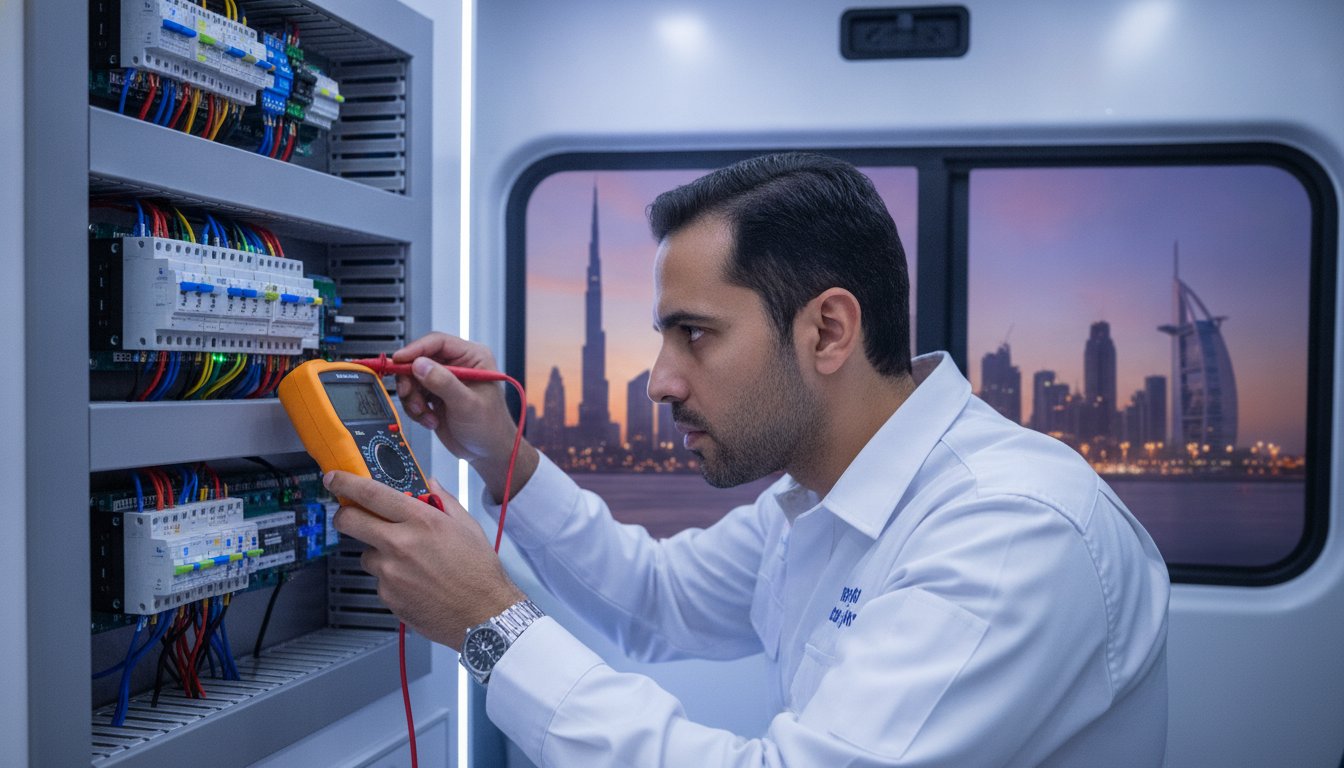
Mission-critical reliability isn't about adding more batteries; it's about intelligent, integrated power management and distribution. Engineering an emergency vehicle for the UAE's 45°C environment means battling more than just heat. You're likely fighting battery drainage during long idling periods and potential electrical interference with sensitive life-support monitors. When it comes to professional ambulance electrical system installation UAE standards demand more than just basic wiring. You need a system that remains 100% stable under the most extreme operational stress.
We understand that a power failure in the field is not an option. This guide will help you master complex power architectures to ensure your specialized fleet never loses power when lives are on the line. We'll provide a clear roadmap to achieving a fail-safe power distribution plan that meets the latest DOH/CEPAR/ST/AA-EMS/V1/2023 and EN 1789:2020 requirements. You'll learn how to integrate high-output alternators and surge-protected delivery systems that protect your medical gear and optimize battery life for the long term.
Key Takeaways
- Learn why standard OEM electrical systems are insufficient for emergency response and how to engineer a dedicated power backbone.
- Master the technical requirements for ambulance electrical system installation UAE professionals use to manage dual-battery isolation and DC-to-DC charging.
- Discover how to implement resettable circuit protection and synchronized emergency lighting to ensure 100% mission-critical accessibility.
- Explore ruggedization strategies designed to prevent electrical failure in the UAE’s extreme heat, dust, and high-vibration environments.
- Understand the benefits of an integrated upfitting approach that combines in-house electrical engineering with precision laser-cut fabrication.
Fundamentals of Emergency Vehicle Electrical System Design
The electrical backbone of an emergency vehicle is the integrated network of wiring, power sources, and controllers that sustain life-saving equipment, sirens, and communication arrays. In the UAE, where ambient temperatures regularly exceed 45°C, a standard factory setup won't suffice. Professional ambulance electrical system installation UAE fleets require focuses on creating a redundant, high-capacity architecture. While a standard vehicle is built for transport, an ambulance is a mobile trauma room. If the power fails, the mission fails, and the stakes are measured in human lives.
To visualize the complexity of these mission-critical circuits, watch this breakdown of emergency siren integration:
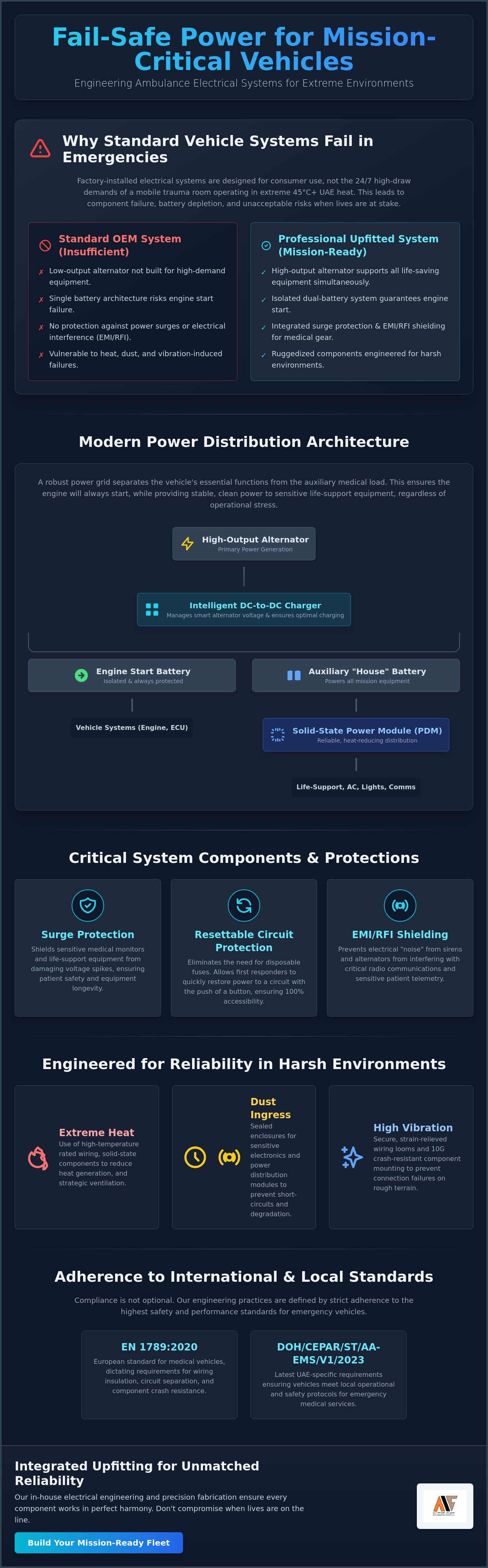
Standard OEM electrical systems are engineered for consumer use, not the 24/7 high-intensity demands of a first responder. A factory alternator isn't designed to support the simultaneous draw of high-output air conditioning, defibrillators, and advanced Emergency Vehicle Equipment. Attempting to run mission-specific gear on a stock system leads to premature component failure and unreliable power delivery during critical patient care.
The High-Draw Challenge
Designing for an ambulance requires calculating the cumulative load of medical monitors, oxygen pumps, climate control, and exterior lighting. The most dangerous state for any system is idling. During long standby periods at a scene, the alternator's output drops while the demand for medical power and cooling remains at its peak. This imbalance can lead to rapid battery depletion. Parasitic load refers to the continuous drain on the battery by electrical components that remain active even when the vehicle ignition is off, potentially leading to total system failure if not managed.
Regulatory Standards and Compliance
Engineering excellence is defined by adherence to international safety standards like EN 1789. This standard dictates strict requirements for wiring insulation, circuit separation, and 10G crash resistance for all electrical components. Beyond physical safety, EMI/RFI shielding is mandatory. Without it, the electrical noise from the vehicle's alternator or sirens can interfere with sensitive medical telemetry or radio communications. Every modification must integrate seamlessly with the base vehicle’s structural integrity to maintain safety ratings.
Different missions dictate different electrical loads. Our team at Auto Industries Factory LLC ensures every conversion is engineered to handle these specific demands without compromising the primary charging system:
- Ambulances: Prioritize surge-protected power for life-support gear and climate stability.
- Police Units: Focus on high-draw ANPR cameras, ruggedized laptops, and long-range comms.
- Military Vehicles: Require blackout lighting modes and extreme vibration resistance for off-road durability.
Power Management and Distribution Architecture
Designing a robust power grid for a mobile medical unit requires more than just high-capacity wires. It demands a sophisticated distribution architecture that separates critical vehicle functions from medical operations. For a professional ambulance electrical system installation UAE fleets rely on, the primary goal is ensuring the engine always starts, regardless of the medical load. This separation is achieved through a dual-battery system where the engine start battery is isolated from the auxiliary house battery. While traditional relays were once the standard, modern vehicle charging requires specialized DC-to-DC chargers. These units overcome the limitations of smart alternators found in current GMC and Toyota platforms, which often reduce voltage to save fuel, inadvertently starving auxiliary batteries of the current they need. Solid-state Power Distribution Modules (PDM) replace traditional mechanical relays to reduce heat generation and increase reliability in the GCC's harsh climate. If you are planning a new fleet, you can explore our comprehensive ambulance conversion solutions at Auto Industries Factory LLC to see how we integrate these complex power architectures.
Split-Charging and Isolation
Voltage Sensitive Relays (VSRs) act as a primary defense, only allowing the auxiliary battery to charge once the starter battery reaches a safe threshold. For the auxiliary bank, deep-cycle batteries are essential for sustained power delivery. In 2026, the industry is shifting toward Lithium-ion (LiFePO4) over traditional AGM. LiFePO4 offers 50% more usable capacity and a significantly higher cycle life. This is critical for heavy-duty ambulance use where equipment runs for hours without the engine being active.
Intelligent Load Shedding
Mission-critical reliability requires intelligent load shedding. This involves programming the PDM to monitor voltage levels in real-time. If battery levels drop below a specific threshold, the system automatically shuts down non-essential components. This might include interior ambient lighting or peripheral chargers, while the system prioritizes ventilators and heart monitors. Adhering to NIST emergency lighting standards ensures that even under load shedding, the vehicle remains visible and compliant. Operators receive immediate visual and audible low-voltage warnings to take corrective action before any critical gear is affected.
Critical Components: Protection, Lighting, and Communication
Reliability in a high-stakes environment depends on the quality of every individual component. For a professional ambulance electrical system installation UAE first responders require, we look beyond standard automotive parts. Every circuit requires dedicated protection to prevent localized faults from cascading into total system failure. This involves integrating high-performance communication gear like GPS and Mobile Data Terminals (MDTs) with clean, surge-protected power. Stable voltage is critical for MDTs to prevent data loss during engine cranking or high-draw events. To maintain battery health during downtime, we install shore power connections with auto-eject technology. It ensures the vehicle is always at 100% readiness without the risk of an operator driving off while still plugged into the station grid. Readiness is non-negotiable.
Advanced Circuit Protection
We prioritize resettable blade-style breakers over traditional one-time fuses. If a medical device causes a surge, a breaker allows the crew to restore power instantly with a single click. This is far more efficient than searching for a replacement fuse in the dark. These components are housed in waterproof and vibration-resistant enclosures to withstand the UAE's fine sand and rugged terrain. We strategically place fuse blocks in accessible service panels for rapid maintenance. Adhering to the NFPA 110 standard ensures these emergency power systems meet rigorous performance benchmarks. It's about engineering for the worst-case scenario.
Lighting and Siren Control
Modern emergency lighting has shifted entirely to high-efficiency LED systems. These units provide superior visibility while drastically reducing the total amperage draw on the auxiliary batteries. We synchronize lightbars, sirens, and perimeter scene lights through a centralized controller. For driver safety, we integrate siren and lighting toggles directly into the steering wheel controls. This keeps the operator's eyes on the road during high-speed responses. For specialized military or police units, we also offer night-vision compatible (NVIS) lighting configurations that provide tactical advantages in low-light operations. Our specialized vehicle modifications at Auto Industries Factory LLC ensure these systems are both robust and intuitive for the end-user. Simple controls save lives.
Engineering for Reliability in Harsh Environments
The UAE’s environmental conditions are among the most demanding in the world for electronic components. Ambient temperatures often exceed 45°C, creating a thermal load that can degrade standard wiring and cause sensitive controllers to throttle or fail. While previous sections detailed the architecture of these systems, the physical execution relies on ruggedization. A professional ambulance electrical system installation UAE fleets utilize must account for fine desert sand, high-frequency road vibration, and extreme heat soak. We don't just build for functionality; we build for survival in the GCC climate. This requires a shift from standard automotive materials to industrial and marine-grade components that offer superior durability.
Corrosion resistance is a critical factor, particularly for vehicles operating in the UAE's coastal regions. We utilize marine-grade tinned copper wire, which resists the oxidation that often plagues standard copper in high-humidity environments. Every connection is secured with sealed, weather-tight connectors rated to IP67 or higher to keep out dust and moisture. To ensure these systems hold up under pressure, we employ rigorous testing protocols. This includes full-load stress testing and thermal imaging of all electrical junctions. By using infrared cameras, we can identify "hot spots" in the wiring before they lead to a component failure, ensuring the vehicle remains mission-ready. If you need a fleet engineered for these conditions, you can request a technical consultation for specialized vehicle modifications today.
Thermal Management Strategies
Heat is the primary enemy of electrical efficiency. We implement both active and passive cooling strategies to protect high-power inverters and DC-to-DC chargers. Active cooling involves dedicated fans and ducting to move air across heat-sensitive components, while passive strategies include the use of custom-fabricated, ventilated enclosures. It's also vital to use chargers with temperature compensation. As ambient heat rises, the charging profile must adjust to prevent the batteries from gassing or overheating. This intelligence extends the life of the battery bank and ensures reliable power delivery during the hottest months of the year.
Vibration and Shock Protection
Constant movement on varied terrain can lead to wire chafing and loose connections. We secure every wiring harness using specialized loom protection and heavy-duty P-clips to eliminate movement. Sensitive Electronic Control Units (ECUs) are mounted on anti-vibration isolators to protect internal circuitry from high-frequency road shock. Our team uses in-house metal fabrication to create custom brackets and supports for heavy components like secondary alternators and large battery banks. This rigid mounting prevents the mechanical stress that often causes standard upfits to fail prematurely. Precision engineering at the mounting stage prevents catastrophic failure in the field.
The Auto Industries Factory Approach to Specialized Upfitting
At Auto Industries Factory LLC, we don't just add components; we engineer complete mission-critical solutions. Our approach to ambulance electrical system installation UAE standards demand is built on total vertical integration. Every project begins in our in-house electrical engineering department, where we map out power distribution before a single wire is run. This ensures the electrical backbone is perfectly synchronized with the vehicle's structural modifications. By controlling every stage, from precision laser cutting of mounting brackets to the final load testing, we eliminate the points of failure common in third-party upfits.
Our expertise allows us to provide highly customized solutions for ambulance conversions. We understand that medical equipment requirements vary significantly between Basic Life Support (BLS) and Advanced Life Support (ALS) units. Similarly, our advanced integration for police vehicle modifications focuses on high-draw surveillance and communication gear. Reliability is our signature. Every vehicle that leaves our facility undergoes a rigorous multi-point electrical inspection to verify that every circuit, breaker, and charger performs flawlessly under operational stress.
Turnkey Conversion Solutions
Our design team works directly with fleet managers to develop custom builds that meet specific operational goals. We specialize in GMC and Toyota platforms, ensuring the integration of electrical systems doesn't compromise the base vehicle's performance or safety ratings. This turnkey process includes structural reinforcements and custom-fabricated interiors designed to house complex wiring looms safely. It's a holistic method that ensures the interior cabinetry and the electrical distribution panel work in harmony rather than competing for space. We build vehicles that are as durable as the professionals who operate them.
Get a Professional Consultation
Early-stage electrical planning is the most critical phase of any conversion project. Waiting until the vehicle is partially built to consider power loads often leads to compromised designs and reduced long-term reliability. By consulting with our engineering team from the start, you can ensure your fleet is equipped with the latest in power management technology. We provide detailed technical estimates based on your specific equipment list and the harsh environmental demands of the GCC region. Don't leave your power supply to chance. You can contact Auto Industries Factory LLC for your custom vehicle conversion and ensure your specialized fleet is ready for the high stakes of emergency response in the UAE.
Future-Proofing Your Emergency Fleet Operations
Reliability in the field isn't a luxury; it's a technical requirement. You've seen how intelligent power distribution and ruggedized thermal management prevent catastrophic failures during high-stakes missions. By prioritizing specialized ambulance electrical system installation UAE fleets can maintain 100% operational readiness even in 45°C heat. Success depends on moving beyond standard automotive wiring to a robust, integrated power architecture that protects both the vehicle and the patient. It's about ensuring every component performs under the most extreme stress.
Auto Industries Factory brings specialized expertise to every conversion. We utilize in-house laser cutting and CNC machining to create custom, vibration-resistant mounting solutions for national fleets. As specialists in ambulance and police conversions, we understand the complexities of mission-critical engineering. It's time to ensure your vehicles are as dependable as the crews who operate them. Take the first step toward a fail-safe power plan and Request a Technical Consultation for Your Fleet today. We look forward to engineering your next mission-ready solution.
To learn more about professional facilities management services that support mission-critical infrastructure in the UAE, partnering with an expert team is essential for maintaining total operational readiness.
Frequently Asked Questions
How do you prevent an emergency vehicle battery from dying during long scenes?
Prevent battery failure by installing a dual-battery system with an intelligent split-charge controller. This setup isolates the engine starter battery from the auxiliary house battery. If medical equipment drains the house bank, the vehicle can still start. Additionally, load-shedding modules automatically shut down non-essential lighting if the voltage drops to a critical level, protecting the primary life-support systems.
What is the difference between a standard alternator and a high-output alternator?
High-output alternators deliver significantly more amperage at low engine speeds, which is vital for vehicles that spend long periods idling. Standard OEM alternators often struggle to power both the vehicle's HVAC and advanced medical gear simultaneously when the engine isn't revving. A high-output unit ensures consistent power delivery to support the heavy electrical loads required for a professional ambulance electrical system installation UAE fleets depend on.
Why is EMI/RFI shielding critical in ambulance and police vehicle design?
Shielding prevents Electromagnetic Interference (EMI) and Radio Frequency Interference (RFI) from disrupting sensitive electronics. Without proper shielding, the electrical noise generated by sirens or the alternator can distort medical telemetry or cause static in mission-critical radio communications. We use shielded cables and grounded enclosures to ensure that life-saving monitors and tactical data terminals operate with total precision and zero signal degradation.
Can I use standard automotive fuses for mission-critical emergency equipment?
Don't use standard glass or plastic fuses for critical gear because they require physical replacement when they blow, wasting precious seconds. We recommend resettable circuit breakers instead. These allow the crew to restore power with a simple flip of a switch. For a reliable ambulance electrical system installation UAE operators need components that offer immediate accessibility and high resistance to the vibration and heat found in desert environments.
What are the benefits of a solid-state power distribution module (PDM)?
Solid-state PDMs replace mechanical relays with electronic switching, which eliminates moving parts that can wear out or arc. These modules generate less heat and allow for programmable logic, such as timed shutdowns or soft-start lighting. Because they're compact and vibration-resistant, they provide a much higher level of reliability for specialized vehicle conversions than traditional fuse blocks and relay banks ever could.
How does extreme heat affect the life of an emergency vehicle electrical system?
Extreme heat increases electrical resistance in wiring and accelerates the chemical degradation of batteries. In the UAE, where cabin and engine bay temperatures can spike, standard insulation can become brittle and fail. We mitigate these risks by using tinned copper wiring and high-temperature loom protection. Active cooling for inverters and chargers is essential to prevent thermal throttling and ensure the system remains stable during the summer.
Is it possible to integrate solar panels into an emergency vehicle electrical system?
Solar integration is a highly effective way to maintain battery health while a vehicle is stationed outdoors without shore power. While solar panels won't run high-draw medical equipment alone, they provide a constant trickle charge to the auxiliary batteries. This offsets the parasitic loads from GPS and MDT units, ensuring the vehicle is at 100% readiness when the ignition is turned on.
How often should an emergency vehicle electrical system be inspected?
Conduct a comprehensive electrical inspection every six months or during every major preventative maintenance interval. Technicians should use thermal imaging cameras to detect hotspots in wiring and junctions that could indicate loose connections or overloading. Regular testing of the alternator output and battery load capacity is vital to prevent unexpected failures during a mission. It's the only way to guarantee long-term fleet dependability.


