A single non-compliant modification can ground your entire fleet. That's not a worst-case scenario; it's the operational reality for businesses and operators who treat vehicle conversion regulations UAE authorities enforce as a post-build checklist rather than an engineering foundation. The RTA, MOIAT, and federal traffic law don't distinguish between an honest oversight and a deliberate shortcut. The result is the same: failed inspections, impounded vehicles, and costly re-fabrication.
If you've found yourself caught between Dubai's RTA requirements and federal MOIAT standards, unsure which authority governs your specific conversion or how to register a commercial unit for a specialized role, you're not alone. The regulatory landscape is layered, and the certification path isn't always clearly signposted.
This guide cuts through that complexity. You'll get a clear breakdown of the legal framework governing specialized vehicle conversions in the UAE for 2026, the inspection standards your build must meet, and the certification steps that take a modified vehicle from workshop to fully registered, road-legal operation. Compliance isn't an afterthought; it starts with how the vehicle is built.
Key Takeaways
- Understanding vehicle conversion regulations UAE authorities enforce requires navigating two distinct layers: federal MOIAT standards and emirate-level RTA registration requirements — and both must be satisfied before a modified vehicle is road-legal.
- Commercial and private vehicle registrations follow different rules, and misclassifying a converted pickup or van can trigger failed inspections and costly re-registration processes.
- Specialized units like ambulances and safari vehicles must meet specific technical benchmarks — including EN 1789 medical standards and defined roll-over protection criteria — that go far beyond standard modification rules.
- Legal modification approval follows a structured multi-phase process; skipping or shortcutting any phase doesn't save time — it creates compliance failures that ground vehicles and delay operations.
- Precision fabrication using certified methods like laser cutting and CNC machining isn't just a quality preference — it's the engineering standard that determines whether a modified vehicle passes or fails a MOIAT inspection.
The Regulatory Framework for UAE Vehicle Conversions
Two distinct regulatory layers govern every specialized vehicle conversion in the UAE, and confusing one for the other is where most compliance problems begin. Federal authority sits with the Ministry of Industry and Advanced Technology (MOIAT), formerly known as ESMA. Emirate-level enforcement belongs to bodies like Dubai's Roads and Transport Authority. Both have jurisdiction. Both must be satisfied. Neither accepts the other's approval as a substitute.
MOIAT sets the technical engineering standards that define what a legally compliant modification looks like at a structural level. The RTA, and equivalent traffic departments in Abu Dhabi, Sharjah, and other emirates, handle physical inspections and issue the updated vehicle registration card, known as the Mulkiya. A vehicle that clears MOIAT's certification process but hasn't been through RTA inspection is still not road-legal. The sequence matters.
The baseline for all imported and locally modified vehicles is the Gulf Standardization Organization (GSO) framework. GCC specifications establish minimum safety thresholds covering structural integrity, lighting, dimensions, load ratings, and emissions. Any conversion, whether it's a safari build on a Toyota Land Cruiser or a box-type ambulance on a commercial chassis, must demonstrate conformity with the relevant GSO standard before any emirate authority will register it. This is the foundation that vehicle conversion regulations UAE authorities build their inspection criteria on.
Key Authorities: MOIAT vs. RTA
MOIAT issues the Modification Certificate, the document that formally recognizes a structural change as technically compliant with UAE federal standards. Without it, a converted vehicle cannot proceed to registration. For newly converted units entering the fleet, there's an additional step: the Vehicle Clearance Certificate (VCC), which confirms the vehicle's configuration is approved for UAE roads before the Mulkiya is issued or updated. The RTA then conducts its own physical inspection to verify the build matches what the paperwork describes. Both authorities are checking different things; both checks are mandatory.
The Legal Risks of Non-Compliant Modifications
The consequences of skipping or shortcutting this process are concrete and costly:
- Vehicle impoundment during routine traffic stops or annual inspection failures linked to uncertified structural changes
- Insurance voidance, since most UAE commercial policies exclude liability for modifications that lack a valid Modification Certificate
- Fleet resale value erosion, as non-compliant builds carry undisclosed liability that informed buyers won't absorb
- Operational downtime while vehicles undergo re-fabrication and re-inspection to meet standards that should have been built in from the start
Under UAE Federal Traffic Law, fines for operating an unlawfully modified vehicle apply per vehicle, per incident. For fleet operators, that exposure compounds fast. Compliance built into the fabrication process from day one isn't a regulatory formality; it's the only version of vehicle conversion regulations UAE enforcement will accept. To help manage these and other complex business requirements, Goodhand provides expert guidance on navigating essential UAE government services and administrative procedures.
Commercial vs. Private Registration Requirements
Registration category determines everything downstream: inspection criteria, permitted accessories, load ratings, and insurance validity. Get the classification wrong, and a fully fabricated conversion still won't pass. The distinction between commercial and private registration in the UAE isn't just administrative; it's a structural checkpoint that vehicle conversion regulations UAE authorities enforce at the point of Mulkiya issuance.
Pickups and panel vans occupy a legally distinct space in the UAE's vehicle classification system. They fall under the "Light Truck" category, which carries different registration rules than standard passenger vehicles. This matters because many operators attempt to register commercially configured builds under private ownership to reduce operating costs. The RTA anticipates exactly this. Private registration of a light truck requires demonstrating a "Nature of Profession" justification: documented evidence that your occupation or business activity requires that vehicle type for non-commercial personal use. Without it, the application defaults to commercial registration, with all the compliance obligations that entails.
Modifying Pickups for Private Use
Hard canopies and bed covers are generally permitted on privately registered pickups, provided they don't extend beyond the vehicle's original width or height envelope beyond defined limits. Roll bars are where operators frequently run into problems. UAE regulations specify that roll bar installations must not obstruct rear visibility beyond permissible thresholds and must not protrude laterally beyond the vehicle's body line. Tubular structures that extend past the cab roofline require additional structural documentation.
Weight is the other variable most builders underestimate. Every aftermarket addition, whether it's a steel canopy, a roof rack, or a reinforced tray liner, reduces available payload capacity. If the combined weight of accessories and cargo exceeds the vehicle's Gross Vehicle Weight Rating (GVWR) as stated on the registration card, the vehicle is technically operating outside its certified specification. That's a compliance failure, not just an engineering concern.
Commercial Fleet Compliance
Commercially registered converted vehicles carry additional obligations that privately registered builds don't face:
- Signage regulations: Branding, company name, and trade licence number must be displayed in Arabic and English on both sides of the vehicle, with minimum size requirements that vary by emirate.
- Mandatory safety equipment: Light Commercial Vehicles (LCVs) must carry fire extinguishers, warning triangles, and first aid kits as standard. For converted units with specialized body types, additional equipment requirements apply based on the vehicle's declared use.
- Body type reclassification: Converting a panel van into a box-type ambulance or a troop carrier doesn't just change the vehicle's appearance; it changes its registration category entirely. The Mulkiya must reflect the new body type, which triggers a fresh inspection cycle and updated insurance classification.
Bull bars are a specific flashpoint for commercial fleet operators. Non-standard front-end structures must not compromise pedestrian impact zones or interfere with airbag deployment sensors. Fabrication quality is scrutinized here. Inspectors check weld integrity, mounting point reinforcement, and material grade. For operators building or replacing front protection structures at scale, understanding the engineering standards behind custom bull bars and bumpers is essential before a single component is ordered.
If you're configuring a commercial fleet and need builds that clear inspection on the first submission, reviewing the full range of specialized conversion services available is a practical starting point for matching your vehicle type to the right fabrication approach.
Standards for Specialized Units: Ambulances and Safari Vehicles
Not all vehicle conversions carry equal regulatory weight. A safari truck that fails inspection inconveniences a tour operator. An ambulance that fails inspection puts lives at risk. UAE authorities treat these categories accordingly, and the technical standards governing specialized units go considerably deeper than the general modification rules that apply to commercial pickups and vans. Vehicle conversion regulations UAE enforcement agencies apply to these builds reflect that elevated stakes.
Structural reinforcement is the common thread. Whether the build is a medical transport unit, a desert touring vehicle, or a security upfit, any modification that alters load-bearing geometry, roll characteristics, or occupant protection must be certified by an approved engineering facility. Self-certified builds don't pass. The documentation trail must trace back to a qualified fabricator with verifiable technical credentials.
Ambulance Conversion Compliance
The EN 1789 standard is the technical benchmark for medical vehicle design in the UAE, and it's unambiguous in what it demands. The standard defines three primary ambulance types, each with distinct internal layout and equipment requirements:
- Type A (Patient Transport Vehicle): Designed for non-emergency transport of patients who don't require active medical intervention. Internal dimensions, stretcher access angles, and patient restraint anchor points must meet defined minimums.
- Type B (Mobile Emergency Unit): Configured for monitoring and maintaining patients during transport. Requires dedicated medical equipment zones, fixed mounting points for defibrillators and IV stands, and defined floor load ratings.
- Type C (Mobile Intensive Care Unit): The highest specification category. Full resuscitation capability, structured crew working zones, and strict dimensional requirements for equipment access during transit.
Beyond layout, electrical system isolation is a critical compliance point. Medical-grade wiring must be separated from the vehicle's standard chassis electrics to prevent interference with sensitive equipment. Medical gas piping, whether for oxygen or other gases, must be installed using approved materials and routed away from heat sources and structural stress points. These aren't optional enhancements; they're inspection criteria. For a detailed technical breakdown of what each build phase involves, the Ambulance Conversion Guide covers the full specification requirements.
Safari and Off-Road Modification Rules
Tour operators running LC70 Land Cruisers or Hilux-based safari builds face a specific compliance matrix that intersects seating regulations, structural safety, and road-legal modification limits. Passenger capacity on converted tour vehicles must match the registered seating count on the Mulkiya. Adding bench seating or roof-mounted passenger positions without updating the registration is a direct compliance failure, regardless of how the seats are fabricated.
Roll-over protection structures on open safari builds must meet defined geometric and material specifications. Tubular roll cages require certified steel grades and verified weld integrity; inspectors don't accept visual confirmation alone. Suspension lift limits are enforced strictly: modifications that raise ride height beyond permissible thresholds alter the vehicle's centre of gravity and affect its type approval status. Tire size changes that exceed the original wheel arch clearance or affect speedometer calibration require separate documentation.
Getting these builds right from the first inspection submission requires precision at the fabrication stage. The Ultimate Guide to Safari Vehicle Conversions details the platform-specific considerations for Land Cruiser and Hilux builds operating in UAE conditions.
Police and military upfits add another compliance dimension. Ballistic protection levels must be documented against recognized standards, and communication system integration cannot interfere with the vehicle's OBD systems or airbag deployment circuitry. These builds require engineering sign-off at each modification stage, not just at final inspection.
The 5-Step Process for Legal Modification Approval
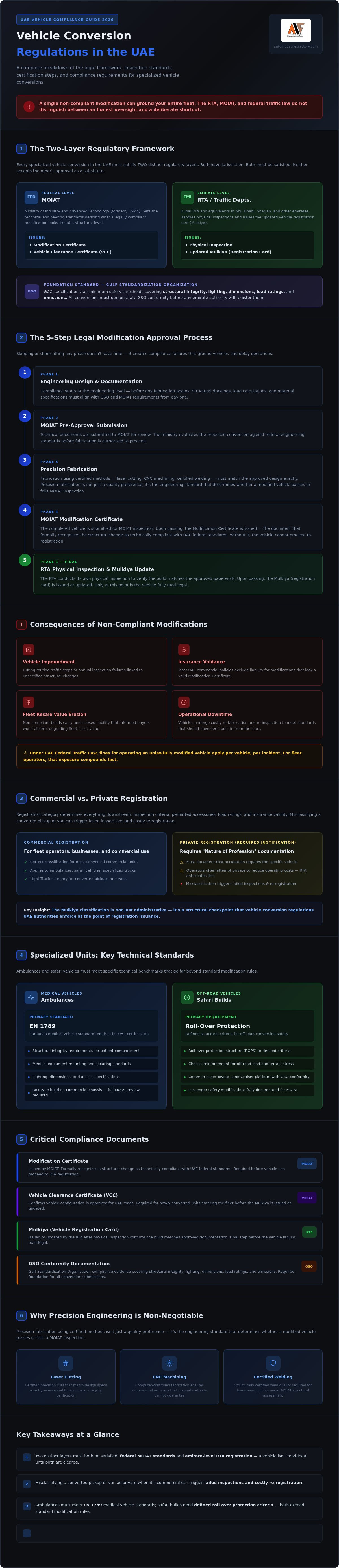
Most compliance failures don't happen at the inspection stage. They happen weeks earlier, when a build begins without a clear understanding of what the approval process actually requires. The vehicle conversion regulations UAE authorities enforce follow a defined sequence, and each phase has specific outputs that the next phase depends on. Skip or compress any of them, and the entire process stalls.
Here's how a legally compliant modification moves from concept to registered, road-legal vehicle.
Phase 1: Engineering Design and Initial Feasibility Review. Before fabrication begins, the proposed modification must be evaluated against the base vehicle's existing type approval, load ratings, and structural geometry. This isn't a paperwork exercise; it's an engineering check that determines whether the intended conversion is achievable within the vehicle's certified parameters. Modifications that alter suspension geometry, increase roof height, or add significant load mass require documented feasibility confirmation at this stage. Changes made post-fabrication to correct design oversights cost significantly more than getting the design right first.
Phase 2: Precision Fabrication at a Certified Facility. Inspectors don't just check whether a modification was made; they check how it was made. Weld quality, material grade, dimensional tolerances, and structural mounting points are all scrutinized. Fabrication using in-house laser cutting and CNC machining produces the dimensional accuracy and surface consistency that inspection criteria demand. Builds completed with imprecise methods or unverified materials routinely fail at Phase 3, requiring re-fabrication before re-submission.
Phase 3: Inspection at a MOIAT-Approved Testing Center. The vehicle is submitted to a MOIAT-approved facility for physical inspection. This is where the build is assessed against the technical standards established in Phase 1. The testing center's role is one that competitors rarely address clearly; it's not a rubber stamp. Inspectors verify that what was built matches what was designed, and that the design itself meets the relevant GSO or EN standard for the vehicle's declared use.
Phase 4: Issuance of the Modification Certificate. A successful inspection result in MOIAT issuing the Modification Certificate. This document formally records the approved structural change and is required for any subsequent registration update. Without it, the RTA will not process a Mulkiya amendment.
Phase 5: Final RTA Inspection and Registration Update. The Modification Certificate is submitted to the relevant emirate authority alongside updated vehicle documentation. The RTA conducts its own physical check to confirm the build matches the certified specification, then issues an updated Mulkiya reflecting the new body type, configuration, or use category. The vehicle is road-legal only from this point forward.
What Happens During a Modification Inspection?
Three areas receive the most scrutiny at the MOIAT testing center. First, weld integrity and structural quality are assessed visually and, where required, through load testing. Second, brake and suspension performance are tested against the vehicle's modified weight profile; additions that increase gross vehicle mass must not degrade stopping distances beyond permissible thresholds. Third, electrical systems for specialized equipment, particularly in ambulance and security upfits, are checked for isolation compliance and interference with OBD and safety systems.
Required Documentation for Fleets
Arriving at any inspection stage without complete documentation guarantees a delay. Fleet operators should have the following prepared before Phase 3 submission:
- Original VCC or current Mulkiya of the base vehicle, confirming the pre-modification specification
- Engineering drawings and material specifications produced by the fabricator, including weld procedures and material grade certificates
- Trade licence copies for all commercial registration applications, with the declared business activity matching the vehicle's intended use
- Modification Certificate from Phase 4 before proceeding to RTA registration update
Managing this process across a fleet multiplies the documentation requirement at every phase. Operators who work with a fabricator capable of handling structural design through to final finishing reduce the coordination burden considerably and improve first-submission pass rates. If you're planning a conversion build and want to understand which services align with your vehicle type and compliance requirements, review the full range of specialized fabrication and conversion services before committing to a build approach.
Why Professional Engineering is Essential for UAE Compliance
There's a clear line between a garage modification and factory fabrication, and UAE inspectors know exactly where it falls. The difference isn't cosmetic. It shows up in weld consistency, dimensional tolerances, material traceability, and the structural documentation that a MOIAT-approved testing center will ask for before it issues anything. Builds that originate in unqualified workshops tend to share the same failure profile: visually acceptable, technically non-compliant, and expensive to correct.
Vehicle conversion regulations UAE authorities enforce don't grade effort. They verify outcomes against defined technical benchmarks. A conversion either meets the standard or it doesn't, and the fabrication method is what determines which side of that line a build lands on.
Precision Fabrication and Safety
Structural welding on mission-critical vehicles requires certified technicians working to documented procedures. Weld integrity isn't assessed visually alone; inspectors look for consistent penetration depth, correct fillet sizing, and the absence of porosity or undercutting that compromises load-bearing capacity. In-house laser cutting and CNC machining eliminate the dimensional drift that manual cutting introduces, producing components that fit correctly the first time and mount to the chassis without stress-inducing gaps or forced alignment.
Material grade matters equally. Ballistic protection builds and roll-over protection structures require steel specifications that are documented and traceable. Substituting a lower-grade material to reduce cost doesn't just compromise safety; it creates a certification failure that can't be papered over. High-grade materials, correctly specified and correctly fabricated, are what allow a build to satisfy both crash-relevant structural requirements and the inspection criteria that follow.
Learn more about Auto Industries Factory's engineering capabilities and how in-house fabrication is structured to meet UAE certification requirements from the design stage forward.
Finishing is the stage most operators underestimate. The GCC climate is punishing: sustained heat, salt-laden coastal air, and significant UV exposure degrade surface treatments that weren't specified for the environment. In-house painting and protective coating applied under controlled conditions extends service life and maintains the structural integrity of welded joints over the vehicle's operational lifespan. A conversion that passes inspection on day one but corrodes within two years creates a recurring compliance and maintenance burden.
Ensuring First-Time Inspection Success
Professional fabricators don't send vehicles to the RTA cold. Pre-inspection checks run through the same criteria that MOIAT testing centers apply: weld quality, dimensional conformity, electrical isolation, and documentation completeness. Identifying a non-conformance in-house costs a fraction of what re-fabrication after a failed official inspection costs, and it keeps the vehicle on schedule.
Design-for-compliance methodology builds the inspection criteria into the engineering brief before a single component is cut. The vehicle's certified parameters, load ratings, and declared use category are all factored in at the design stage, not retrofitted after fabrication is complete. For fleet operators, this approach directly reduces downtime. Vehicles that pass on first submission stay in service; vehicles that fail cycle through re-work and re-inspection while operational capacity sits idle.
If you're planning a specialized conversion and need a fabrication partner who understands what UAE compliance actually demands at every build phase, contact Auto Industries Factory for a specialized vehicle consultation.
Build It Right the First Time
Vehicle conversion regulations UAE authorities enforce aren't designed to create obstacles; they exist because the stakes on UAE roads are real. A non-compliant build doesn't just fail an inspection. It grounds vehicles, voids insurance, and creates liability that compounds across an entire fleet.
The path forward is straightforward: understand which authority governs your conversion, build to the correct technical standard from day one, and work with a fabricator who treats compliance as an engineering requirement rather than a final checkbox. That's what separates builds that pass on first submission from those that cycle through costly re-work.
Auto Industries Factory brings in-house laser cutting and CNC precision to every build, with proven expertise in mission-critical ambulance and security conversions, all structured to meet UAE national safety standards from the design stage forward.
Don't let a compliance gap delay your operation. Get a professional estimate for your vehicle conversion and move forward with a fabrication partner who knows exactly what UAE inspectors are looking for.
Frequently Asked Questions About Vehicle Conversion Regulations in the UAE
Can I register a commercial pickup for private use in the UAE?
Yes, but it requires justification. The RTA classifies pickups under the "Light Truck" category, and private registration requires documented proof of a "Nature of Profession" that legitimately requires that vehicle type for personal, non-commercial use. Without that documentation, your application defaults to commercial registration automatically. Attempting to register a commercially configured build as private to reduce costs is a common mistake that inspectors are trained to identify.
What is a MOIAT Modification Certificate and why do I need it?
A MOIAT Modification Certificate is the federal document that formally recognises a structural vehicle change as technically compliant with UAE standards. It's issued by the Ministry of Industry and Advanced Technology after a successful inspection at an approved testing centre. Without it, no emirate-level authority, including Dubai's RTA, will process a Mulkiya update for your converted vehicle. It's a mandatory step in the approval sequence, not an optional upgrade.
Are bull bars and off-road bumpers legal for road use in the UAE?
They're legal when built and installed correctly. Non-standard front-end structures must not compromise pedestrian impact zones or interfere with airbag deployment sensors. Inspectors verify weld integrity, mounting point reinforcement, and material grade during the MOIAT inspection. Poorly fabricated or improperly mounted bull bars fail on structural grounds, not just aesthetics. Vehicle conversion regulations UAE authorities apply here are specific, and the fabrication standard is what determines whether the component passes.
What are the specific requirements for an ambulance conversion to be registered?
Ambulance conversions must comply with EN 1789, which defines three vehicle types based on medical capability, from basic patient transport through to mobile intensive care. Each type has defined internal dimensions, equipment mounting requirements, and patient restraint anchor point specifications. Beyond layout, electrical systems for medical equipment must be isolated from the chassis electrics, and any medical gas piping must use approved materials routed away from heat sources. All of this is inspected before registration is updated.
How does adding a metal canopy affect my vehicle's registration?
Adding a metal canopy changes your vehicle's declared configuration, which means the Mulkiya must be updated to reflect the modification. The canopy's weight reduces your available payload capacity, and if the combined load exceeds the vehicle's registered Gross Vehicle Weight Rating, the vehicle is operating outside its certified specification. Canopies that extend beyond the original width or height envelope beyond defined limits also require additional structural documentation before the RTA will approve the registration amendment.
Do I need to re-inspect my vehicle every year if it has been converted?
Converted vehicles are subject to the same annual inspection cycle as standard vehicles, but the inspection criteria applied to them reflect their modified configuration. Inspectors verify that the build still matches the certified specification recorded in the Modification Certificate. Any subsequent changes made after initial certification, even minor ones, can trigger a fresh modification approval process. Keeping the vehicle in its certified state between inspections is the simplest way to avoid complications at renewal.
What is the maximum suspension lift allowed for off-road vehicles in the UAE?
The UAE enforces specific suspension lift limits, and modifications that raise ride height beyond permissible thresholds affect the vehicle's type approval status. Exact limits are assessed against the base vehicle's original specification and declared use category, so there isn't a single universal figure that applies to every platform. Changes that alter the centre of gravity or affect speedometer calibration require separate documentation. Consulting a certified fabricator before committing to a lift specification is the practical approach, since non-compliant lifts require reversal before the vehicle can pass inspection.
Can I change the color of my specialized vehicle after conversion?
Yes, vehicle colour changes are permitted, but the process requires official approval and a Mulkiya update to reflect the new colour. For specialized units like ambulances or security vehicles, colour changes may also need to align with regulatory requirements for that vehicle category, since certain colour designations carry operational significance under UAE traffic law. The colour change must be completed at an approved facility, and the updated registration documentation must be obtained before the vehicle returns to road use.


