The success of your mission-critical fleet hinges on the quality of its fabrication. Yet, choosing a partner in the UAE's competitive market can feel like navigating a minefield of exaggerated claims, potential project delays, and the critical risk of non-compliance with local regulatory standards. A poor choice leads directly to costly vehicle downtime and compromises operational readiness. This is why knowing exactly how to choose a vehicle fabricator is not just a procurement task-it's a strategic decision that impacts the safety, reliability, and long-term value of your entire fleet.
This comprehensive 2026 guide is engineered to eliminate that uncertainty. We provide a direct, no-nonsense framework to cut through the noise and empower you to make a confident, low-risk decision. Inside, you will find an actionable checklist to rigorously evaluate potential partners on everything from technical capability and material quality to their proven adherence to UAE regulations. As Auto Industries Factory LLC, we understand the critical importance of these choices. Prepare to move forward with a clear strategy to select a heavy-duty fabrication partner who will maximize your fleet's performance and protect your investment for years to come.
Key Takeaways
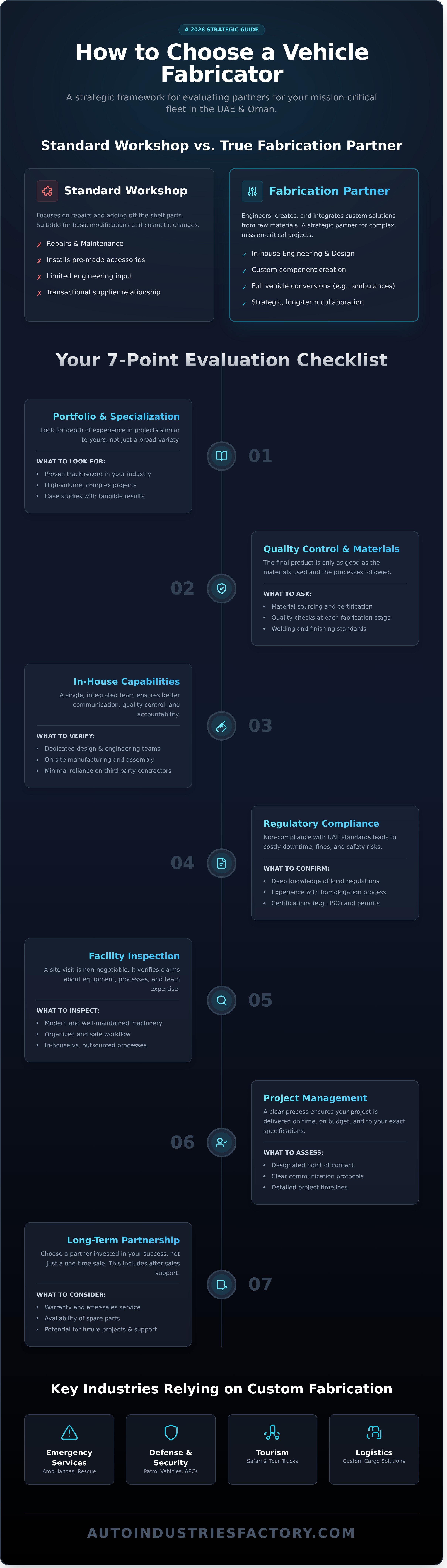
- Understand the critical difference between a standard workshop and a true fabrication partner to ensure your project receives expert engineering, not just cosmetic changes.
- Master our 7-point evaluation checklist to systematically assess a fabricator's portfolio, technical skills, and project management capabilities for your fleet in Oman.
- The process of how to choose a vehicle fabricator involves more than technical specs; discover the partnership criteria that ensure your project meets demanding operational requirements.
- Learn why a facility inspection is non-negotiable for mission-critical projects and what to look for to verify in-house capabilities for superior quality control and timelines.
Beyond the Workshop: Defining a True Vehicle Fabrication Partner
When your mission demands more than a standard vehicle can offer, you need more than a simple mechanic. While a mechanic repairs and a custom shop adds off-the-shelf parts, a true vehicle fabricator engineers, creates, and integrates solutions from raw materials. This distinction is critical because the stakes are incredibly high; the structural integrity, operational readiness, and ultimate safety of your fleet depend on the quality of the work. Understanding how to choose a vehicle fabricator begins with recognizing that you are selecting a long-term engineering partner, not just a supplier.
To see the level of skill and tooling involved, this video offers a glimpse into the world of a professional fabricator:
A fabrication partner collaborates with you to transform a concept into a mission-ready asset. They bring advanced engineering knowledge to the table, ensuring every weld, cut, and component not only fits perfectly but also enhances the vehicle's performance and durability. This level of craftsmanship has deep roots in the history of vehicle fabrication, evolving from simple coachbuilding to creating today's sophisticated, purpose-built machines.
Fabrication vs. Conversion: Understanding the Difference
It's vital to grasp the two core services offered. Fabrication involves creating specific, custom components like heavy-duty bull bars, rugged canopies, or specialized storage systems. Conversion is a complete transformation of the vehicle's purpose, such as turning a standard van into a mobile command unit or a 4x4 into a fully-equipped ambulance. A partner with proven expertise in both can deliver a more integrated and reliable final product, as every fabricated part is designed to support the vehicle's new core function.
Key Industries Relying on Custom Fabrication
In demanding environments like those in Oman, specialized vehicles are not a luxury-they are a necessity. Key sectors depend on expert fabrication to meet their unique operational challenges:
- Emergency Services: Ambulances and rescue vehicles built for rapid response.
- Defense & Security: Armoured personnel carriers, patrol vehicles, and tactical units.
- Tourism: Custom safari trucks and desert tour vehicles designed for safety and comfort.
- Logistics: Specially modified trucks and vans for transporting sensitive or oversized cargo.
Choosing a fabricator with direct experience in your industry ensures they understand the specific standards, environmental challenges, and performance requirements you face.
Your 7-Point Checklist for Evaluating Vehicle Fabricators
Once you have defined your project's scope, the next critical step is vetting potential partners. This checklist provides a robust, systematic framework for evaluation. Using these seven points is fundamental to understanding how to choose a vehicle fabricator who can deliver on specifications, quality, and timelines, ensuring your investment results in a durable, mission-ready vehicle.
Portfolio and Specialization
Look beyond a broad gallery of images for evidence of true expertise. A specialist fabricator demonstrates depth, not just breadth. Have they built one hundred heavy-duty ambulances or just one of everything? Assess if their past projects match the complexity and scale of your requirements, and look for documented experience with clients similar to your organization, whether you are a government agency or a private commercial enterprise.
- Verify In-House Capabilities: Confirm that the fabricator has a dedicated in-house team for design, engineering, and manufacturing. A single, integrated team from concept to completion ensures seamless workflow, superior quality control, and direct accountability.
- Scrutinize Quality Control Processes: Inquire about their process for sourcing raw materials like steel and composites. A reputable fabricator will have stringent quality control protocols at every stage, from material inspection to final assembly, guaranteeing a rugged and reliable final product.
Certifications and Compliance
Professional certifications are non-negotiable proof of a commitment to quality and safety. Ask for evidence of ISO 9001 for quality management systems. For projects in Oman, confirm their knowledge of Gulf Standardization Organization (GSO) standards. For specialized vehicles like ambulances, they must demonstrate compliance with standards like EN 1789. While region-specific, globally recognized benchmarks like the Federal Motor Vehicle Safety Standards (FMVSS) set a high bar for excellence that top-tier fabricators often reference.
- Evaluate Project Management: A professional partner will have a clear project management process, a designated point of contact, and a commitment to transparent communication regarding progress and timelines.
- Request Client References: Don't just take their word for it. Request references from past clients, particularly those with projects similar to yours. Detailed case studies provide valuable insight into their problem-solving capabilities.
- Understand After-Sales Support: Your relationship doesn't end at delivery. Clarify their warranty policies on workmanship and installed components. A reliable fabricator stands behind their work with robust after-sales support.
Assessing Core Capabilities: What to Look for On-Site
A glossy brochure or an impressive website can promise world-class results, but the reality of a fabricator’s capabilities is found on their workshop floor. For any significant vehicle conversion or fabrication project, an on-site facility tour-or at minimum, a comprehensive live virtual tour-is non-negotiable. This is your opportunity to verify their claims and see their processes in action. Fabricators with extensive in-house capabilities have greater control over quality, timelines, and the final product's durability, which is a critical factor in understanding how to choose a vehicle fabricator you can depend on.
Design & Engineering
A premium build begins with a flawless blueprint. The foundation of any successful and safe vehicle modification lies in its initial design. Confirm that the fabricator utilizes modern CAD/CAM (Computer-Aided Design/Manufacturing) software for precision planning. More importantly, ask to speak with their engineering team. A competent fabricator should be able to provide detailed technical drawings and crucial load calculations to ensure the structural integrity and safety of the final build.
Fabrication Technology
The equipment a workshop uses is a direct indicator of its commitment to precision and quality. During your tour, look for key machinery that separates professional-grade operations from basic garages. This technology ensures a level of accuracy and repeatability that manual methods simply cannot match. Key equipment includes:
- CNC Laser or Plasma Cutting: For perfectly clean and precise cuts on steel and aluminum.
- Hydraulic Press Brakes: Essential for creating accurate, consistent bends for components like bull bars, canopies, and custom bodywork.
- Certified Welding Stations: Clean, organized stations operated by skilled technicians are a sign of professional-grade work.
Also, ask about their finishing processes. An in-house powder coating or advanced painting facility demonstrates end-to-end quality control and results in a more durable finish that can withstand Oman's demanding climate.
Quality Control Process
A fabricator’s true dedication to excellence is revealed in their quality control (QC) process. Ask pointed questions about how they ensure every project meets exacting standards. A robust QC program ensures every component is fit for purpose, similar to how government bodies define minimum technical and quality specifications to guarantee fleet safety and performance. Do they have a dedicated team that inspects welds and material quality? Is there a multi-stage inspection process? A thorough final inspection and functional testing before delivery should be standard procedure, providing you with the ultimate assurance of a job well done.
Partnership & Logistics: The Factors Beyond the Factory Floor
Precision engineering and advanced fabrication skills are essential, but they only tell half the story. A truly successful vehicle conversion project depends on the strength of the business partnership. When you investigate how to choose a vehicle fabricator, you must look beyond the workshop to evaluate communication, regional expertise, and long-term support. These factors determine whether your project is delivered on time, to specification, and with the assurance of lasting performance.
Project Management and Communication
Clear, consistent communication is the backbone of any complex fabrication project. A breakdown here can lead to significant delays and costly errors. Before committing, you must have clear answers to critical questions:
- Will a dedicated project manager or a single point of contact be assigned to your build?
- How frequently will you receive progress updates, and in what format (e.g., photos, reports)?
- Is there a formal process for handling change orders or addressing potential issues?
A fabricator with a structured communication plan demonstrates a commitment to transparency and partnership, ensuring you remain informed and in control throughout the entire process.
Understanding of Regional Requirements (Oman & GCC)
A vehicle built for Europe will not survive the demanding conditions of Oman and the wider GCC. A premier fabricator must possess deep, practical knowledge of our unique regional challenges. This includes engineering vehicles to withstand extreme summer heat and fine desert dust, as well as ensuring full compliance with local traffic laws and specifications mandated by authorities like the Royal Oman Police (ROP). A UAE-based partner like Auto Industries Factory has a distinct advantage, offering proven experience in regional logistics, cross-border shipping, and building vehicles truly fit for our environment.
After-Sales Support & Warranty
The relationship with your fabricator shouldn’t end when you take delivery of the vehicle. A company’s after-sales support is a direct reflection of the confidence they have in their own workmanship. Scrutinize the warranty they offer: what components are covered, and for how long? Understand their process for handling post-delivery repairs or modifications. A strong, clearly defined warranty and a responsive support system provide invaluable peace of mind and protect your investment for years to come.
Making Your Final Choice with Auto Industries Factory
You've reviewed portfolios, checked certifications, and asked the right questions. The final step in understanding how to choose a vehicle fabricator is selecting a partner that not only meets but exceeds every criterion. For discerning clients in Oman and across the GCC, Auto Industries Factory (AIF) is the definitive choice, delivering unmatched engineering, reliability, and project control.
Your evaluation checklist likely prioritized technical capability, quality control, and proven experience. Here is how AIF stands as the premier solution for your specialized vehicle needs.
Our In-House Expertise, Your Peace of Mind
Unlike fabricators who rely on third-party contractors, AIF manages every stage of your project under one roof. From the initial concepts developed by our in-house design team to precision cutting with advanced CNC laser technology and final assembly by our expert welding teams, we maintain absolute control. This integrated approach guarantees flawless quality, eliminates costly delays, and ensures your vehicle is built to exact specifications. It’s a commitment to excellence you can depend on. See our full range of specialized vehicle conversions.
A Proven Partner for Operations in Oman
Auto Industries Factory has a distinguished track record of delivering heavy-duty, purpose-built vehicles for clients across the region. Our team possesses deep, practical knowledge of the unique operational and regulatory demands within Oman and the wider GCC. We engineer rugged, durable vehicles designed to perform flawlessly in the most demanding environments, from the rocky tracks of the Al Hajar Mountains to the vast desert landscapes. When mission-critical performance is non-negotiable, AIF is the trusted partner that delivers.
Ultimately, the most critical part of how to choose a vehicle fabricator is finding a team that treats your project with the precision and urgency it deserves. With our specialization in high-stakes ambulance, military, and safari conversions, AIF has built its reputation on delivering robust solutions that never fail. Partner with us to transform your vision into a formidable reality. Contact Auto Industries Factory today to discuss your project requirements.
Partner with a Proven Leader in Vehicle Fabrication
Choosing the right partner for your vehicle conversion is a critical decision that extends far beyond the workshop floor. As we've covered, success depends on evaluating a fabricator's core capabilities, logistical prowess, and commitment to a true partnership. Ultimately, knowing how to choose a vehicle fabricator is about finding an expert who guarantees precision, durability, and flawless execution from concept to completion.
For discerning clients in Oman and across the region, Auto Industries Factory (AIF) exemplifies these principles. As specialists trusted by government and commercial clients in the UAE, we deliver robust solutions for Ambulance, Military, and Safari conversions. Our complete in-house design, fabrication, and engineering capabilities ensure that every project meets the most demanding specifications and mission-critical requirements.
Don't leave your critical vehicle projects to chance. Take the decisive step towards a superior build quality and unmatched reliability. Request a Free Consultation and Project Estimate today and let our team of expert engineers bring your vision to life.
Frequently Asked Questions
What is the difference between vehicle fabrication and vehicle conversion?
Vehicle fabrication involves creating custom components from raw materials, such as heavy-duty steel or aluminium. This includes engineering and manufacturing parts like rugged bull bars, roof racks, or custom storage systems. Vehicle conversion, on the other hand, is the comprehensive process of modifying a standard vehicle for a specialized purpose. This involves integrating fabricated parts and other systems to create a mission-ready unit, such as transforming a Toyota Land Cruiser into a fully-equipped ambulance or a tactical police vehicle.
How long does a typical custom vehicle conversion project take?
The timeline for a custom vehicle conversion depends heavily on the project's complexity and scope. A straightforward modification, like outfitting a 4x4 with a bull bar and roof rack, might take one to two weeks. However, a complete conversion, such as building a Type A ambulance or a specialized military vehicle, is a more intensive process involving detailed engineering and systems integration, typically requiring 4 to 8 weeks from final design approval to completion.
What certifications should a reputable vehicle fabricator have?
When considering how to choose a vehicle fabricator, verifying their certifications is critical for ensuring quality and safety. Look for internationally recognized standards like ISO 9001:2015, which demonstrates a commitment to consistent quality management systems. For specialized conversions like ambulances, certifications from authorities like the Society of Automotive Engineers (SAE) or compliance with regional health and safety regulations in Oman are essential indicators of a professional and reliable operation.
Can I provide my own vehicle for conversion?
Yes, clients can and often do provide their own base vehicles for custom conversion. Our process begins with a thorough inspection of your vehicle to assess its structural integrity and suitability for the intended modifications. This ensures the final converted vehicle meets our stringent standards for performance and durability. We commonly work on client-provided platforms like the Toyota Land Cruiser, Nissan Patrol, and various commercial vans, transforming them into specialized, purpose-built assets.
How much does custom vehicle fabrication cost?
The cost of custom vehicle fabrication varies significantly based on the project's scope, materials, and complexity. A single custom component like a heavy-duty steel bumper could range from $800 to $2,000. A comprehensive conversion, such as transforming a van into a mobile workshop or a basic safari vehicle, might start from $10,000, while a fully-equipped, advanced life support ambulance conversion can exceed $35,000, depending on the medical equipment and technology integrated.
What information do I need to provide to get an accurate quote?
To receive a precise and comprehensive quote, please provide the following: the make, model, and year of the base vehicle; a detailed description of the intended application (e.g., desert safari, mobile medical unit); and a list of all required features and equipment. Supplying technical specifications, reference images, or even simple sketches of your concept will allow our engineers to provide the most accurate cost and timeline estimate for your project.
Do you offer international shipping for converted vehicles?
While our primary operations are based in the UAE, we can facilitate international shipping for completed vehicles to clients in Oman and across the GCC region. We work closely with trusted and experienced logistics partners to manage the entire process, from secure loading at our facility to customs clearance and final delivery. Our team will assist with all necessary documentation to ensure a smooth and efficient transit of your custom-built vehicle to its destination.
What kind of warranty comes with a custom fabricated vehicle?
All of our custom fabrication and conversion work is backed by a comprehensive warranty that covers craftsmanship and materials. We typically offer a 12-month warranty on all fabricated components and structural modifications. Any third-party equipment installed during the conversion, such as medical devices, winches, or specialized lighting, is covered by the original manufacturer's warranty. We provide full support to ensure every component of your vehicle delivers mission-ready reliability and performance.


